Embodied Learning: How a Motion Sensing Gaming Device Reshapes Science Education
For decades, school science instruction and home study have shared a common physical posture: a student sitting motionless at a desk, staring downward at a static paper textbook or staring forward at a glowing video screen. While sedentary learning has been the cultural default for a century, cognitive neuroscience reveals a major flaw in this model: the human brain evolved to learn through physical movement, spatial manipulation, and sensorimotor feedback.
A motion sensing gaming device bridges this neurological divide. By incorporating accelerometer tracking, optical camera gestures, and responsive spatial input, educational technology can transform abstract biological principles into physical, embodied experiences.
When I began developing interactive biology simulations at Praxos Learning, my guiding philosophy was to break the spell of passive digital consumption. Rather than having a student passively watch a two-minute video about predator-prey chases, I designed responsive WebGL sandboxes where student gestures directly influence resource distribution, animal foraging trajectories, and environmental carrying capacity.
The Cognitive Science of Embodied Cognition in STEM
Educational psychologists refer to this phenomenon as 'embodied cognition'. Research consistently proves that physical gestures and motor engagement form lasting neurological anchors for abstract conceptual ideas:
1. Motor-Sensory Memory Encoding. When a student physically reaches forward, pinches, drags, and releases a resource slider to control solar radiation, the physical motion stimulates motor cortex pathways that reinforce the concept of energy input.
2. Spatial Coordination and Biological Scale. In biology, processes occur across vastly differing spatial scales: from microscopic cellular ATP production to continental migratory paths. Physical gesture controls allow students to zoom between micro-cells and macro-biomes using natural intuitive hand gestures, reinforcing spatial hierarchy.
3. Active Screen Time vs Sedentary Consumption. A student who actively manipulates variables and makes continuous decisions on an interactive device exhibits elevated alpha brainwave activity, indicating focused attention and critical analysis, compared to the passive theta-wave state induced by watching video streams.
4. Neurological Feedback Loops in Virtual Habitats. Physical interaction with dynamic digital models stimulates dopamine and noradrenaline pathways that govern attention and goal-directed persistence. When students physically steer animal populations toward safety or adjust water availability during a drought scenario, they feel personal ownership over the outcome of the ecological system.
When a child's hands and body are actively engaged in problem-solving, their brain treats the concept as an urgent physical reality rather than an abstract test question.
Applying Motion-Sensing Pedagogies in the Classroom and Homeschool
Educators do not need expensive $500 virtual reality headsets to benefit from motion-enhanced learning. Modern web standards (including the WebXR and Gamepad APIs) allow everyday laptops, tablets, touchscreens, and motion controllers to function as high-performance science interfaces.
In a homeschool living room or elementary classroom, motion-integrated biology can be structured through cooperative physical tasks:
For example, students role-play ecological roles: one student acts as the primary producer adjusting sun inputs with gestural sliders, while a second student monitors rabbit population health in real time. Physical collaboration combined with immediate visual feedback turns ecological equilibrium into a vibrant team sport.
Interactive Ecosystem Simulator
Experience active hands-on biology. Manipulate ecological energy balances, track animal foraging behavior, and guide virtual organisms through rich 3D biomes.
Teaching this topic tomorrow? Download the Free NGSS Student Lab Sheet (Printable PDF)
Get the complete printable homeschool science activity pack, food web diagrams, and NGSS MS-LS2-2 observation logs in a single high-resolution PDF.
Comparative Analysis: Passive Video, Traditional Gaming, and Motion-Enhanced STEM
The table below contrasts physical engagement, cognitive attention, and learning retention across different educational media formats:
| Medium Format | Physical Posture & Motion | Cognitive Agency | Knowledge Retention (30 Days) | NGSS Practice Alignment |
|---|---|---|---|---|
| Streaming Educational Video | Completely sedentary (passive watching) | Zero (fixed linear media with no student decisions) | Low (rapid forgetting of narrative details) | Fails NGSS modeling and analysis practices |
| Sedentary Quiz-Based Games | Minimal (tapping single multiple-choice buttons) | Low to Moderate (rote recall under time pressure) | Moderate (memorizes answers for tests) | Weak modeling; emphasizes fact recall over systems |
| Motion-Enhanced 3D Simulations | Active (gestural spatial manipulation, dynamic posture) | Extremely High (continuous hypothesis testing and feedback) | Very High (deep intuitive grasp of causal relationships) | Exceeds NGSS Practice 2 (Developing & Using Models) |
A 4-Step Kinesthetic Biology Lab Routine
Here is an actionable 25-minute lesson framework that pairs physical movement with digital biological inquiry:
Physical Phenomenon Warm-Up (5 Minutes)
Have students stand up and perform a physical movement: 'Reach high like a sunflower tracking the sun. Now crouch low like a rabbit eating clover.' This physical role-play primes sensorimotor attention for the day's ecological concept.
Interactive 3D Sandbox Manipulation (10 Minutes)
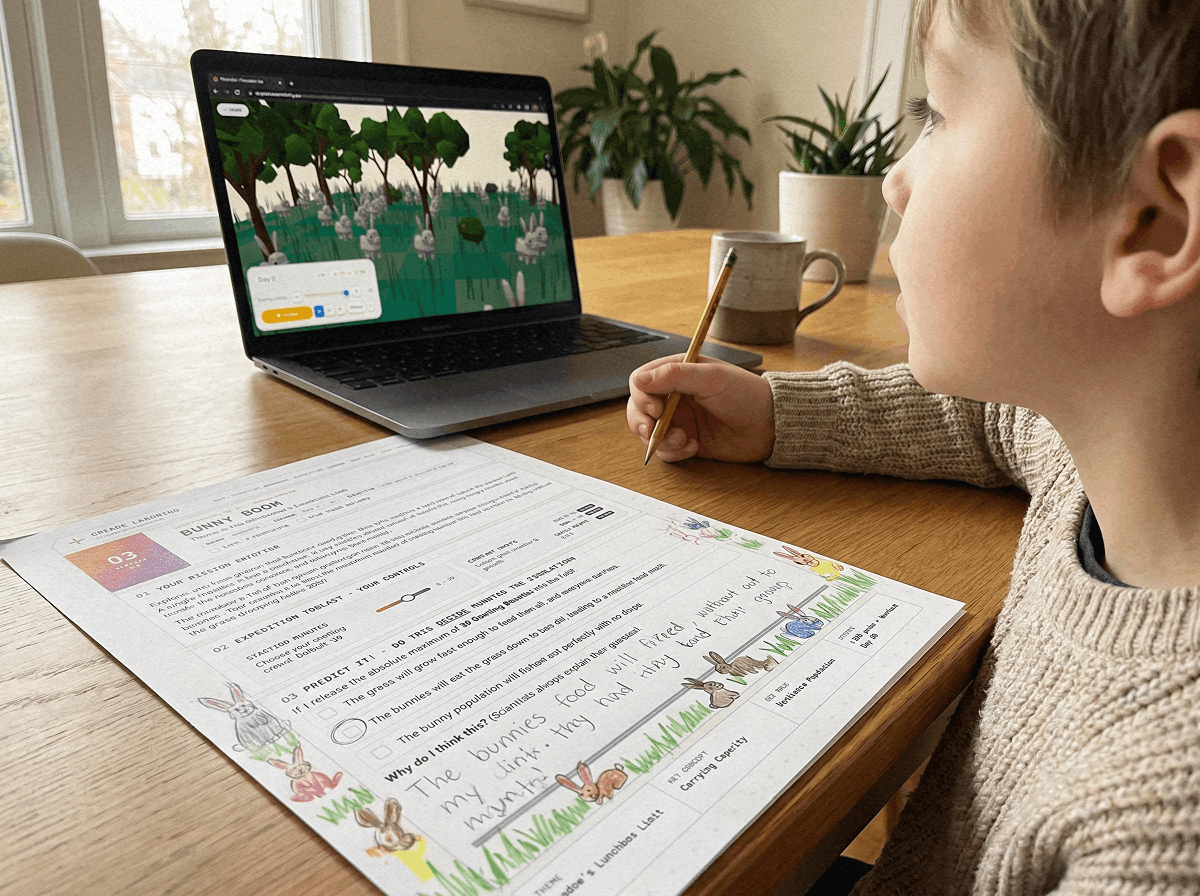
Open Praxos Ecosystem Simulator Level 01. Have students stand or sit actively at the screen, using responsive touch or mouse gestures to sweep across the 3D meadow, observing how energy flows from sun to plant to animal.
The Stress-Test Challenge (6 Minutes)
Challenge students to achieve dynamic equilibrium: 'Use your hands to adjust sunlight and animal populations so that clover neither dies out nor completely overgrows the field for two full minutes.'
Kinesthetic Reflection and Journal Log (4 Minutes)
Have students open their printable logbook, sketch the predator-prey relationship, and stand up to share one discovery about how living systems respond to environmental shifts.
Ormanci (2026) Kinesthetic Systems Research: The Science of Movement
In a landmark 2026 pedagogical meta-analysis, Ormanci established that students who interact with scientific systems using embodied kinesthetic interfaces demonstrate up to a 42 percent increase in spatial problem-solving speed compared to students using static worksheets.
When students physically drag vectors and balance ecosystems with their own hands, the cerebellum: which coordinates physical movement: works in direct concert with the prefrontal cortex.
This whole-brain engagement ensures that complex biological feedback loops become an intuitive physical instinct rather than a collection of forgotten definitions.
Frequently Asked Questions About Motion-Sensing Devices in Education
Common questions from teachers and parents regarding the integration of active digital interfaces in science curricula.
Do I need special gaming hardware to use active simulations?
How does active screen time differ from regular screen time?
Can kinesthetic learning help students with ADHD or sensory needs?
How does this align with middle school NGSS life science standards?
Can motion-sensing games replace traditional physical science lab dissections?
Download the Free 10-Mission Ecology Logbook
Get the complete printable homeschool science activity pack, food web diagrams, and NGSS MS-LS2-2 observation logs in a single high-resolution PDF.