Where Kids Learn to
THINK IN SYSTEMS|
A healthier way for kids to play and learn on screens. Interactive 3D simulation labs + printable workbooks. Ages 7-12.
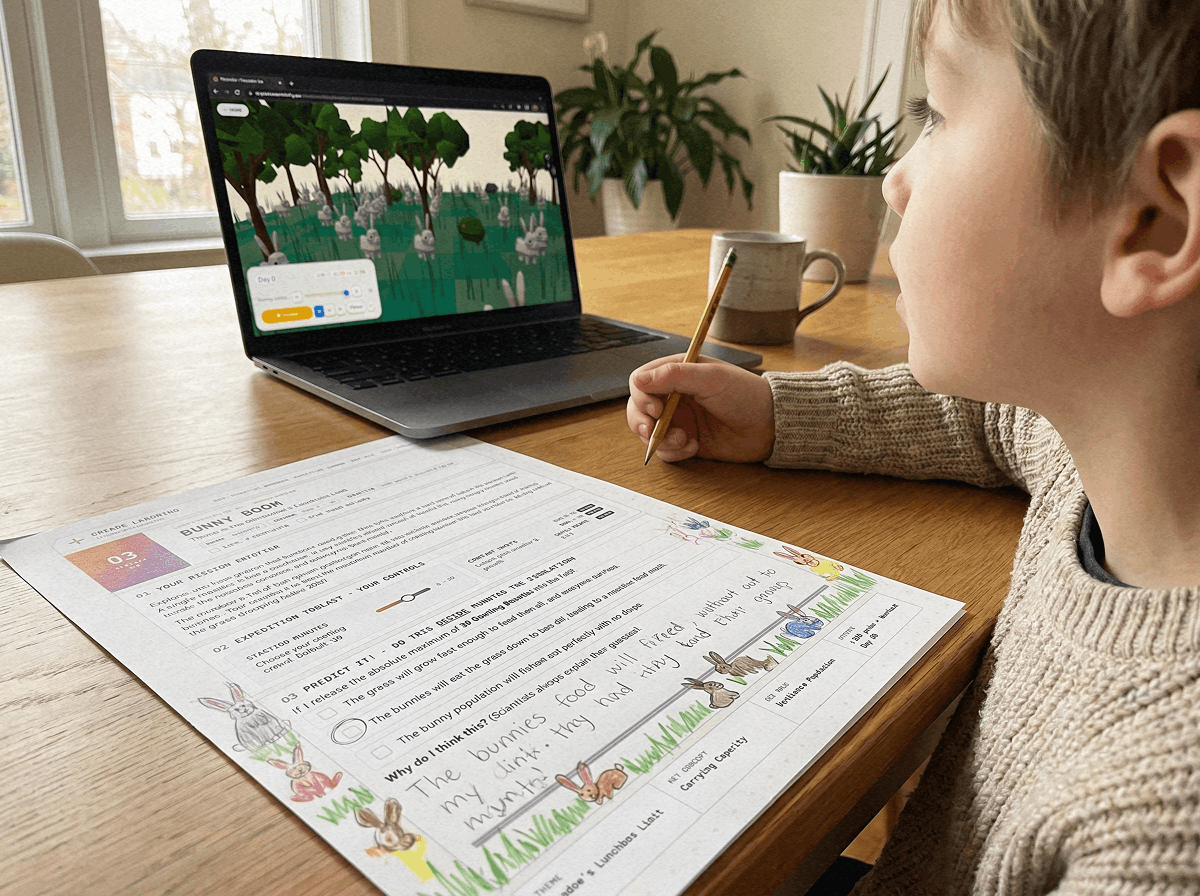
WHERE PHYSICAL PAPER MEETS THE 3D DIGITAL LAB
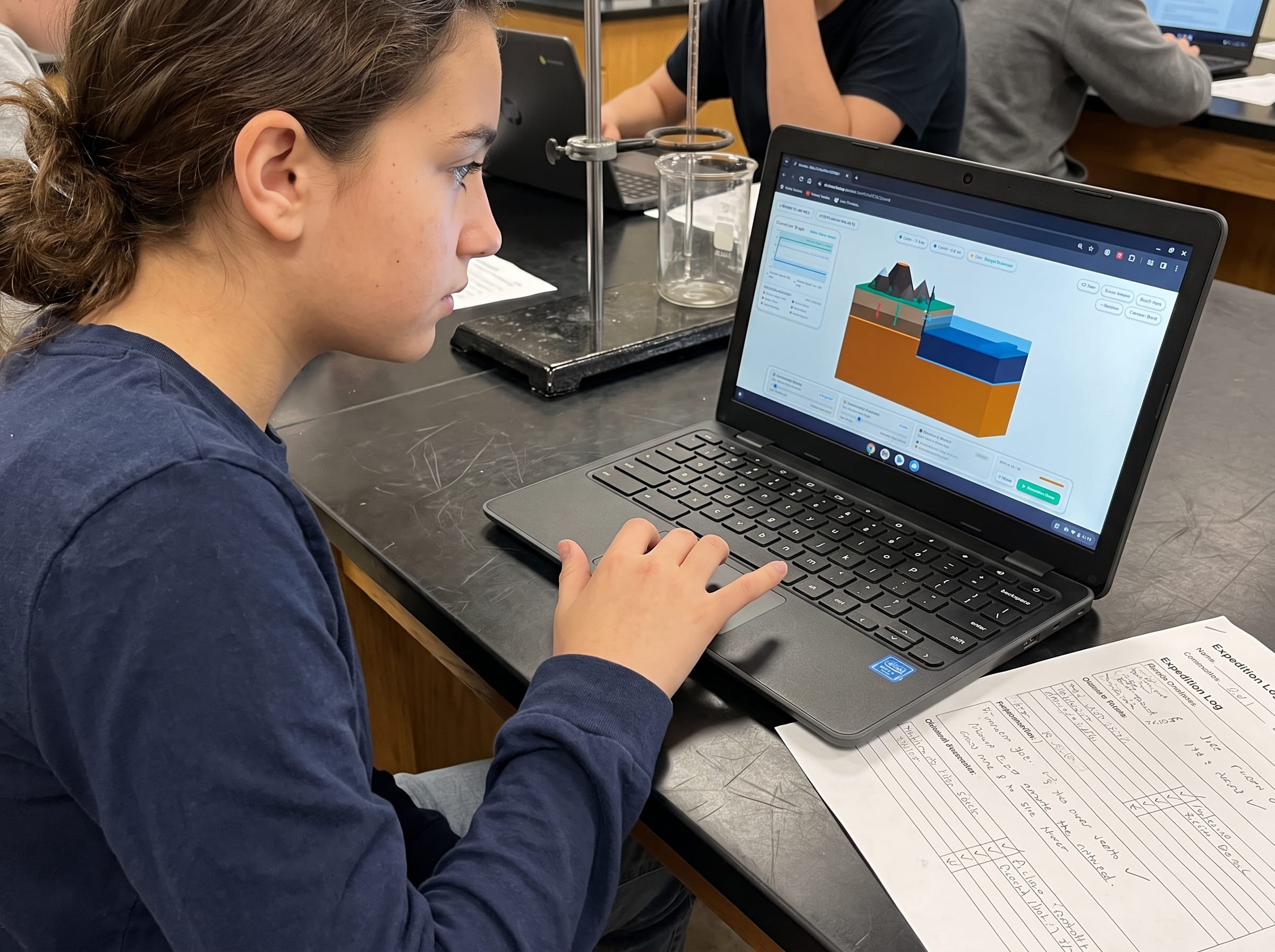
We separate screen play from logical thinking. The computer is the visual lab; physical paper is where kids hypothesize, map data, and reflect. Real learning, active inquiry, and zero screen guilt.

The Paper Science Journal: Where the Deep Thinking Happens
Guilt-free screen time meets physical writing. We separate game interaction from academic reflection.
01. Clear Screen Clutter
The 3D game stays a pure, distraction-free visual laboratory with zero text clutter. All data logging happens on physical paper.
02. Active Scientific Method
Children formulate hypotheses before running trials, record population numbers, and physically sketch resource curves.
03. Guilt-Free Screen Relief
Writing on paper pulls eyes away from the screen, preventing digital fatigue and giving parents tangible proof of work.
04. Bring Science to the Family Table
The "Family Roundtable" questions turn learning into dinner conversations where kids teach parents what carrying capacity means.
WHY OUR GAMES WORK: PROVEN BY SCIENCE
A 2026 peer-reviewed study in Systems evaluated 5th-grade students and proved that interactive simulation labs significantly outperform traditional textbook memorization in systems reasoning and problem-solving confidence.
Students who simulate score significantly higher on systems thinking
Students using interactive simulations demonstrated statistically significant gains over control groups in systems reasoning, mastering how components interact rather than memorizing isolated facts.
Safe visual experimentation builds resilience and problem-solving confidence
The study proved a direct positive correlation between simulation modeling and problem-solving perceptions. When failure provides immediate visual feedback, students persist through complex challenges without frustration.
Abstract cause-and-effect loops become intuitive in real time
Simulations make invisible natural processes visible. Students intuitively traced feedback loops, resource depletion, and carrying capacity by watching living systems respond dynamically to their inputs.
Hands-on simulation models produce long-term conceptual retention
Manipulating variables in a simulation lab builds durable mental models that transfer directly into broader scientific problem-solving, outperforming passive textbook memorization.
ECOSYSTEM: 20 GUIDED LABS. 4 MASTERY PHASES.
From fundamental carrying capacity to real-world Yellowstone trophic cascades. Click any lab to inspect its scientific mission, systems mechanics, and printable companion worksheet.
03. Bunny Boom
A meadow is like a lunchbox with a limited amount of food. Find the maximum bunnies this field can feed for 60 days without the grass crashing.
Calculate the carrying capacity threshold and record the bathtub resource equilibrium.
VERIFIED FIELD REPORTS: CLASSROOM & HOME LABS
How educators, homeschool parents, and STEM co-ops use the predict, simulate, and journal loop to build real scientific reasoning.
"My kids ask to play this instead of YouTube, which honestly never happens."
They are learning about carrying capacity and predator-prey balance without even realizing it. The combination of the 3D lab on screen and the physical paper workbook completely removes screen-time guilt from our house.
"I printed the workbook and it gave me a complete 45-minute lesson plan in minutes."
My fourth graders stayed focused for the entire period. Having them formulate hypotheses on paper before launching the simulation turned abstract ecology concepts into active, hands-on scientific investigation.
"Runs flawlessly on older school laptops with zero tech headaches."
We run on a mix of older Chromebooks and family laptops. The simulation loads instantly in any browser with no downloads, and the kids love being active scientists instead of passive observers.
QUESTIONS, ANSWERED
Everything you need to know about the 20-level curriculum, dual-format screen time model, school standards, and student privacy.
We separate visual experimentation from academic reflection. The 3D browser simulation is the active laboratory where kids test hypotheses and watch ecosystem dynamics unfold. The physical paper workbook is where they log carrying capacity numbers, sketch population curves, and reflect on principles. Kids spend more than 50% of their lab time looking away from the screen with pencil in hand, eliminating digital fatigue.
HAVE A SPECIFIC QUESTION?
Have a question about your homeschool cohort, classroom setup, or curriculum mapping? Send a note directly to Julius, founder of Praxos Learning.
TURN SCREEN TIME INTO ACTIVE THINKING TIME
Unlock the first 10 interactive 3D simulation labs plus the 24-page printable science journal, delivered instantly by email. No account. No credit card required.
10 Interactive 3D Labs
Instant WebGL access to Levels 01 through 10. Test plant genesis, predator-prey dynamics, and drought survival.
24-Page Lab Journal
Printable 24-page physical science workbook. Children formulate hypotheses, log carrying capacity numbers, and sketch curves.
Roundtable Prompts
Dinner conversation questions that turn screen time into family discussions where kids explain science to parents.