The Power of Story: Why Families Choose a Literature Based Homeschool Curriculum
Among all modern homeschooling philosophies, few have inspired more devotion than the literature-based approach. Popularized by educational pioneers like Charlotte Mason and classical educators, a literature based homeschool curriculum replaces dry, summarized textbooks with what educators call 'living books': beautifully written narrative volumes authored by passionate subject matter experts whose prose conveys infectious human enthusiasm.
In subjects like history, biography, and geography, living books are astonishingly effective. When a child reads an engaging autobiography of an explorer or a vivid narrative of medieval life, history ceases to be a list of disconnected dates to memorize for a Friday test. It becomes an emotional, memorable human journey that captures the imagination.
However, as a software developer and science curriculum architect, I frequently see parents encounter a significant challenge when applying a pure living-books philosophy to science: narrative prose alone cannot teach quantitative physical systems, variable manipulation, or spatial mathematical modeling.
The Science Dilemma in Literature-Based Programs: Where Living Books Stumble
In a traditional literature based homeschool curriculum, science is often taught through biography: reading about Gregor Mendel tending peas in his monastery garden, or Rachel Carson studying coastal tidal pools. While these biographical narratives build wonderful historical context and scientific empathy, they stop short of modern NGSS requirements.
Science is not merely the history of what other people discovered centuries ago. Authentic scientific literacy requires active participation: generating testable hypotheses, isolating independent and dependent variables, observing feedback loops, and analyzing numerical population data.
When students only read narrative accounts of nature, they can describe what an ecosystem looks like, but they struggle to predict what happens when an invasive herbivore enters a food web or how carrying capacity limits population growth.
Living books provide the emotional inspiration and wonder; interactive 3D simulations provide the quantitative laboratory where students test and verify scientific principles firsthand.
The Hybrid Solution: Pairing Living Literature with Interactive 3D Sandboxes
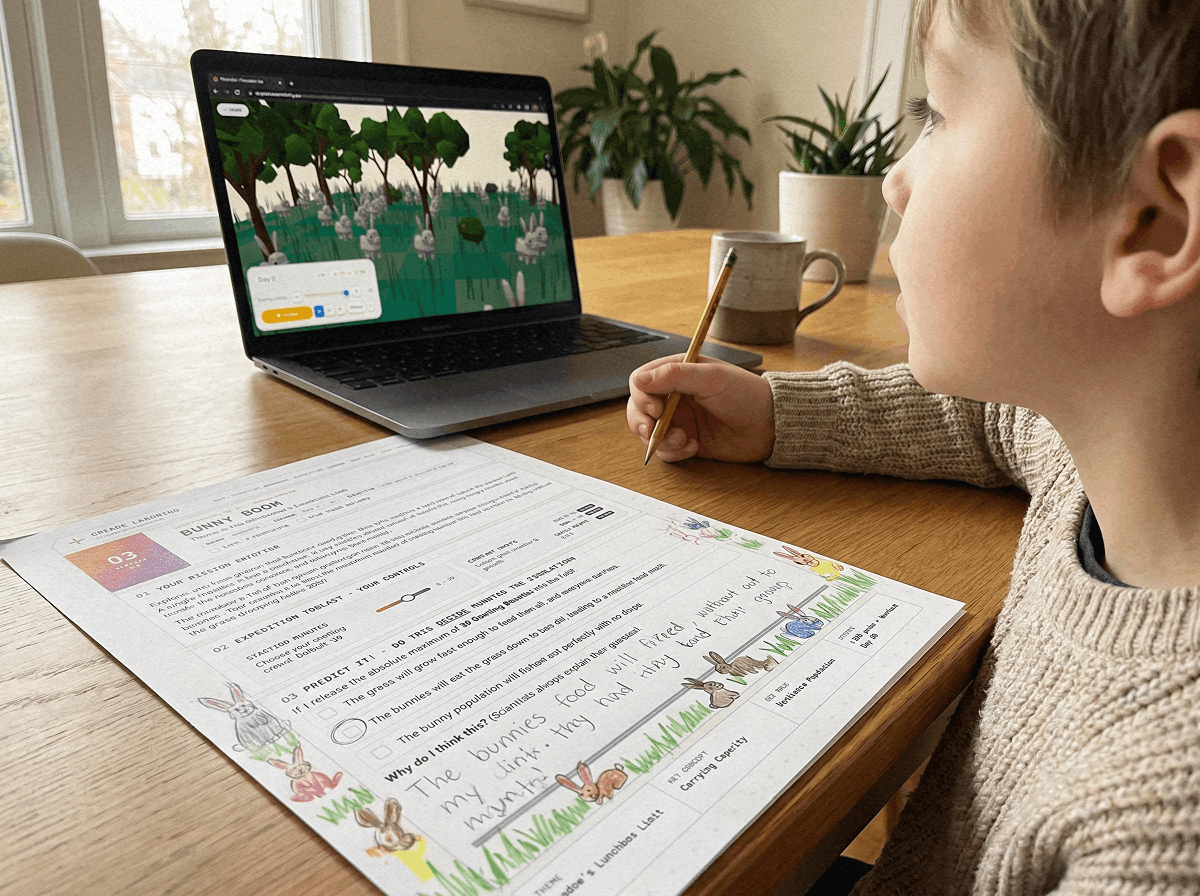
The ideal homeschool science architecture does not discard living books; it enriches them. By pairing 20 minutes of rich literary reading with 15 minutes of interactive 3D simulation, students experience the best of both worlds.
For example, when reading Jean Craighead George's classic ecological novel 'Julie of the Wolves', students read about the delicate relationship between arctic caribou, tundra vegetation, and gray wolf packs. That evening, instead of answering passive comprehension questions at the back of a chapter, the student opens Praxos Ecosystem Simulator Level 01.
In the digital sandbox, the student recreates the exact tundra food web described in the novel, manipulating wolf pack density and observing how vegetative biomass recovers: turning literary storytelling into active systems inquiry.
Complete 3D Biology Sandbox
Bridge narrative nature stories with real-time digital ecology. Watch sunlight feed green plants, observe animal forage patterns, and test carrying capacity in 3D.
Teaching this topic tomorrow? Download the Free NGSS Student Lab Sheet (Printable PDF)
Get the complete printable homeschool science activity pack, food web diagrams, and NGSS MS-LS2-2 observation logs in a single high-resolution PDF.
Curriculum Architecture Comparison: Textbooks, Pure Literature, and Literature-Hybrid STEM
The table below contrasts the pedagogical outcomes, student retention, and NGSS alignment across three common homeschooling science formats:
| Curriculum Architecture | Primary Learning Vehicle | Emotional Engagement | NGSS Modeling Alignment | Best Fit For |
|---|---|---|---|---|
| Standard Science Textbook | Hardcover chapter texts and fill-in-the-blank comprehension worksheets | Low (feels like generic busywork; high student resistance) | Moderate (covers factual terms, but lacks dynamic modeling) | Families who prefer strict traditional schooling at home |
| Pure Literature Approach | Narrative living books, nature biographies, and oral narrations | Very High (children fall in love with great stories and characters) | Low (does not meet NGSS requirements for data analysis and model building) | Early elementary years and humanities-focused homeschooling households |
| Literature-Hybrid STEM | Living books paired with browser-based 3D digital laboratories and sketch journals | Extremely High (unites narrative wonder with hands-on mechanical agency) | Exceeds NGSS standards (direct hypothesis testing, variable isolation, systems modeling) | Homeschool families seeking rigorous, joyful science without parent burnout |
A 4-Step Daily Routine for Literature-Based Science Lessons
Here is an actionable, 35-minute lesson structure that integrates seamless living book reading with interactive digital inquiry:
The Living Book Read-Aloud (12 Minutes)
Read one chapter of a beautifully written science book together on the couch. Focus on the core natural phenomenon: for example, how bees pollinate flowering meadows or how beavers build wetland dams.
Oral Narration (5 Minutes)
Follow the classic Charlotte Mason practice: have your child tell back in their own words what happened in the reading. This active mental recall cements vocabulary and conceptual structure.
Interactive 3D Experimentation (12 Minutes)
Open Praxos Ecosystem Simulator on your tablet or laptop. Challenge your student to test the living book concept in real time: 'The book described how rabbits hide from predators. Let's test what happens in our 3D meadow when we add rock shelters versus open grass.'
Nature Journal Sketch and Data Log (6 Minutes)
Have your student open their printable logbook and sketch the food chain or write two complete sentences summarizing the result of their 3D simulation run.
Ormanci Systems Thinking: Why Stories Need Systems Models
In modern cognitive science, research by Ormanci (2026) demonstrates that human brains naturally organize information into narrative scripts (stories with a beginning, middle, and end). However, natural systems: like climate patterns and ecological trophic cascades: do not operate linearly; they operate through interconnected feedback loops.
When students only experience nature through stories, they tend to assume every biological event has a single villain or single hero. In contrast, when students interact with digital multi-agent ecosystems, they realize that predator-prey balance is a regulatory balancing feedback loop.
Combining the narrative warmth of living books with the causal rigor of 3D systems models produces young thinkers who possess both deep empathy and exceptional analytical discernment.
Frequently Asked Questions About Literature-Based Homeschool Curriculum
Common questions from homeschool educators about implementing living books in science without compromising academic rigor.
What is the difference between a living book and a regular science textbook?
Can a student get into college with a literature-based science background?
How do I choose high-quality living science books?
Does Praxos Learning provide book lists that align with the 3D simulations?
Download the Free 10-Mission Ecology Logbook
Get the complete printable homeschool science activity pack, food web diagrams, and NGSS MS-LS2-2 observation logs in a single high-resolution PDF.