The Core Purpose of Science for Kindergarten Learners
Five-year-old children enter educational environments with an extraordinary natural gift: boundless curiosity about the physical world. When guiding science for kindergarten, educators and parents have the unique opportunity to transform playful questioning into systematic, joyful scientific inquiry. At this developmental stage, young minds do not need dense textbooks or abstract formulas. Instead, they require structured opportunities to observe, describe, sort, and touch the world around them.
Under the Next Generation Science Standards (NGSS), science for kindergarten focuses on three core disciplinary domains: Life Science (what plants and animals need to survive), Earth and Space Science (local weather patterns and the warming effect of sunlight), and Physical Science (pushes and pulls on objects). By framing these concepts around tangible daily experiences, children begin to recognize that our planet operates according to observable rules.
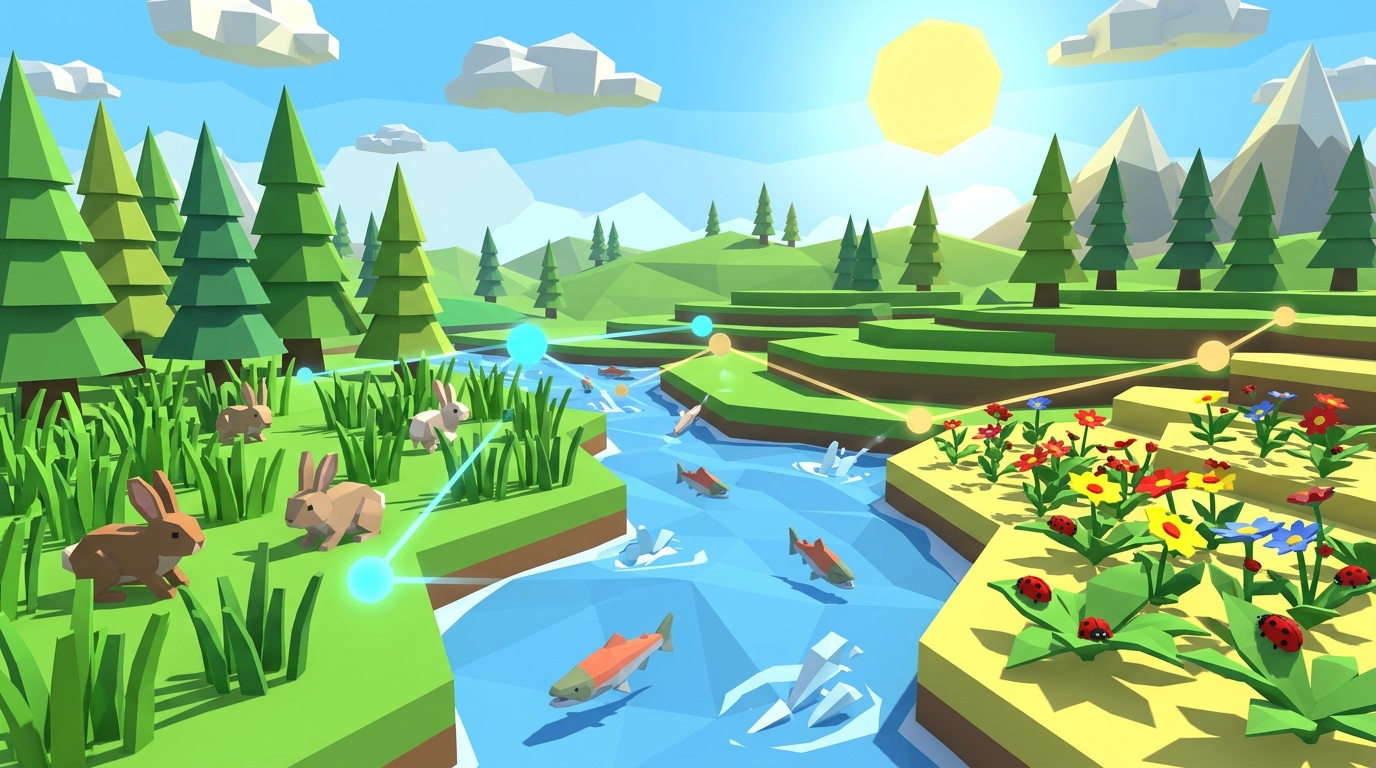
When I built the visual sandboxes at Praxos Learning, I intentionally created uncluttered, bright 3D environments where early learners could see immediate cause-and-effect relationships. Watching a virtual sunflower turn toward the morning sun or seeing a rabbit seek shelter under a pine tree allows young children to connect digital observations directly to their outdoor playground experiences.
Four Essential Science for Kindergarten Inquiry Domains
A well-structured curriculum in science for kindergarten builds foundational competency across four interdisciplinary areas:
1. Living versus Non-Living Classification (NGSS K-LS1-1). Kindergarteners learn to distinguish between organisms that grow, breathe, and reproduce, and non-living objects that do not. A stone sits still on a rock, while a sprout grows leaves toward the sky.
2. Plant and Animal Basic Needs. Children discover that all animals require food, water, air, and shelter, while plants need water, soil nutrients, and sunlight. In an interactive sandbox, students can see what happens when plants receive bright sunlight versus deep shade.
3. Weather Patterns and Solar Warming (NGSS K-ESS2-1). Kindergarteners track daily temperatures, observe cloud formations, and investigate how sunlight warms soil, sand, and water. Touching warm asphalt in the afternoon demonstrates radiant energy transfer in concrete terms.
4. Motion, Pushes, and Pulls (NGSS K-PS2-1). Early physics introduces forces as gentle interactions: pushing a toy wagon increases its speed, while pulling a brake slows it down.
In kindergarten, science is about sharpening the senses. Teaching children to look closely, listen carefully, and document what they observe builds the bedrock for lifelong analytical thinking.
Structuring Hands-On Science for Kindergarten Units
To make science for kindergarten practical for homeschool families and elementary classrooms, lessons should follow a predictable 15- to 20-minute rhythmic cycle. Young attention spans thrive when physical tactile activities alternate with visual digital exploration:
Step 1: The Wonder Question. Begin each session with a compelling phenomenon: 'Why do earthworms come out when it rains?' or 'Can a plant grow in the dark?'
Step 2: Tactile Outdoor Investigation. Give children magnifying glasses, small collecting trays, or weather charts. Let them touch tree bark, inspect soil textures, or measure puddle depths.
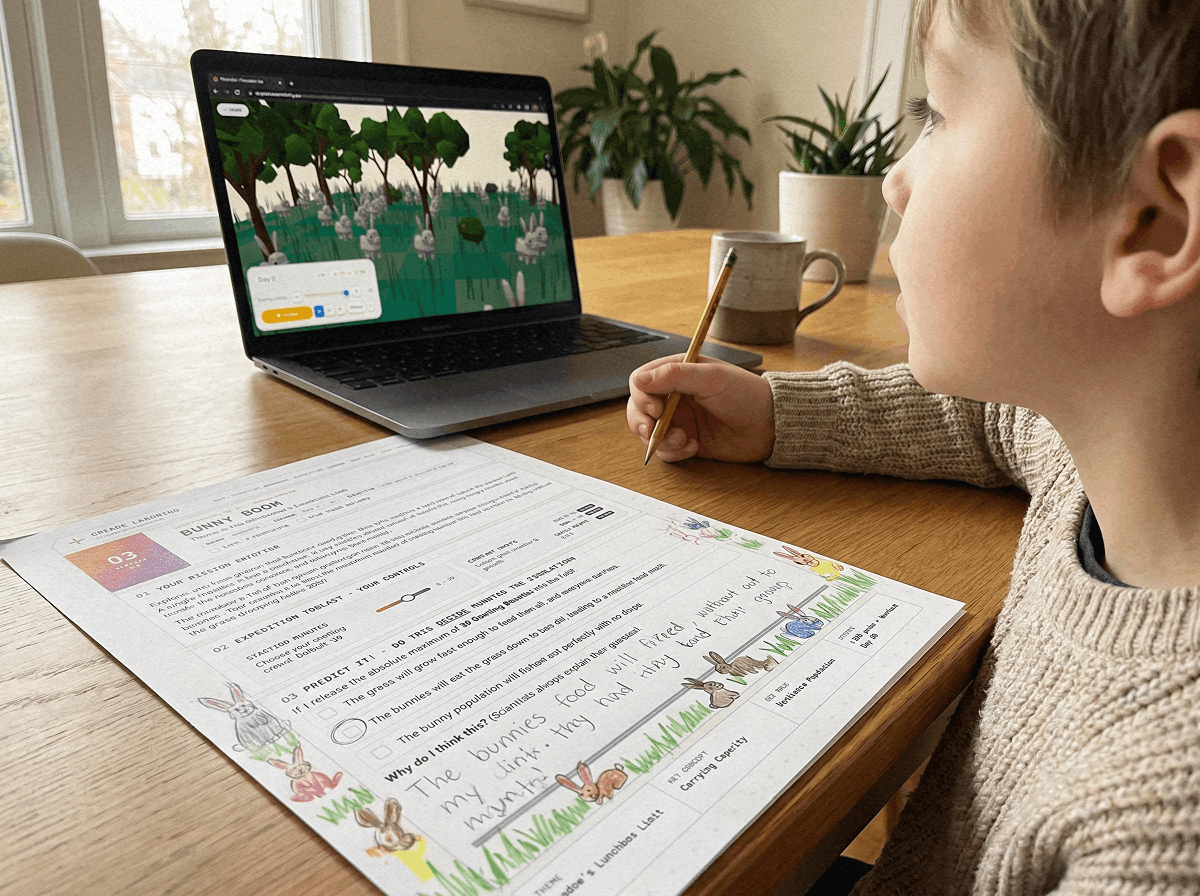
Step 3: Interactive Visual Synthesis. Transition to a gentle 3D digital model where children test variables safely. In our ecosystem simulation, young learners can turn on the sun and watch colorful flowers open.
Step 4: Creative Journaling. Conclude by having students draw what they discovered in their physical science notebook, using crayons to document colors, shapes, and weather symbols.
The Wonder Question
Pose a simple, observable natural question that sparks immediate curiosity.
Hands-On Sensory Check
Use five senses to explore physical leaves, rocks, water, or soil samples.
Digital Simulation Experiment
Manipulate sunlight and water sliders in a child-friendly 3D sandbox.
Draw and Document
Record observations in a printed field journal using colorful drawings.
Ecosystem Observation Sandbox
Introduce kindergarteners to natural systems in gentle 3D. Watch golden sunlight nurture plants, observe friendly animals seeking shade, and discover what living organisms need to thrive.
Teaching this topic tomorrow? Download the Free NGSS Student Lab Sheet (Printable PDF)
Get printable kindergarten observation sheets, weather tracking journals, and living thing scavenger hunt checklists in a beautiful high-resolution PDF.
Curriculum Comparison: Traditional Worksheets vs Interactive Inquiry
Choosing the right approach in science for kindergarten significantly influences a child's attitude toward STEM. The table below illustrates the pedagogical difference between passive paper sheets and experiential inquiry:
| Curriculum Feature | Traditional Coloring Worksheets | Hands-On Interactive Inquiry | Child Cognitive Impact |
|---|---|---|---|
| Primary Activity | Coloring static outlines of animals | Observing living behaviors in 3D sandbox | Develops genuine systems understanding |
| Concept of Sunlight | Drawing yellow sun in corner of paper | Testing plant growth under light vs shade | Connects solar energy directly to life |
| Weather Tracking | Filling out multiple-choice checkboxes | Measuring temperature and recording clouds | Fosters scientific data collection habits |
| Student Engagement | Brief, task-oriented completion | Deep, self-directed playful inquiry | Builds lasting enthusiasm for STEM learning |
Implementing Science for Kindergarten in Classroom and Homeschool Routines
Whether teaching in a public school classroom or around a kitchen table, establishing a consistent weekly cadence for science for kindergarten eliminates teacher stress while maximizing student retention. I recommend designating two 20-minute sessions per week dedicated entirely to nature exploration.
On Tuesdays, focus on living organisms: plant bean seeds in clear plastic cups with damp paper towels so root germination remains visible. Have students observe root hair growth under magnifying glasses and predict which direction leaves will emerge.
On Thursdays, explore earth systems: take a small thermometer outdoors to measure surface temperatures of grass, soil, and concrete. Compare readings in direct sunlight versus beneath tree shade, allowing children to conclude independently that sunlight transfers thermal warmth to surfaces.
Frequently Asked Questions About Science for Kindergarten
Below are helpful answers for parents and educators establishing early childhood science routines.
What science topics should a kindergartener master by end of year?
How long should a kindergarten science lesson last?
Are digital science games appropriate for 5-year-olds?
How do I assess my child's progress in kindergarten science?
Download the Free 10-Mission Ecology Logbook
Get printable kindergarten observation sheets, weather tracking journals, and living thing scavenger hunt checklists in a beautiful high-resolution PDF.