Igniting Curiosity: The Core Goals of 1st Grade Science
First grade marks a magical threshold in a child's educational journey. At 6 and 7 years old, children transition from early preschool play into structured, inquisitive thinkers who constantly ask 'Why is the sky blue?' and 'What do plants eat?'. A high-quality 1st grade science curriculum harnesses this innate wonder, channeling natural curiosity into foundational scientific practices.
Under the Next Generation Science Standards (NGSS), 1st grade science focuses on three core domains: Life Science (how plants and animals use external parts to survive), Physical Science (light and sound vibrations), and Earth/Space Science (sun, moon, and seasonal sky patterns).
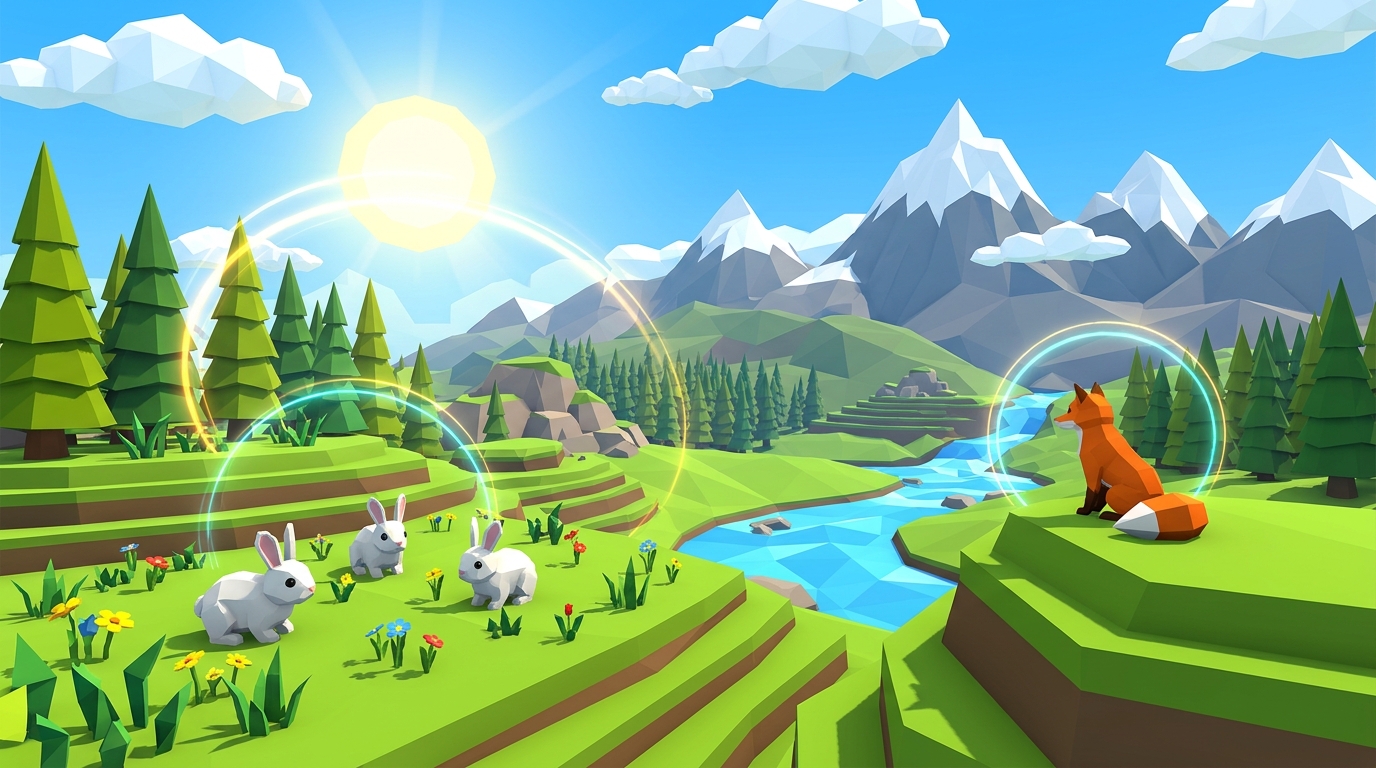
When I created our early learning modules at Praxos Learning, I designed them specifically for early elementary learners. By giving young children a vibrant, clutter-free 3D world where they can observe how sunshine makes grass grow and how animals seek shelter, abstract scientific concepts become delightful, concrete discoveries.
The 4 Core Life Science Pillars for First Graders
In 1st grade science, life science provides the most intuitive and engaging entry point for young learners. The curriculum centers around four key biological principles:
1. Living vs. Non-Living Things. First graders learn that living organisms grow, breathe, take in nutrients, and reproduce, while non-living objects (rocks, water, toys) do not. In a digital sandbox, children test this by seeing that rabbits need grass and water, while geometric stones remain unchanged.
2. External Body Parts for Survival (NGSS 1-LS1-1). Animals have specialized body parts that help them survive: birds have beaks for cracking seeds, rabbits have long ears for hearing predators, and ducks have webbed feet for paddling. Plants have roots to absorb water, stems to stand tall, and leaves to catch sunlight.
3. Animal Parents and Offspring (NGSS 1-LS3-1). Young animals resemble their parents, but are not identical clones. Children explore how ducklings look like ducks and saplings have leaves like parent trees, introducing the foundational concept of biological heredity.
4. Basic Needs of Organisms. Every living thing requires water, air, food (or sunlight for plants), and safe living space. Experiencing what happens when rain ceases or food runs out in a gentle simulation helps young minds grasp environmental interdependence.
In 1st grade, science is not about memorizing complex terminology; it is about building the habit of careful observation and asking testable questions.
Integrating Active 3D Inquiry With Tactile Handwriting
Many educators worry about giving screen time to 6- and 7-year-olds. That concern is entirely justified when screen time means passively watching mindless cartoons or clicking through flashing banner ads.
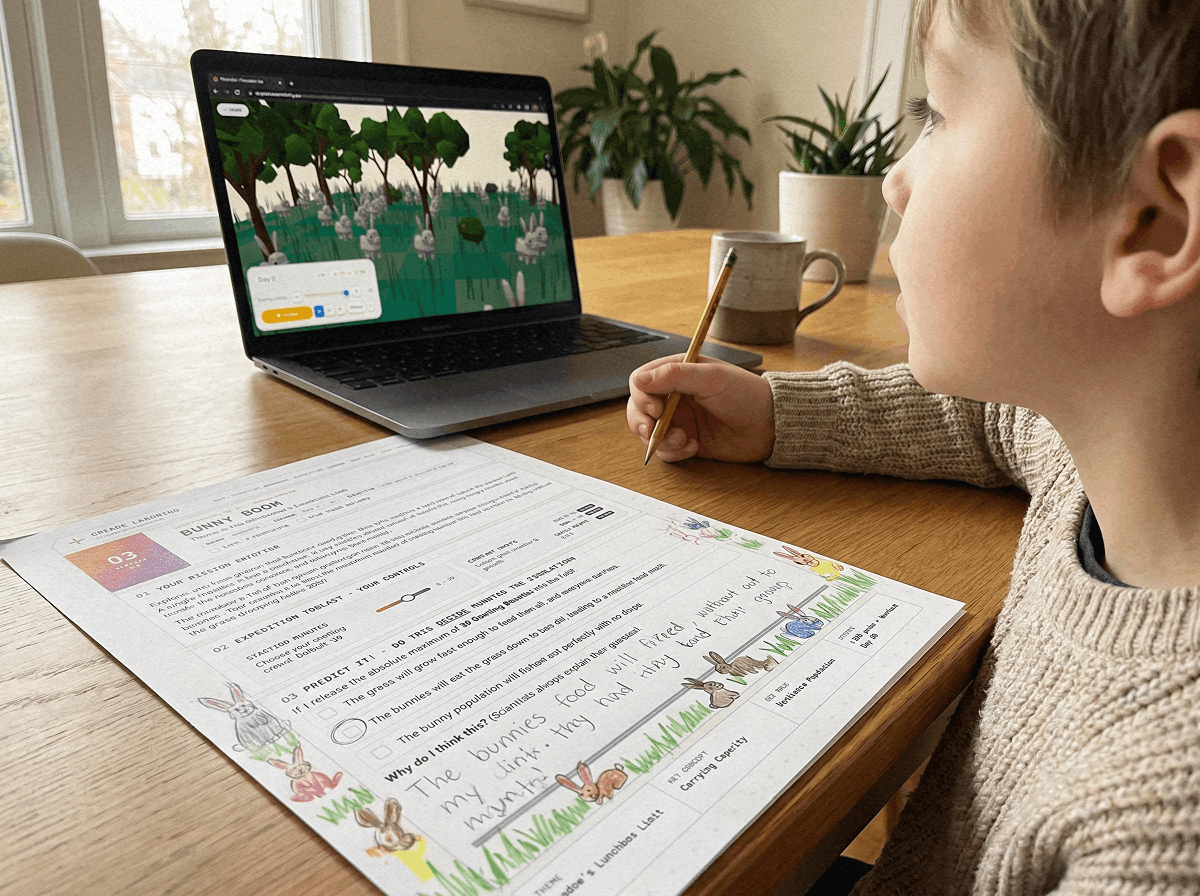
However, active purposeful screen time is fundamentally different. When a 1st grader uses an interactive 3D simulation to test whether plants grow better in bright sunlight or deep shade, they are conducting an authentic experiment. They formulate a guess, turn the sun slider, observe the result, and draw what happened.
Pairing 15 minutes of guided 3D simulation with 10 minutes of physical drawing and coloring in our printable logbook reinforces motor skills and cements conceptual memory.
Interactive Ecosystem Simulator
Introduce 1st graders to living systems in gentle 3D. Watch sunny daylight feed grass, guide friendly rabbits to find food, and discover what living things need to survive.
Teaching this topic tomorrow? Download the Free NGSS Student Lab Sheet (Printable PDF)
Get the complete printable 1st grade science activity pack, animal trait matching sheets, and NGSS 1-LS1-1 observation logs in a single high-resolution PDF.
1st Grade Science Skills Matrix: Concepts, Milestones, and Standards
To help parents and teachers track educational progression, the table below maps core 1st grade science standards to observable student competencies and simulation activities:
| Curriculum Unit | NGSS Standard | Core Science Concept | Observable Student Milestone | Interactive Simulation Activity |
|---|---|---|---|---|
| Plant Structures | NGSS 1-LS1-1 | Roots, stems, leaves, sunlight capture | Can explain why leaves need sun and roots need soil water | Adjust solar radiation slider; watch virtual grass grow and bloom |
| Animal Body Parts | NGSS 1-LS1-1 | External adaptations for eating and safety | Identifies how rabbits use long ears and claws for survival | Observe low-poly rabbits foraging and fleeing when startled |
| Heredity & Traits | NGSS 1-LS3-1 | Young animals resemble adult parents | Matches animal babies with parents based on physical traits | Trace multi-generation animal groups across seasonal cycles |
| Basic Needs | NGSS K-2-ETS1-1 | Living things need water, food, and air | Predicts what happens to organisms when food is absent | Adjust meadow resource balances; log population health |
| Sun & Seasons | NGSS 1-ESS1-1 | Daylight hours change with seasons | Notices that days are longer and warmer in summer | Toggle day/night cycles; observe nocturnal animal activity |
Classroom and Homeschool Routine: 4 Steps for a 1st Grade Science Lesson
Keep early learners energized and focused with this simple, structured 20-minute lesson sequence:
The Wonder Question (3 Minutes)
Ask an engaging physical observation question: 'Touch your ears. Why do you think rabbits have ears that are five times longer than yours?'. Let children touch their ears and guess.
The 3D Meadow Exploration (10 Minutes)
Open Ecosystem Simulator Level 01 on your tablet or laptop. Let your child guide a white rabbit across the green tiles, watching it find green clover and take drinks from the sparkling blue river.
Draw and Color the Discovery (5 Minutes)
Open the printable 1st grade journal sheet. Have your child draw the rabbit eating grass and use a yellow crayon to draw the sunshine that feeds the plant.
The Celebration Check (2 Minutes)
Ask your student to give a high-five and share one new fact they discovered today about what living animals need to stay healthy and strong.
Fostering Scientific Confidence at an Early Age
Research in early childhood pedagogy by Ormanci (2026) demonstrates that children who experience science as joyful discovery before age eight develop substantially higher confidence in math and logic throughout their later school years.
When children see themselves as investigators capable of understanding the physical world, science ceases to be an intimidating subject full of technical jargon. It becomes a thrilling adventure of asking questions and finding answers.
Providing first graders with vibrant visual models and encouraging their curiosity lays the groundwork for a lifetime of intellectual confidence.
Frequently Asked Questions About 1st Grade Science
Here are answers to the most common questions parents and early childhood educators ask about 1st grade science instruction.
How long should a 1st grade science lesson be?
Do first graders need to memorize scientific vocabulary?
How can I teach 1st grade science without buying expensive materials?
How does 3D simulation help 6-year-old learners?
Download the Free 10-Mission Ecology Logbook
Get the complete printable 1st grade science activity pack, animal trait matching sheets, and NGSS 1-LS1-1 observation logs in a single high-resolution PDF.