Why Parents Seek an All in One Homeschool Curriculum
For families stepping into home education, the initial planning phase can feel overwhelming. Choosing separate math curricula, language arts readers, history anthologies, and science textbooks requires juggling dozens of disparate schedules and teaching philosophies. This logistical burden explains why so many parents search for an all in one homeschool curriculum: a unified system promising cohesive grade-level coverage across every major subject under a single organized binder.
A well-designed all-in-one package provides undeniable reassurance. Parents receive an open-and-go weekly schedule, synchronized reading passages, and standardized grading rubrics. In subjects like grammar or arithmetic, this sequential linear progression works exceptionally well. Students practice spelling rules, complete structured math drills, and build steady cumulative skills.
However, when evaluating science within an all in one homeschool curriculum, parents frequently discover an unexpected deficit. Too many boxed curricula treat science as a passive reading comprehension subject: students read a two-page summary about cell division or volcano layers, answer five multiple-choice questions, and move on. This traditional approach misses the essence of scientific inquiry: formulating hypotheses, manipulating variables, and observing systemic feedback.
Evaluating Science Within an All in One Homeschool Curriculum
Before investing in a boxed all in one homeschool curriculum, parents should evaluate the science component against four essential educational benchmarks:
1. NGSS Three-Dimensional Alignment. Modern science standards do not evaluate memorized facts alone. Rigorous curricula integrate Disciplinary Core Ideas, Crosscutting Concepts (such as cause and effect or stability and change), and Science and Engineering Practices.
2. Authentic Laboratory Rigor. Does the curriculum require students to test hypotheses and analyze quantitative data, or does it merely suggest craft projects like baking soda volcanoes that lack real measurement?
3. Systems Thinking Pedagogy. Does the science unit demonstrate how variables interact dynamically? For instance, when rabbit populations surge, do students see how grass depletion triggers famine, or do they only study isolated definitions?
4. Dual-Format Learning Support. Does the package pair interactive digital modeling with physical pencil-and-paper scientific journaling, ensuring screen time remains active and academically accountable?
Science is an active process of discovery, not a passive reading assignment. If your boxed curriculum lacks experimental modeling, pair it with dynamic 3D simulation tools.
Bridging an All in One Homeschool Curriculum with Dual-Format Simulations
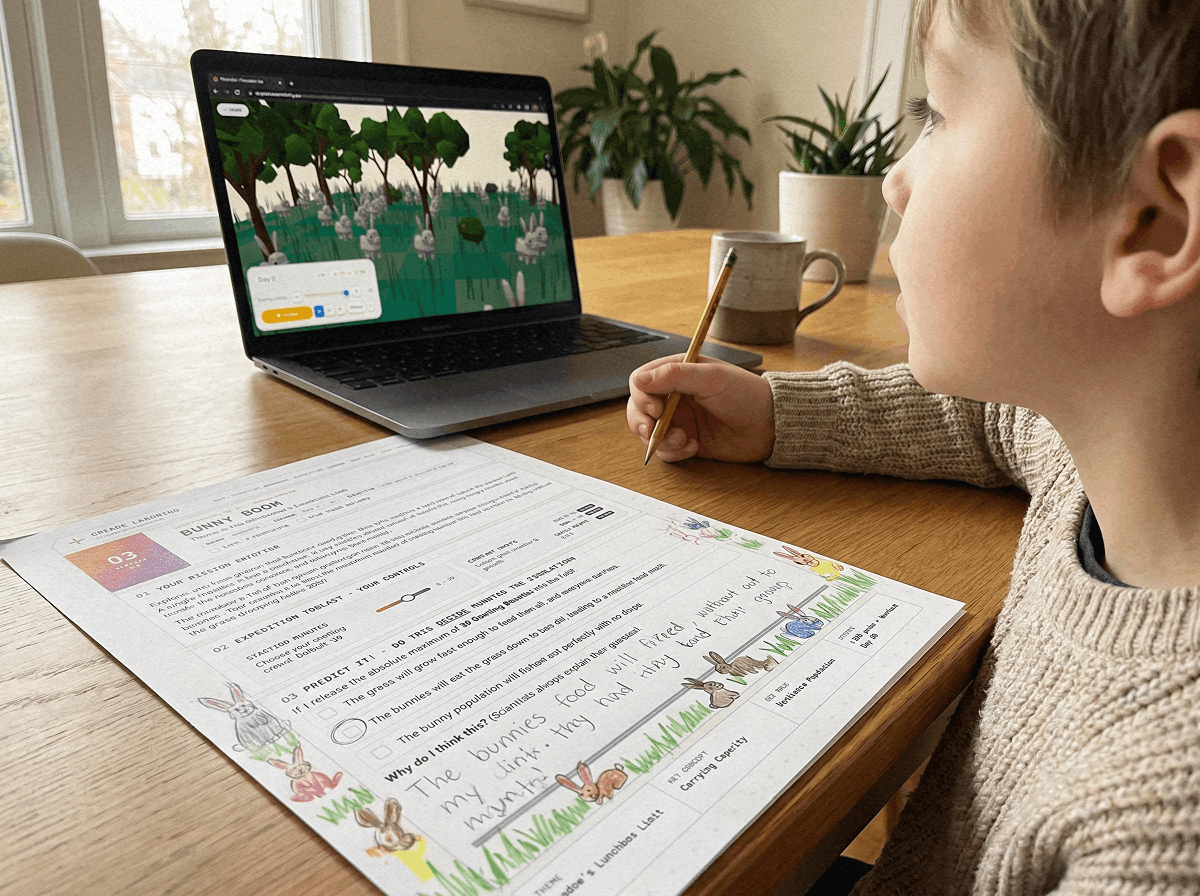
When I founded Praxos Learning, my goal was to solve the exact dilemma facing homeschool educators: how to deliver cutting-edge STEM rigor without requiring an expensive garage full of fragile glassware and toxic chemicals. The solution lies in Dual-Format Learning: pairing browser-based 3D digital sandboxes with physical, printable field scientist logbooks.
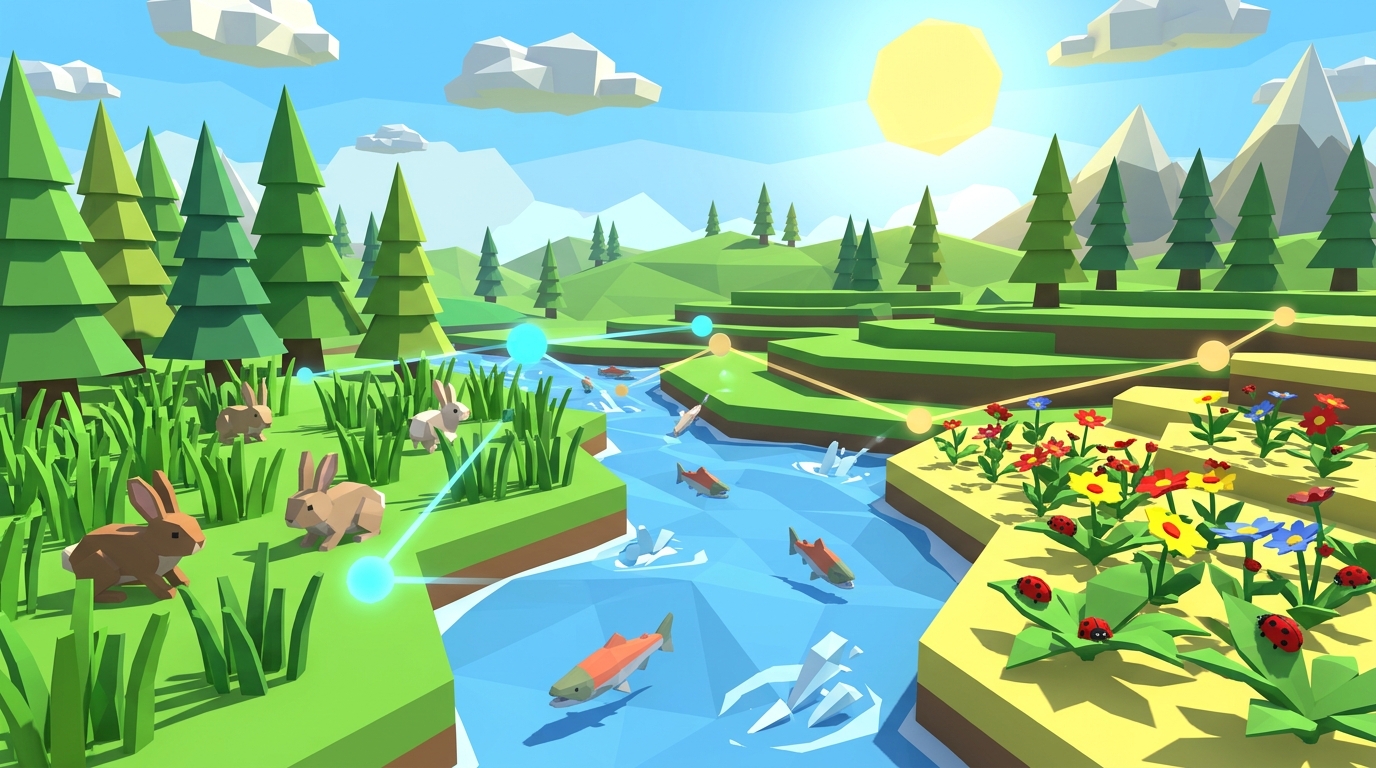
In our ecology and geophysics modules, students use the 3D simulator to test scenarios that are physically impossible in a home kitchen: manipulating tectonic plate boundary velocities, observing mantle convection currents, or managing predator-prey trophic ratios across a living meadow.
Crucially, the student does not passively click buttons. Beside their keyboard rests a printed Field Geologist Logbook or Ecology Journal. Before running a digital experiment, the student writes their hypothesis. During the run, they log numerical carrying capacity data. After the run, they graph population equilibrium curves by hand. This deliberate bridge ensures that digital exploration reinforces disciplined physical handwriting and analytical reflection.
Complete 3D Biology Sandbox
Upgrade your homeschool science day with real-time ecological modeling. Trace caloric energy flows, test herbivore carrying capacities, and observe ecosystem feedback loops in interactive 3D.
Teaching this topic tomorrow? Download the Free NGSS Student Lab Sheet (Printable PDF)
Supplement your homeschool curriculum with printable scientific logs, population graphing tables, and NGSS MS-LS2-1 experiment sheets in a 10-page PDF.
Feature Matrix: Boxed Curricula vs Dual-Format Homeschool Science
To help home educators make informed purchasing decisions, the table below compares standard bundled all-in-one programs with an integrated dual-format approach:
| Curriculum Dimension | Standard Boxed All-in-One | Dual-Format 3D Inquiry | Homeschool Benefit |
|---|---|---|---|
| Scientific Engagement | Reading static textbook chapters | Manipulating live variables in 3D sandbox | Deep conceptual retention through experimentation |
| Lab Preparation Time | Hours gathering obscure household supplies | Zero prep: opens instantly in any browser | Eliminates homeschool parent burnout completely |
| Systems Thinking | Isolated linear facts (A causes B) | Dynamic feedback loops and equilibrium | Prepares students for advanced STEM disciplines |
| Portfolio Evidence | Standardized multiple-choice quizzes | Hand-drawn charts and scientific lab logs | Provides audit-proof documentation for homeschool reviews |
Optimizing Your Weekly Schedule with an All in One Homeschool Curriculum
Integrating a rich STEM component into your all in one homeschool curriculum does not require extending your school day. By following a structured 30-minute block twice weekly, students achieve superior mastery without academic overwhelm:
Block 1 (Tuesday: Concept Introduction & Digital Lab). Spend 10 minutes reading your core curriculum lesson. Transition immediately to the Praxos 3D simulation for 15 minutes, allowing your student to test the concept dynamically. Conclude with 5 minutes of data recording in the printed lab sheet.
Block 2 (Thursday: Variable Manipulation & Journal Analysis). Re-enter the simulation with a specific challenge: 'Can you keep the rabbit population above 40 for five generations without collapsing producer grass biomass?' Have the student log their parameters and summarize their findings in three complete scientific sentences.
Frequently Asked Questions About All in One Homeschool Options
Here are practical answers to common questions about selecting and supplementing boxed homeschool packages.
Is an all in one homeschool curriculum sufficient for middle school science?
How do I know if my homeschool science program is secular?
Can I use Praxos simulations alongside my existing boxed curriculum?
How do printable logbooks enhance digital simulation learning?
Download the Free 10-Mission Ecology Logbook
Supplement your homeschool curriculum with printable scientific logs, population graphing tables, and NGSS MS-LS2-1 experiment sheets in a 10-page PDF.