The Architect's Dilemma: Why Designing an Ecosystem Is the Ultimate Systems Test
In standard science education, students are almost always asked to analyze systems that already exist. They trace arrows in a textbook food chain or answer multiple-choice questions about an existing biome.
Yet the ultimate test of scientific mastery is not analysis; it is synthesis. At the very peak of Bloom's Taxonomy and cybernetic engineering lies a much deeper question: can you take empty bedrock and engineer an entire living world that sustains itself without human intervention?
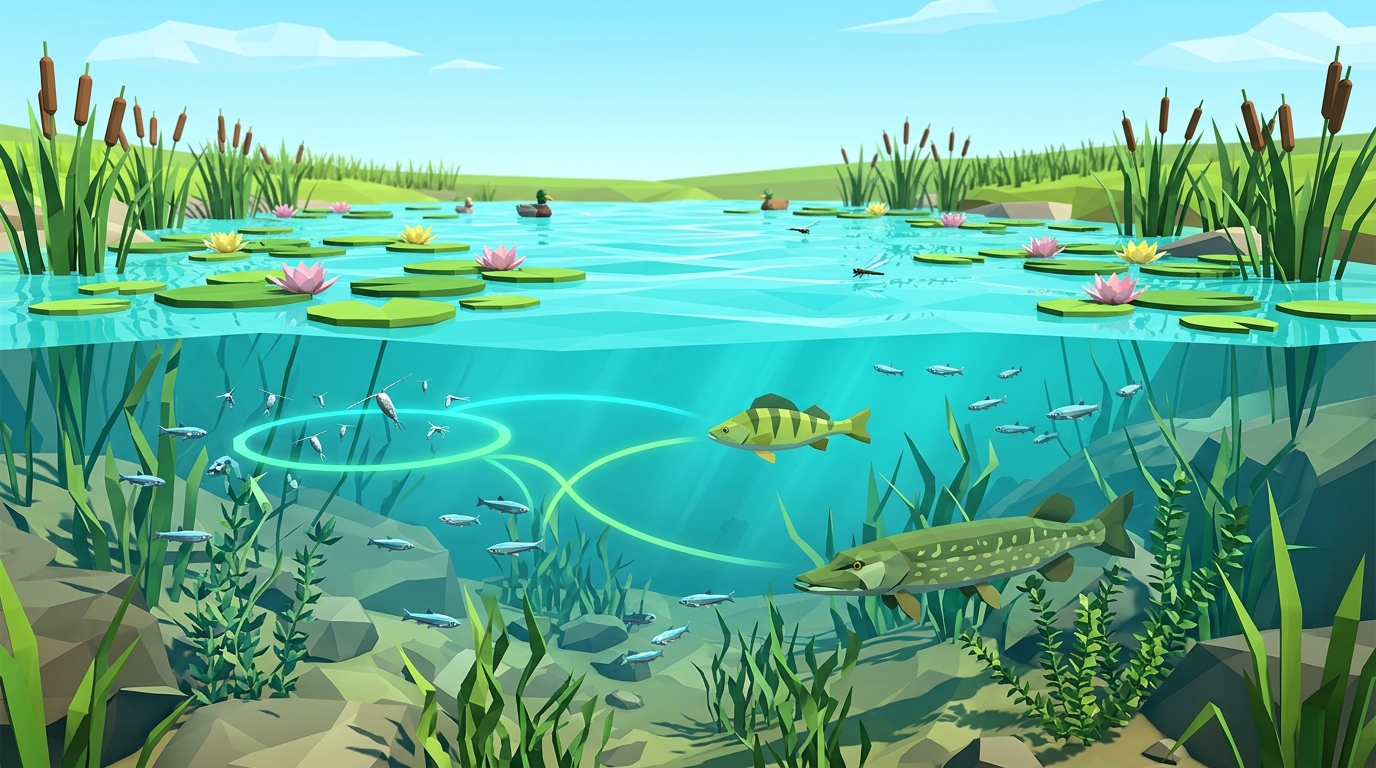
Anyone can adjust a single variable slider to solve a localized puzzle. But when you build an entire biosphere from scratch, you face the Architect's Dilemma: every single element you add creates ripple effects across every other element. Plant too much clover, and herbivores experience a population boom that defoliates your trees. Introduce too few wolves, and overgrazing destroys your riverbanks. Omit soil decomposers, and trapped carbon starves your atmosphere.
In Level 19 of the Praxos 3D simulation ("Build Your Biome"), the scripted mission guardrails fall away. Students are handed full CAD-style sandbox controls to sculpt, seed, and balance an autonomous miniature planet.
Open the Level 19 Sandbox. Choose your terrain elevations, water tables, and starting species ratios. Once you are satisfied with your initial blueprint, press "Engage Autonomous Run" and take your hands off the controls. Can your miniature world run for 200 continuous simulation days without a single extinction event?
Launch Level 19 SandboxLessons from Biosphere 2: Why Real-World Synthetic Worlds Struggle
If creating a self-sustaining biosphere sounds simple, consider the most ambitious ecological engineering experiment in human history: Biosphere 2. Built in Oracle, Arizona in 1991, Biosphere 2 was a sealed 3.14-acre glass megastructure designed to test whether humans could create an autonomous, closed life-support biome for future space colonies on Mars.
The facility contained five synthetic biomes: a rainforest, an ocean with a coral reef, a savannah grassland, a mangrove marsh, and a fog desert. Over 3,800 carefully chosen plant and animal species were sealed inside alongside eight human scientists ("biospherians").
Despite spending over $150 million, the artificial world ran into catastrophic systemic imbalances within months:
1. The Oxygen Plunge: Atmospheric oxygen plummeted from a normal 21% down to a suffocating 14.5% (the equivalent of living at 12,000 feet altitude). Engineers discovered that overly fertile compost soils had triggered an explosive metabolic boom among soil microbes, which devoured oxygen faster than plants could produce it.
2. The Carbon Sink Trap: The massive concrete foundations of the structure chemically reacted with carbon dioxide, locking away atmospheric carbon and preventing plants from photosynthesizing efficiently.
3. The Pollination Collapse: Synthetic light angles and lack of natural wind cues caused all 19 species of pollinating bees, moths, and hummingbirds to go extinct. Without pollinators, fruiting crops failed, forcing biospherians into severe calorie deficits.
4. Runaway Monocultures: Fast-growing morning glory vines escaped their agricultural beds and choked out native rainforest shrubs because the designers had omitted natural balancing insect predators.
Biosphere 2 proved a profound scientific truth: you cannot balance an ecosystem through rigid human management. A living world requires internal negative feedback loops, balanced metabolic stocks, and requisite complexity (Ormancı 2026).
| Architectural Pillar | Engineered Component | Failure Mode if Omitted | Cybernetic Balancing Dynamic |
|---|---|---|---|
| PRODUCERSPrimary Producers (Energy Inflow) | Layered flora: grasses, berry shrubs, aspens, and climax oaks | Zero solar capture; food web starves on Day 1 | Photosynthetic conversion of insolation into usable organic glucose |
| PRIMARY CONSUMERSHerbivore Grazers (Biomass Conversion) | Multi-tier primary consumers: field mice, rabbits, and deer herds | Vegetation overgrows, chokes out light, and enters senescence | Pruning pressure keeps flora young; converts cellulose to animal protein |
| PREDATORSApex Carnivores (Top-Down Dampening) | Specialized predators: red foxes and gray wolf packs | Herbivore boom-bust cycles cause catastrophic overgrazing collapse | Balancing feedback loop regulating herbivore numbers below K |
| DECOMPOSERSDecomposer Loop (Nutrient Recycling) | Subterranean mycorrhizal fungi and bacterial detritivores | Dead organic matter piles up; nitrogen and phosphorus run out | Closed circular flow converting carcasses and dung into fertile soil loam |
Inside Simulation Level 19: Blueprinting, Seeding, and the 200-Day Autopilot Run
In Level 19, students take on the title of Chief Biosphere Architect. The mission takes place on an expansive 16x16 grid canvas where students build an ecosystem from ground zero across five engineering phases:
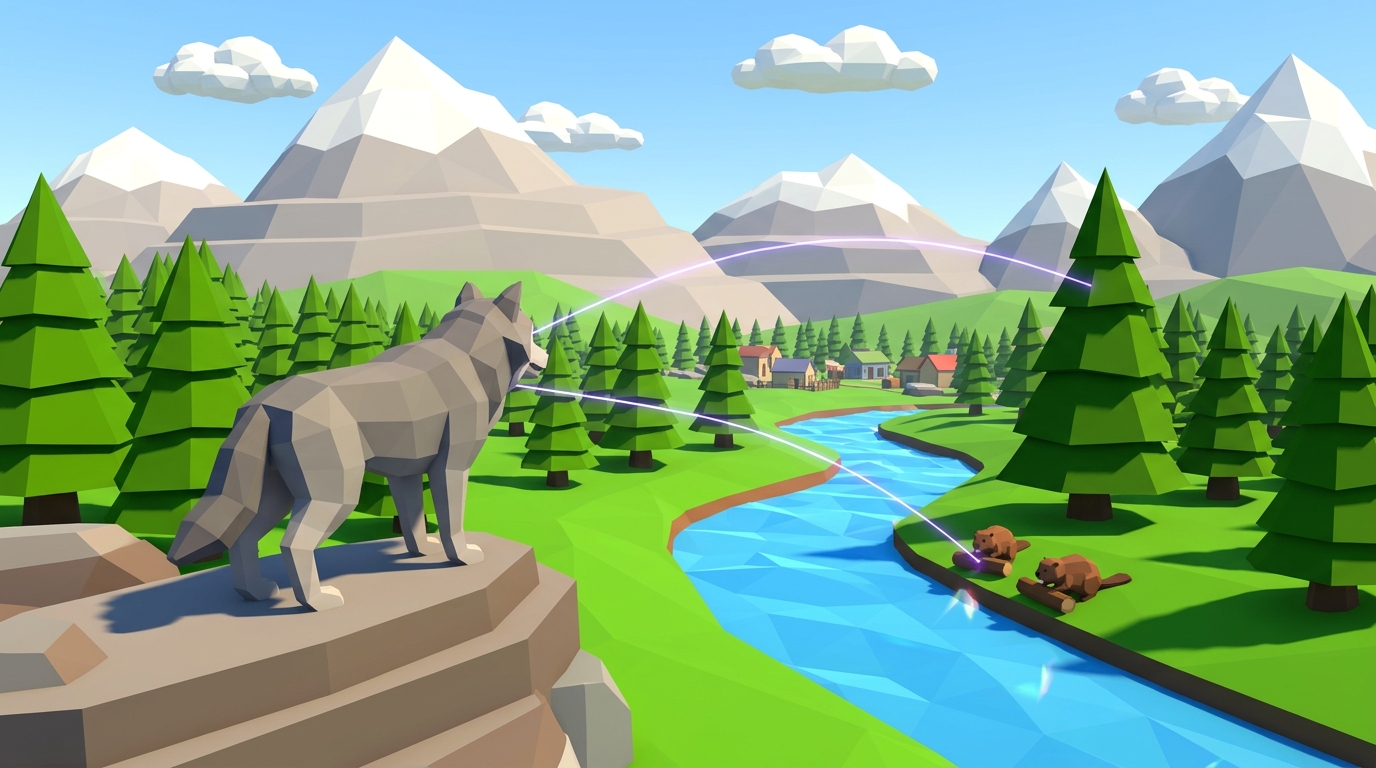
Phase 1: Topographic Sculpting. Using elevation brushes, students carve high alpine ridges, rolling foothills, and valley lowlands. Routing a freshwater river from mountain snowmelt down to a lowland lake establishes the subsurface water table across all surrounding land tiles.
Phase 2: Climate and Insolation Calibration. Students set the solar insolation curve, defining summer temperature peaks and winter dormancy lows.
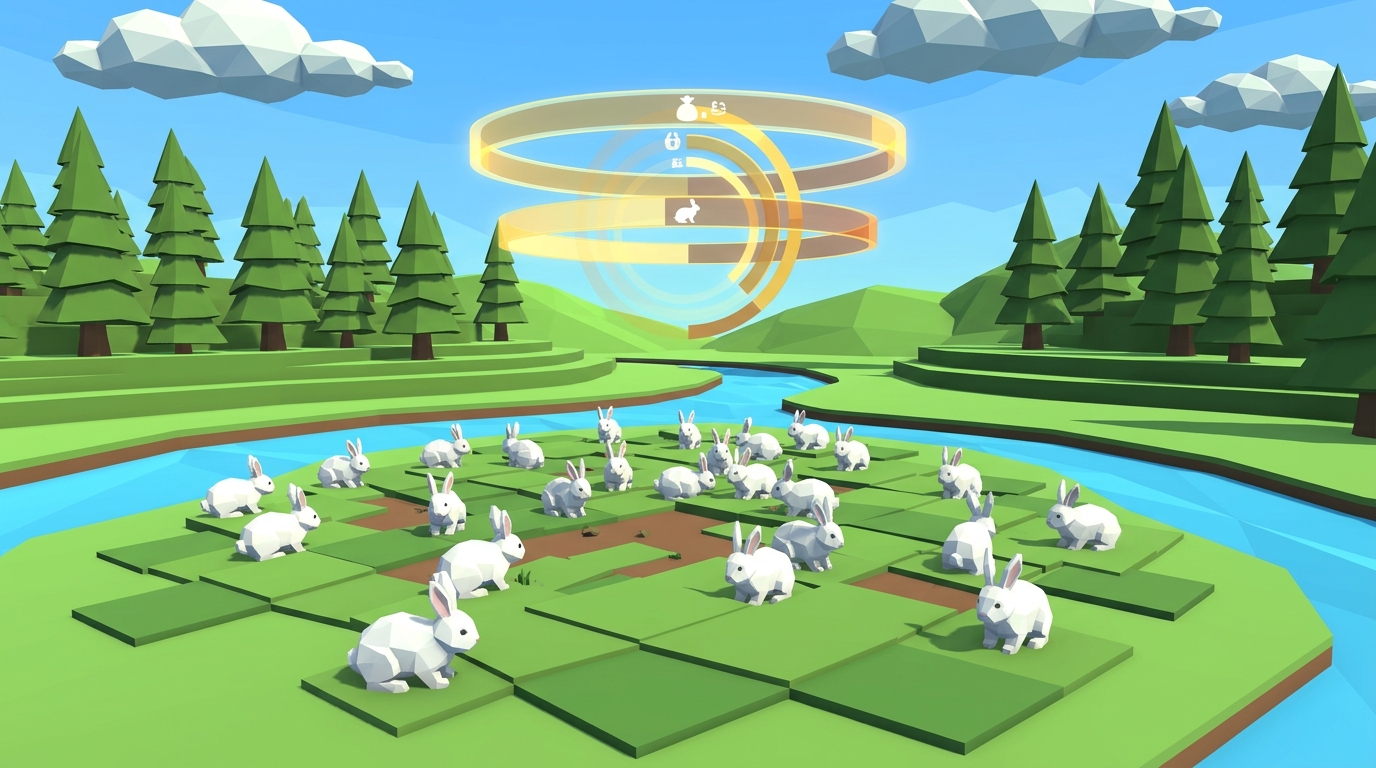
Phase 3: Trophic Biomass Calculation. Applying Raymond Lindeman's 10% trophic efficiency rule, students calculate proper population ratios. To support a pack of 2 wolves (Tertiary Consumers, requiring ~10 units of biomass), students must seed at least 20 rabbits and deer (Primary Consumers, ~100 units), which in turn require at least 120 patches of mature grass and berry bushes (Primary Producers, ~1000 units).
Phase 4: Decomposer Integration. Students allocate soil fertility credits to establish subterranean fungal networks, ensuring that dead biomass returns to the soil as available nitrogen.
Phase 5: The 200-Day Autopilot Flight. Once the student clicks "Engage Autonomous Run," all interactive placement tools lock. The simulation engine accelerates time: students watch seasonal snowstorms, predator hunts, plant regrowths, and demographic cycles unfold across 200 simulation days. If any single species goes extinct or vegetation coverage collapses below 25%, the trial ends. If all trophic tiers survive through Day 200 in dynamic equilibrium, the student earns the Master Biosphere Architect badge.
Sculpt Topography and Route Freshwater Aquifers
Carve alpine ridges and route a mountain river to establish a high water table across at least 60% of the sandbox grid.
Seed Layered Plant Species to Build the 1000-Unit Base
Plant deep-root grasses, flowering shrubs, and shade trees to create diverse feeding niches and microclimates.
Introduce Consumers Using the 10% Trophic Rule
Carefully balance primary consumers (rabbits, deer) against apex predators (wolves) to prevent premature starvation or overgrazing.
Lock Controls and Complete the 200-Day Autopilot Run
Engage autonomous simulation mode, observing natural Lotka-Volterra waves and sustaining all species through Day 200.
Common Student Misconceptions in Sandbox Biosphere Design
When middle schoolers design open-world biospheres, four predictable design errors routinely emerge:
Misconception 1: "More predators make a world exciting, so add lots of wolves." Students often seed 10 wolves alongside 15 rabbits because predators look impressive. Within ten sim days, the wolves eat every rabbit on the map and starve to death by Day 18. Apex carnivores require a vast, healthy prey pyramid beneath them.
Misconception 2: "Plants take care of themselves as long as you provide dirt." Without herbivores to prune fast-growing annual grasses, a single aggressive weed species will shade out all competing plants, creating a brittle monoculture that collapses during the first winter freeze.
Misconception 3: "A successful biosphere must show flat, unchanging population graphs." Living systems never remain at a static, flat number. Healthy ecosystems pulse in perpetual dynamic oscillations: prey numbers rise, predators follow with a phase lag, prey drops, predators drop, and the cycle begins anew. Stability is defined by bounded waves, not stillness.
An architect does not rule an ecosystem; an architect designs the balancing loops that allow nature to govern itself. True ecological genius is building a living world that thrives without your help.
Frequently Asked Questions About Level 19
Practical reference answers for educators, parents, and young system designers:
What NGSS standards are targeted in Level 19?
Can students save and iterate on their custom biomes?
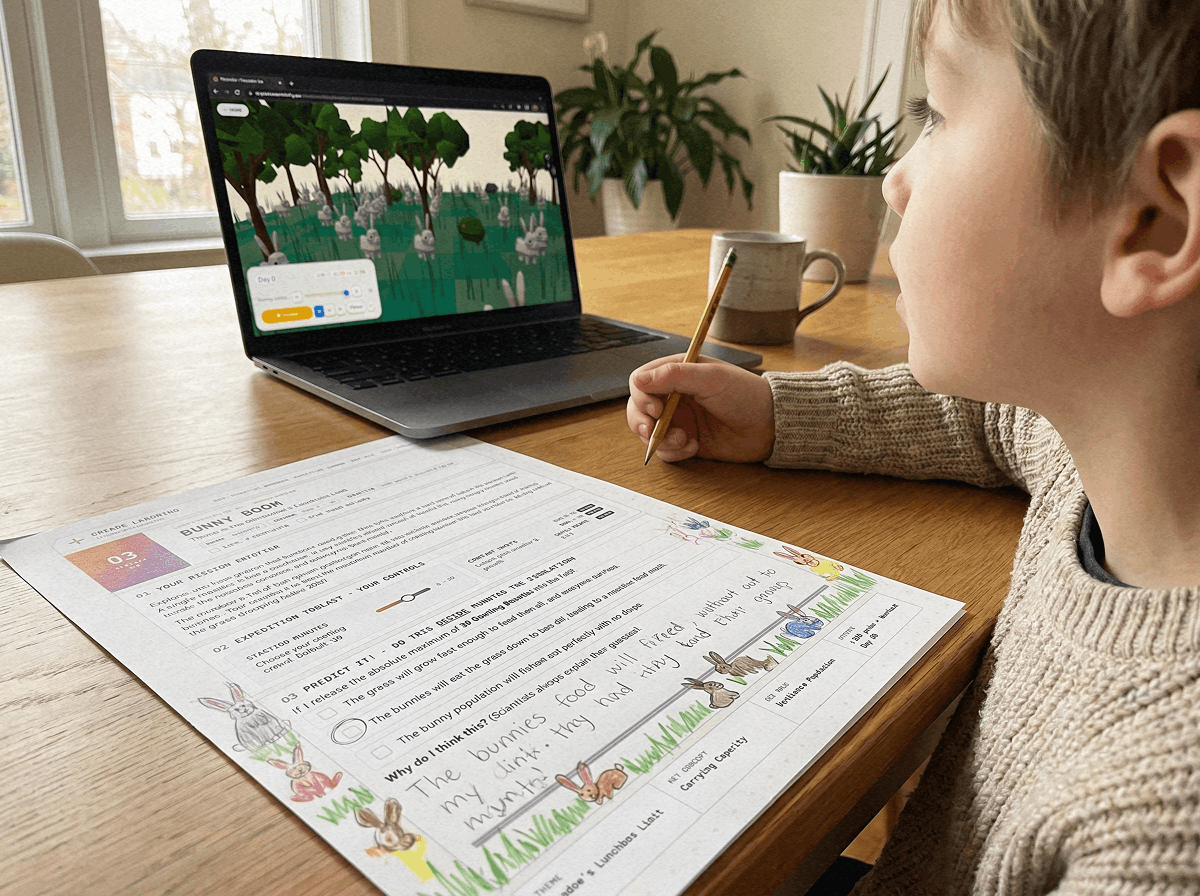
What is the printable challenge for Level 19 in the Expedition Science Journal?
Level 19 Mission Log & Comprehensive Biosphere Engineering Charter (PDF)
A printable 24-page Expedition Science Journal charter containing blueprint grid templates, trophic biomass pyramid calculators (Lindeman 10% efficiency), and 200-day diagnostic flight recorders.