Beyond Arcade Explosions: Why Gaming Volcano Physics Matter
In commercial entertainment video games, volcanoes almost always function as dramatic visual backdrops: glowing rivers of red liquid, crumbling stone platforms, and sudden fireballs designed to test a player's reflexes. While entertaining, these arcade representations reinforce deep scientific misconceptions. Lava is depicted as an instantly lethal red dye, eruptions occur on arbitrary timers, and every volcanic peak explodes like a bomb.
In contrast, an educational gaming volcano environment harnesses the captivating power of interactive 3D mechanics to teach authentic earth science. In the real world, whether a volcano oozes harmless fluid basalt or obliterates an entire mountainside in a cataclysmic plinian eruption depends on precise chemical physics: silica concentration, dissolved water vapor exsolution, magma viscosity, and subterranean reservoir overpressure.
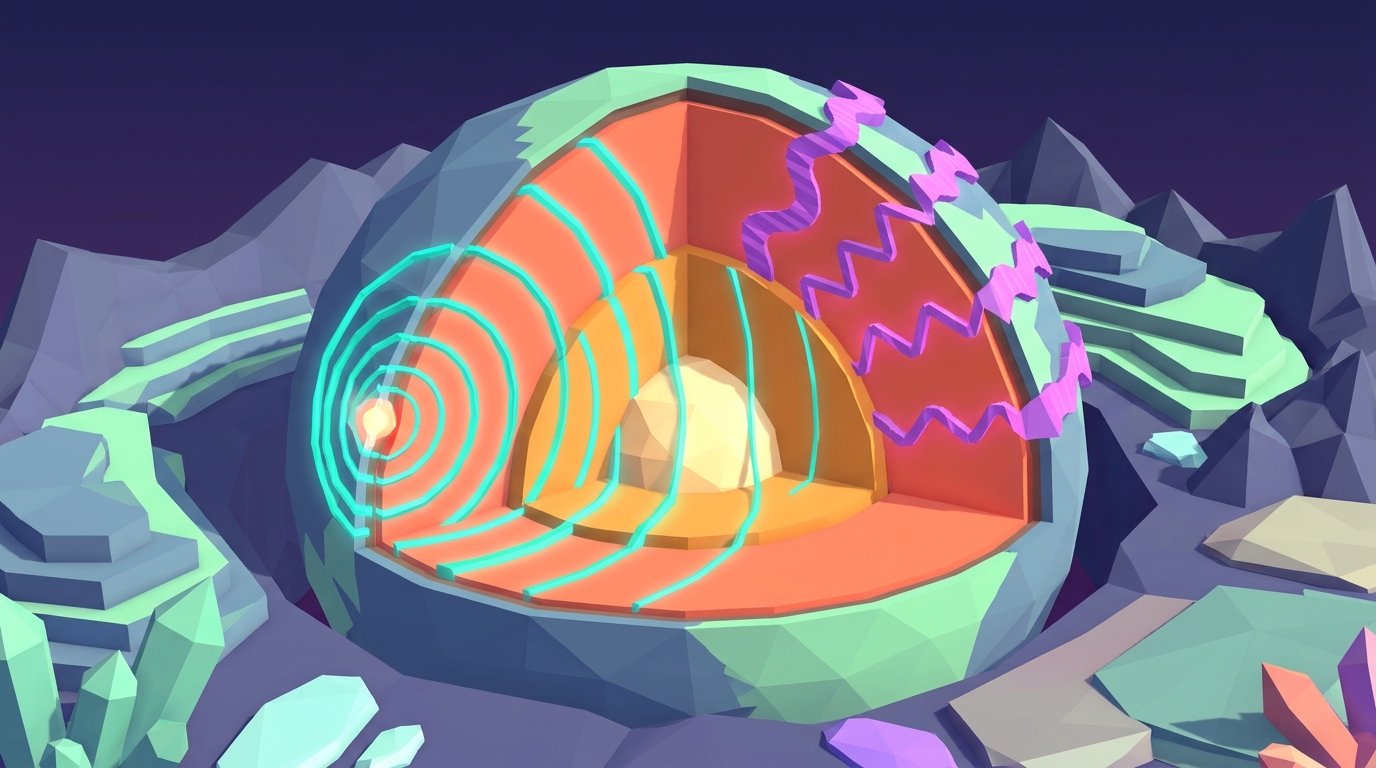
When I programmed Volcano Island at Praxos Learning, my mission was to put students in the cockpit of a subterranean magma chamber. By turning abstract rheological equations into responsive visual sliders, a gaming volcano transforms passive textbook diagrams into an intuitive, inquiry-driven physics laboratory where students test hypotheses in real time.
Core Geophysics Mechanics Inside a Gaming Volcano Sandbox
A rigorous, curriculum-aligned gaming volcano simulation models four interconnected volcanic principles defined by the Next Generation Science Standards (NGSS MS-ESS2-2):
1. Silica Polymerization and Viscosity. Silicon dioxide (SiO2) tetrahedra link together into complex molecular chains as magma cools. Low-silica basaltic magma (50% SiO2) remains fluid and runny like warm honey, producing gentle effusive shield volcano flows. High-silica rhyolitic magma (70% to 75% SiO2) forms dense, tangled polymer networks with immense viscosity, trapping escaping volatiles.
2. Volatile Gas Exsolution. Deep underground, immense lithostatic pressure keeps dissolved water and carbon dioxide dissolved inside the liquid melt. As magma ascends and confining pressure drops, dissolved gases rapidly boil out of solution like opening a shaken soda bottle. In viscous rhyolite, expanding gas bubbles cannot escape, building catastrophic explosive pressure.
3. Magma Chamber Evacuation and Caldera Collapse. When a massive magma reservoir drains during a plinian eruption, the structural roof loses mechanical support. Gravity causes the central mountain block to collapse downward along ring faults, forming a colossal caldera basin like Crater Lake or Santorini.
4. Basaltic Columnar Jointing. When thick lava pools cool slowly over decades, contractual cooling stresses propagate through the rock mass, cracking the basalt into hexagonal columns.
Low silica yields gentle, flowing lava and broad shield volcanoes. High silica traps volatile gas bubbles, generating immense internal pressure that culminates in explosive composite eruptions.
Comparing Arcade Volcanology with Authentic Gaming Volcano Physics
To help educators differentiate between superficial arcade games and genuine scientific sandboxes, the comparison matrix below breaks down key physical mechanics:
| Simulation Parameter | Arcade Entertainment Game | Scientific Gaming Volcano | Pedagogical Learning Value |
|---|---|---|---|
| Magma Chemistry | Uniform red liquid texture | Adjustable silica (50% to 75% SiO2) | Teaches chemical composition controls fluid dynamics |
| Eruption Triggers | Scripted cutscenes or timers | Volatile gas exsolution overpressure | Demonstrates gas expansion and confining pressure |
| Volcano Morphology | Identical steep rocky cones | Morphs from shield to stratovolcano | Connects eruptive style to landform construction |
| Subterranean View | Invisible underground mechanics | Cutaway 3D magma chamber reservoir | Visualizes structural roof stress and caldera collapse |
Volcano Island Geophysics Sandbox
Take command of an active subterranean magma chamber. Adjust silica content from 50% basalt to 75% rhyolite, track dissolved gas exsolution, and trigger realistic caldera collapses in full 3D.
Teaching this topic tomorrow? Download the Free NGSS Student Lab Sheet (Printable PDF)
Get printable volcano classification charts, silica viscosity calculation tables, and NGSS MS-ESS2-2 inquiry labs in high-resolution PDF format.
How Classroom Gaming Volcano Labs Replace Static Textbooks
In a conventional middle school earth science class, students study volcanic types by memorizing labeled diagrams of shield volcanoes, cinder cones, and composite stratovolcanoes. Within two weeks, most students forget which volcano correlates with which lava type.
In an interactive gaming volcano lab, students take on the role of planetary geophysicists. They are challenged to design a volcano that safely releases volcanic pressure without triggering an explosive disaster. Students manipulate temperature, silica percentage, and dissolved gas content, watching their volcano respond in real time.
When students set silica to 72% and volatile gases to 6%, they watch the chamber pressure needle sweep into the red zone before the entire mountain peak shatters in an explosive blast. Experiencing this failure mode firsthand burns the relationship between silica viscosity and volcanic hazards permanently into cognitive memory.
Set Basaltic Baseline
Configure silica to 50% and observe fluid pahoehoe lava building a broad, gentle shield volcano.
Increase Silica Viscosity
Raise silica to 65% to see magma stiffen into sticky andesite, forming steep composite layers.
Charge Volatile Gases
Increase dissolved water vapor to observe rapid gas bubble nucleation and chamber overpressure.
Analyze Caldera Collapse
Trigger reservoir drainage and watch the unsupported caldera peak collapse along vertical ring fractures.
Connecting Gaming Volcano Simulations with Physical Lab Journals
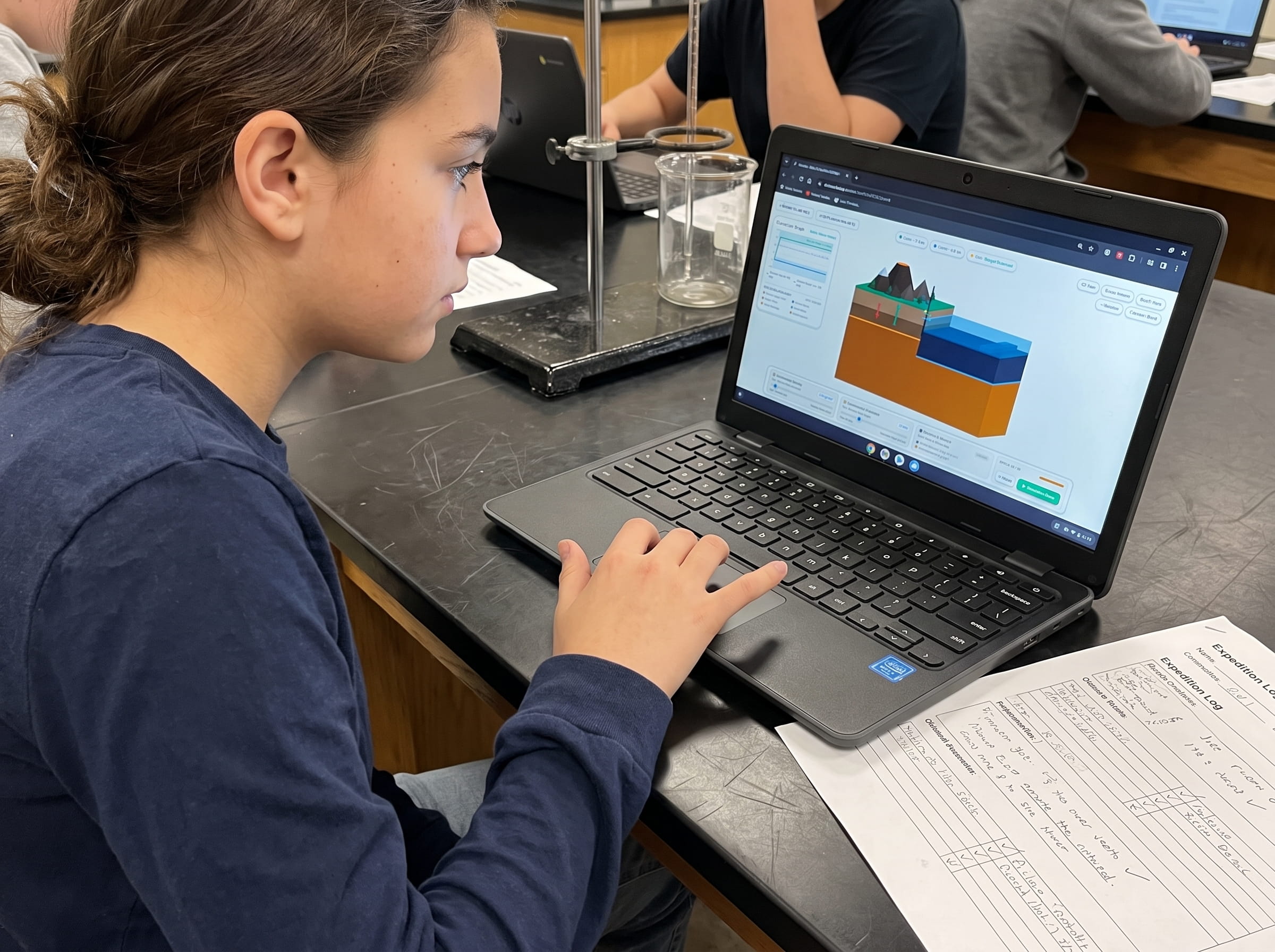
To ensure that digital game-based learning translates into rigorous academic achievement, students must pair their on-screen experiments with physical scientific documentation. At Praxos Learning, our Dual-Format Learning protocol requires students to record their parameters before every test.
In their printed Field Geologist Logbook, students sketch the magma chamber cross-section, log numerical viscosity values in poise, and calculate the Volcanic Explosivity Index (VEI) based on plume height and eruptive volume.
This intentional integration of digital simulation and physical writing prevents passive screen consumption, giving teachers and homeschooling parents clear, verifiable proof of student STEM mastery.
Frequently Asked Questions About Gaming Volcano Science
Below are clear answers to common questions about using interactive volcano simulations in educational settings.
What is the educational value of a gaming volcano simulation?
How does silica percentage affect volcanic eruptions?
Can gaming volcano simulations run on Chromebooks in school classrooms?
How do gaming volcano simulations align with NGSS standards?
Download the Free 24-Page Field Geologist Logbook
Get printable volcano classification charts, silica viscosity calculation tables, and NGSS MS-ESS2-2 inquiry labs in high-resolution PDF format.