
The Predator-Free Superpower: Understanding Ecological Release
In its native habitat, no living species can expand without limit. Every plant, insect, and animal lives under an invisible blanket of natural balancing feedback loops: specialized predators hunt it, co-evolved pathogens infect it, and native competitors contest every square meter of territory.
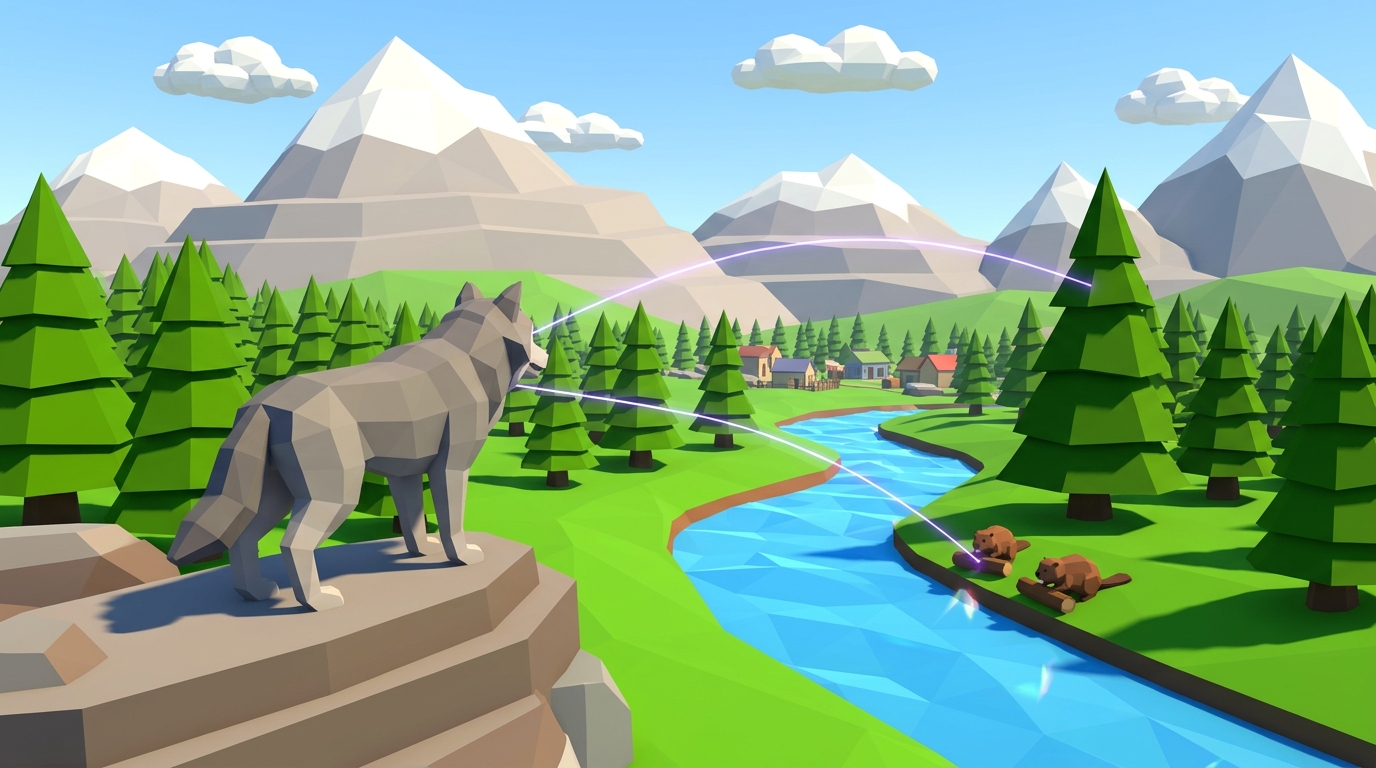
When humans transport an organism across a geographic barrier (such as an ocean or mountain range) into a brand-new biome, something dramatic happens. The organism escapes its entire evolutionary baggage of natural enemies. This phenomenon is known in ecology as ecological release.
Local predators do not recognize the newcomer as edible prey. Native plants lack defenses against its feeding habits. Soil bacteria do not know how to infect it. Free from balancing friction, the invader shifts into unconstrained exponential reproduction, consuming nutrients at double the rate of native species and crowding out resident wildlife.
In Level 13 of the Praxos 3D simulation ("The Invaders"), students manage an active biosecurity perimeter, discovering why biological invasions are one of the most mathematically dangerous threats on Earth.
Invasive species are not inherently stronger or smarter than native wildlife. They simply operate without the natural balancing loops that keep local species in check.
The 102 Cane Toads Disaster: Australia's Costly Mistake
History provides one of the clearest examples of what happens when humans miscalculate ecological release: the 1935 introduction of the cane toad (*Rhinella marina*) to Australia.
Australian sugarcane farmers were struggling with native cane beetles that devoured the roots of their crops. Seeking a chemical-free biological solution, government entomologists imported 102 cane toads from Hawaii and released them into northern Queensland sugarcane fields.
The experiment failed immediately. Cane beetles lived high up on the stalks of tall sugarcane plants, while heavy cane toads hopped along the ground and could not climb. The toads completely ignored the beetles.
Instead, the toads began eating native Australian insects, frogs, small lizards, and bird eggs. Because cane toads produce lethal bufotoxin poison glands behind their eyes, native apex predators like dingoes, quolls, monitor lizards, and freshwater crocodiles that tried to eat them died within minutes.
With zero natural predators and zero effective parasites, those original 102 toads multiplied into an invading army of over 200 million individuals, colonizing thousands of miles of tropical wilderness and causing devastating multi-tier ecological collapse.
| Ecological Dimension | Native Species (Co-Evolved Community) | Invasive Alien Species (Ecological Release) |
|---|---|---|
| PREDATION LOOPPredation Pressure | Regulated by co-evolved apex carnivores and mesopredators | Effectively zero (local predators do not recognize or cannot digest them) |
| GROWTH CURVEGrowth Trajectory | Logistic S-curve constrained by carrying capacity (K) | Initial unconstrained exponential J-curve ($N_t = N_0 e^{rt}$) |
| COMPETITIONResource Consumption | Niche partitioned with coexisting resident species | Asymmetric competitive exclusion; defoliates shared food reserves |
| MANAGEMENT COSTContainment Window | Endogenous stability requiring minimal human intervention | Time-critical; containment costs escalate exponentially with each day of delay |
Inside Simulation Level 13: Time-Critical Containment Windows
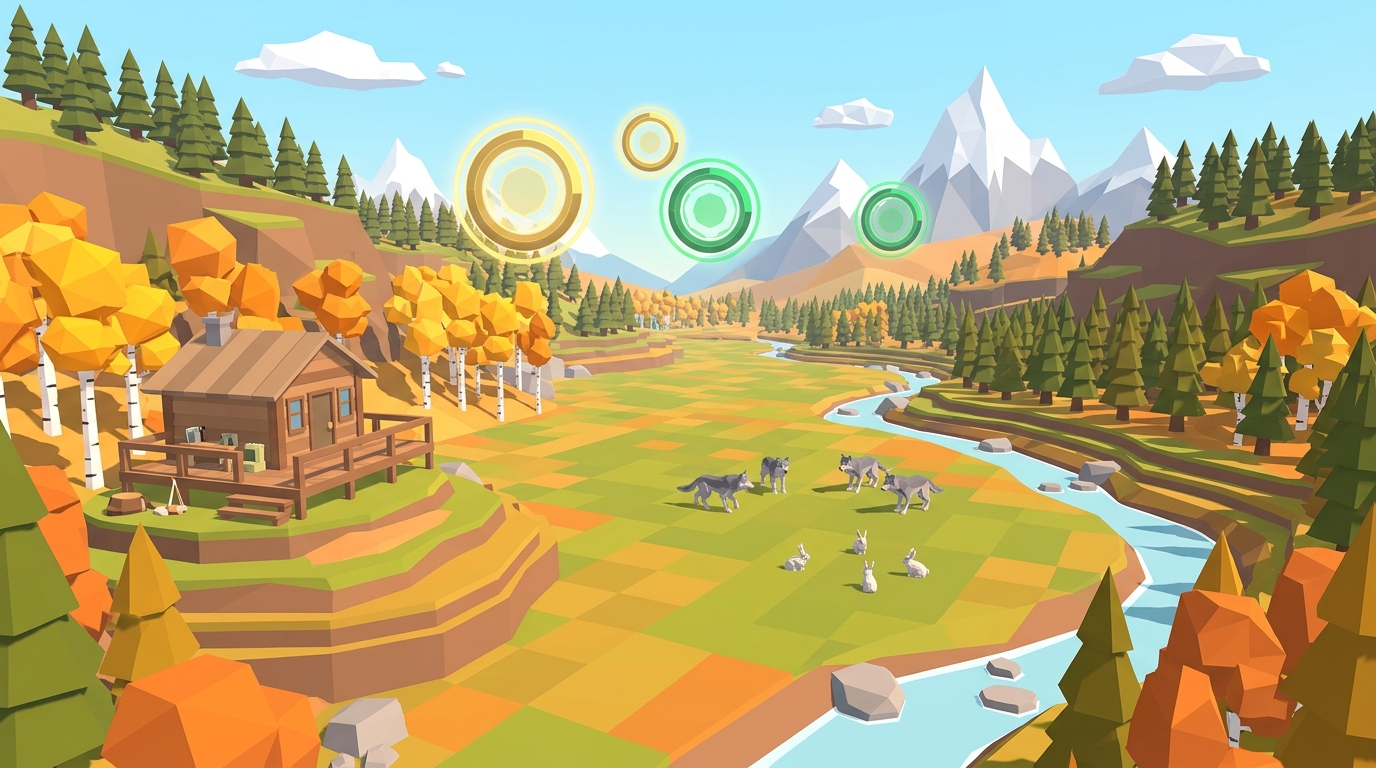
In Level 13, students begin with a healthy 12x12 meadow containing 60 grass cells, 10 native rabbits, and 3 native wolves. The ecosystem operates in quiet equilibrium.
At Day 5, an alarm sounds: two Swarm Locust entities spawn in the northwest corner. These exotic insects move twice as fast as native rabbits, devour twice as much grass per day, reproduce at 2.5 times the rabbit rate, and are 100% ignored by native wolves.
Students are allocated a fixed Biosecurity Budget of 100 credits. They have two interactive containment levers: Quarantine Fence borders (10 credits each) and Targeted Bio-Removal brushes (15 credits per click).
The core systems lesson lies in the mathematical escalation of intervention delay. If the student acts between Day 5 and Day 10, the outbreak is confined to a tiny 2x2 corner; enclosing it requires only 4 fence borders (40 credits) and 2 bio-removal clicks (30 credits), safely within the 100-credit budget.
If the student hesitates until Day 20, the swarm expands exponentially across 8 grid tiles. Enclosing the invasion now requires 16 fences and 10 bio-removals (310 credits), far exceeding total available funds. Grass coverage collapses below 10%, native rabbits starve, and the mission fails.
Detect the Northwest Spawning Event
Run the simulation through Day 5 and identify the exact corner coordinates where the exotic locust swarm first touches down.
Erect the Quarantine Perimeter Immediately
Pause the run or act quickly to construct electric-cyan Quarantine Fence borders around the 2x2 spawning zone before the insects migrate into central pastures.
Deploy Targeted Biological Extraction
Use the Bio-Removal brush inside the quarantined zone to eradicate 100% of the trapped locusts, spending 30 to 45 credits while preserving reserve funds.
Sustain Native Biodiversity Through Day 60
Verify that zero locusts remain on the board and confirm that at least 5 native rabbits and 40% green grass thrive through Day 60 to complete the mission.
Common Student Misconceptions About Invasive Species
Classroom testing reveals three persistent misconceptions children have about exotic species:
Misconception 1: "Nature will automatically adapt and solve the problem." Children assume that if an invader arrives, native animals will just start eating it. In reality, behavioral and immunological adaptations take thousands of generations, while an invasive swarm causes collapse in weeks.
Misconception 2: "Invasive species are evil monsters." Organisms do not invade with malicious intent. A cane toad or a locust is simply doing what all organisms do: surviving and reproducing. The crisis is caused by the absence of environmental limits.
Misconception 3: "We can just wait and fix it later when we have more money." The mathematical reality of exponential growth means waiting doubles or triples the required cleanup resources every few days. Once a species becomes naturalized across millions of acres, eradication becomes financially impossible.
An ounce of prevention is worth a million pounds of cure. In biological invasions, acting on Day 1 is cheap; waiting until Day 30 is catastrophic.
Frequently Asked Questions About Level 13
Practical reference answers for teachers and homeschooling families exploring Level 13:
What NGSS standards are targeted in Level 13?
Why don't native wolves eat the invasive locusts in the simulation?
What is the printable journal exercise for Level 13?
Level 13 Mission Log & Invasive Containment Cost Calculator (PDF)
A printable 24-page Expedition Science Journal activity calculating the exponential cost curve of delayed biological containment, analyzing Australia's cane toad disaster, and designing an early-detection biosecurity defense protocol.