
The Cosmic Law of Nature: Open Energy, Closed Matter
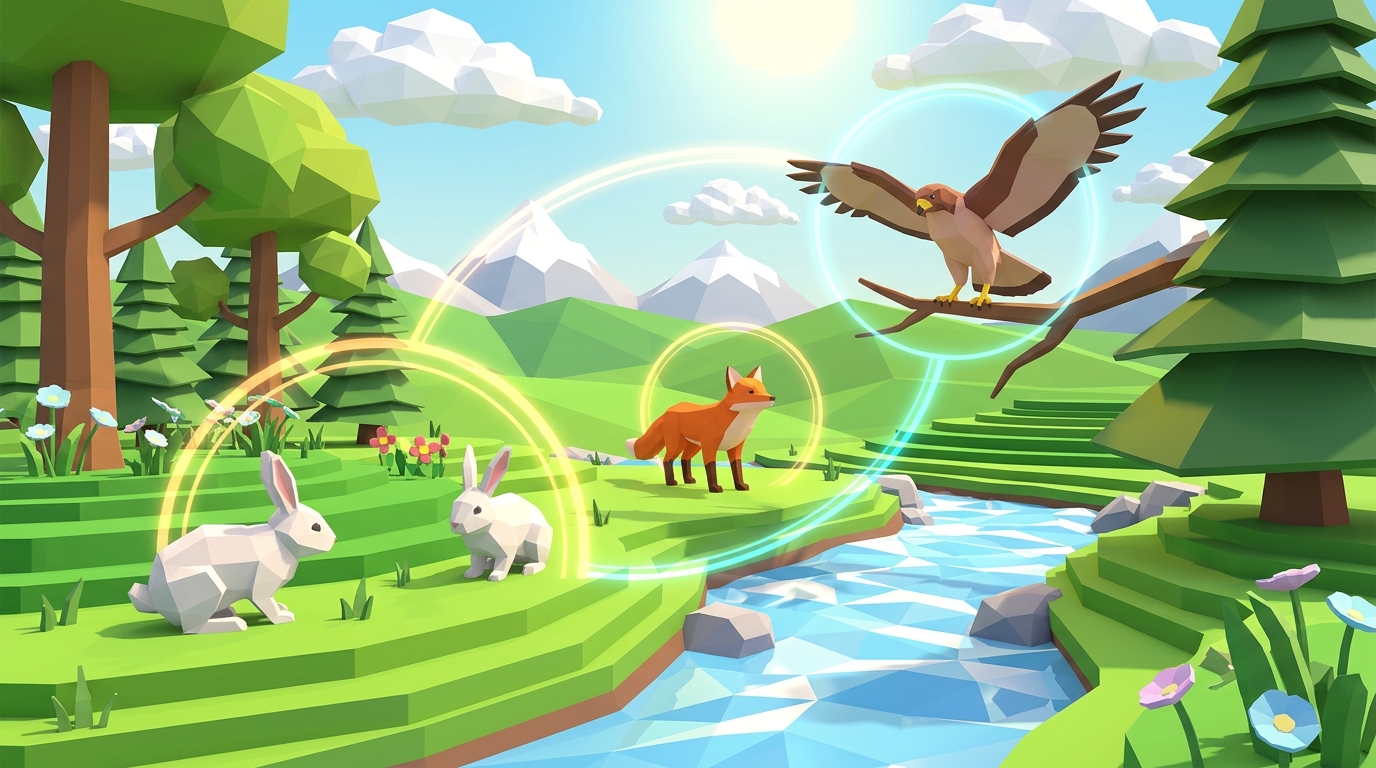
In traditional middle school biology, food chains are almost always drawn as straight arrows: sunlight warms the grass, a rabbit eats the grass, and a wolf catches the rabbit. But that linear depiction conceals a dangerous scientific misconception.
Energy indeed travels in a one-way street. Solar photons radiate down onto plant leaves, chemical energy passes along trophic links, and metabolic work inevitably radiates energy away into the atmosphere as low-grade thermal heat. The Sun continuously supplies fresh energy every morning.
Chemical matter, however, obeys a completely different physical law. Earth is essentially a closed thermodynamic system for physical elements. Every single atom of carbon, nitrogen, calcium, and phosphorus inside our bones and trees today was present when the planet formed billions of years ago. Nature cannot order new atoms from outer space; it must recycle the exact inventory it already holds.
In Level 11 of the Praxos 3D simulation ("The Cleanup Crew"), students enter Phase 3 of the curriculum, confronting the catastrophic consequences that occur when this vital recycling loop is severed.
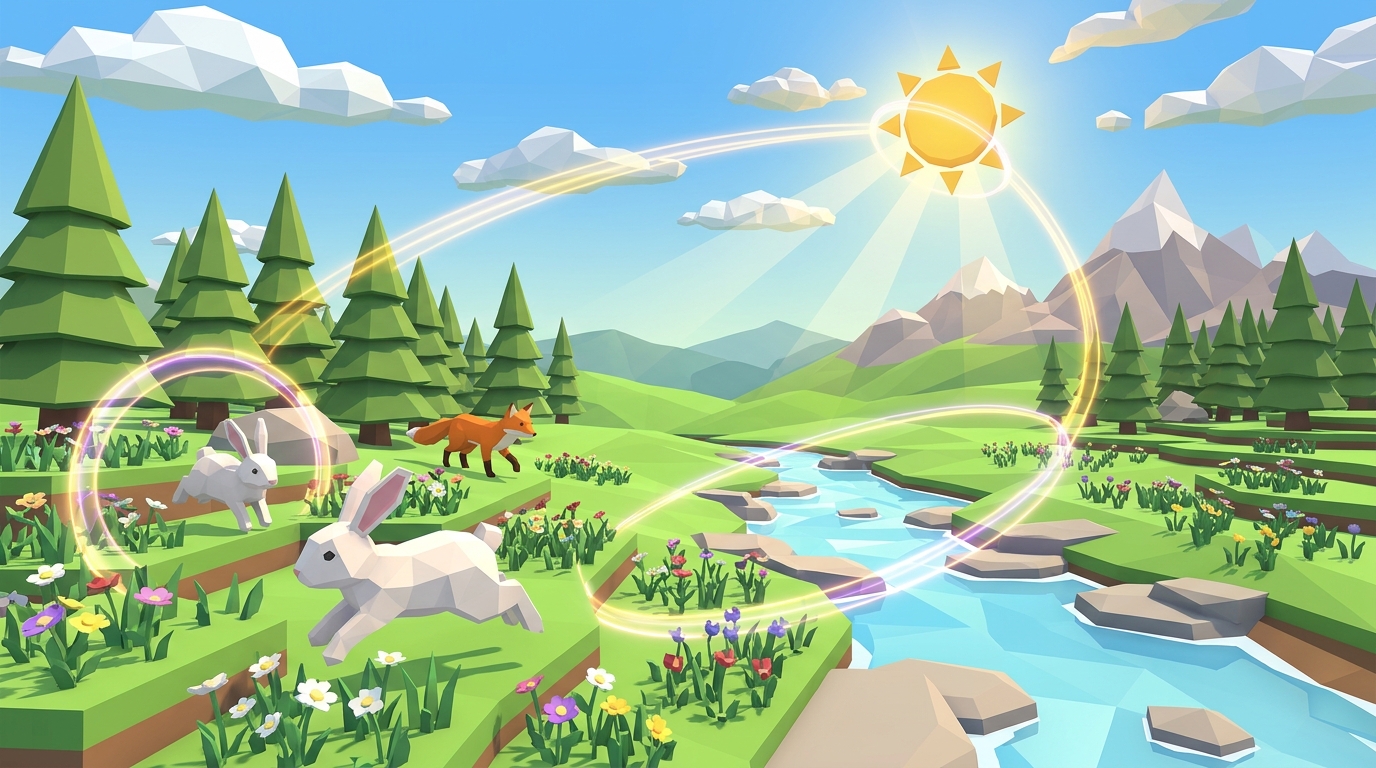
Energy dissipates outward as heat; matter circulates inward through loops. Without decomposers to unlock mineral nutrients, an ecosystem starves in the midst of dead abundance.
The 50-Million-Year Tree Pileup: A Real Earth Case Study
What happens when nature forgets to recycle? This is not merely a theoretical computer experiment; it actually happened during Earth's Carboniferous Period approximately 300 million years ago.
During this era, ancient vascular trees evolved a groundbreaking structural polymer called lignin. Lignin made bark rigid, waterproof, and durable, allowing trees to grow dozens of meters tall and form Earth's first sprawling primeval forests.
The problem was that no fungus, beetle, or bacterium had yet evolved the specialized enzymes necessary to digest lignin. For nearly 50 million years, when giant trees died, they did not decompose. They simply fell on top of one another, forming massive, non-decaying log piles hundreds of feet thick.
Because nutrients could not cycle back into the soil, topsoils gradually depleted. The gigantic non-decayed wood piles were eventually compressed underground by tectonic pressure and heat, forming the massive fossil coal beds that industrial civilization burns today. Only when white-rot fungi finally evolved lignin-digesting peroxidases did Earth's closed recycling loop restore itself.
| System Dimension | Energy Dynamics (Thermodynamic Inflow) | Matter Dynamics (Nutrient Cycling) |
|---|---|---|
| ARCHITECTURESystem Architecture | Open, directional flow (Sun -> Producers -> Consumers -> Heat) | Closed, recirculating biogeochemical loops (Soil -> Plants -> Animals -> Decomposers -> Soil) |
| PERSISTENCETerminal State | Dissipates irreversibly into space as infrared heat | Conserved indefinitely; transformed between organic and inorganic states |
| DRIVING MECHANISMPrimary Engine | Solar fusion and chloroplast chlorophyll absorption | Saprotrophic bacteria, mycorrhizal fungi, and detritivore invertebrates |
| SYSTEM COLLAPSEFailure Consequence | Immediate thermal stasis and cessation of photosynthesis | Resource lock-up: primary producers exhaust free soil nitrates and starve |
Inside Simulation Level 11: Mechanics of Decay and Soil Recovery
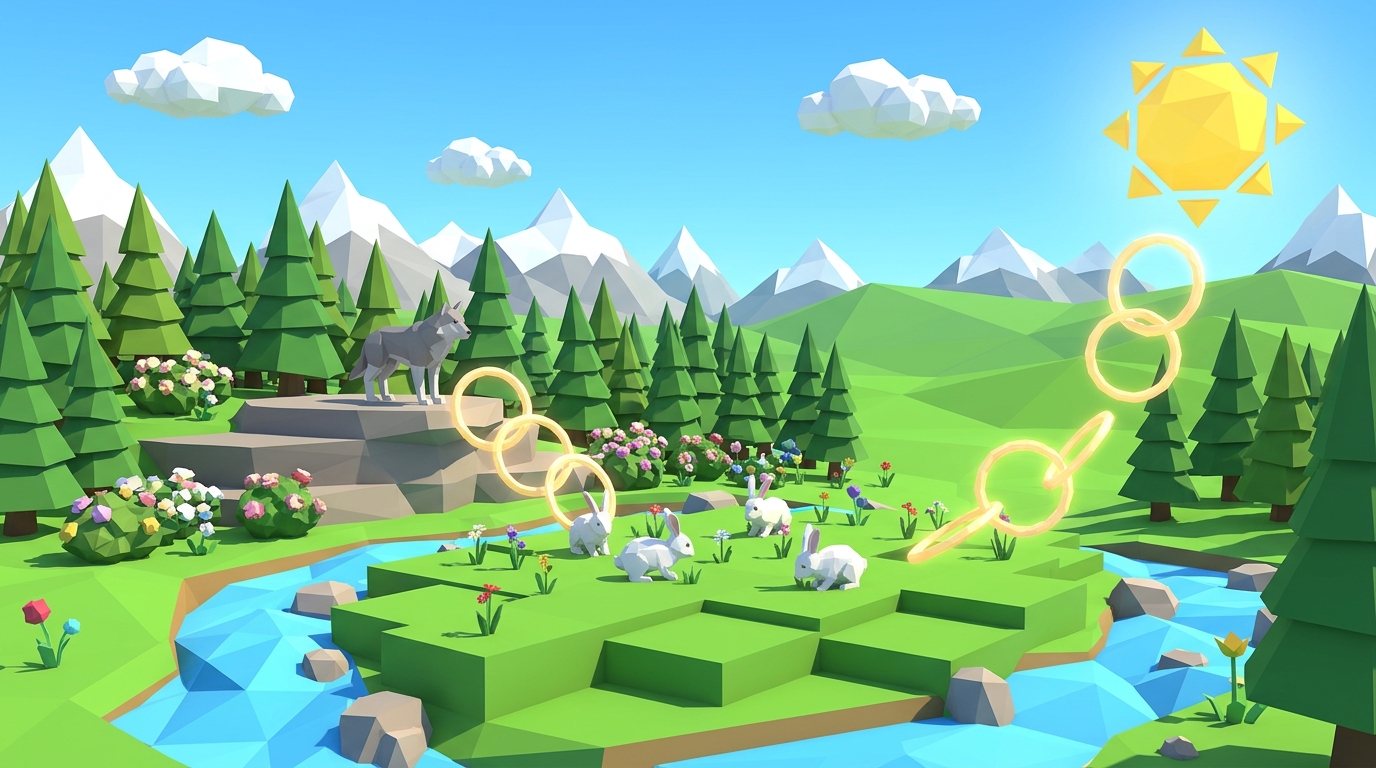
In Level 11, the simulation grid expands to track abiotic soil chemistry alongside animal populations. When herbivores or wolves perish from predation or natural life spans, their models do not vanish into thin air.
Instead, an organic Carcass entity is instantiated on that exact grid cell, possessing 30 biomass units and a rising pathogen counter. If decomposer colonies are toggled OFF, carcasses remain stationary on the meadow tiles.
Within four simulation days, non-recycled carcasses begin releasing toxic pathogen plumes. If live rabbits or wolves enter contaminated tiles, they lose health points and perish from contagious infection.
Simultaneously, free soil nitrogen drops toward zero as grass regrows without mineral replenishment. By Day 25, grass regrowth speed is penalized by 80%, turning lush green pastures into pale, barren dirt.
When students activate Decomposer Colonies and deploy Mushroom Spore Inoculators, crawling detritivore units break down carcasses at 1.5 units per day. The organic waste converts directly into bioavailable soil nitrogen (+1.2 per day), soil tiles darken into nutrient-dense loam, and grass regrowth rebounds to full capacity.
Audit the Carcass Accumulation
Run the simulation for the first 10 days with decomposers toggled OFF. Observe how deceased animal models linger on the terrain and note the rising pathogen warning meter on the telemetry HUD.
Deploy Saprotrophic Colonies
Toggle Decomposer Colonies ON before Day 15. Watch orange shelf mushrooms sprout dynamically across the fallen biomass as microscopic detritivore units break down organic tissues.
Inoculate Rotting Infection Clusters
Use the mid-run Mushroom Spore Inoculator brush to target dense carcass clusters. Eliminating carcasses before Day 4 prevents pathogen spikes above the critical 40% threshold.
Achieve 60-Day Closed-Loop Balance
Maintain soil nitrogen above 35% and sustain at least 5 rabbits and 2 wolves with zero disease casualties across the full 60-day operational cycle to complete the mission.
Common Student Misconceptions About Decomposers
Classroom trials with students highlight several common cognitive hurdles when learning soil ecology:
Misconception 1: "Decomposers are harmful pests that spread filth." Students often associate mushrooms, mold, and beetles with decay and spoilage. In reality, decomposers are the primary sanitation force of the planet. Without them, infectious pathogens would accumulate indefinitely.
Misconception 2: "Plants get their food from the soil." Many students assume soil nutrients are food. In truth, plants produce their own food (glucose) via solar photosynthesis. Soil nitrates and minerals act as chemical tools (like vitamins and building blocks) that enable chlorophyll synthesis and cell division.
Misconception 3: "Dead organisms disappear into nothing." Matter cannot be destroyed. Every gram of an animal body is either exhaled as carbon dioxide, metabolized by bacteria, or converted into humus soil particles.
What looks like gross decay to the human eye is actually the living heart of soil fertility. Decomposition is not the end of life; it is the prerequisite for new life.
Frequently Asked Questions About Level 11
Detailed answers for educators and homeschooling parents guiding children through Level 11:
What exact NGSS standard does Level 11 target?
How do decomposers prevent disease outbreaks in the simulation?
What is the printable lab journal exercise for this mission?
Level 11 Mission Log & Nitrogen Atom Journey Worksheet (PDF)
A printable 24-page Expedition Science Journal exercise tracing an individual nitrogen atom from atmospheric fixation into clover, rabbit muscle, decomposing biomass, fungal mycorrhizae, and back to topsoil.