The Boiling Soup Paradox: How Solid Rock Circulates Like Liquid
Watch a thick pot of tomato soup or oatmeal simmering over a kitchen burner. Near the bottom of the pan, hot soup absorbs thermal energy, expands, becomes less dense, and surges upward in a boiling plume. Once at the surface, it vents steam into the cooler kitchen air, cools down, increases in density, and plunges back down along the outer rim. This rolling circular loop is called thermal convection.
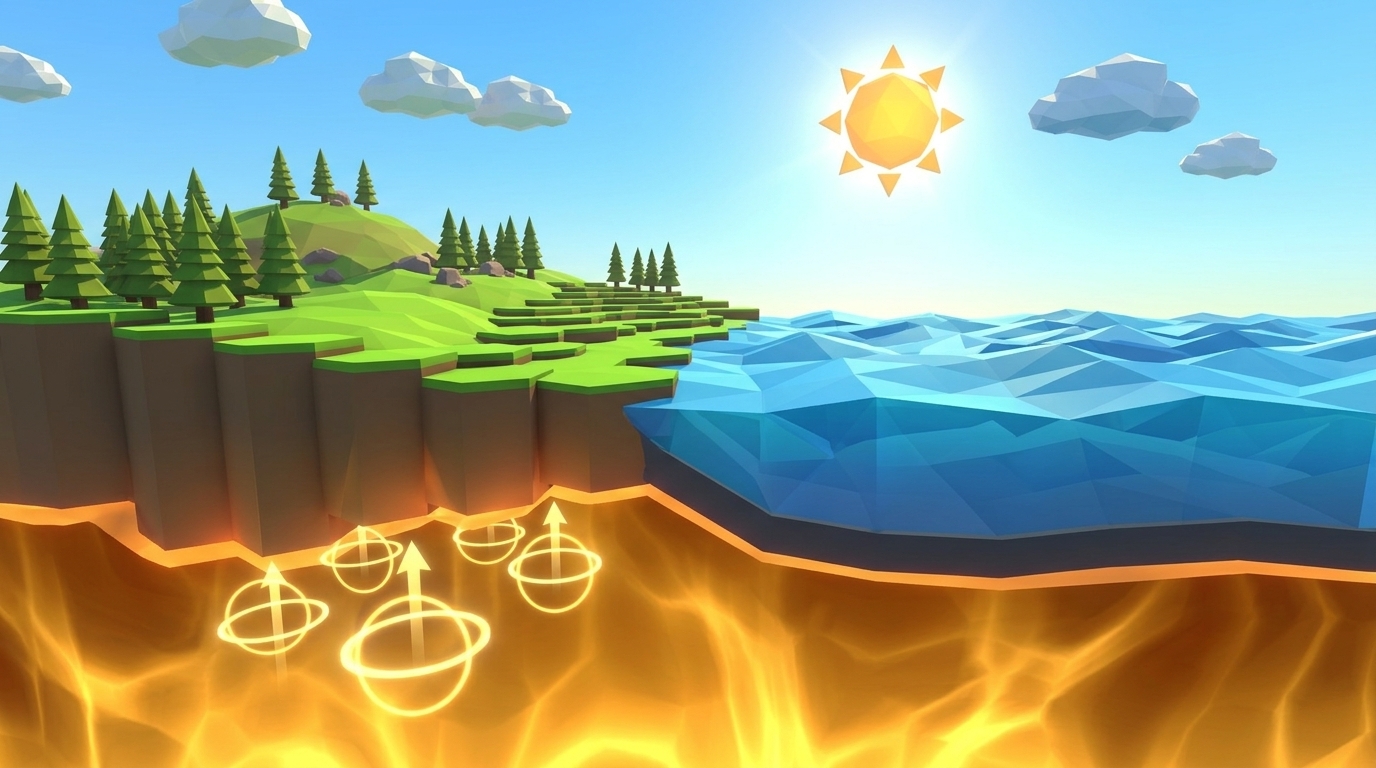
Now imagine that same physical process occurring inside planet Earth, across a layer of solid silicate rock 2,900 kilometers thick. This is the central paradox of planetary geophysics: Earth's mantle is not liquid magma, yet it circulates like a boiling pot of soup.
How can solid rock flow? The answer lies in the high-temperature rheology of ductile solids. Under the colossal pressures (up to 1.3 million atmospheres) and scorching temperatures (1,000°C to 3,700°C) of the deep interior, silicate minerals like olivine and pyroxene do not shatter. Instead, their crystalline lattices slowly deform through microscopic dislocation creep, allowing solid rock to flow at speeds of 2 to 10 centimeters per year, roughly the rate human fingernails grow.
In middle school Earth Science curricula aligned with NGSS MS-ESS2-1 and MS-PS3-3, students must grasp that thermal energy transfer is the invisible engine driving planetary geography. Without mantle convection, continental drift would freeze, mountains would stop growing, and Earth would become a geologically dead world like the Moon.
The mantle is not an ocean of molten lava; it is solid, red-hot rock under such immense pressure that it deforms plastically over geological epochs, transferring heat from Earth's core to the crust.
The Deep Heat Battery: Primordial Energy vs. Radioactive Decay
What fuels this titanic planetary engine? Earth's internal heat budget originates from two distinct energy reservoirs acting together:
1. Primordial Heat (Accretion & Core Differentiation): Approximately 4.5 billion years ago, countless protoplanetary boulders violently collided to forge our planet. The kinetic energy of those catastrophic impacts was converted into intense thermal energy. Simultaneously, dense molten iron and nickel sank toward the center of the planet, releasing immense gravitational potential energy that remains trapped in the core today.
2. Radiogenic Heat (Nuclear Decay): Deep within Earth's silicate mantle and continental crust, natural radioactive isotopes slowly decay into stable daughter elements. Four key isotopes: Uranium-238, Uranium-235, Thorium-232, and Potassium-40, continuously release thermal energy as subatomic particles decay. This radiogenic decay produces roughly half of Earth's internal heat output.
At the Core-Mantle Boundary (the D'' layer at 2,900 km depth), temperatures hover near 3,800°C. This extreme thermal contrast with the cold lithospheric crust above creates a steep geothermal gradient, launching buoyant thermal plumes toward the surface.
| Planetary Layer | Material State & Composition | Temperature Range (°C) | Convective Velocity | Tectonic Role |
|---|---|---|---|---|
| TECTONIC ENGINEUpper Mantle (Asthenosphere) | Ductile semi-solid peridotite rock | 1,300°C to 1,600°C | 3.0 to 10.0 cm/year | Fast convective rolls; applies basal drag to move lithospheric plates |
| DEEP RESERVOIRLower Mantle (Mesosphere) | High-pressure bridgmanite & ferropericlase | 1,600°C to 3,800°C | 0.5 to 2.0 cm/year | Sluggish deep convection; anchors massive thermal upwelling superplumes |
| CORE FURNACEOuter Core | Liquid iron-nickel alloy | 3,800°C to 5,000°C | Kilometers/year (rapid fluid vortex) | Generates Earth's geomagnetic shield and supplies bottom heat flux to mantle |
The Mechanics of Level 02: Calibrating Mantle Convection in Real-Time 3D
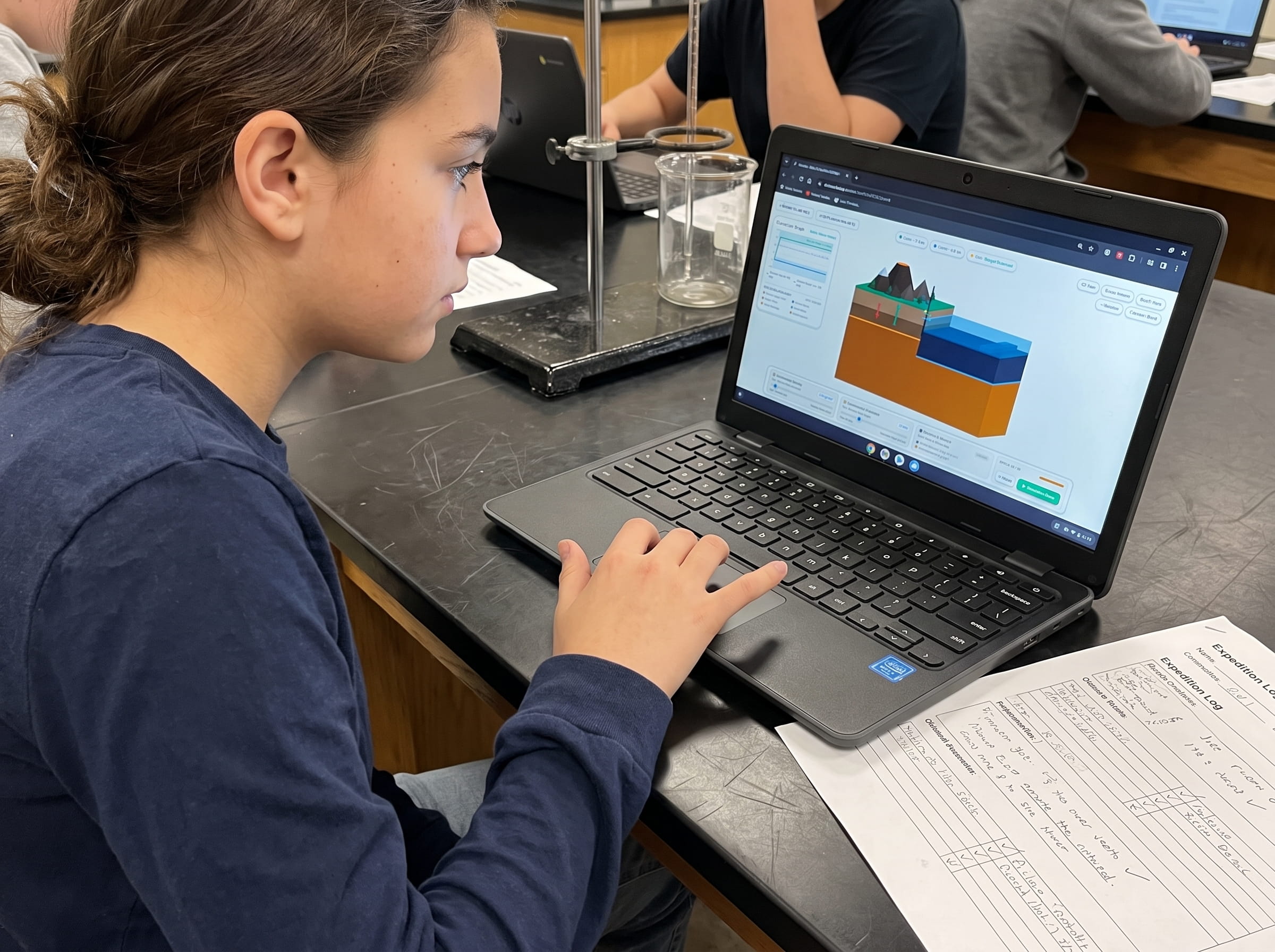
In Level 02 of the Praxos Volcano Island simulation laboratory (Mantle Convection), students step directly into the control room of Earth's deep thermal engine. An interactive 3D cutaway diorama displays a 2,900 km vertical cross-section of Earth's mantle, seeded with 400 thermal tracer particles color-coded by temperature.
The base of the mantle borders a glowing core boundary, while the top represents the rigid, cool lithospheric crust. The student manipulates two vital geophysical variables:
1. Core Base Heat Flux: Adjustable from 0% to 100% (defaulting to a cold, sluggish 10%).
2. Asthenosphere Viscosity: Adjustable from 0% to 100% (defaulting to a rigid, locked 90% stiffness).
As the simulation ticks forward across 40 epochs, the Three.js physics engine calculates real-time thermal expansion, buoyancy upwelling, and viscous drag. A synchronized 2D coordinate graph plots Convection Cell Velocity (orange line, cm/yr) and Thermal Temperature Gradient (red line, Delta °C).
If the rock is too stiff or heat is too low, the mantle freezes into a motionless standstill (velocity < 1.0 cm/yr). If heat is cranked to maximum while viscosity drops to zero, the mantle enters catastrophic turbulent boiling (velocity > 12.0 cm/yr), ripping the crust apart. To win, students must calibrate a smooth, stable circulation between 3.0 and 5.0 cm/year for 40 consecutive ticks.
Before launching the simulation, students evaluate three structured hypotheses in their inquiry modal:
Hypothesis A: The Balanced Convection Loop (Dynamic Equilibrium)
Calibrate Core Heat Flux to 65% and Asthenosphere Viscosity to 40%. The thermal energy softens the ductile rock, generating two symmetrical counter-rotating convection rolls that stabilize at 4.2 cm/year.
Hypothesis B: The Blazing Core Boil (Turbulent Instability)
Crank Core Heat Flux to 100% while dropping Viscosity to 10%. Overwhelming heat causes chaotic thermal boiling. Velocities exceed 14 cm/year, triggering immediate mission failure.
Hypothesis C: The Cold Asthenospheric Freeze (Rigid Gridlock)
Leave Viscosity at 90% and Heat Flux at 15%. Even with modest bottom heating, the rock is too rigid to deform. Convection stalls at 0.3 cm/year, failing to move surface plates.
Take control of Earth's deep heat engine in your browser. Balance thermal heat flux and fluid viscosity in real-time 3D to power planetary plate motion.
Launch Free Level 1 Volcano SimulationCalibrate Earth's Subterranean Convection Engine in 3D
Tune Core Heat Flux and Asthenosphere Viscosity in our real-time cutaway diorama. Stabilize dual symmetrical convection rolls between 3.0 and 5.0 cm/year without freezing or boiling. Zero sign-up, instant browser play.
Connecting Convection to Plate Motion: Ridge Push vs. Slab Pull
How does rolling mantle rock actually push or pull a multi-trillion-ton continental landmass across the globe? Geophysicists have identified three primary driving forces coupling mantle convection to lithospheric motion:
1. Basal Drag (Asthenospheric Traction): As warm mantle rock sweeps horizontally beneath a tectonic plate, friction between the ductile asthenosphere and the rigid lithosphere exerts a horizontal dragging force.
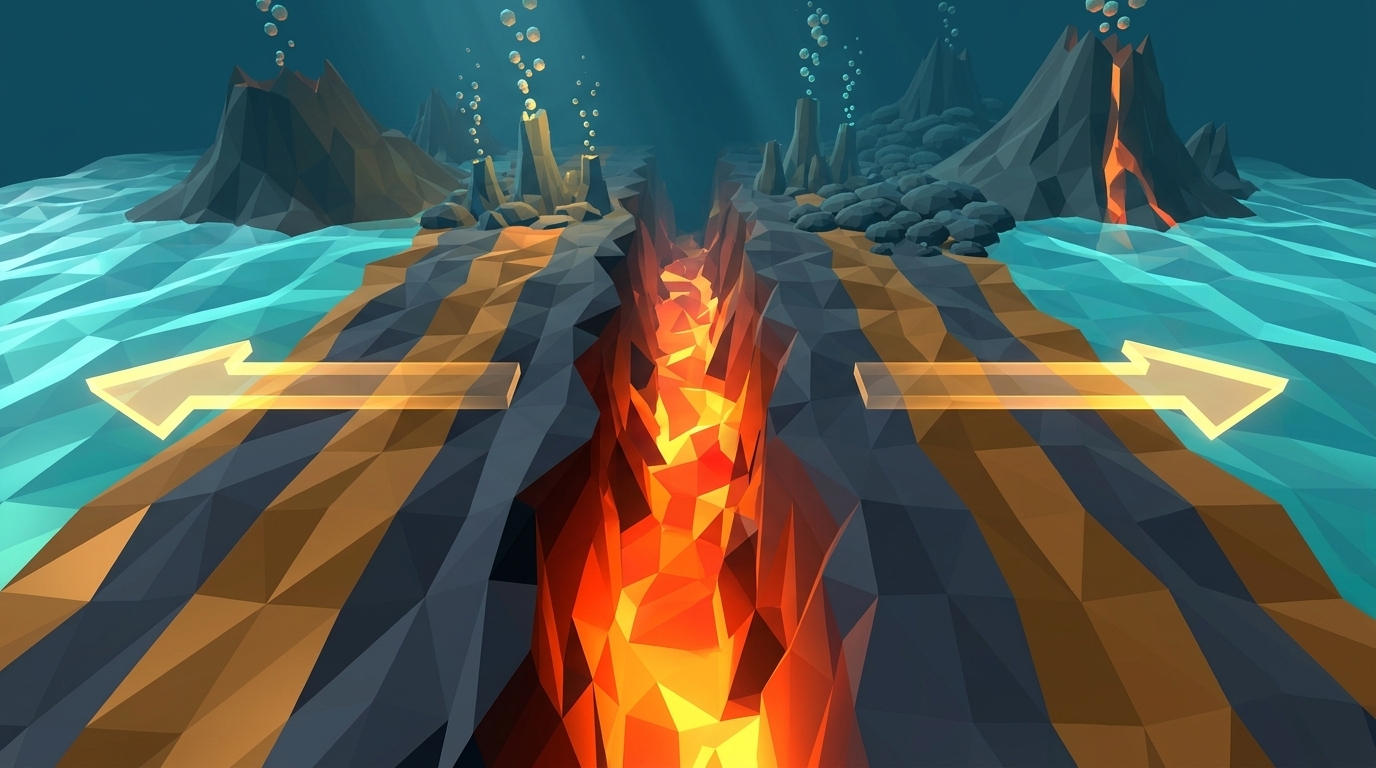
2. Ridge Push (Gravitational Sliding): At divergent mid-ocean boundaries (explored in Level 3), upwelling magma creates buoyant, elevated oceanic ridges standing two to three kilometers above the abyssal plains. Gravity pulls the elevated rock downward and outward, pushing the seafloor away from the ridge crest.
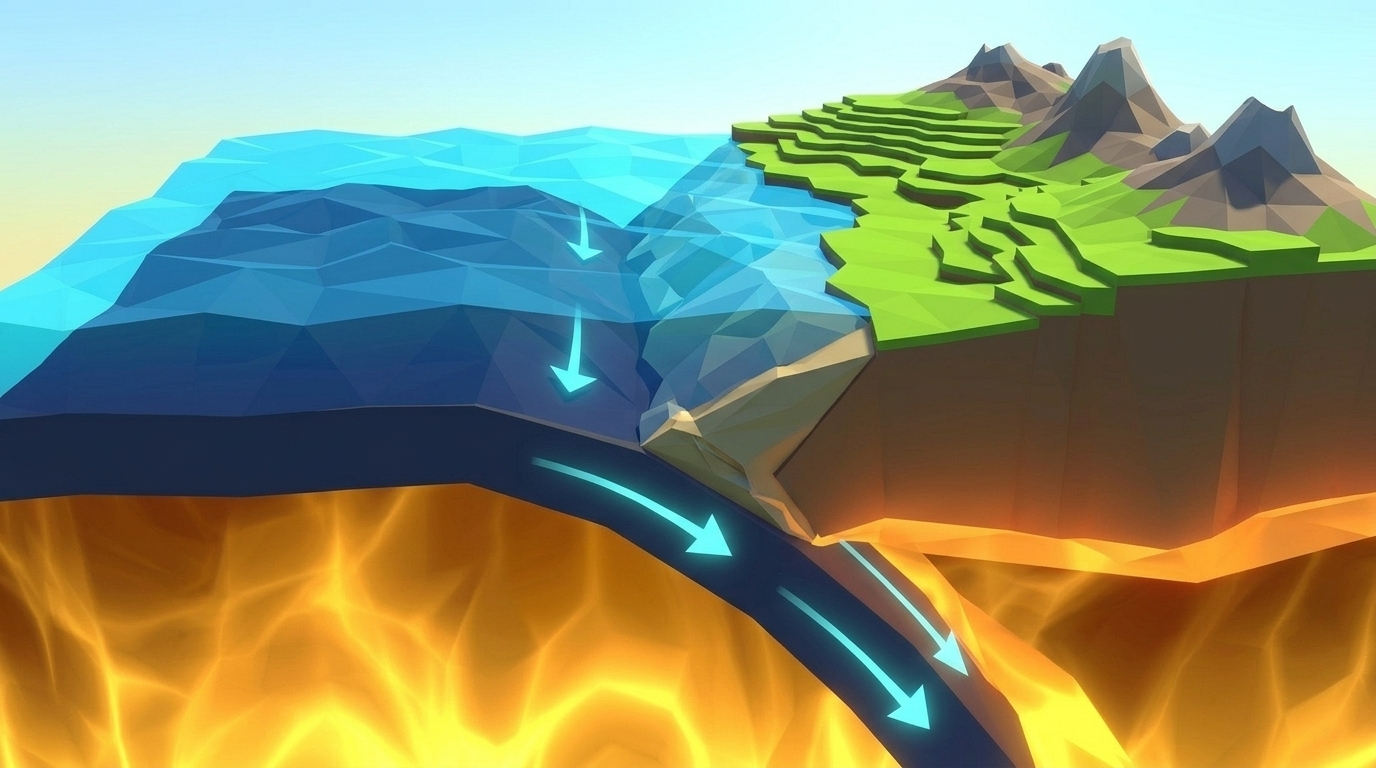
3. Slab Pull (Negative Buoyancy of Cold Slabs): At convergent subduction zones (explored in Level 4), old oceanic lithosphere cools, thickens, and becomes significantly denser than the underlying asthenosphere. As it sinks into the deep mantle, its enormous gravitational weight acts like an anchor on a chain, dragging the entire trailing plate behind it.
While early geologists believed basal drag was the main engine of plate motion, modern computational models show that slab pull is actually the dominant mechanical force, providing up to 90 percent of the total pulling power.
Tectonic plates are not merely pushed by rising hot plumes; they are actively dragged across the surface by cold, dense oceanic slabs plunging into deep subduction trenches.
The Dual-Format Advantage: Mapping Thermal Streamlines on Paper First
Why does Praxos require students to complete printed journal entries before touching the simulation controls? Because hands-on kinesthetic sketching forces students to construct mental spatial models of multi-dimensional systems.
In our dual-format curriculum, students open their printable Volcano Island Expedition Science Journal to Mission 02. Before adjusting sliders, they sketch the core-mantle boundary, draw circular convection vectors with colored pencils (red for rising buoyant plumes, blue for sinking cold slabs), and calculate mantle transit times.
For example, if the mantle is 2,900 kilometers thick and rock rises at an average velocity of 4.5 centimeters per year, how long does one complete convective turnover take? Students calculate that a single cycle requires over 64 million years! By recording live velocities on their printable 40-epoch coordinate grid, students transform abstract textbook arrows into quantitative physical principles.
Prompt for students: Diagram the circular feedback loop of mantle convection. Label where thermal energy enters the system, where rock density decreases, where heat is lost to the ocean and atmosphere, and where negative buoyancy drives downwelling.
Frequently Asked Questions About Mantle Convection and Level 02
Answers to common questions from science educators, homeschool parents, and middle school students studying planetary heat transfer.
Is Earth's mantle made of molten liquid lava?
What would happen to Earth if the core completely cooled down?
How do scientists know mantle convection is real if we cannot drill that deep?
What is the exact win condition for Volcano Island Level 2?
How does Level 2 prepare students for Level 3 (Seafloor Spreading)?
Related Earth Science Units & Simulation Lab Resources
Continue your middle school Earth and Space science exploration with these curriculum-aligned resources:
Review crustal buoyancy in our crustal buoyancy isostasy simulation Level 1 guide.
Discover mid-ocean rifts in our seafloor spreading divergent boundary simulation Level 3 lab.
Investigate subduction abysses in our subduction zones deep trench simulation Level 4 article.
Review complete homeschool science options in our earth science homeschool curriculum guide.
Set up student accounts with zero student logins on our educator dashboard.
24 pages of printable isostatic buoyancy calculation tables, mantle convection loop diagrams, and seismogram triangulation exercises designed for grades 4 to 8.
DOWNLOAD EXPEDITION LOGBOOK (PDF)Level 2 Thermal Convection Loop & Velocity Journal (PDF)
A printable 24-page Volcano Island Expedition Science Journal featuring structured thermal gradient tables, circular convection vector diagrams, and tectonic drift rate worksheets.