Why Many "Educational" Games Feel Like Junk Food
Many popular mobile learning applications employ the identical psychological mechanics found in commercial casino slot machines: spinning reward wheels, ticking countdown timers, flashing gems, fanfare sirens, and artificial streaks. These mechanisms trigger brief dopamine surges, yet build zero lasting analytical patience or real-world problem-solving capacity.
When an app rewards rapid button tapping over calm observation, students learn to chase cosmetic badges rather than asking the foundational question of scientific inquiry: "Why did that system respond this way?"
The Dopamine Slot Machine vs The Scientific Workbench
Children do not need fewer digital screens; they need screens that function like high-precision scientific instruments rather than digital babysitters. A true scientific simulation is calm, deliberate, and ad-free: no popups, no micro-transactions, and no artificial time pressure.
When young learners control biological variables and observe deterministic cause-and-effect, cognitive engagement replaces passive overstimulation. They transition from consumers of entertainment into directors of inquiry.
The Antidote: The Digital Lab Meets Real Paper
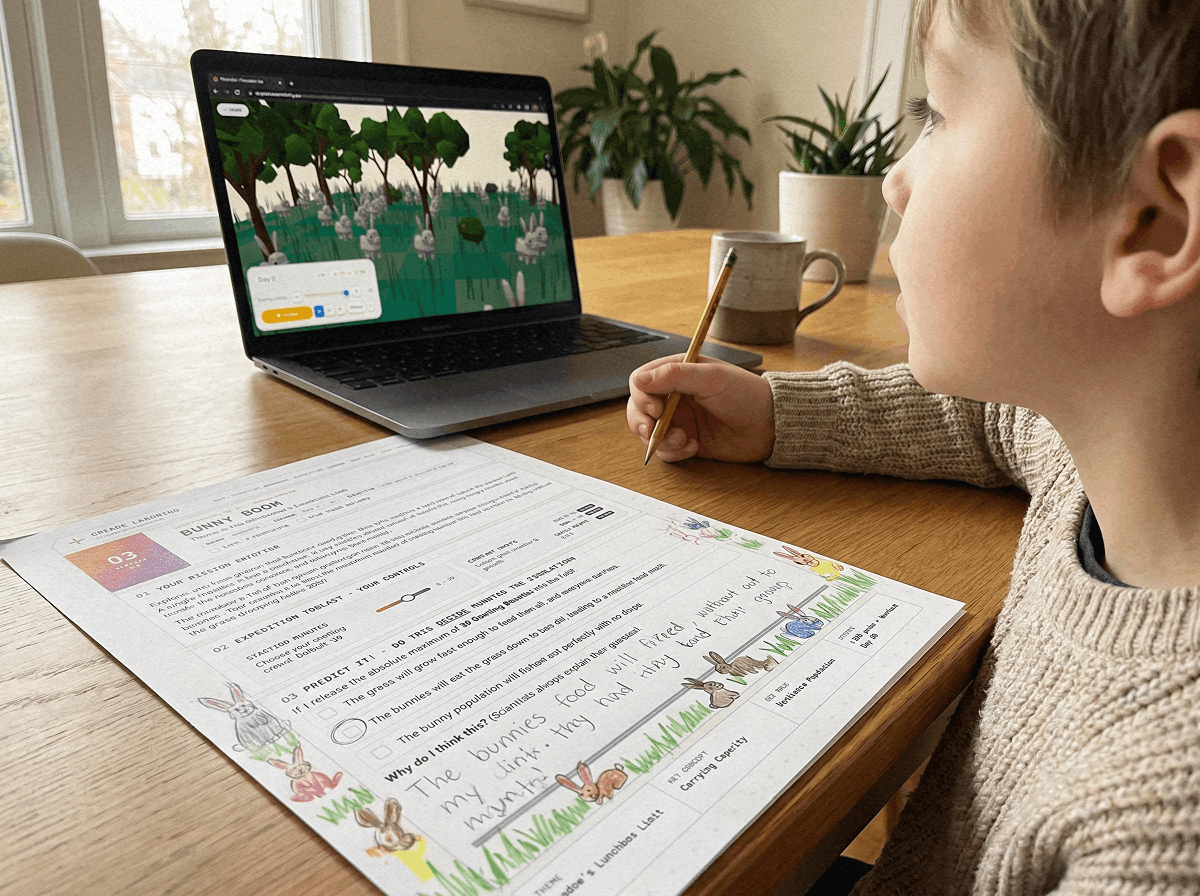
The true cognitive breakthrough occurs when digital experimentation is paired with a physical science journal. Before adjusting an in-game slider, the child writes down their hypothesis with a real pencil. After testing, they record their numerical observations and sketch the outcome.
This dual-format discipline creates a natural break from back-lit screens, encourages deep reflection, and activates motor memory pathways that keyboard tapping cannot match.
Play the first mission directly in your browser with zero registration or sign-ups required.
PLAY LEVEL 1 DEMOA Pure Science Lab Without Distractions
Zero ads, zero timers, zero flashing casino sounds, and zero microtransactions. Just sunlight, rain, and living plant biology.
The 5-Point Healthy Screen-Time Evaluation Checklist
1. Zero Third-Party Advertising: Ensure no commercial banners or sponsored popups disrupt your child's train of thought.
2. No Manufactured FOMO Mechanics: Avoid apps with daily streak penalties, countdown timers, or virtual cosmetic currencies.
3. Deterministic Physics and Biology: Choose tools where 1 day of elapsed time produces realistic, reproducible scientific consequences.
4. Physical World Tethering: Look for programs that incorporate paper notes, physical drawing, or dinner-table verbal discussion.
5. Easy Transition Boundaries: Digital blocks should naturally conclude after 10 to 15 minutes, following a structured 30-minute science routine.
The Dopamine Spectrum: Passive Consumption vs Generative Problem-Solving
Not all digital screen time affects a child developing brain in the same manner. Neurobiological research distinguishes sharply between passive consumption (which triggers rapid dopamine spikes through algorithmically curated video feeds and instant gratification gaming loops) and generative problem-solving (which engages the prefrontal cortex in sustained focus, hypothesis testing, and spatial reasoning).
Passive digital media relies on intermittent variable reward schedules; the same psychological mechanism behind slot machines; keeping children hyper-stimulated yet cognitively passive. In contrast, interactive scientific simulations require active cognitive input: the child must form a theory, adjust physical variables, observe dynamic outcomes, and interpret numerical graphs.
When digital tools demand active intellectual effort and output, screen time becomes an empowering cognitive amplifier rather than an addictive distraction.
A 4-Step Screen Hygiene Protocol for Conscious Families
Establish healthy digital habits in your home with this 4-step family protocol: (1) Define Clear Objective Milestones (e.g., Today we are testing Level 4 carrying capacity rather than Play on the computer for 30 minutes). (2) Pair Every Digital Session with Physical Notebooking (require offline notes for every online run). (3) Maintain a 100% Ad-Free Environment (never allow apps with banner ads, pop-ups, or microtransactions in study sessions). (4) Conclude with a Verbal Teach-Back (have the child explain one scientific concept they discovered to a parent or sibling).
This intentional structure protects children focus, nurtures sustained attention spans, and fosters healthy boundaries with technology.
Family Screen-Time Balance Guide
A 2-page printable guide with conversation starters and tips for setting healthy 30-minute inquiry blocks.