The 10-10-10 Framework for Low-Stress Science
Many homeschool parents avoid hands-on science because the prospect of gathering vinegar, baking soda, messy beakers, and hard-to-find supplies feels daunting after a busy morning.
The 10-10-10 framework requires zero mess, zero kitchen prep, and delivers exceptional conceptual depth:
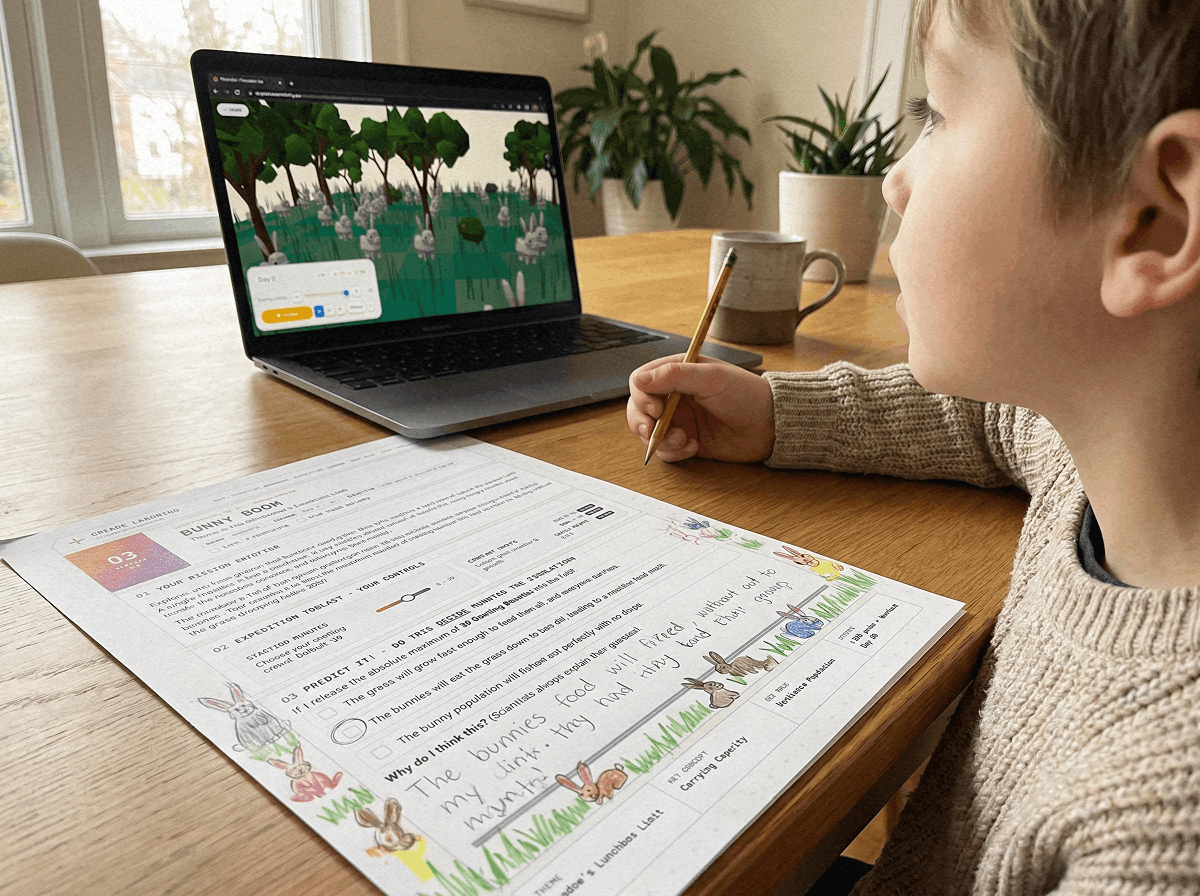
1. Minutes 1 to 10 (Paper Hypothesis): The student reads the daily mission brief in their physical science journal and writes down their prediction with a pencil.
2. Minutes 11 to 20 (Digital Lab): They open the 3D browser simulation, manipulate independent variables, and observe real-time population dynamics.
3. Minutes 21 to 30 (Reflection & Sharing): They close the device, graph their data points on paper, and explain what surprised them.
Because screen time is capped at exactly 10 minutes, children stay hyper-focused and transition away from the computer without emotional resistance.
Why Digital Transitions Trigger Meltdowns (and How Structure Fixes It)
Screen-time meltdowns typically occur when a child is abruptly interrupted in the middle of an open-ended, algorithmic dopamine loop. When there is no clear boundary or objective, stopping feels like a sudden loss.
Under the 10-10-10 framework, the digital segment has a clear scientific goal: run three trials, log the Day 50 population number, and close the screen. Because the transition to paper is built into the scientific method, kids shift smoothly without arguments.
Sample 5-Day Weekly Science Block Blueprint
Monday: Producers and Sunlight (Level 1 abiotic factor testing).
Tuesday: Primary Consumers (Level 2 herbivore grazing balance).
Wednesday: Carrying Capacity Limits (Level 3 exponential boom and bust).
Thursday: Apex Predator Regulation (Level 4 trophic cascade intro).
Friday: Family Lab Roundtable & Synthesis (Reviewing week-long graphs and awarding mastery badges).
Run a 30-Minute Lab Block
Start with Level 1 instantly in your browser (no sign-up needed). Unlocking the full lab with your email gives you Levels 1 to 3 for a complete open-and-go 30-minute daily science routine.
Troubleshooting Common Homeschool Science Hurdles
What happens when a child wants to keep clicking after the 10-minute digital timer expires? The most effective strategy is redirecting their curiosity to the physical logbook: "Let us record what just happened on paper so we can design a brand new experiment for tomorrow."
If an experiment leads to an unexpected population crash, treat it as an exciting discovery rather than an error. Ask your learner: "What specific variable pushed the system past its tipping point?" In authentic science, anomalous findings generate the deepest analytical discussions.
How to Pair Screen Time with Nature Walks & Field Observations
The ultimate goal of digital simulation modeling is to enrich your child's perception of the physical natural world. After completing a 30-minute laboratory session on primary producers and sunlight, take a short walk in your backyard or local neighborhood park.
Encourage your child to look for real-world abiotic variables: which garden patches receive full southern sun versus dense tree shade? How does soil moisture under leaf litter compare to open gravel? Connecting digital systems models to tangible outdoor observations transforms abstract biology into lifelong scientific intuition.
The 10-15-5 Time Allocation Blueprint: Maximizing Depth per Minute
The 30-Minute Screen Rule achieves maximum learning velocity through a precise 10-15-5 chronological breakdown: 10 minutes of offline preparation, 15 minutes of focused digital simulation, and 5 minutes of reflective synthesis.
During Minutes 0-10, the laptop remains closed. The student reviews their mission brief in the printed science journal, identifies independent variables, and writes a formal prediction. During Minutes 10-25, the simulation is launched: the child runs 3 controlled experimental trials, systematically recording numbers into their physical data table. During Minutes 25-30, the screen is shut down so the student can draft their final conclusion and calculate rate of change without visual distraction.
This structured pacing ensures that digital technology serves as a focused scientific instrument rather than an open-ended browsing vortex.
Troubleshooting Common Friction Points in Timed Science Blocks
When implementing timed science routines, parents often encounter two common friction points: student resistance to closing the screen when a simulation run is going well, and frustration when an unexpected result occurs near the end of the time block.
Address screen transition friction by establishing the Laboratory Logbook Rule: the experiment is not complete when the simulation stops, but when the data is safely recorded in the physical logbook. If an experiment triggers intense curiosity that exceeds 30 minutes, celebrate the excitement by writing down a Tomorrow Investigation Question in their journal, giving the student an exciting hypothesis to test during the next day science block.
This maintains healthy schedule discipline while validating genuine scientific passion.