
The Screen Time Dilemma: Why Arbitrary Timers and Blanket Bans Always Backfire
In almost every modern household, screen time is the single greatest source of daily parent-child conflict. Parents feel persistent guilt watching their children stare into glowing rectangles, while children experience sudden device confiscation as arbitrary, punitive, and unjust.
When parents rely solely on rigid countdown timers, alarms, or abrupt WiFi shutoffs, children do not learn emotional regulation or healthy digital boundaries. Instead, they enter a state of anticipatory panic, rushing to squeeze in as much entertainment as possible before the timer expires, or attempting to hide devices after bedtime.
Developmental psychologists and pediatric researchers have discovered that the root cause of these power struggles is not screen exposure itself, but rather the type of media children consume and the lack of structured transition routines. Replacing blanket bans with clear media classifications transforms digital time from a battleground into an opportunity for intellectual growth.
Short-form videos and hyper-stimulating games produce continuous dopamine spikes. When a screen is abruptly removed mid-activity, a child experiences an immediate neurochemical drop, resulting in emotional dysregulation and defensive meltdowns.
Quality Over Quantity: Shifting from Passive Consumption to Active Creation
For decades, standard pediatric guidance recommended a flat two-hour daily limit for all children over age two. However, in an era where school assignments, coding environments, educational simulations, and creative tools all live on digital devices, treating all screen time as equivalent is obsolete.
The American Academy of Pediatrics (AAP) and leading child development specialists now emphasize media quality and context over simple stopwatch minutes. Digital media falls into three distinct behavioral categories: passive consumption, semi-interactive entertainment, and active inquiry.
When screen time involves scientific problem-solving, hypothesis testing, or creative production, it strengthens executive function and spatial reasoning. In contrast, passive scrolling drains attention spans and elevates baseline stress.
| Media Category | Primary Activities | Cognitive Impact | Recommended Daily Guideline |
|---|---|---|---|
| PASSIVEPassive Consumption | Short-form video feeds, autoplay streaming, mindless scrolling | Low cognitive engagement; rapid dopamine spikes; reduced attention retention | Minimize (0 to 30 min daily max) |
| RECREATIONALSemi-Interactive Gaming | Commercial arcade games, linear mobile apps, repetitive platformers | Moderate hand-eye coordination; reward-driven loops; high arousal | Moderate (30 to 45 min daily max) |
| HIGH-IMPACT STEMActive Inquiry & Simulation | 3D science labs, programming environments, digital sketching, collaborative building | High executive function; hypothesis testing; spatial modeling; systems thinking | Encouraged (60 to 90 min daily) |
The 5-Step Household Screen Time Audit: Establishing Sustainable Family Habits
Rather than imposing sudden authoritarian rules that spark rebellion, successful families implement collaborative digital media agreements. This 5-step audit allows parents and kids to build mutual trust and transparent expectations.
Inventory Weekly Media Types Together
Sit down with your child and map out where their digital time actually goes: educational research, active creation, interactive games, and passive video feeds.
Designate Tech-Free Physical Zones and Time Windows
Establish inviolable physical boundaries: no devices at the dining table, no screens in bedrooms overnight, and zero digital screens during the first 30 minutes after waking up.
Implement the 10-Minute Transition Bridge
Never pull the plug while a child is mid-level or mid-task. Give a 10-minute heads-up followed by a 2-minute checkpoint, allowing their nervous system to transition gracefully.
Shift to the Create Before Consume Protocol
Require active cognitive output (completing a hands-on science trial, drawing, or reading) before passive entertainment video streams are unlocked.
Co-Play and Review Weekly Insights
Spend 15 minutes each week sitting beside your child while they navigate their digital tools. Ask them to teach you how their systems or games work.
The Replace, Do Not Just Remove Strategy: Introducing 30-Minute Active Science Blocks
When parents simply confiscate screens without providing an engaging alternative, children experience acute boredom and frustration. The most effective long-term solution is to replace mindless digital consumption with high-agency, interactive STEM simulations.
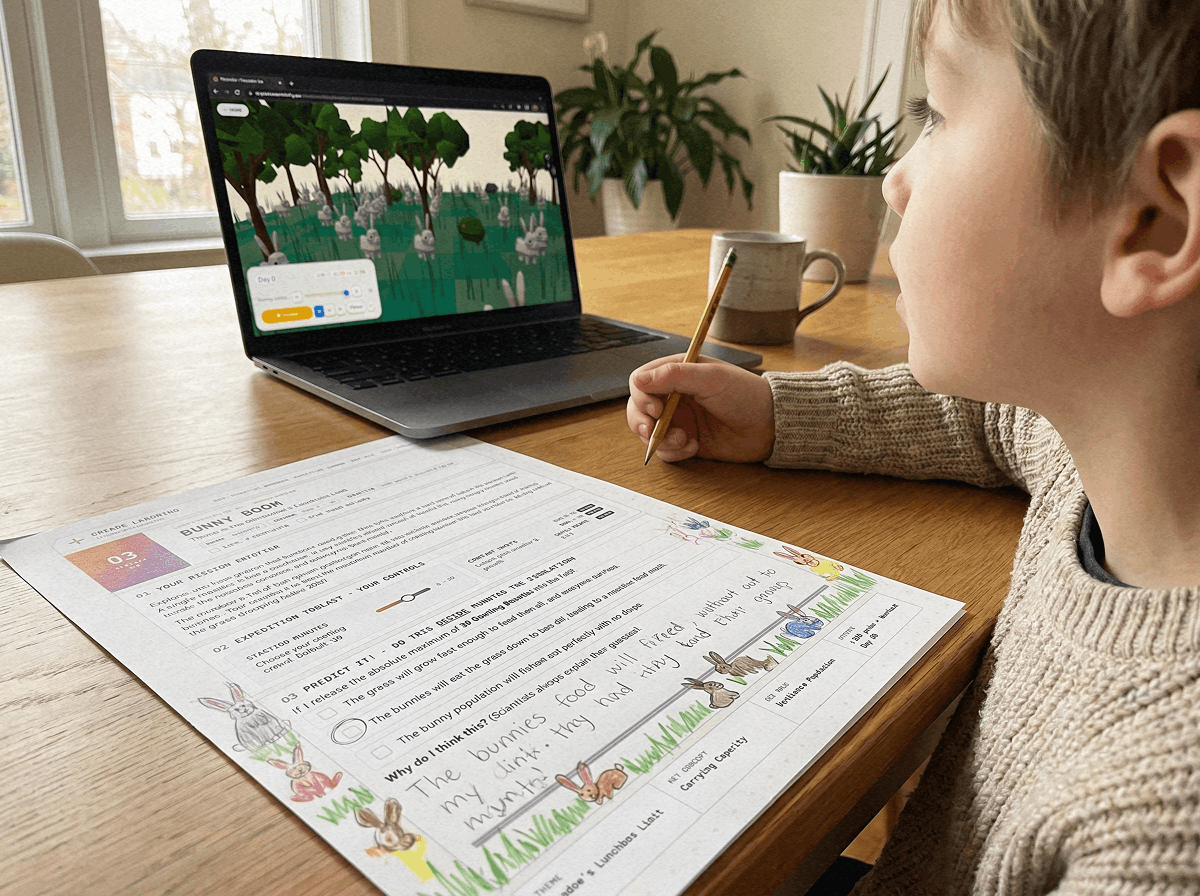
In a dual-format routine, digital tools are paired with tactile physical notebooks. In the Praxos 3D Ecosystem Sandbox, for example, students do not just click buttons passively. They formulate a written prediction in their physical lab journal, adjust abiotic parameters like sunlight and water in the 3D WebGL engine, and graph real-time population oscillations on paper coordinate grids.
This pencil-first structure anchors screen time in empirical science, training children to view technology as an exploratory instrument rather than an addictive digital pacifier.
Students manipulate multi-species food webs, examine carrying capacity thresholds, and witness trophic cascades in real time. Level 1 starts instantly in your browser with zero sign-up.
Launch Free 3D Simulation LabWhat to Do When Kids Resist: Practical De-Escalation Scripts
Even with clear routines, pushback is a normal part of childhood development. The key to handling protests is calm, empathetic boundary maintenance without entering verbal debates.
When a child complains that stopping is unfair, acknowledge their emotional experience while holding the agreed boundary firm. Statements such as I know it is hard to close the game when you are having fun, and our agreement is to shut down at 5:00 PM validate their feelings without compromising household standards.
Over several weeks of consistent enforcement, children develop internal pacing mechanisms and begin self-regulating their digital consumption without needing parental intervention.
Frequently Asked Questions About Screen Time and Digital Balance
Here are evidence-based answers to common questions parents ask when structuring screen time rules for elementary and middle school students.
How much screen time should a child have per day?
Is educational screen time really different from gaming or YouTube?
How do I stop my child from throwing tantrums when screen time ends?
Should screens be completely banned during school days?
Active Screen Time & Science Journal (PDF)
A 24-page hands-on student lab journal with structured inquiry prompts and coordinate graphing sheets designed to anchor digital simulation trials on paper.