
The Big Bad Wolf Fallacy: Reframing Predators as Ecosystem Guardians
From Little Red Riding Hood to the Three Little Pigs, cultural folklore has spent centuries teaching children that wolves are sinister villains that should be eliminated from the woods. When elementary students first learn about predators, their emotional reaction is almost always sympathy for the hunted prey and hostility toward the carnivore.
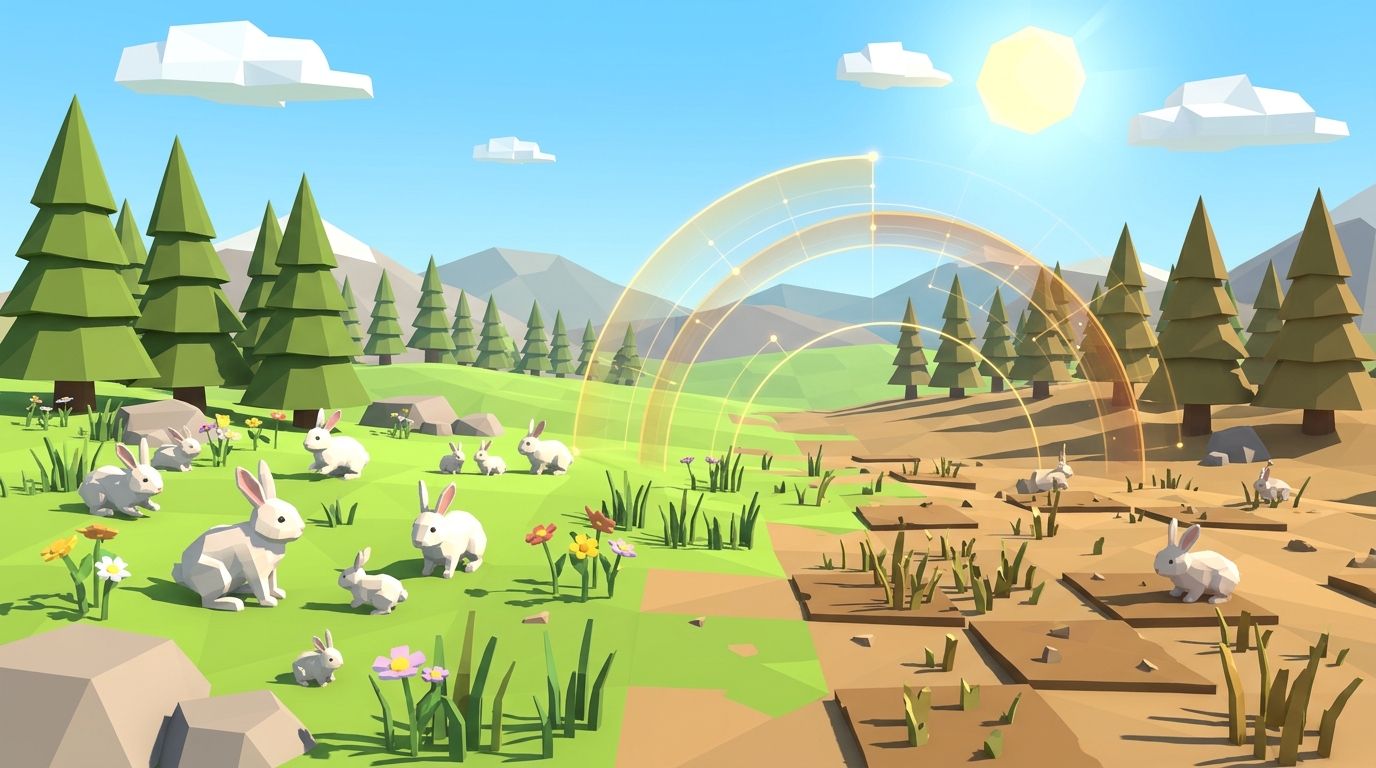
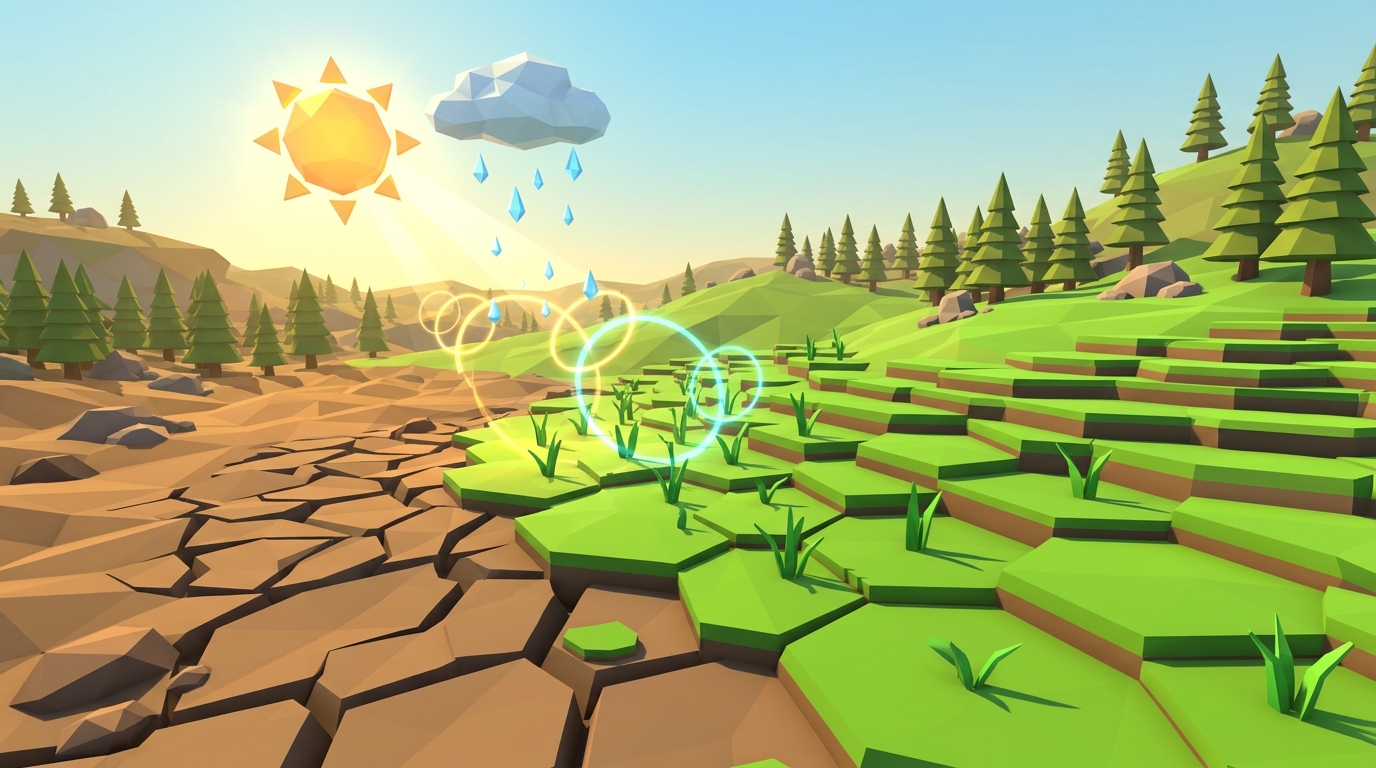
However, real-world ecology tells the exact opposite story. When humans eradicate apex predators from a landscape, the result is not a peaceful wildlife sanctuary. Instead, without natural mortality, herbivore populations multiply unchecked until they strip every sapling, bush, and grass blade to dust.
A famous historical example occurred in the Grand Canyon's Kaibab Plateau in 1906. To protect mule deer, government bounties wiped out thousands of wolves, cougars, and coyotes. With zero predators, the deer herd swelled from 4,000 to over 100,000 animals, overbrowsed the forest down to bedrock, and then suffered a catastrophic winter crash where 60,000 deer starved to death. Predators do not threaten biodiversity; they defend it.
Eliminating predators does not save prey animals. It condemns them to boom-and-bust overpopulation cycles, degraded habitats, and mass starvation.
Circular Systems Causality: Moving Beyond Linear Thinking
In standard classroom instruction, students often struggle with systems thinking because human intuition prefers linear, straight-line cause-and-effect: "Wolves eat rabbits, therefore wolves are bad for rabbits."
Under the systems dynamics framework (Ormancı 2026), true ecological balance requires circular feedback thinking. Apex carnivores close a vital balancing (negative) feedback loop that stabilizes the entire community:
More grass creates more rabbits. More rabbits create more food for wolves. As wolves hunt, they trim the rabbit herd down to sustainable numbers. Trimming the herd allows the grass to regrow and stay healthy. Healthy grass ensures that future generations of rabbits will always have food to eat.
| Trophic Tier | Species in Level 4 | Primary Energy Source | System Regulatory Role |
|---|---|---|---|
| ENERGY BASEPrimary Producers | Meadow Grass (100 Tiles) | Solar Photons & Soil Moisture | Generates initial glucose biomass; sets energetic ceiling K for all life |
| PRIMARY GRAZERSPrimary Consumers | Herbivorous Rabbits | Vegetative Grass Biomass | Converts plant cellulose into animal tissue; exerts continuous grazing pressure |
| APEX GUARDIANSApex Predators | Gray Wolf Pack | Herbivore Flesh & Calories | Closes balancing feedback loop; caps herbivore density; prevents pasture defoliation |
The Mechanics of Level 04: Restoring Trophic Balance Across 60 Days
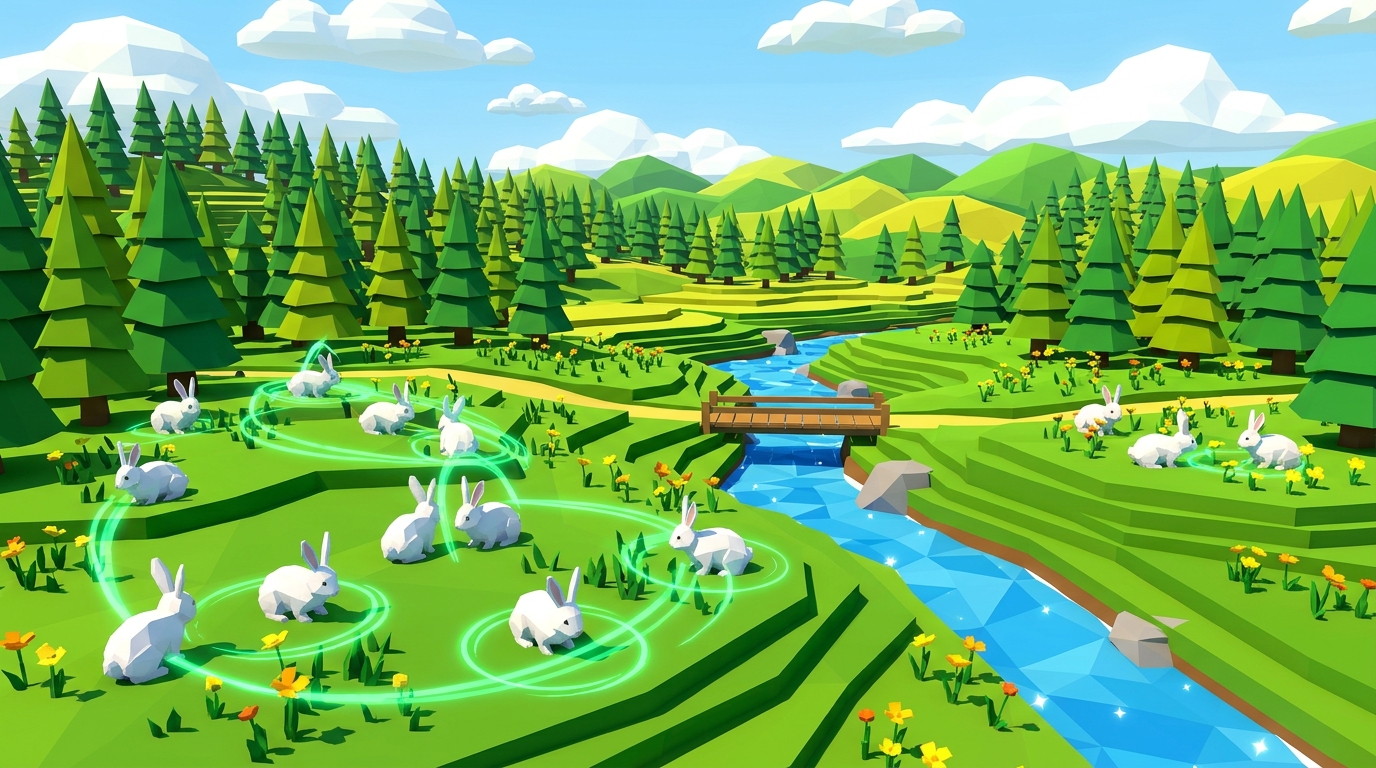
In Level 04 (The Gray Shadow), the simulation places the student in the role of an ecological manager faced with an imminent catastrophe. The meadow begins with 50 hungry rabbits and 0 wolves. If the student presses Play without adjustments, the herd exhausts all grass within 12 days and perishes from starvation.
The student controls two sliders: Starting Rabbits (0 to 60) and Starting Wolves (0 to 10). Low-poly wolves hunt autonomously, tracking the nearest rabbit and closing the distance across the 3D terrain. A successful hunt restores wolf energy; if a wolf fails to catch prey, its calorie bar depletes until starvation occurs.
The win condition is stringent: keep all three trophic tiers alive (Grass $\ge 20\%$, Rabbits $\ge 1$, Wolves $\ge 1$) through Day 60 without either animal species going extinct. Students test three distinct hypotheses:
Hypothesis A: The Guardian Pack (35-45 Rabbits, 2-3 Wolves)
Start with 35 to 45 rabbits and 2 to 3 wolves (telemetry sweet spot averages 32.9 rabbits and 3.8 wolves). The small wolf pack thins the dense herd down to ~18 individuals, releasing grazing pressure so grass regenerates up to 60%. Both species survive all 60 days for a 3-star victory.
Hypothesis B: Predator Carnage (8 to 10 Wolves)
Introduce too many predators (8 to 10 wolves). The oversized pack hunts relentlessly, wiping out every single rabbit within 15 days. With their prey extinct, all wolves starve to death shortly after, triggering total level failure.
Hypothesis C: The Unguarded Meadow (50 Rabbits, 0 Wolves)
Run the default scenario with zero wolves. Without apex predation, rabbits overgraze the pasture below the 15% grass floor, causing mass herbivore starvation within two weeks.
Start Level 1 free to launch the simulation sequence, or advance directly to Level 4 to test predator-prey trophic cascades in real-time 3D.
Launch Free Ecosystem LabThe Dual-Format Advantage: Drawing the 3-Step Trophic Pyramid on Paper
Scientific learning solidifies when digital observations are translated into physical models on paper. In the Level 4 lab module of the Expedition Science Journal, students draw the 3-Tier Trophic Pyramid.
They label the broad base as Producers (Grass), the middle tier as Primary Consumers (Rabbits), and the narrow apex as Secondary/Apex Consumers (Wolves). Students write the population numbers from their winning simulation trial beside each tier, noticing that biomass naturally decreases by approximately 90% as energy moves upward.
Finally, the student writes their Claim-Evidence-Reasoning (CER) conclusion defending the statement: "Apex predators paradoxically protect green plants by capping herbivore consumption outflow." This pencil-first routine transforms screen time into genuine cognitive growth.
Student Reflection Prompt: In your own words, explain how adding wolves to the meadow resulted in more grass at Day 60 than leaving the rabbits alone. Trace the circular causal loop.
Frequently Asked Questions About Apex Predators and Level 04
Key questions addressed by parents and science teachers exploring predator-prey dynamics in grades 4 through 8.
How do wolves decide which rabbit to hunt in the 3D engine?
Why can't there be equal numbers of wolves and rabbits?
What happens if grass drops below 15% in Level 4?
How does Level 4 connect to Level 5 (The Dance)?
Level 4 Mission Log & 3-Tier Trophic Pyramid (PDF)
A printable 24-page Expedition Science Journal featuring 3-step trophic pyramids, predator-prey ratio calculations, and cause-and-effect systems loop diagrams.