
The Homeschool Science Dilemma: Why Static Workbooks Fall Short
When homeschooling parents search for the best rated homeschool curriculum for elementary and middle school science, they are often overwhelmed by dozens of boxed curricula, heavy textbooks, and endless fill-in-the-blank worksheets. While traditional workbooks provide neat daily checkboxes, parents quickly notice a troubling trend: children memorize bold vocabulary terms for Friday's quiz, only to forget everything by Monday morning.
Science is not a collection of static facts to be memorized; it is an active method of investigating the universe. In traditional classrooms and legacy homeschool programs, students read about food webs or plate tectonics on flat paper without ever manipulating the variables that make those systems work.
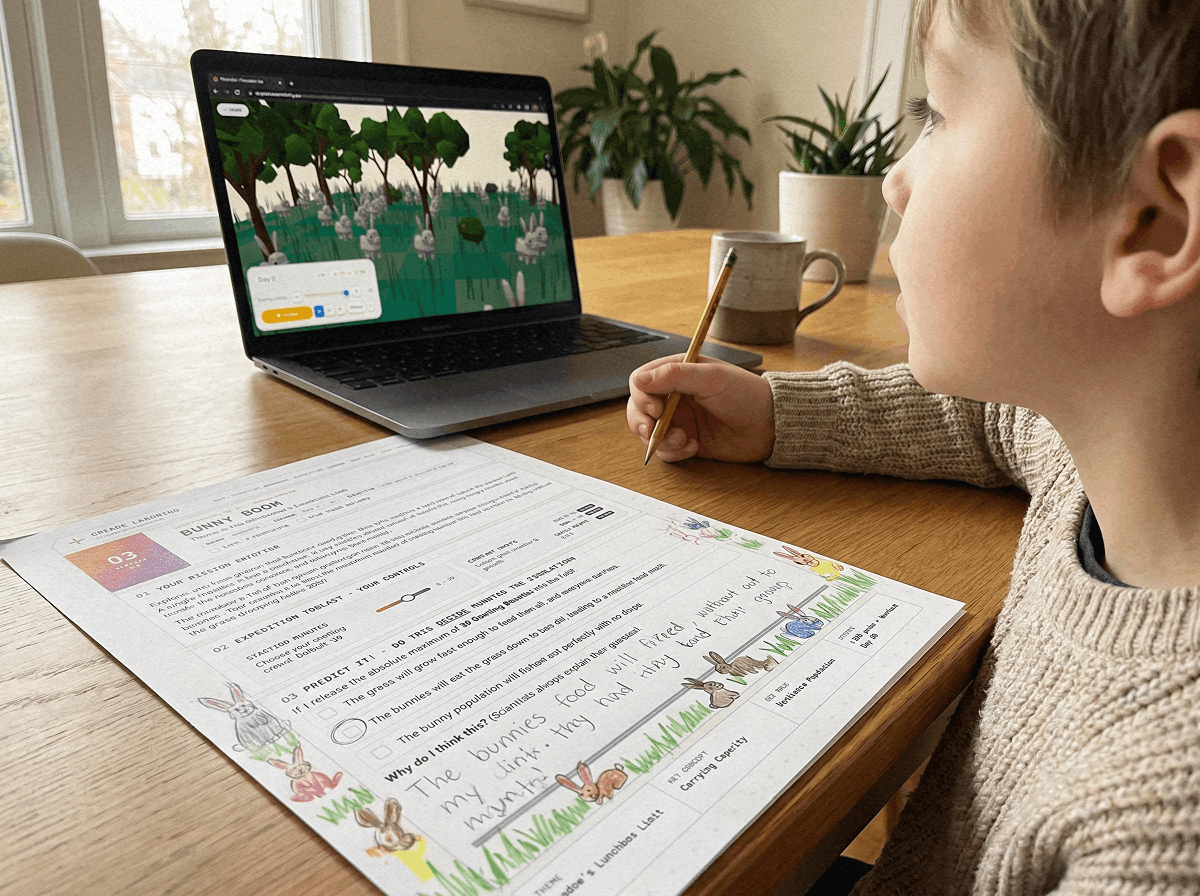
When I founded Praxos Learning, my core mission was reimagining homeschool STEM education. By pairing tactile, high-quality physical notebooks with real-time 3D browser simulations, students transition from passive consumers of textbook trivia into genuine scientists testing hypotheses.
The 4 Hallmarks of the Best Rated Homeschool Science Programs
To identify the best rated homeschool curriculum for your family, look for these four indispensable pedagogical hallmarks:
1. Active Inquiry Over Passive Memorization. Superior science curricula challenge students to ask 'What happens if?' rather than 'What is the definition of?'. When students can increase solar radiation, adjust rainfall, or slide tectonic plates in an interactive sandbox, they build deep mental models of causality.
2. Dual-Format Learning (Digital Simulation + Physical Journal). The most effective learning happens at the intersection of technology and tactile handwriting. Students manipulate 3D digital models on screen, then pick up a pencil to record data, sketch observations, and write reflections in a dedicated printed journal.
3. NGSS Phenomena-Based Standards Alignment. Look for curricula aligned with Next Generation Science Standards (NGSS). Rather than teaching isolated facts, NGSS organizes learning around observable natural phenomena, teaching systems thinking, crosscutting concepts, and scientific inquiry.
4. Low Parent Prep and Zero Frustrating Science Mess. Many hands-on curricula require parents to buy expensive glassware or spend hours sourcing obscure materials for kitchen experiments that often fail. Digital 3D laboratories give children unlimited experimental trials without costly kits or messy cleanups.
Children retain up to 75% of what they learn through interactive simulation and physical logging, compared to less than 10% from reading static textbooks alone.
Systems Thinking: The Core Skill Missing in Traditional Schooling
Educational research by Ormanci (2026) highlights that traditional science instruction is overly linear: teaching isolated cause-and-effect chains (A leads to B). In the real world, however, climate, biology, economics, and ecology operate as interconnected feedback networks.
Top-rated homeschool programs incorporate systems thinking concepts: stocks, flows, time delays, and non-linear balancing loops. When students explore ecosystems in 3D, they witness firsthand how removing wolves does not just affect deer: it alters riverbank erosion, beaver populations, and songbird nesting habitats.
Teaching systems thinking equips children with cognitive tools they will use for the rest of their lives: evaluating complex problems, anticipating unintended consequences, and thinking critically.
Complete 3D Biology Sandbox
Experience the core simulation engine behind modern homeschool science. Manipulate solar radiation, track producer growth, and guide primary consumers across a balanced living biome.
Teaching this topic tomorrow? Download the Free NGSS Student Lab Sheet (Printable PDF)
Get the complete printable homeschool science companion workbook with structured lab observation templates, data charts, and NGSS rubrics in a single PDF.
Homeschool Science Approaches Compared: Textbooks, Kits, and 3D Sandboxes
To help parents evaluate options objectively, the table below compares the three primary formats of homeschool science curriculum across cost, engagement, and learning efficacy:
| Curriculum Approach | Parent Prep Time | Student Engagement | Long-Term Retention | Cost & Materials | Primary Learning Mode |
|---|---|---|---|---|---|
| Interactive 3D Sandboxes + Logbook (Praxos) | Zero Prep: Launches instantly in web browser | Very High: Gamified agency & real-time simulation | High: Deep conceptual systems intuition | 100% Free with email sign-up | Inquiry-driven hypothesis testing & tactile logging |
| Traditional Textbooks & Workbooks | Low: Read chapters and assign worksheet pages | Low to Moderate: Passive reading & memorization | Low: Rote facts forgotten after chapter tests | $60 to $150 per grade level | Passive reading, vocabulary flashcards, written tests |
| Subscription Hands-On Science Kits | High: Sorting components & supervising messy labs | High: Fun physical craft building | Moderate: Often focuses on craft over deep science | $30 to $50 per month subscription | One-time tactile assembly; limited experimental trials |
| Video-Based Online Courses | Zero Prep: Automated grading & video lectures | Moderate: Screen-based video streaming | Moderate: High passive screen time risk | $120 to $250 annual platform fee | Watching instructors lecture; multiple-choice quizzes |
Classroom and Homeschool Routine: 4 Steps to Structure Your Science Day
Here is a proven, flexible 30-minute daily science routine used by thousands of homeschool families to implement active inquiry without burnout:
The 5-Minute Phenomenon Hook
Begin with a compelling question or real-world mystery from the printable logbook (e.g., 'Why do Hawaiian volcanoes gently ooze while Mount St. Helens blew its top off?'). Let your child formulate a spontaneous hypothesis.
The 15-Minute 3D Digital Lab
Launch the corresponding level in Volcano Island or Ecosystem Simulator. Let your child independently manipulate variables: adjust silica levels, introduce predators, or alter rainfall: observing immediate consequences.
The 7-Minute Physical Data Log
Have your student open their printed journal to sketch their simulated terrain, record numerical population trends, and document whether their initial hypothesis was supported or disproved.
The 3-Minute Socratic Synthesis
Close the lesson with an open-ended discussion question: 'If you were a wildlife ranger managing this park, what rule would you enact based on what you observed today?'.
Building Independence and Executive Function Through Self-Paced STEM
One of the greatest gifts of homeschooling is fostering independent, self-directed learners. When science curriculum empowers children to experiment safely without fear of failure, their relationship with education transforms.
In our simulations, failure is celebrated as essential scientific data. If an ecosystem collapses because a student added too many herbivores, the simulation does not flash a red 'Game Over' screen; it shows the starving rabbits, prompting the student to ask 'Why did that happen?' and reset the sliders with new insights.
This iterative mindset builds emotional resilience, analytical problem-solving skills, and a lifelong curiosity about the natural world.
Frequently Asked Questions About Homeschool Curriculum Selection
Educators and parents frequently ask these practical questions when selecting science curriculum for their homeschool learners.
How do I ensure my homeschool science curriculum meets state standards?
How many hours per week should homeschoolers spend on elementary science?
Can 3D simulations count as lab hours for middle school science?
Is Praxos Learning really 100% free for homeschool families?
Download the Free 10-Mission Ecology Logbook
Get the complete printable homeschool science companion workbook with structured lab observation templates, data charts, and NGSS rubrics in a single PDF.