What Should a 5th Grader Learn in Science? (NGSS Standards Breakdown)
Fifth grade represents a major turning point in elementary science education. Students transition from simply identifying nature facts to developing causal models, testing multi-variable systems, and tracing invisible flows of energy and matter.
Under the Next Generation Science Standards (NGSS) and leading state frameworks, a rigorous 5th grade science curriculum covers three primary domains:
1. Life Science (5-LS1 & 5-LS2): How plants use air and water to create biomass through photosynthesis, how energy flows through food webs, and how matter recycles through decomposers in terrestrial and aquatic biomes.
2. Physical Science (5-PS1 & 5-PS3): Structure and properties of matter (states of matter, conservation of mass during chemical changes), and energy in food originating from solar radiation.
3. Earth and Space Science (5-ESS1 & 5-ESS2): Earth spheres interactions (geosphere, biosphere, hydrosphere, atmosphere), global water distribution, and patterns of stars and shadows.
By the end of 5th grade, students should not just define vocabulary terms; they should be able to sketch a system model, predict what happens when an environmental variable shifts, and explain the causal mechanism in plain English.
The 5 Major Homeschool Science Approaches Compared
Homeschool families have five primary curriculum formats to choose from when designing a 5th grade science year. Each model serves different learning styles, household budgets, and parent time constraints.
Here is an objective breakdown of how these five models operate:
Traditional Textbook & Workbook Programs
Structured, chapter-by-chapter curriculums with comprehension quizzes and standardized test prep. Examples include BJU Press, Abeka, and Christian Liberty Press. Strengths: thorough scope and zero parent lesson planning. Weaknesses: heavy reading loads and low long-term concept retention.
Literature-Based & Living Books Curricula
Story-driven learning inspired by the Charlotte Mason philosophy. Examples include Sonlight, BookShark, and Beautiful Feet Books. Strengths: rich narrative storytelling, engaging biographies of scientists, and strong family discussion. Weaknesses: lighter on quantitative data collection and digital lab skills.
Subscription Hands-On Experiment Kits
Monthly physical project boxes containing glassware, motors, reagents, or crafting components. Examples include MEL Science, KiwiCo Eureka Crate, and Groovy Lab in a Box. Strengths: high tactile excitement. Weaknesses: high recurring cost ($30-$50/month), consumable clean-up, and variable curriculum pacing.
Video Lecture & Online Recorded Courses
Screen-based video lessons delivered by instructors with follow-up online quizzes. Examples include Generation Genius, Outschool, and Acellus. Strengths: completely independent for the student. Weaknesses: passive viewing habits and lack of hands-on data manipulation.
Interactive Inquiry Simulations & Dual-Format Labs
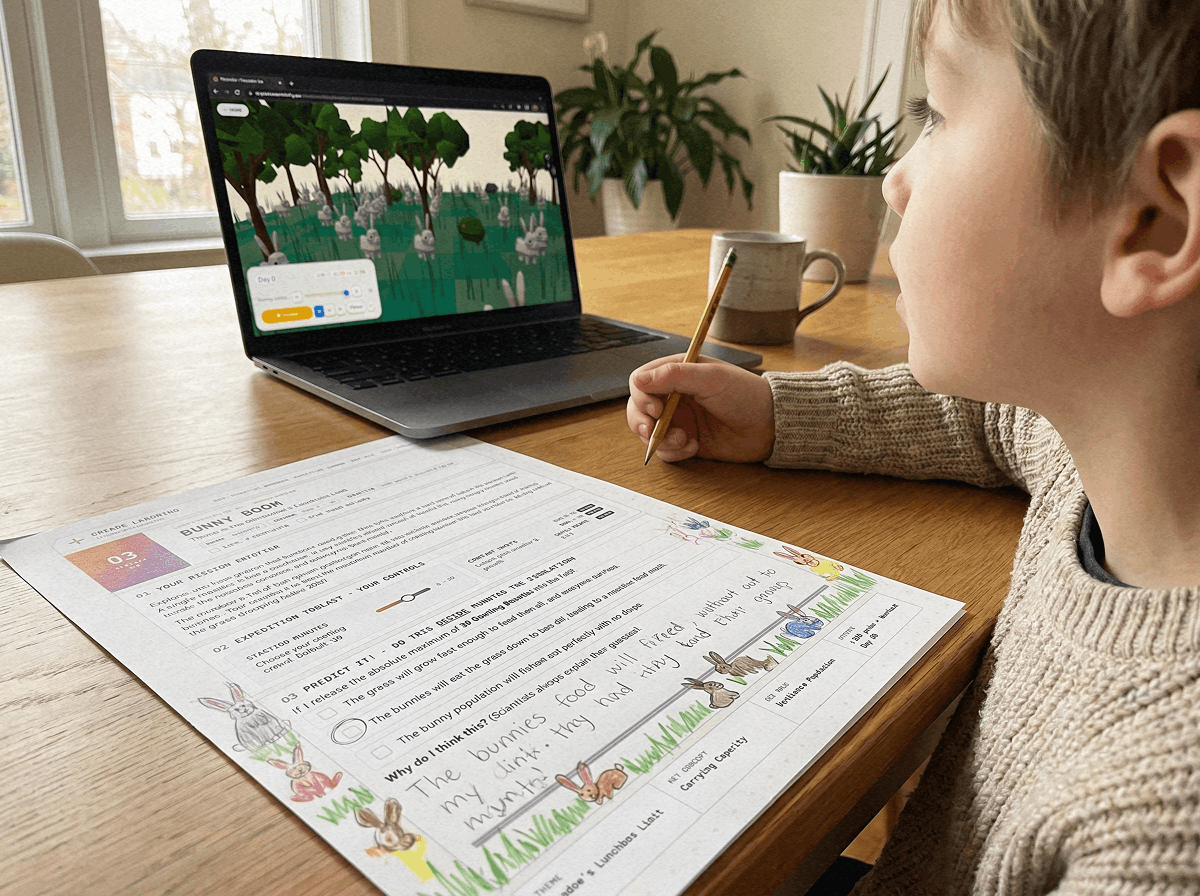
A modern hybrid approach combining interactive 3D WebGL computer labs with physical print-at-home student logbooks (such as Praxos Learning and PhET). Strengths: zero supply prep, deterministic multi-variable testing, and pencil-first prediction logs. Weaknesses: requires computer access.
Comprehensive Comparison: 5th Grade Homeschool Science Options
To help you decide which format matches your homeschool routine, the table below compares all five approaches across preparation requirements, student engagement, and scientific rigor:
| Curriculum Model | Parent Prep Time | Student Engagement | NGSS Inquiry Depth | Annual Cost Range | Best Fit Family |
|---|---|---|---|---|---|
| Traditional Textbook | Low (15 min/week) | Moderate (Read & write) | Low to Moderate (Recall focus) | $80 - $180 | Families wanting structured test prep and independent chapter pacing. |
| Living Books / Literature | Moderate (30 min/week) | High (Rich narratives) | Moderate (Conceptual discussion) | $120 - $280 | Charlotte Mason and classical homeschoolers who love reading together. |
| Hands-On Kit Subscriptions | High (Setup & cleanup) | Very High (Tactile builds) | Moderate (Physical crafts) | $360 - $600 | Families with large supply budgets looking for weekly sensory projects. |
| Video Lecture Portals | Zero (Self-directed) | Moderate (Screen viewing) | Moderate (Quiz checkpoints) | $120 - $300 | Busy parents needing fully autonomous educational screen time. |
| TOP INQUIRY VALUEDual-Format 3D Labs (Praxos) | Zero (No prep required) | Very High (Interactive trials) | Very High (Multi-variable inquiry) | Free to $49 (One-time pass) | Families wanting rigorous STEM inquiry and systems thinking without lab mess. |
What Praxos Learning Covers (And What It Does Not)
I believe in complete transparency about curriculum capabilities. Praxos Learning is built to deliver world-class inquiry science, but it is focused on specific core disciplines rather than attempting to be a shallow, 1,000-page generic encyclopedia.
Here is an honest breakdown of where Praxos fits into your 5th grade homeschool year:
What Praxos Excels At: Delivering a comprehensive, 10-week NGSS 5-LS2 life science and ecology unit. Your student masters food web energy arrows, trophic cascades, carrying capacity mathematical limits, predator-prey feedback loops, and abiotic factor regulation through 10 guided 3D simulation levels paired with a 24-page printed journal.
What Praxos Does Not Cover: Solar system astronomy (5-ESS1), rock cycle geology (5-ESS2), and chemical state reactions (5-PS1). For those topics, I recommend pairing Praxos with targeted living science books or modular unit studies.
Many experienced homeschool families use a modular approach: they use living books for history and astronomy, and plug in Praxos Learning as their dedicated 10-week digital biology and ecology lab spine.
10-Week 5th Grade Ecology Unit Pacing Schedule
If you choose to use Praxos Learning as your 5th grade life science component, here is the recommended 10-week pacing schedule:
Level 1: The Meadow (Energy and Biomass)
Explore primary producers, sunlight, and rainfall variables. Complete Journal Mission Log 1 on plant biomass accumulation.
Level 2: The First Bites (Primary Consumers)
Introduce herbivore feeding mechanics and calculate plant consumption rates in Journal Mission Log 2.
Level 3: Bunny Boom (Carrying Capacity)
Observe exponential population growth, overgrazing, and carrying capacity collapse. Graph population curves in Mission Log 3.
Level 4: The Gray Shadow (Secondary Consumers & Predation)
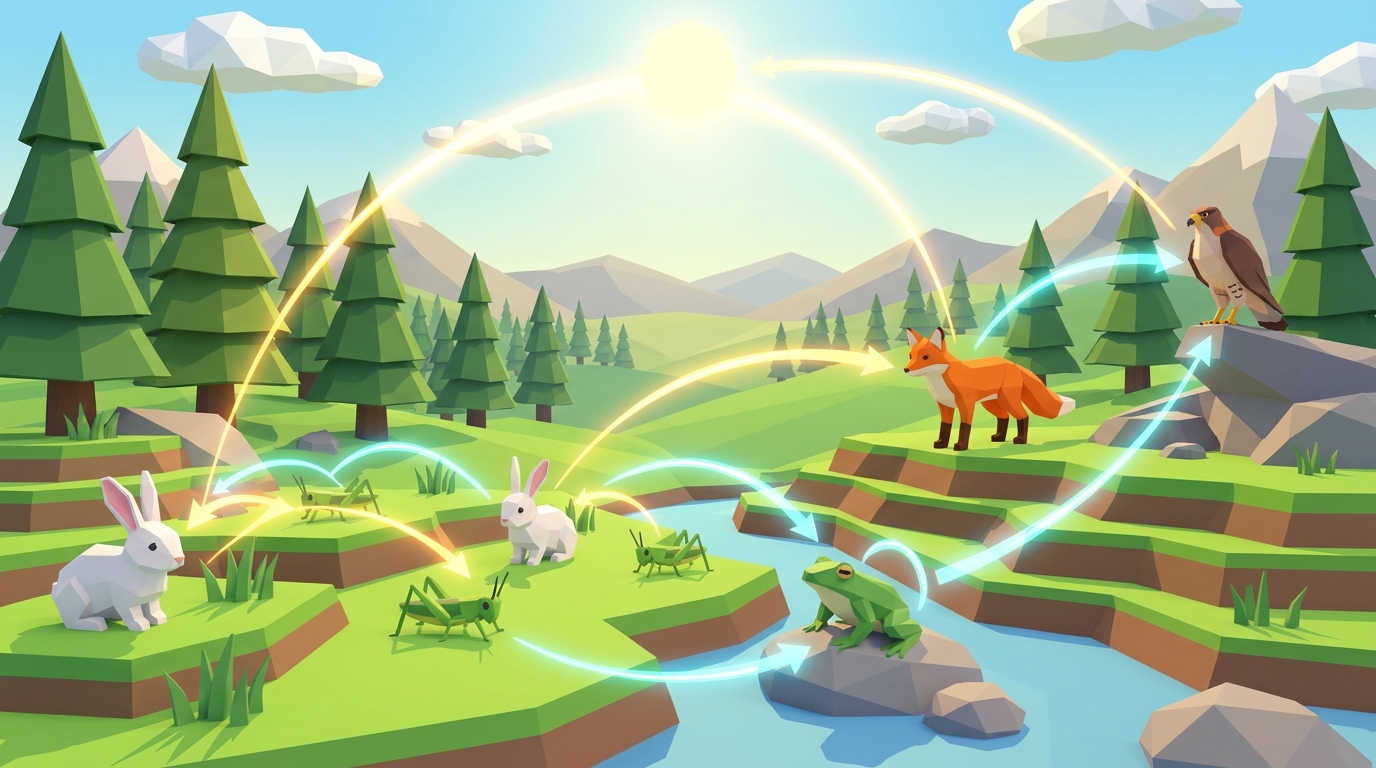
Introduce predators and study apex population regulation. Map food web arrows and energy flow in Mission Log 4.
Level 5: The Dance (Dynamic Equilibrium & Feedback Loops)
Balance herbivore hiding cover against predator efficiency. Master balancing vs reinforcing feedback loops in Mission Log 5.
Level 6: Scorched Earth (Drought & Abiotic Pressures)
Simulate severe climate shifts and observe resilience thresholds across multiple trophic levels.
Level 7: The Super Bloom (Resource Surges)
Analyze what happens when nutrient inflows double suddenly, observing delayed population spikes.
Level 8: The Invader (Invasive Species Dynamics)
Model competitive exclusion when a non-native herbivore enters the ecosystem.
Level 9: The Web (Multi-Tier Biodiversity)
Build complex interlocking food webs with songbirds, foxes, and decomposers.
Level 10: Master of the Biosphere (Capstone Trial)
Design and sustain a custom self-regulating ecosystem for 100 simulation days. Complete final field report certification.
Download the full 24-page printable student journal covering all 10 missions. Includes prediction charts, food web diagram practice, and reflection rubrics.
Download Free Journal (PDF)Frequently Asked Questions About 5th Grade Science at Home
Here are answers to the most common questions homeschool parents ask when planning their 5th grade science year:
How many hours per week should a 5th grader spend on science?
Most homeschool state guidelines recommend 2 to 3 hours of science per week for 5th grade. A great routine is two 45-minute sessions or three 30-minute sessions combining reading, hands-on trials, and journal logging.
Can I teach 5th grade science alongside a 3rd or 4th grader?
Yes; family-style science works remarkably well in elementary school. Siblings can explore the same 3D ecosystem simulation together, with the 3rd grader focusing on animal observations while the 5th grader records mathematical carrying capacity data in their logbook.
Do I need expensive lab equipment for 5th grade science?
No. Modern 5th grade science focuses on conceptual modeling and systems understanding. A reliable digital simulation paired with printable paper observation sheets delivers higher inquiry rigor than expensive chemical kits.
5th Grade Ecology Unit: 10-Mission Pacing Guide
A complete 10-week homeschool pacing schedule mapping 5th grade NGSS standards to hands-on investigation prompts and 3D simulation missions.