Why Linear Thinking Limits Young Problem Solvers
Most standard classroom curricula train children to evaluate the world through direct, linear equations: Event A causes Event B. Push a domino, and it falls over. Turn on the garden hose, and the bucket fills up. While linear thinking is helpful for isolated, mechanical tasks, real-world challenges rarely behave like single rows of dominos.
When children enter the real world; whether studying ecology, managing personal habits, understanding financial decisions, or navigating human relationships; they encounter complex dynamic systems. In a dynamic system, the outcome of an action circles back to alter the original cause through circular feedback loops. When a child understands systems thinking, they stop treating symptoms in isolation and begin addressing root causal structures.
Linear thinking asks: "What is the immediate fix for this symptom?" Systems thinking asks: "How does this system behave over time, and what unintended side effects will our solution create?"
How to Teach Systems Thinking: 4 Accessible Building Blocks
You do not need an advanced engineering degree to teach systems thinking to an 8-year-old or 12-year-old. The entire discipline rests on four accessible building blocks that children can observe in everyday life.
By introducing these four concepts through physical analogies and visual sketches, parents and teachers can give kids a powerful mental toolkit for life:
Elements and Boundaries
Help children identify the key parts of a system and decide where the boundary lies. For example, in a fish tank, the elements are the water, fish, plants, filter, and light. Changing any one element affects all the others.
Stocks and Flows (The Bathtub Rule)
A stock is a reservoir of something that accumulates over time (like water in a tub, energy in a battery, or savings in a piggy bank). Inflows increase the stock; outflows decrease it. When inflow equals outflow, the stock remains stable.
Feedback Loops (Balancing vs Reinforcing)
Reinforcing loops amplify change and create exponential growth or runaway crashes (like a snowball rolling downhill). Balancing loops resist change and push systems back toward a target equilibrium (like a thermostat or hunger signals).
Time Delays
Effects rarely happen instantaneously. When you plant a tomato seed, water it, or change your study habits, the results take days or weeks to appear. Recognizing time delays prevents children from overreacting prematurely.
Age-by-Age Progression: Teaching Systems Thinking from Kindergarten to Grade 8
Children develop systems reasoning capabilities in developmental stages. Use this age-by-age framework to introduce appropriate concepts and tools:
| Age Group | Core Systems Focus | Real-World Metaphor | Recommended Hands-On Activity |
|---|---|---|---|
| AGES 5-7Early Elementary (Ages 5-7) | Elements, Wholes & Interconnectedness | Fish tank or Lego structure | Sorting parts vs wholes; tracing where dinner food originated |
| AGES 8-10Upper Elementary (Ages 8-10) | Stocks, Flows & Time Delays | The Kitchen Bathtub & Piggy Bank | Inflow/Outflow experiments; seed germination logging in paper journals |
| AGES 11-14Middle School (Ages 11-14) | Balancing & Reinforcing Loops, Trophic Cascades | Thermostats & Predator-Prey Balance | Causal loop diagrams; 3D WebGL ecosystem simulation trials |
Linear Thinking vs Systems Thinking: Real-World Comparisons
To help children internalize systems thinking, compare straight-line thinking against systems thinking across familiar daily scenarios.
The table below illustrates how looking at the broader loop reveals solutions that linear logic completely misses:
| Scenario | Linear Perspective (Straight-Line) | Systems Perspective (Feedback Loop) | System Principle |
|---|---|---|---|
| Garden Pest Problem | Spray chemical pesticide to wipe out all aphids immediately. | Recognize that pesticide also eliminates ladybugs, causing an even larger aphid surge next week. | Balancing Predator-Prey Feedback |
| Homework Procrastination | Stay up late past midnight to finish an overdue science assignment. | Late night causes morning exhaustion, leading to lower daytime focus and more backlog tomorrow. | Vicious Reinforcing Loop |
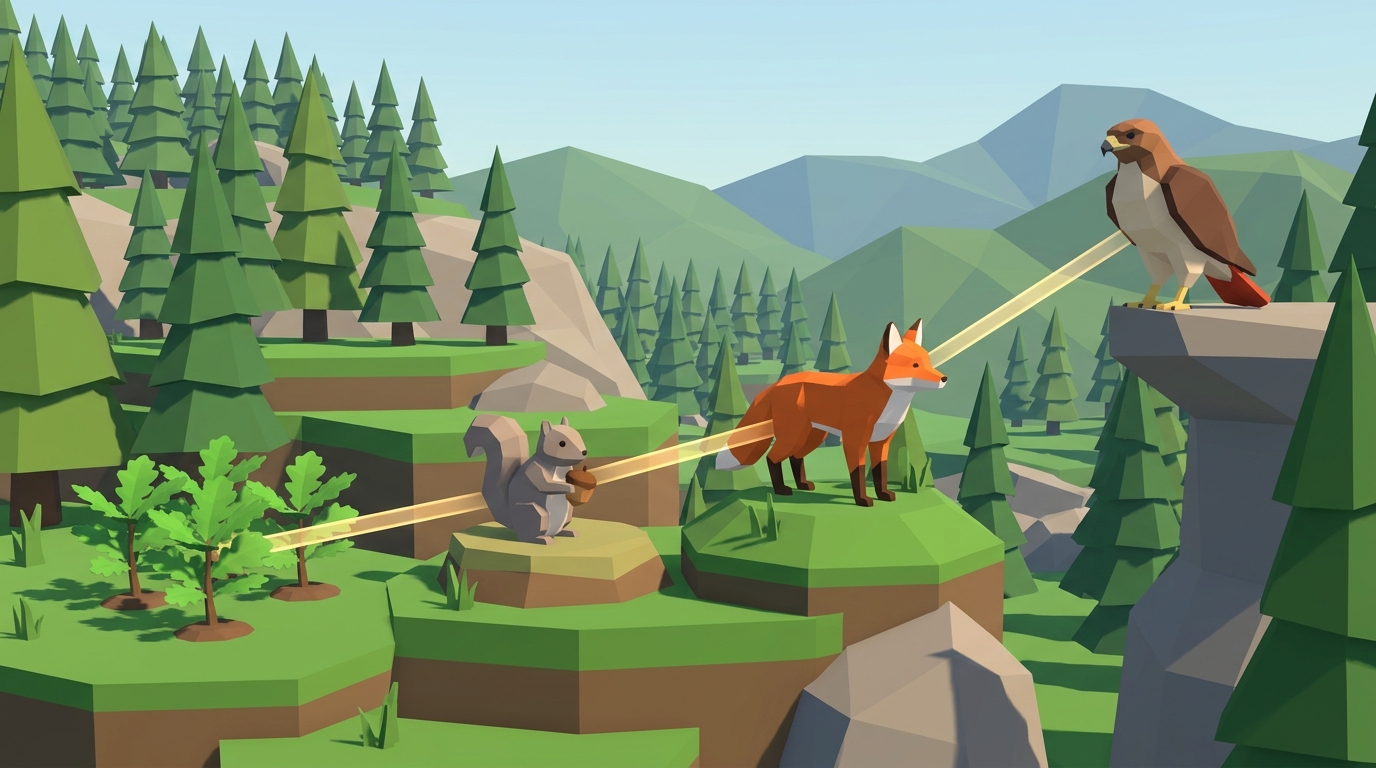
| Wildlife Conservation | Remove all predatory wolves so deer and elk can flourish safely. | Unchecked deer overgraze riverbanks, causing soil erosion and collapsing songbird and beaver habitats. | Trophic Cascades & Interdependence |
| Regulating Room Temperature | Crank the thermostat to maximum heat when feeling cold in winter. | System overshoots target comfort level, creating excessive heat and wasting energy before shutting off. | Time Delays & Equilibrium |
| Meadow Rabbit Boom | Introduce 100 new rabbits assuming the meadow can feed infinite animals. | Grass depletes faster than it regrows, causing severe carrying capacity overshoot and population crash. | Limits to Growth & Carrying Capacity |
5 Hands-On Activities to Develop Systems Thinking at Home and in Class
Developing systems intuition does not require dry lectures or abstract mathematical formulas. The most effective way to build these mental habits is through interactive play, physical analogies, and guided reflection.
Here are five practical activities you can implement immediately with kids ages 7 to 14:
The "And Then What Happens?" Curiosity Game
Whenever a news event, storybook twist, or family decision occurs, ask your child: "And then what happens next?" Follow the chain of events through at least four sequential ripple effects until it circles back to the starting point.
Causal Loop Sketching on Paper
Give your child a blank sheet of paper and colored markers. Have them write two key factors (e.g. Sleep Quality and School Focus) and connect them with curved arrows, labeling whether more of one creates more (+) or less (-) of the other.
The Kitchen Sink Bathtub Challenge
Use a plugged kitchen sink with the faucet running slightly. Challenge your child to adjust the drain plug until the water level stays perfectly flat. This builds physical intuition for dynamic equilibrium and inflow/outflow balance.
Real-Time Ecosystem Simulation Labs
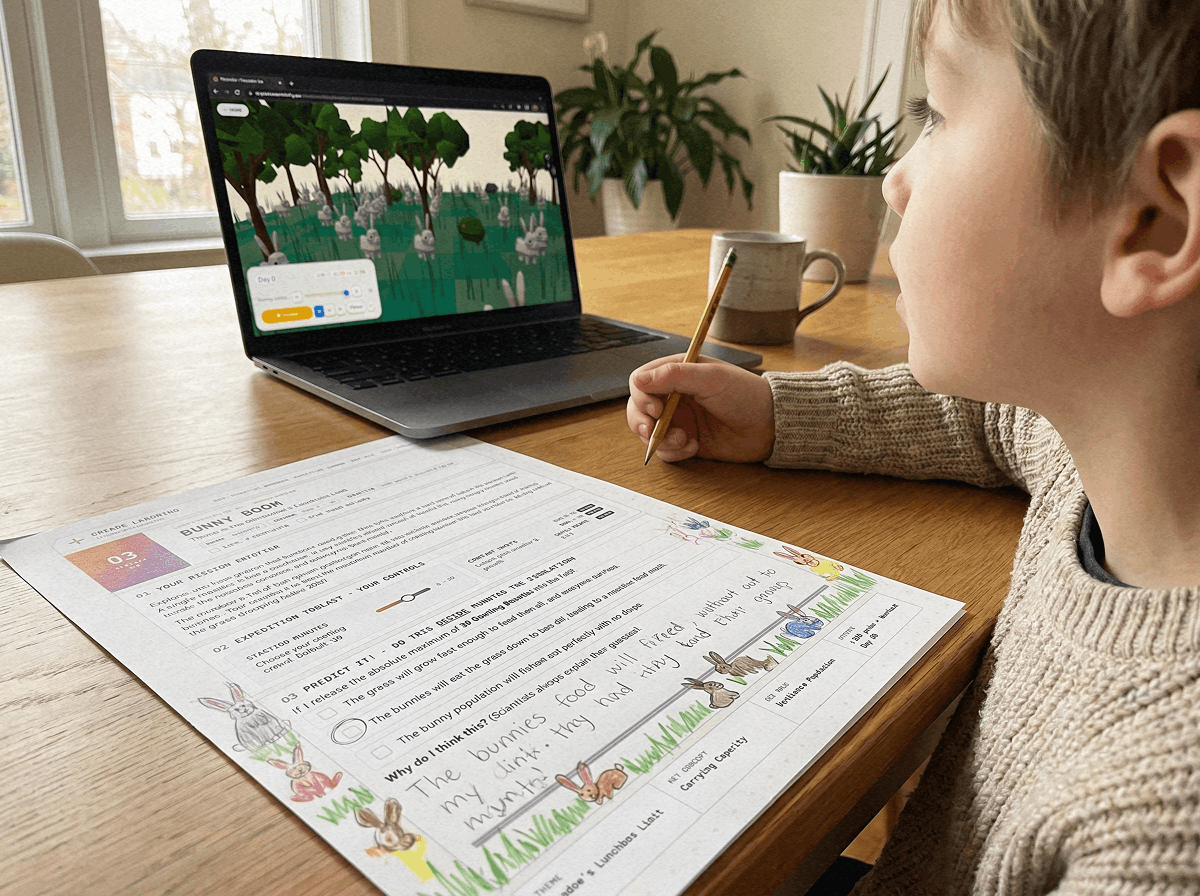
Use an interactive 3D digital laboratory like Praxos Ecosystem. Allow your child to adjust abiotic variables like sunlight, rainfall, or predator counts, watching how the entire biological food web responds in real time.
Behavior-Over-Time Graphing (BOTGs)
Instead of recording static numbers, have your child draw simple line graphs showing how a variable changes over a week (such as plant height, room clutter, or daily pet energy levels).
In Level 5 of Praxos Ecosystem, students observe how hiding bushes create a stabilizing delay that prevents wolves from driving rabbits to extinction. Test the simulation free in your browser.
Launch Free LabWhy Interactive Simulations Build Systems Intuition Faster
When children study complex systems purely through flat textbook diagrams or static multiple-choice questions, they miss the most critical aspect of systems: dynamic motion over time. A diagram can show that arrows on a food web point from prey to predator, but it cannot show what happens when that balance is pushed to its breaking point.
Inside an interactive 3D simulation, students experience the consequences of their hypotheses directly. If a child doubles the herbivore population without increasing vegetation, they watch the grass vanish, observe hunger mechanics kick in, and witness the resulting population crash. This kind of experiential learning transforms abstract systems principles into vivid, unforgettable intuition.
All 10 simulation missions and the complete 24-page Expedition Science Journal are 100% free with email. Level 1 starts instantly in your browser with zero registration.
Pair digital experiments with our free 24-page Expedition Science Journal. Kids map loops on paper before launching the 3D lab.
Download Free WorksheetFrequently Asked Questions About Systems Thinking for Kids
Here are answers to the most common questions educators and homeschool parents ask when introducing systems thinking to elementary and middle school students:
What is systems thinking for kids in simple words?
How do you teach systems thinking to young children?
What is an example of a feedback loop kids can understand?
Why is systems thinking important in STEM education?
What are the best free tools to practice systems thinking?
Systems Thinking & Causal Loop Starter Journal (PDF)
A 24-page student lab printable designed for hands-on causal mapping. Children draw balancing loops and predict multi-variable outcomes before testing them in the 3D simulation.