What Does a 3rd Grader Need to Learn in Science?
Eight- and nine-year-olds are natural investigators. In 3rd grade, science shifts from informal nature exploration to structured inquiry: learning how to form a testable hypothesis, record observations, and notice patterns over time.
Under the Next Generation Science Standards (NGSS), a well-rounded 3rd grade homeschool curriculum encompasses four key areas:
1. Life Cycles and Inherited Traits (3-LS1 & 3-LS3): How organisms have unique life cycles, and how plants and animals inherit traits from parents while adapting to environmental conditions.
2. Organism Interactions and Habitat Change (3-LS2 & 3-LS4): How animals form groups for survival, what happens when habitats change, and how fossils provide clues about prehistoric environments.
3. Balanced and Unbalanced Forces (3-PS2): How pushes, pulls, gravity, and magnets affect object motion.
4. Weather Patterns and Climate (3-ESS2 & 3-ESS3): Recording daily weather data, identifying seasonal patterns, and evaluating natural hazard solutions.
At age 8 to 9, children have developed the fine motor skills to draw accurate diagrams and the reading confidence to record data in a structured science logbook.
3rd Grade Life Science Scope and Inquiry Framework
Life science is the most captivating topic for 3rd graders because it connects directly to living animals and plants they observe in nature.
The table below illustrates the core life science units and how hands-on modeling brings each concept to life:
| Topic Area | Core Scientific Question | Hands-On Investigation | Digital Simulation Bridge |
|---|---|---|---|
| Plant Growth & Sunlight | Do plants need sunlight and water to produce food? | Seed sprouting in dark vs light cups | Adjust sun and rain sliders in Praxos Level 1 |
| Herbivore Diets & Feeding | What happens to animals if plant food becomes scarce? | Nature walk feeding evidence scavenger hunt | Observe rabbit foraging in Praxos Level 2 |
| Habitat Overcrowding | Can a small meadow support an infinite number of rabbits? | Bean population grid counting game | Test carrying capacity limits in Praxos Level 3 |
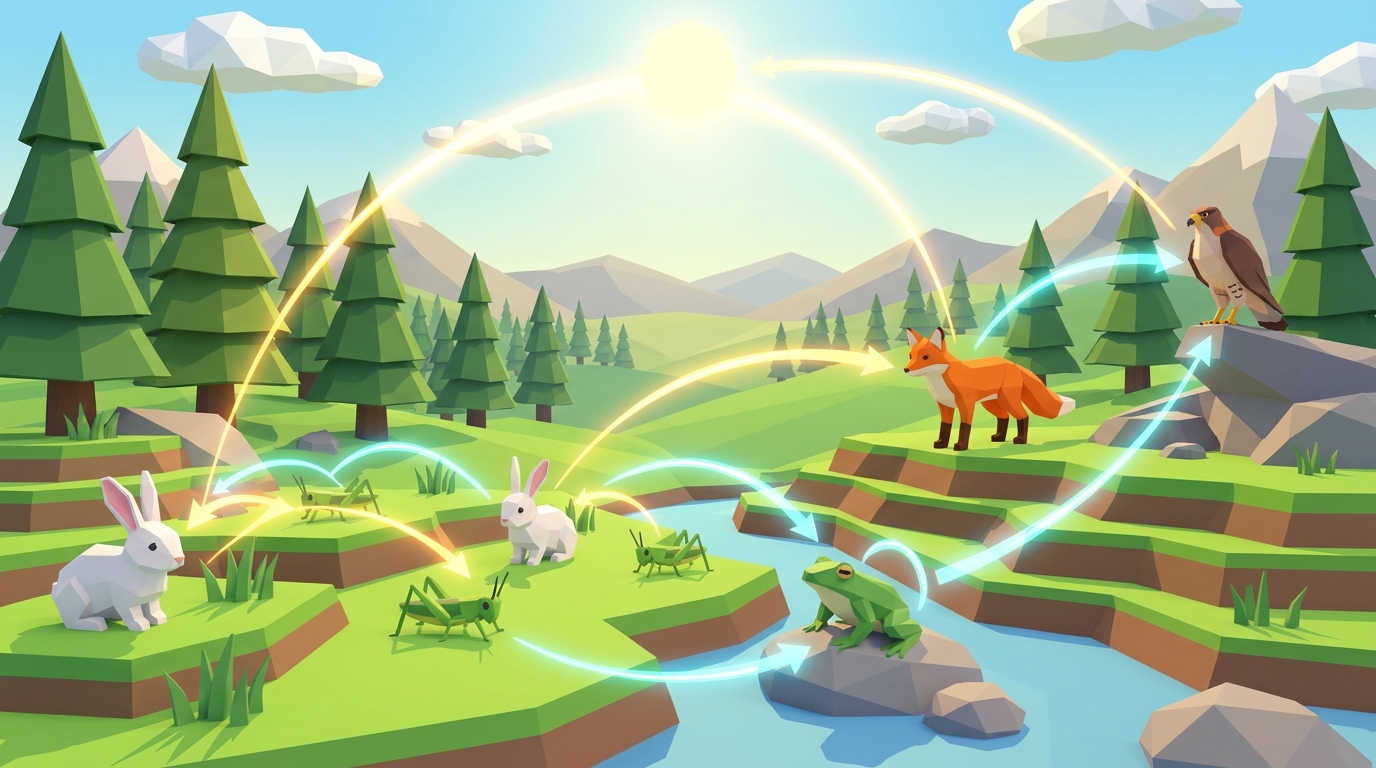
| Predator-Prey Balance | Why do ecosystems need both foxes and rabbits? | Camouflage hiding card game | Introduce wolves and hiding bushes in Praxos Level 5 |
How to Build a Simple 30-Minute Homeschool Science Routine
You do not need an elaborate 2-hour laboratory setup to teach 3rd grade science effectively. A focused 30-minute block twice a week delivers deep conceptual understanding while preserving your child curiosity.
Here is an easy four-step daily rhythm that works for any elementary homeschool family:
5 Minutes: The Big Question (Discussion)
Open with an intriguing real-world question: "What would happen if all the grass in our yard stopped growing tomorrow?"
10 Minutes: Pencil-First Prediction (Sketching)
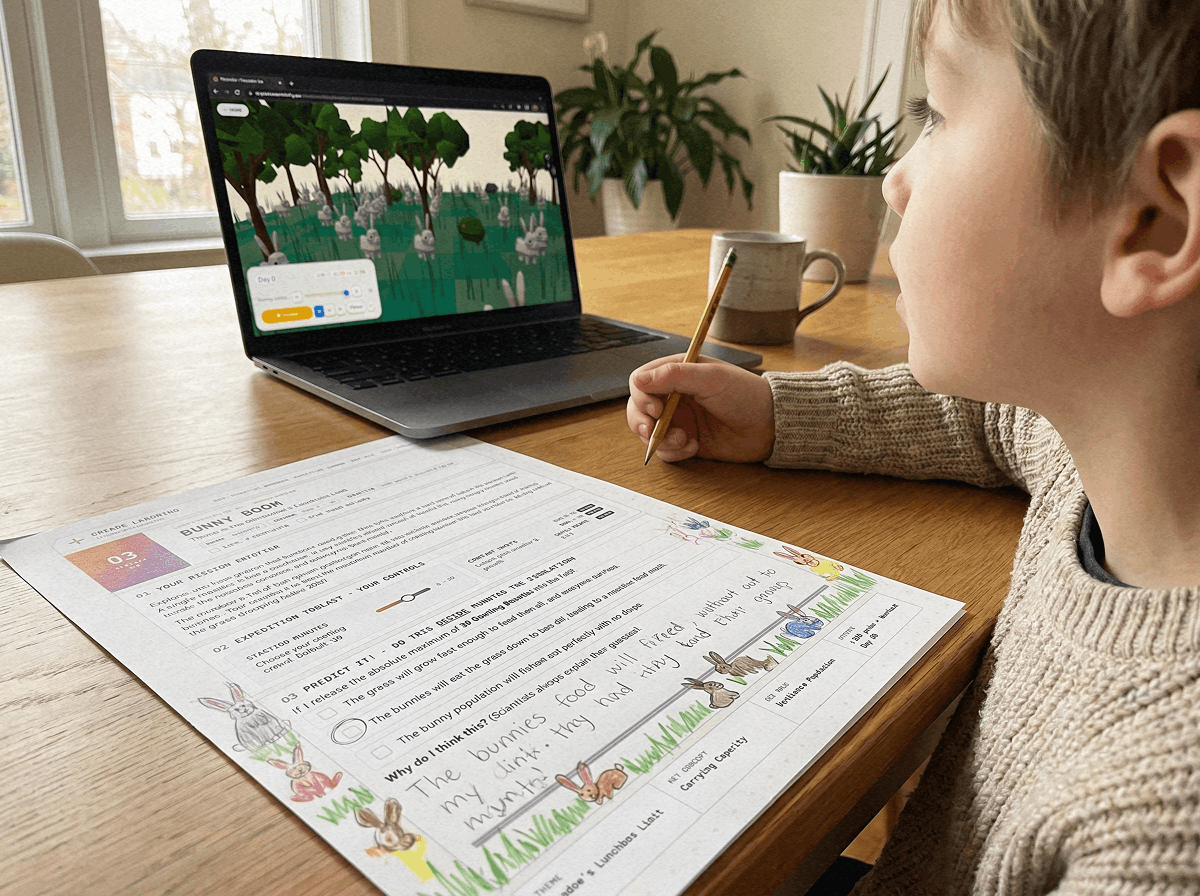
Have your 3rd grader draw what they think will happen in their printable journal before touching any digital controls.
10 Minutes: Simulation Trial (Observation)
Launch the browser lab and test the hypothesis live, watching the animals and plants react to slider adjustments.
5 Minutes: Field Log Reflection
Write one complete sentence summarizing the finding: "When rainfall stopped on Day 15, the plants turned brown and the rabbits had less food."
Level 1 of Praxos Ecosystem runs immediately in any web browser without logins or downloads. Perfect for 3rd grade nature investigations.
Launch Free 3D LabFrequently Asked Questions About 3rd Grade Homeschool Science
Here are quick answers to common questions from parents starting 3rd grade science at home:
Should 3rd grade science be graded?
For 3rd grade, emphasis should be placed on curiosity, careful observation, and completed journal entries rather than letter grades on tests.
How is 3rd grade science different from 5th grade science?
Third grade science focuses on qualitative observations and simple cause-and-effect pairs, whereas 5th grade introduces quantitative data graphing, complex feedback loops, and conservation of matter.
Where can I find companion guides for other grades?
Explore our complete guides for 5th grade science curriculum and food web arrows explained.
3rd Grade Science Lab Observation Sheet
A printable drawing and observation sheet designed for young scientists to sketch predictions and count animals during digital trials.