The Energetic Crisis of Winter: Zero Inflow, Accelerated Outflow
For living organisms, winter is not merely cold weather; it is an unforgiving thermodynamic crisis. In systems thinking, any living organism can be modeled as an open energy stock. To stay alive, an animal must maintain internal body heat and cellular function by balancing energy inflows (calories consumed from food) against energy outflows (metabolic burn, movement, and heat loss to the freezing air).
During spring and summer, solar energy fuels rich vegetative photosynthesis. Caloric energy flows abundantly up the food web. But when winter arrives, temperature plunges below freezing, snow blankets the soil, and plant growth halts entirely. Energy inflow suddenly drops to zero.
Worse still, the second law of thermodynamics dictates that heat flows spontaneously from warm bodies into cold surroundings. In sub-zero winds, a warm-blooded animal loses body heat rapidly. If the animal attempts to stay active and forage as usual, its internal furnace must burn through calories twice as fast simply to avoid freezing to death. Zero food coming in, doubled energy going out: without special adaptations, starvation and hypothermia are mathematically guaranteed within days.
In Level 7 of the Praxos 3D simulation ("Winter Freeze"), students witness this thermodynamic bottleneck across a full multi-season timeline, discovering how behavioral and physiological adaptations keep species alive through the darkest months.
When energy inflows drop to zero, an animal cannot survive by running faster. It must slash energy outflows by entering dormancy and utilizing thermal insulation.
Hibernation, Torpor, and Dormancy: Biology's Energy-Saving Modes
How do wild animals solve this thermodynamic equation? Rather than fighting the cold, nature's most resilient species execute a deliberate metabolic state transition. In middle school biology, students often confuse several related strategies:
True Hibernation: A prolonged physiological state where an animal drops its core body temperature near freezing, reduces its heart rate from several hundred beats per minute down to single digits, and decreases oxygen consumption by up to 98%. Animals such as groundhogs and marmots enter deep hibernation for months at a time.
Daily Torpor: A flexible, short-term reduction in metabolic rate and body temperature that lasts for several hours or overnight. Hummingbirds, chickadees, and small desert mammals use torpor to conserve calories during chilly nights without committing to months of dormancy.
Winter Dens and Burrows: Many mammals that do not enter full cryogenic hibernation (including wild rabbits, badgers, and foxes) retreat into subterranean burrows. Soil and packed snow act as outstanding natural insulation blankets, maintaining temperatures well above external sub-zero winds. In a sheltered underground nest, curled tightly together, animals conserve up to 50% of their daily caloric expenditure.
| Adaptation Strategy | Examples in Nature | Metabolic Rate Change | Primary Survival Mechanism |
|---|---|---|---|
| DEEP DORMANCYDeep Hibernation | Arctic Ground Squirrel, Marmot, Little Brown Bat | Drops by 90% to 98% of baseline | Extreme drop in core body temperature; heart rate drops to 2-4 bpm; survives on brown adipose fat |
| THERMAL SHELTERSubterranean Burrows & Dens | Cottontail Rabbit, Badger, Red Fox | Drops by 40% to 60% of baseline | Earth and snow pack trap thermal heat; eliminates wind chill; curtails unnecessary movement |
| PHYSIOLOGICALPhysical Insulation & Morphing | Canada Lynx, Gray Wolf, Snowshoe Hare | Burn rate stays normal / insulated | Grows dense winter underfur; footpads widen into snowshoes; fur changes color for camouflage |
The Mechanics of Level 07: Surviving the Sub-Zero Deep Freeze
Level 07 places students in charge of a meadow ecosystem navigating a 75-day multi-season timeline. The simulation advances through distinct seasonal phases: Spring (Days 0-15), Summer (Days 15-30), Autumn (Days 30-45), Winter (Days 46-60), and Spring Thaw (Days 61-75).
At Day 46, winter strikes: the green meadow turns white with snow tiles, snowflakes drift through the air, and grass regrowth drops to exactly 0%. At the same time, ambient cold doubles animal metabolic burn rates.
The win condition requires keeping both species alive (Rabbits >= 1 and Wolves >= 1) through the entire 75-day cycle. If a student runs the simulation with default settings (Burrows OFF), rabbits exhaust their calorie bars within 8 days of snowfall, and wolves starve shortly after, causing total level failure.
To achieve a 3-star victory, students test specific hypotheses before pressing Play:
Step 1: Activate Thermal Insulation (Toggle Rabbit Burrows ON)
Before pressing Play, toggle the Rabbit Burrows control to ON. This equips the rabbit herd with underground sheltering behavior. When sub-zero weather hits on Day 46, rabbits retreat underground, slashing their cold-weather energy expenditure by 50%.
Step 2: Calibrate Sustainable Starting Density (22-26 Rabbits, 2 Wolves)
Set starting rabbits to 22-26 and starting wolves to 2. This balanced starting ratio allows wolves to lightly trim the herd during lush autumn weeks, preventing overpopulation before snow falls.
Step 3: Weather the Freeze and Catch the Spring Thaw (Day 46 to Day 75)
During the Day 46-60 winter freeze, plant growth is completely stopped. Because burrows reduce rabbit calorie burn by half, a viable core of 8 to 12 rabbits survives. When Spring thaw arrives at Day 61, grass sprouts anew and the surviving animals rebuild the meadow population for an easy victory.
Start Level 1 free in your browser to learn core ecosystem controls, or advance to Level 7 to test winter burrows and seasonal energy budgets across 75 simulation days.
Play Level 1 Free in BrowserReal-World Phenomenon: The Arctic Ground Squirrel
To understand how extreme seasonal dormancy can get in nature, scientists study the Arctic ground squirrel (Urocitellus parryii) in Alaska and northern Canada. This small mammal endures sub-arctic winters where surface temperatures plunge to -40 degrees Celsius.
During its 8-month hibernation, the Arctic ground squirrel drops its core body temperature below freezing, reaching -2.9 degrees Celsius without freezing solid. It achieves this remarkable feat through supercooling: eliminating crystal nucleation points in its blood and fluids.
Its heart rate slows from 300 beats per minute to just 3 or 4 beats per minute. By slashing its metabolic budget to near zero, it survives eight brutal winter months entirely on stored white and brown adipose fat, emerging in April to mate and feed when tundra grasses sprout.
In Level 7, our low-poly rabbits use the same mathematical principle. By reducing metabolic burn rates when ambient temperatures fall, they transform an otherwise fatal winter freeze into a manageable seasonal pause.
The Arctic ground squirrel drops its body temperature below freezing without forming ice crystals, proving that surviving winter is a masterclass in metabolic throttling.
Hands-On Science Journal: 4-Season Calorie Budget Audit
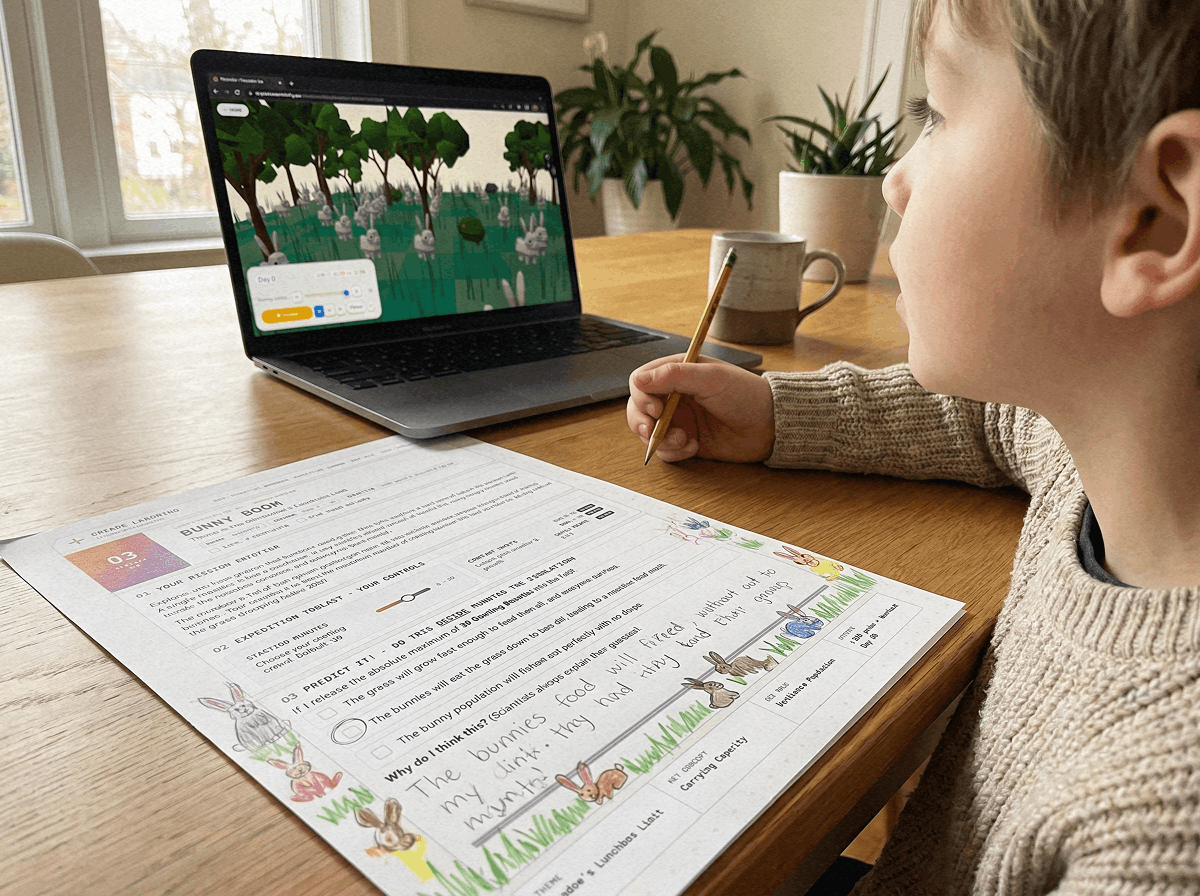
Reinforce active systems thinking with your child or science class by opening a paper science journal and completing these three inquiry prompts:
1. The 4-Season Calorie Budget Diagram: Draw four large circles labeled Spring, Summer, Autumn, and Winter. In each circle, draw an inflow arrow (Food Available) and an outflow arrow (Energy Burned). In Winter, draw the inflow arrow as zero and explain why the outflow arrow must be shrunk using burrows or thick fur coats.
2. The Hibernation vs. Migration Debate: Write a short paragraph comparing the strategy in Level 6 (migrating or shrinking herd size during drought) with the strategy in Level 7 (burrowing underground and sleeping during winter). Why might an animal choose to sleep through winter rather than fly thousands of miles south?
3. The Snow as an Insulator Experiment: On a cold winter day or using a freezer with ice cubes, place one thermometer in open air and another beneath 6 inches of snow or blankets. Record how snow acts as an insulating blanket that protects life beneath it.
Download the free 24-page PDF journal to graph seasonal metabolic budgets, sketch animal winter adaptations, and log simulation data.
Download Level 7 Journal (PDF)Frequently Asked Questions: Winter Adaptations & Dormancy
Common questions from homeschoolers, teachers, and curious students about winter ecology:
What is seasonal dormancy in biology?
Why do rabbits in the simulation survive better with burrows active?
What happens to predators during the winter freeze in Level 7?
Can students play Praxos Level 7 in the browser for free?
Level 7 Mission Log & Winter Metabolic Budget Worksheet (PDF)
A printable 24-page Expedition Science Journal featuring 4-season energy budget diagrams, hibernation vs. torpor comparisons, and thermal burrow insulation sketches.