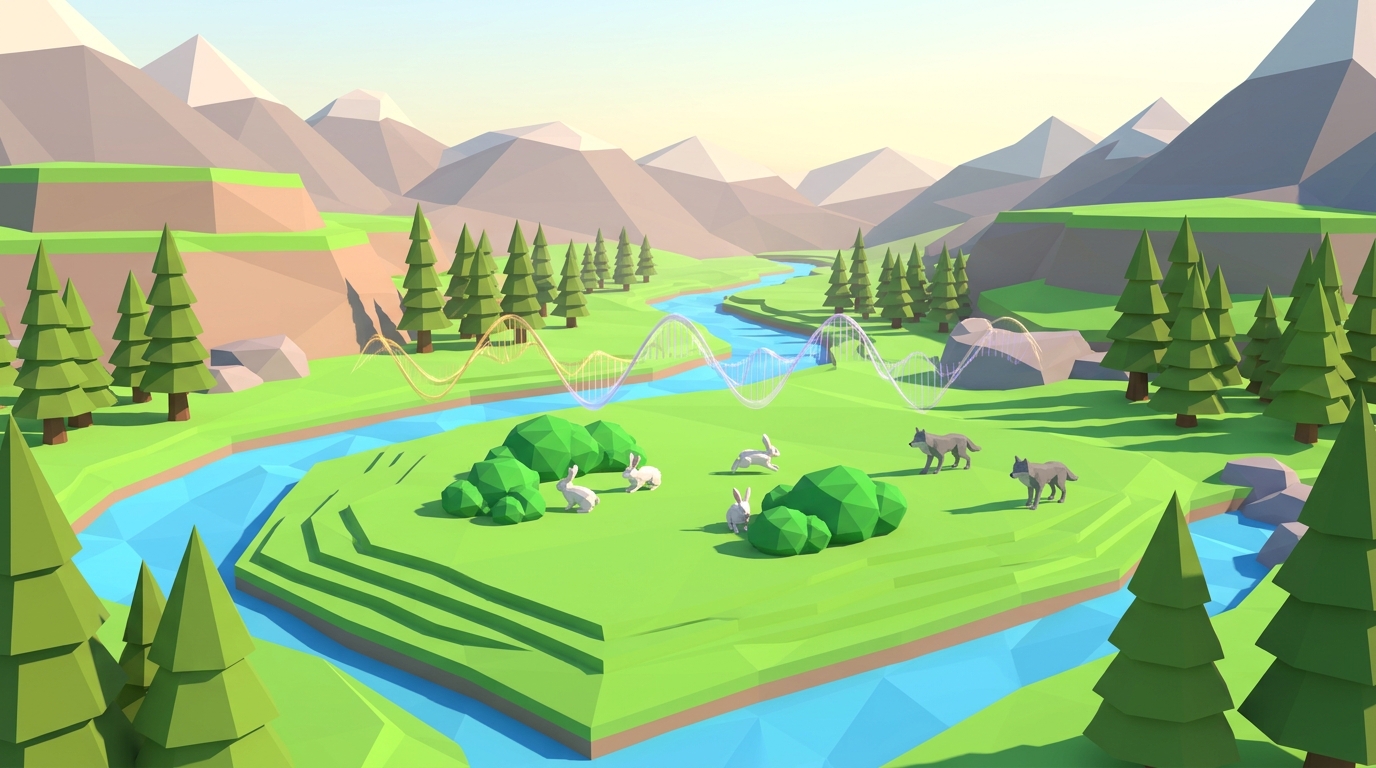

The Fallacy of the Fixed Ceiling: Carrying Capacity Moves
In introductory life science classes, carrying capacity (often designated as the variable K) is almost universally taught as a fixed horizontal dotted line on a chalkboard. Students are told: "This forest can support 100 deer. If there are 80 deer, the population grows; if there are 120 deer, some die until the population returns to 100."
While this mental model is clean and easy to test on multiple-choice quizzes, it creates a dangerous misunderstanding of living ecologies. In real environments, carrying capacity is never a stationary ceiling. Carrying capacity is a moving target that expands during lush rainy seasons and violently contracts during severe droughts.
When rainfall drops to zero, the abiotic foundation of the habitat collapses. Soil moisture evaporates, plant photosynthesis grinds to a halt, and grass regrowth plummets by 80% or more. The environment that comfortably supported 40 herbivores two weeks ago can suddenly support only 10.
In Level 6 of the Praxos 3D simulation ("Dry Season"), students face this reality head-on. The lush green meadow from earlier levels is subjected to a severe scripted drought between Day 15 and Day 30, forcing young scientists to grapple with bottom-up climate stress.
Carrying capacity is not a static number written on a rock. It is a live pulse governed by abiotic drivers: when rain stops, carrying capacity drops immediately.
The Mechanics of Level 06: Surviving the 15-Day Dry Spell
Level 06 challenges learners to keep both pasture vegetation (Grass >= 20%) and the herbivore population (Rabbits >= 4) alive across 60 full simulation days. However, an environmental shock divides the mission:
Pre-Run Forecast: The weather forecast warns that from Day 15 to Day 30, precipitation drops to 0.10. At Day 15, the crystal blue river running through the 3D grid visibly dries up, turning into cracked, arid mud tiles.
Grass Regrowth Penalty: Without moisture, grazed grass blades regenerate at only one-fifth of their normal speed. Every bite taken by a hungry rabbit leaves bare dirt that remains unreplenished for weeks.
The Default Trap: The level defaults to 28 starting rabbits. If a student hits Play without planning ahead, 28 rabbits quickly strip the meadow bare just as the drought begins. By Day 24, all rabbits starve to death, resulting in total level failure.
Students have two distinct pathways to solve this ecological crisis, each teaching a different facet of systems resilience:
Strategy 1: Pre-Run Slack Calibration (12 to 16 Starting Rabbits)
Before pressing Play, downsize the starting herd from 28 down to 12-16 rabbits. During Days 1 to 14, this lean herd grazes lightly, leaving 70% to 80% of the meadow dense and healthy. When the drought strikes at Day 15, the accumulated plant biomass serves as an emergency food bank. The smaller herd survives on deep-root patches until rain returns at Day 30.
Strategy 2: The Day 8 Emergency Evacuation Lifeline
If you begin with 28 rabbits, an emergency drought warning flashes on Day 8 with a special button: "EVACUATE 50% OF HERD". Clicking this lifeline safely transports half the animals to a neighboring valley before pasture degradation becomes fatal, leaving ~10 rabbits to weather the dry spell.
The Rain Return & Recovery (Day 31 to Day 60)
At Day 30, rainfall resumes, moisture returns to the soil, and the riverbed refills with flowing water. Surviving rabbits begin reproducing again, restoring the herd to healthy numbers and securing a 3-star victory by Day 60.
Start Level 1 free in your browser to master ecosystem basics, or test your climate resilience strategies in Level 6 with live weather controls.
Play Level 1 Free in BrowserSystem Slack: Why Max Efficiency Leads to Fragility
In engineering, economics, and biology, there is a fundamental trade-off between peak efficiency and robust resilience. A system operating at 100% capacity with zero wasted resources is considered highly efficient in stable conditions, but it is extraordinarily fragile when unexpected disruptions occur.
Consider an ecosystem that can support a maximum of 40 rabbits during a perfect, rainy spring. If the herd expands to exactly 40 rabbits, the ecosystem is running at 100% utilization. But the moment a 2-week heatwave or drought hits, there is zero margin for error. With no surplus vegetation in reserve, starvation is immediate and catastrophic.
Systems thinkers define system slack as the buffer capacity maintained between current operating levels and catastrophic thresholds. In Level 6, tuning your starting herd to 14 rabbits instead of 28 is an intentional decision to prioritize slack over maximum headcount.
| Management Strategy | Pre-Drought Biomass | Drought Window Survival | Long-Term Ecosystem Health |
|---|---|---|---|
| FRAGILEMax Capacity (28 Rabbits, Zero Slack) | Grass grazed down to 30% before drought begins | 0% Survival (Total extinction by Day 24) | Catastrophic collapse; pasture stripped to bedrock; zero seed recovery |
| RESILIENTLean Buffer (12-16 Rabbits, High Slack) | Grass stock maintained at 75-85% reserve | 80-100% Survival (10 to 14 rabbits survive) | High resilience; pasture survives; herd rebounds rapidly once rain returns |
Real-World Phenomenon: The Great Serengeti Migration
How do wild animals handle dynamic carrying capacity on our own planet? The most breathtaking real-world example is the Great Serengeti Migration in East Africa.
Over 1.5 million blue wildebeest, 250,000 zebras, and hundreds of thousands of gazelles embark on a continuous 500-mile circular trek across Tanzania and Kenya every year. They do not migrate for fun; they migrate because carrying capacity in any single region of the savanna drops to near zero during the dry season.
As southern plains dry out in July and August, water holes vanish and sweet grasses wither. If the herds stayed put, over a million animals would starve within weeks. Instead, the animals follow the smell of rain northward toward the Mara River, continually tracking where abiotic rainfall is currently expanding local carrying capacity.
By playing Level 6, students understand the energetic necessity of animal migrations. When moving across a continent is impossible (as in an isolated valley or fenced reserve), the only way a resident population survives a dry spell is through low starting density or stored reserves.
Animals do not migrate because they enjoy traveling. They migrate because abiotic rain moves across the globe, and carrying capacity travels with the clouds.
Hands-On Science Journal: Drought Survival Plan
Deepen active screen time with your student or homeschooler by opening a physical science journal and completing these three inquiry prompts:
1. The Emergency Drought Plan: Draw a timeline from Day 0 to Day 60. Divide the timeline into three distinct zones: Green Spring (Days 0-14), Arid Drought (Days 15-30), and Rainy Recovery (Days 31-60). Beneath each zone, write the recommended rabbit population target and the expected grass regrowth rate.
2. The Household System Slack Audit: Discuss what "slack" looks like in human households. Ask: "Why do we keep extra food in the pantry, emergency flashlights in the closet, or extra water in the garage even when grocery stores are open?" Relate human emergency reserves to the pasture buffer in Level 6.
3. Abiotic vs. Biotic Disruption Comparison: In Level 4, rabbits faced a biotic stress (predators hunting them). In Level 6, rabbits face an abiotic stress (lack of rain). Write two sentences contrasting how bottom-up climate stress differs from top-down predator control.
Download the free 24-page PDF journal to map drought timelines, calculate herd carrying capacity, and record ecosystem recovery data.
Download Level 6 Journal (PDF)Frequently Asked Questions: Drought & Carrying Capacity
Common questions from teachers, parents, and young scientists exploring abiotic disruptions:
What is the difference between biotic and abiotic factors in an ecosystem?
Why does drought reduce carrying capacity so quickly?
What is system slack in ecology?
Can students play Praxos Level 6 in the browser for free?
Level 6 Mission Log & Drought Resilience Plan (PDF)
A printable 24-page Expedition Science Journal featuring abiotic stress graphs, drought carrying capacity calculations, and system buffer planning templates.