The Potted Plant Paradox: Why Living Systems Depend on Non-Living Inputs
Place a healthy potted fern inside a pitch-black closet and pour fresh water into the pot every single morning. Within two weeks, the plant will turn yellow, collapse, and rot. Conversely, place the exact same fern on a sunny windowsill but never give it a single drop of water. Within days, the fronds will bake, crack, and turn to dust.
This simple observation reveals the foundational law of planetary biology: all living organisms (biotic factors) are strictly governed by non-living physical elements (abiotic factors). When students study nature, their eyes naturally gravitate toward the animals and tall trees. However, biology cannot function without physics and chemistry.
In introductory science curricula aligned with NGSS 5-LS1-1 and MS-LS2-1, students must grasp that plants do not consume soil like food. Instead, primary producers absorb non-living solar photons, split water molecules, and capture atmospheric carbon dioxide to synthesize glucose. Without abiotic equilibrium, the energetic foundation of every food web ceases to exist.
Biotic factors include living organisms, bacteria, and decayed organic matter. Abiotic factors are physical and chemical conditions: sunlight intensity, precipitation, ambient temperature, humidity, and soil moisture.
Liebig's Law of the Minimum: The Broken Wooden Barrel Analogy
In 1840, agricultural chemist Justus von Liebig made an observation that transformed modern science: plant growth is controlled not by the total amount of available resources, but by the single scarcest resource.
To help students visualize this principle, scientists use the famous Broken Barrel analogy. Imagine a wooden bucket made of vertical staves of varying lengths. Each wooden stave represents a critical abiotic input: one stave is solar light, one is soil moisture, one is ambient heat, and one is atmospheric carbon.
If the water stave is only three inches tall while the sunlight stave is ten inches tall, how high can you fill the bucket with water? Only three inches. Any additional water pours over the shortest stave and is wasted. You cannot compensate for a lack of water by adding more sunlight, just as you cannot compensate for total darkness by drowning seeds in endless rain.
| Abiotic Input | Excessive Condition | Deficient Condition | Ecosystem Equilibrium |
|---|---|---|---|
| ENERGY INFLOWSolar Radiation (Sunlight) | Scorched soil, rapid evapotranspiration, heat shock | Stalled photosynthesis, pale chloroplasts, zero growth | Sustained glucose synthesis fueling cellular mitosis |
| MOISTURE STOCKPrecipitation (Rain) | Waterlogging, anaerobic root suffocation, fungal mold | Cellular dehydration, stomatal closure, wilting | Turgor pressure maintenance and nutrient transport |
| OPTIMAL THRESHOLDCombined Ratio (Sun + Rain) | High-humidity jungle conditions; rapid biomass surge | Arid desertification; barren dirt with zero seeds | The Golden Zone (50% to 75% balanced input ratio) |
The Mechanics of Level 01: Transforming Bare Dirt in Real-Time 3D
In the Praxos simulation laboratory, Level 01 (The Empty Field: Bare Dirt Genesis) deliberately strips away all animal life. There are no rabbits to graze, no wolves to hunt, and no complex food web arrows to distract young minds. The student faces a single scientific challenge: turning a 10x10 grid of parched, cracked brown dirt into a vibrant green meadow.
The simulation runs across a 30-day timeline. Students interact with two primary abiotic controls: the Sunlight Intensity slider (0.0 to 1.0) and the Precipitation slider (0.0 to 1.0). Each daily tick calculates plant biomass growth based on the interplay of both variables.
To succeed, students must test three specific hypotheses before starting the simulation:
Hypothesis A: The Golden Zone (Balanced Ratio)
Set Sunlight to 0.75 and Rain to 0.75. When both abiotic inputs operate in harmony, grass shoots spread rapidly across the dirt grid, reaching the 80% coverage threshold around Day 18 to 22.
Hypothesis B: Drought Decay (Sun Only)
Set Sunlight to 1.00 and Rain to 0.00. Despite maximum solar energy, the absence of moisture triggers scorched earth particles. Grass coverage stalls below 10%, causing an abiotic failure at Day 30.
Hypothesis C: Waterlogged Rot (Rain Only)
Set Rain to 1.00 and Sunlight to 0.05. Flooding the meadow without solar radiation triggers mold spore particles. Without light to power chloroplasts, root systems drown and seeds fail to germinate.
Start Level 1 instantly in your browser with zero registration. Experience how abiotic balancing creates life from parched dirt.
Launch Free Level 1 SimulationThe Dual-Format Advantage: Pencil-First Science Before Screen Interaction
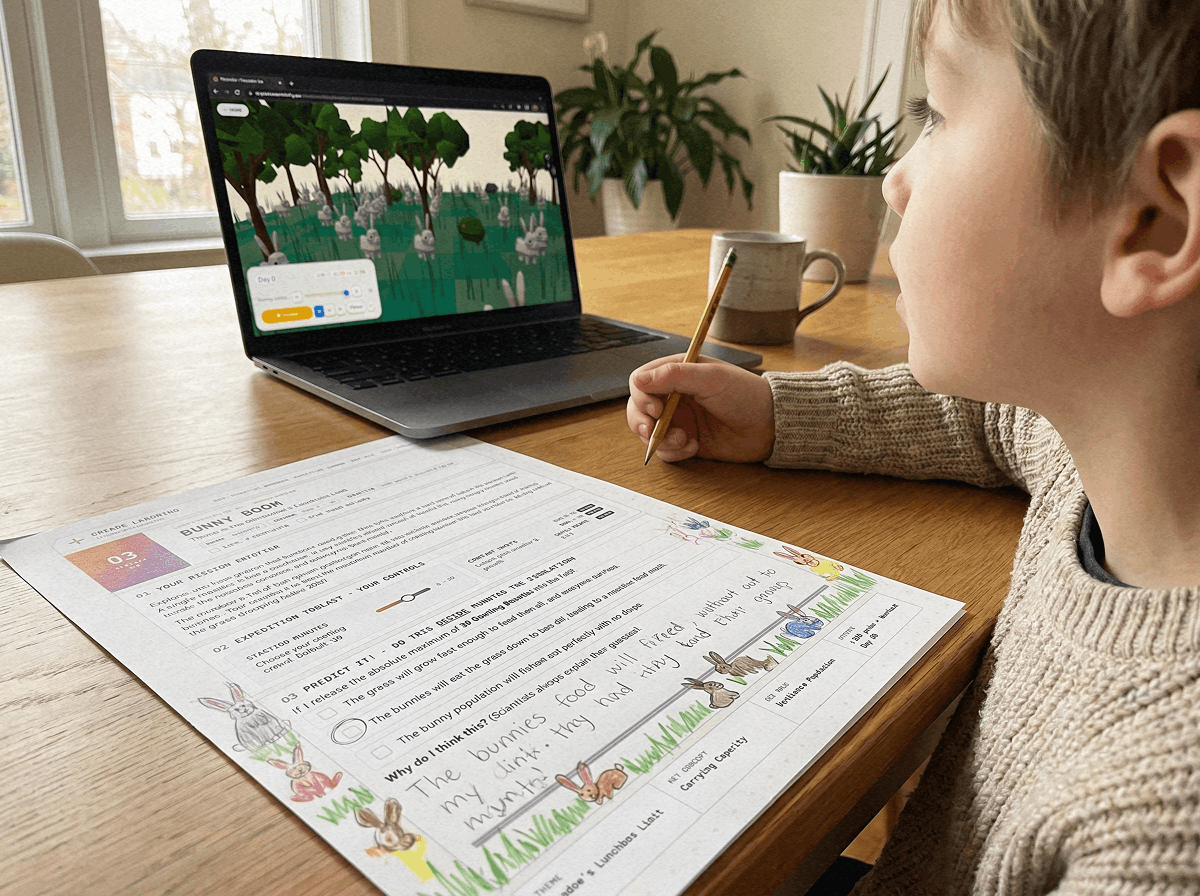
Why does Praxos pair a 3D browser simulation with a physical printable lab journal? Because when children only touch digital screens, they tend to behave like video gamers: dragging sliders randomly back and forth until a victory chime sounds, without absorbing the causal mechanisms.
In our dual-format curriculum, the student opens the physical Expedition Science Journal before clicking Play. They record their initial sunlight-to-rain ratio, isolate their independent variable, and sketch their predicted greening curve on paper.
During the 30-day simulation run, the student logs actual grass coverage percentages at Day 10, Day 20, and Day 30. Finally, they translate these discrete data points into a coordinate line graph and write a four-sentence Claim-Evidence-Reasoning (CER) conclusion. This tactile routine anchors digital experimentation in authentic scientific methodology.
Prompt for students: What was your limiting factor during your first trial? Explain why adding more rain failed to increase grass coverage when the sunlight slider was set below 0.30.
Frequently Asked Questions About Abiotic Factors and Level 01
Common questions from homeschool educators and STEM teachers introducing abiotic systems in upper elementary and middle school.
Why does Level 1 start with zero animals?
What is the exact win condition for Level 1?
How does Level 1 connect to higher levels like drought and climate shocks?
Can kids play Level 1 on school Chromebooks or tablets?
Level 1 Mission Log & Greening Tracker (PDF)
A printable 24-page Expedition Science Journal featuring structured prediction hypotheses, abiotic ratio data tables, and coordinate grid greening charts.