Gause's Principle: Why Identical Competitors Cannot Coexist
In the 1930s, Russian biologist Georgy Gause conducted a famous series of laboratory experiments with two microscopic species of paramecia: Paramecium aurelia and Paramecium caudatum. When grown in separate test tubes with daily rations of bacteria, each species thrived and reached a stable carrying capacity.
However, when Gause placed both species together in the exact same test tube with the same bacterial food source, the outcome was dramatic: P. aurelia grew rapidly, while P. caudatum dwindled and vanished into total extinction within 16 days. Even though neither organism attacked or harmed the other, P. aurelia was slightly faster at gathering food. That tiny advantage in consumption efficiency was mathematically insurmountable.
Gause formulated what is now taught across biology as the Competitive Exclusion Principle: two species with identical ecological niches cannot coexist indefinitely when resources are limited. One will always outcompete and exclude the other.
In Level 9 of the Praxos 3D simulation ("Too Many Mouths"), students confront this harsh rule of nature. When 18 rabbits and 12 deer are placed in the same meadow to compete for ground grass, students watch the larger deer strip the pasture bare, driving rabbits into rapid starvation.
Two organisms cannot occupy the exact same job in the exact same place. Without differentiation, the more efficient consumer drives the other to extinction.
Niche Partitioning: How Nature Solves the Food Fight
If Gause's Principle is true, why is our planet filled with millions of diverse species sharing the same forests, grasslands, and oceans? Why hasn't a single super-efficient herbivore driven all other plant-eaters extinct?
The answer is niche partitioning. Instead of competing directly for the exact same resource, competing species differentiate their behaviors, foraging locations, or feeding times to divide up the habitat:
Spatial Partitioning: Species forage in different physical zones. For example, in an African savanna, giraffes feed on high acacia tree branches (5 to 6 meters high), kudu browse intermediate shrubs (1 to 2 meters high), and zebras graze on ground grasses.
Temporal Partitioning: Competitors feed at different times of day or night. Hawks hunt rodents by daylight, while owls hunt the same rodent population under cover of darkness.
Dietary Specialization: Species develop digestive adaptations for different plant components. Zebras eat fibrous, tough outer stems, clearing the way for gazelles to access tender, nutrient-rich inner shoots.
| Ecological Setup | Available Resource Stock | Deer Diet Breakdown | Rabbit & System Outcome |
|---|---|---|---|
| EXCLUSIONUnpartitioned Pasture (0 Canopies) | Ground Grass Only (100% Shared) | 100% Ground Grass (Consumes 1.65x rabbit rate) | Ground grass collapses by Day 25; rabbits go extinct; total level failure |
| PARTIAL RELIEFPartial Partitioning (1-2 Canopies) | Ground Grass + Local High Browse | 50% Browse, 50% Ground Grass | Pasture holds until Day 40; partial survival; high extinction risk remains |
| STABLE COEXISTENCEFull Multi-Tiered Canopy (3 Canopies) | Stratified: High Browse + Ground Grass | 85% High Browse, 15% Ground Grass | Ground grass preserved for rabbits; both herbivores coexist across 60 days |
The Mechanics of Level 09: Eco-Energy and Forest Canopy Management
Level 09 challenges learners to sustain both herbivore species (Rabbits >= 1 and Deer >= 1) and preserve pasture coverage (Grass >= 20%) through 60 full simulation days. The level introduces the Eco-Energy resource management mechanic:
The Competition Disadvantage: Deer have an eatRate of 0.5 (consuming 1.65x more grass per bite than rabbits at 0.3). With both populations sharing ground grass, rabbits are completely excluded and starve within 25 days.
The Eco-Energy System: Students begin with 20 Eco-Energy points. Planting a tall tree canopy costs exactly 20 points. Eco-Energy recharges at +1.5 points per simulation day (capped at 60), meaning students can afford a new canopy roughly every 14 days.
The Behavioral Shift: When a canopy grows, deer within a 1.5-tile radius switch 85% of their diet to high tree leaves. Each canopy leaf layer regrows at +0.22 per day, comfortably feeding 1 to 2 deer and releasing grazing pressure on ground grass.
Here is the verified 3-star scientific strategy for clearing Level 9:
Step 1: Plant Canopy #1 Pre-Run (Spend 20 Starting Eco-Energy)
Before pressing Play, spend all 20 starting Eco-Energy points to plant your first tree canopy in the center of the forest meadow. Set starting populations to 10-18 rabbits and 6-12 deer.
Step 2: Plant Canopy #2 Around Day 14 (Mid-Run Intervention)
Press Play and watch the telemetry graph. As Day 14 approaches, your Eco-Energy recharges back to 20 points. Immediately plant your second tree canopy in an open clearing to lure more deer away from ground grass.
Step 3: Plant Canopy #3 Around Day 27 (Complete Stratification)
Around Day 27-30, plant your third tree canopy with freshly recharged Eco-Energy. With three mature canopies, the vast majority of deer feed high, leaving lush ground pasture for rabbits to graze peacefully through Day 60.
Start Level 1 free in your browser to master foundational ecology, or advance to Level 9 to engineer vertical forest canopies and resolve competitive exclusion.
Play Level 1 Free in BrowserReal-World Phenomenon: MacArthur's Boreal Warblers
The classic real-world study that demonstrated vertical niche partitioning was published in 1958 by legendary ecologist Robert H. MacArthur.
MacArthur investigated five closely related species of wood warblers (Cape May, yellow-rumped, black-throated green, blackburnian, and bay-breasted) living in the same spruce forests of New England. All five birds were roughly the same size, lived in the same trees, and ate the same forest caterpillars. On the surface, this directly violated Gause's Competitive Exclusion Principle.
By spending hundreds of hours meticulously recording the birds' exact positions in the trees, MacArthur uncovered an astonishing pattern: each species divided the spruce trees into distinct vertical and horizontal feeding zones.
The Cape May warbler fed exclusively on the outermost new needles at the very top of the tree. The blackburnian warbler fed in the upper middle interior. The black-throated green warbler fed in the middle dense foliage. The bay-breasted warbler fed on old needles near the trunk in the lower middle. The yellow-rumped warbler fed near the ground and lower dead branches.
By partitioning the tree into vertical zones, all five warbler species avoided direct competition, coexisting in high numbers in the same forest. In Level 9, students replicate MacArthur's discovery by establishing a vertical food web with canopy leaves above and grass below.
Five warbler species divided a single spruce tree into distinct vertical feeding floors, proving that spatial stratification allows competitors to flourish side by side.
Hands-On Science Journal: The Vertical Niche Matrix
Bring forest niche ecology into your student's physical science journal with these three hands-on inquiry investigations:
1. The Vertical Forest Profile Diagram: Draw a tall cross-section of a forest showing the canopy (tree tops), understory (shrubs), and forest floor (moss and grass). Draw three different animals at each height level and write an explanation of what food each animal eats to avoid competing with its neighbors.
2. Fundamental vs. Realized Niche Table: Create a 2-column comparison chart. In Column 1, define the Fundamental Niche (all the food deer could eat if rabbits were not present). In Column 2, define the Realized Niche (the actual food deer focus on once canopies are grown to avoid exhausting ground grass).
3. The Cafeteria Niche Thought Experiment: Relate niche partitioning to human environments. Ask: "What would happen if everyone in the school cafeteria wanted to sit at the exact same table and eat the exact same slice of pizza?" Discuss how having multiple tables, lunch periods, and menu choices is human niche partitioning.
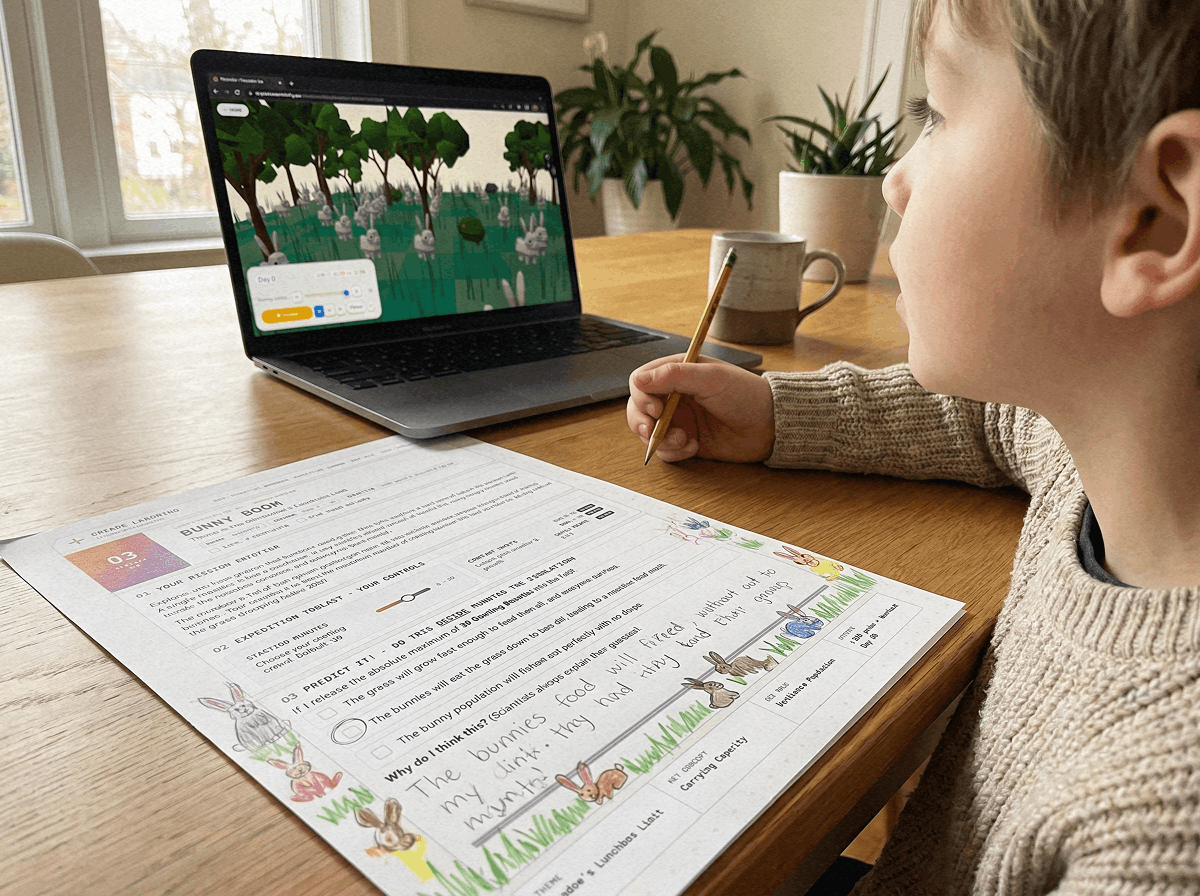
Download the free 24-page PDF journal to graph competitive exclusion curves, sketch vertical niche stratification profiles, and record simulation data.
Download Level 9 Journal (PDF)Frequently Asked Questions: Interspecies Competition & Niches
Common questions from teachers, parents, and homeschoolers exploring competitive exclusion and ecological niches:
What is Gause's Competitive Exclusion Principle?
Why do rabbits go extinct first in Level 9 if no trees are grown?
How does planting tree canopies save the rabbits?
Can students play Praxos Level 9 in the browser for free?
Level 9 Mission Log & Niche Matrix Worksheet (PDF)
A printable 24-page Expedition Science Journal featuring MacArthur warbler vertical canopy charts, fundamental vs. realized niche diagrams, and interspecific competition graphs.