What Separates a Real Science Project from a Craft Demonstration?
Many classic elementary science activities (such as baking soda volcanoes or clay solar system dioramas) are fun arts-and-crafts exercises, but they rarely teach the scientific method. In a true science project, students manipulate an independent variable, measure a dependent variable, and reach an evidence-based conclusion.
Whether you are preparing for a homeschool science fair, fulfilling NGSS standards for 3rd through 6th grade, or designing weekly STEM units, these 15 projects emphasize measurable outcomes, hypothesis testing, and systems thinking.
15 High-Impact Elementary Science Projects for Grades 3 to 6
Each of the following 15 projects includes recommended grade bands, key scientific concepts, required materials, and step-by-step experimental procedures.
Virtual 3D Ecosystem Equilibrium & Trophic Cascades
Grades 3-6 (Life Science & Ecology)
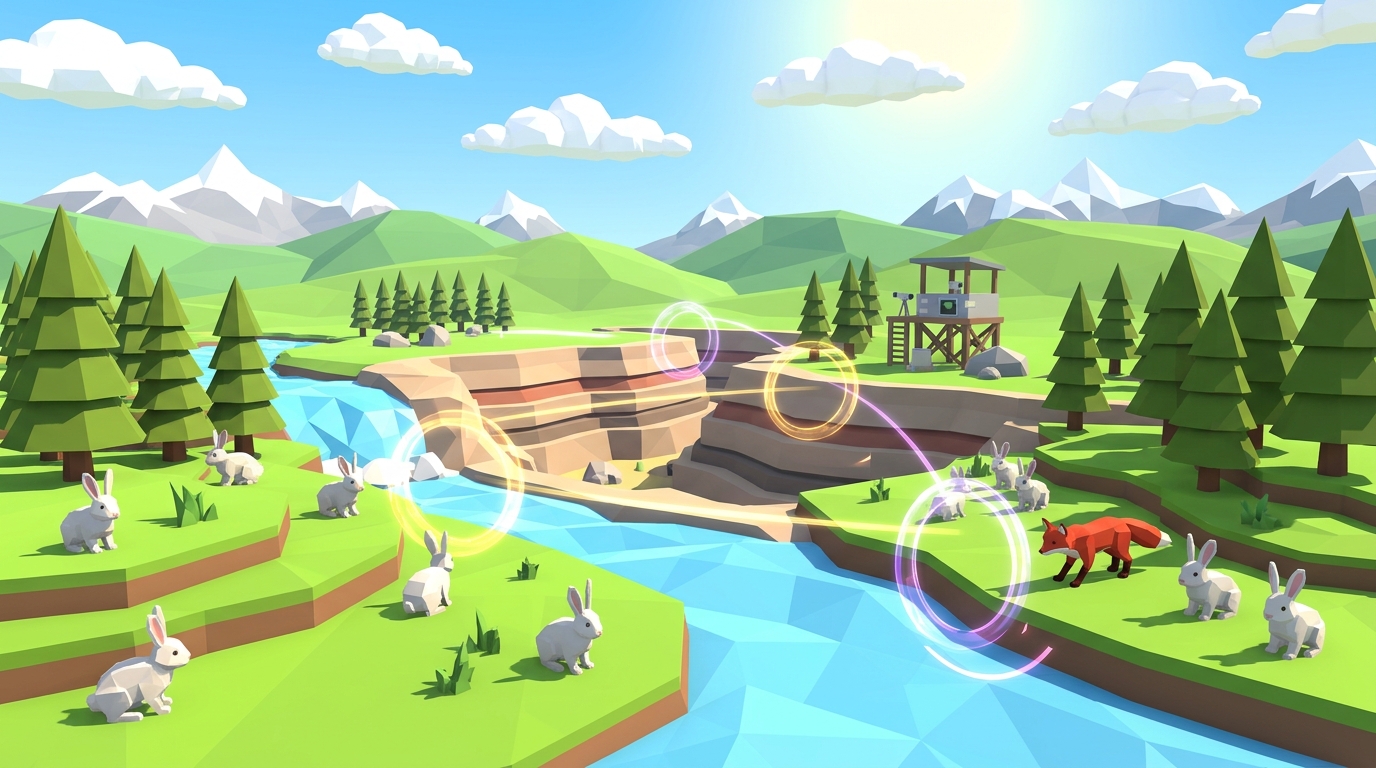
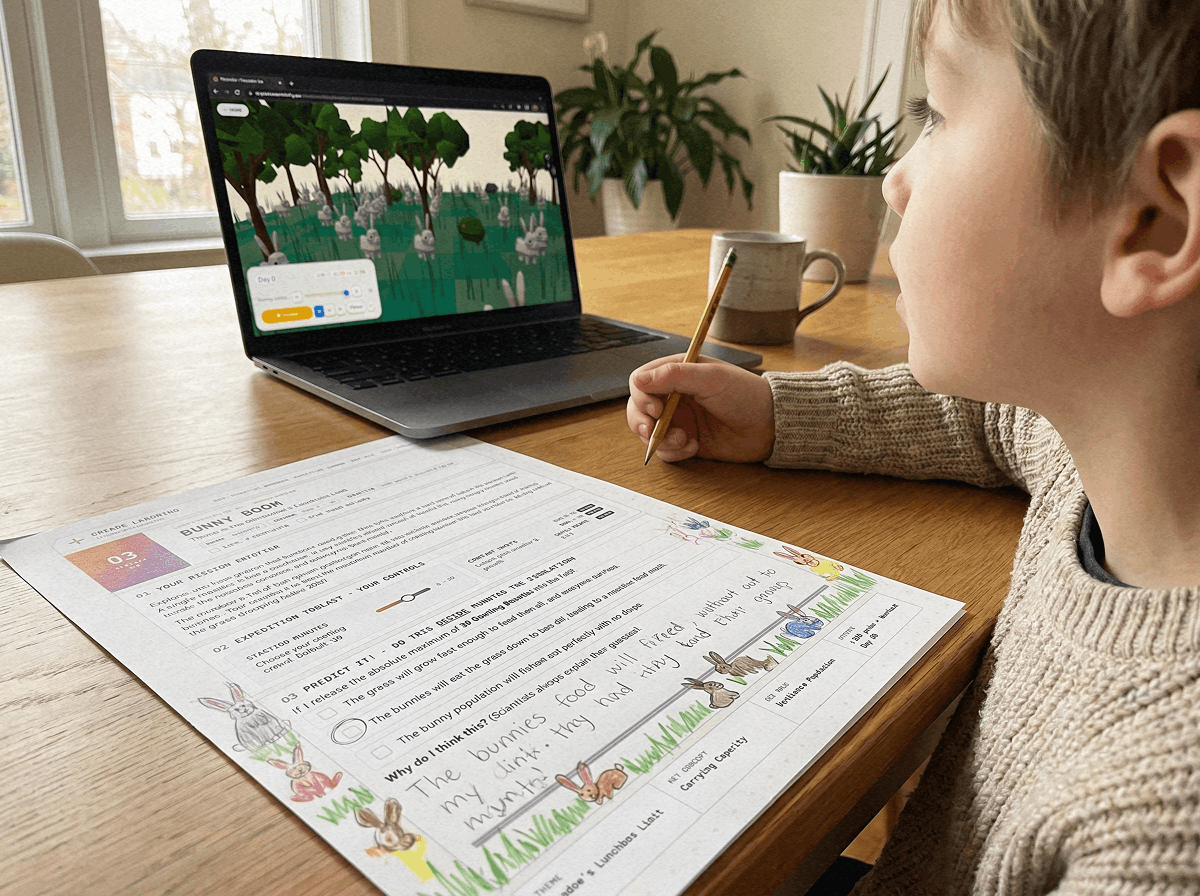
Students investigate carrying capacity and multi-trophic interactions in an interactive 3D web simulation. By manipulating plant producer densities and apex predator ratios across 10-generation cycles, students record population oscillations and identify systemic collapse thresholds on printed lab logbooks.
- ✓Concepts: Carrying capacity, trophic cascades, predator-prey equilibrium
- ✓Materials: Web browser (Praxos Ecosystem) + printed 24-page lab logbook
- ✓Time: 30 minutes across 3 trials
Hydrophobic vs. Hydrophilic Soil Absorption Rates
Grades 3-5 (Earth Science & Soil Mechanics)
Compare water percolation speeds through three soil types: sand, potting soil, and clay. Students time how long 100 mL of water takes to filter through each substrate using coffee filters and kitchen funnels, measuring retention capacity.
- ✓Concepts: Porosity, permeability, runoff, watershed dynamics
- ✓Materials: 3 clear cups, funnels, coffee filters, sand, topsoil, clay, stopwatch
- ✓Time: 45 minutes
Thermal Insulation Showdown: Keeping Ice Intact
Grades 3-6 (Physical Science & Heat Transfer)
Students design miniature insulation chambers using foil, cotton balls, bubble wrap, and wool socks to determine which material minimizes conductive and radiative heat transfer onto an ice cube over a 60-minute trial.
- ✓Concepts: Conduction, convection, radiation, thermal resistance
- ✓Materials: 4 ice cubes, digital kitchen scale or graduated cylinder, insulation wraps
- ✓Time: 60 minutes
Seed Germination Under Phototropic Stress
Grades 3-5 (Botany & Plant Physiology)
Grow bean seeds inside cardboard mazes with single light entry points. Students measure daily shoot angles and stem growth rates to quantify phototropism and auxin hormone distribution.
- ✓Concepts: Phototropism, cellular elongation, plant adaptations
- ✓Materials: Fast-sprouting bean seeds, shoeboxes, damp paper towels, ruler
- ✓Time: 7-day observation (10 mins/day)
Ramp Angle vs. Toy Car Momentum and Velocity
Grades 4-6 (Physics & Classical Mechanics)
Construct cardboard ramps at 15, 30, 45, and 60-degree angles. Measure the distance a toy car travels across smooth flooring, graphing velocity and stopping distance against gravitational potential energy.
- ✓Concepts: Potential vs kinetic energy, friction, acceleration, velocity
- ✓Materials: Cardboard track, protractor, toy car, tape measure, masking tape
- ✓Time: 40 minutes
Surface Tension Disruption: The Pepper and Surfactant Matrix
Grades 3-4 (Chemistry & Molecular Forces)
Investigate how dish soap breaks hydrogen bonding in water. Students sprinkle black pepper on water and test different surfactants (liquid hand soap, olive oil, milk, isopropyl alcohol) to measure surface tension collapse radius.
- ✓Concepts: Hydrogen bonding, surface tension, surfactant chemistry
- ✓Materials: Shallow dishes, water, black pepper, cotton swabs, various liquids
- ✓Time: 25 minutes
Yeast Respiration & Carbon Dioxide Sugar Fuel Trial
Grades 4-6 (Microbiology & Cellular Respiration)
Mix active dry yeast with warm water and varying sugar concentrations (0g, 5g, 10g, 20g) in plastic water bottles topped with balloons. Measure balloon circumference over 45 minutes to quantify fermentation rates.
- ✓Concepts: Cellular respiration, anaerobic fermentation, chemical reactions
- ✓Materials: Active dry yeast packets, 4 empty water bottles, balloons, table sugar, string
- ✓Time: 45 minutes
Solar Oven Heat Trap: Passive Solar Collector Efficiency
Grades 4-6 (Environmental Science & Renewable Energy)
Build a miniature solar cooker using a pizza box, aluminum foil, black construction paper, and plastic wrap. Record internal temperature increases every 10 minutes on a sunny afternoon and melt a marshmallow.
- ✓Concepts: Greenhouse effect, solar thermal energy, reflection, absorption
- ✓Materials: Pizza box, aluminum foil, plastic wrap, thermometer, black paper
- ✓Time: 60 minutes
Electromagnet Strength: Wire Coils vs. Magnetic Flux
Grades 4-6 (Electromagnetism & Physics)
Wrap copper wire around an iron nail with 20, 40, and 60 turns. Connect to a D-cell battery and count how many steel paperclips the resulting magnetic field can lift, proving the relationship between electrical coils and magnetic force.
- ✓Concepts: Electromagnetism, magnetic fields, electrical circuits
- ✓Materials: Iron nail, insulated copper wire, D-cell battery, paperclips
- ✓Time: 35 minutes
Water Filtration Column: Natural Substrate Purification
Grades 3-6 (Environmental Engineering & Hydrology)
Create a multi-layer gravity water filter using an inverted plastic bottle packed with gravel, coarse sand, fine sand, and activated charcoal. Pour muddy water through and evaluate particulate clarity and pH changes.
- ✓Concepts: Mechanical filtration, purification, municipal water systems
- ✓Materials: 2-liter bottle, cotton balls, activated charcoal, sand, gravel, dirty water
- ✓Time: 50 minutes
Penny Oxidation & Chemical Cleaning Solutions
Grades 3-5 (Chemistry & Acid-Base Reactions)
Submerge oxidized copper pennies in vinegar + salt, lemon juice, soda, and tap water for 10 minutes. Students determine which acidic solvent effectively removes copper oxide, observing shiny copper recovery.
- ✓Concepts: Oxidation, chemical reactions, acid-base interactions
- ✓Materials: Dull copper pennies, 4 cups, vinegar, salt, lemon juice, paper towels
- ✓Time: 30 minutes
Paper Airplane Wing Surface Area vs. Glide Distance
Grades 3-6 (Aerodynamics & Engineering Design)
Fold 4 standard paper airplane designs with varying wing spans and dihedral angles. Conduct 5 test throws per design in a calm hallway, recording distance and flight duration to calculate lift-to-drag efficiency.
- ✓Concepts: Lift, drag, gravity, thrust, aerodynamic stability
- ✓Materials: Standard printer paper, measuring tape, stopwatch, tape
- ✓Time: 40 minutes
Plant Transpiration in a Sealed Bag
Grades 3-5 (Botany & Water Cycle)
Fasten a clear plastic ziplock bag around a leafy tree branch on a sunny morning. Measure and record water droplet condensation volume after 4 hours to calculate hourly plant transpiration output.
- ✓Concepts: Transpiration, stomata, water cycle, vascular plant systems
- ✓Materials: Clear ziplock bags, twist ties, measuring dropper, sunny outdoor plant
- ✓Time: 4 hours (passive), 15 mins active
Eggshell Acid Erosion: Dental Enamel Decay Analog
Grades 3-6 (Human Biology & Dental Health)
Soak hard-boiled eggs in vinegar, cola, orange juice, and water for 48 hours. Compare calcium carbonate shell softening and discoloration to demonstrate how acidic beverages erode human dental enamel.
- ✓Concepts: Calcium breakdown, enamel erosion, acid effects on minerals
- ✓Materials: 4 hard-boiled eggs, clear glasses, vinegar, dark cola, citrus juice
- ✓Time: 48-hour observation (15 mins setup)
Bouncing Ball Temperature vs. Rebound Elasticity
Grades 4-6 (Physics & Thermodynamics)
Test the bounce height of rubber tennis balls or bouncy balls at three distinct temperatures: frozen (in freezer 2 hours), room temperature (72°F), and warm (in warm water bath). Connect molecular kinetic energy to material elasticity.
- ✓Concepts: Elastic collisions, thermodynamic kinetic energy, polymer flexibility
- ✓Materials: 3 identical bouncy balls, measuring tape, thermometer, freezer, warm water
- ✓Time: 45 minutes
Elementary Science Project Selection Matrix by Grade Level
Match your student grade level with appropriate conceptual depth and mathematical analysis using this planning guide:
| Grade Level | Focus Domain | Recommended Projects | Key Skill Emphasized |
|---|---|---|---|
| CORE LIFE SCIENCEGrades 3-4 | Living Systems & Habitats | Projects #1, #4, #6, #11, #13 | Observational logging & basic variable control |
| Grades 4-5 | Earth & Physical Systems | Projects #2, #3, #7, #8, #14 | Timed rate tracking & multi-trial bar charts |
| Grades 5-6 | Forces, Energy & System Dynamics | Projects #1, #5, #9, #10, #12, #15 | Multi-variable mathematical modeling & scatter plots |
The 4-Step Scientific Method Framework for Elementary Students
Every successful elementary science project follows a disciplined four-stage cycle. Guide your young scientist through each milestone using their printable lab logbook:
Identify a Single Testable Question
Avoid broad questions like "How do plants grow?" Frame a specific variable comparison: "Does increasing soil sand concentration from 10% to 50% decrease water retention time?"
Formulate an "If / Then / Because" Hypothesis
Require students to state causal reasoning before collecting data: "If we double the apex predator population, then the herbivore population will decline because predation pressure increases faster than reproductive output."
Conduct Minimum 3 Controlled Trials
Teach experimental validity by running at least 3 identical trials for each condition, averaging results to eliminate random anomalies.
Graph Empirical Data and State Evidence-Based Conclusions
Students convert numeric measurements into visual charts and write a two-sentence conclusion explicitly accepting or rejecting their initial hypothesis.
Frequently Asked Questions About Elementary Science Projects
Common questions from parents and elementary educators organizing science investigations and homeschool science fairs.
How do I help my child choose a science fair project topic?
Are digital simulation projects accepted in traditional science fairs?
What is the best way to document an elementary science project?
Is Praxos Ecosystem free for student science projects?
Launch Your Elementary Science Project with Praxos Lab
Give your elementary students a powerful, interactive science lab that makes ecosystem dynamics and population equilibrium intuitive.
Start Level 1 instantly in your browser with no account setup. Unlock all 10 simulation missions and the complete 24-page Expedition Science Journal 100% free with email.
Launch our interactive ecology simulation to test food webs, carrying capacity, and population dynamics.
LAUNCH FREE 3D LABElementary Science Project Logbook & Data Sheets (PDF)
A 24-page printable student lab journal with structured hypothesis templates, data tables, variable tracking logs, and graphing sheets designed for all 15 projects.