Why Hands-On Food Chain Activities Build Deep Ecological Intuition
Food chains and food webs are foundational concepts in life science, yet traditional textbook instruction often reduces them to static two-dimensional line drawings. When children simply look at printed arrows on a page, they rarely internalize what those arrows represent: the dynamic transfer of chemical energy and the delicate balance of living populations.
To build genuine scientific intuition, students need multi-sensory learning experiences. By combining physical manipulative crafts, kinesthetic outdoor games, and interactive 3D digital labs, educators can accommodate diverse learning styles while making complex ecological concepts unforgettable.
10 High-Impact Food Chain Activities for Elementary & Middle School
Here are 10 structured food chain activities ranked from simple classroom crafts to advanced computational modeling investigations:
Paper Chain Links of Life (Color-Coded Trophic Rings)
Grades K-3 (Visual Sequencing & Fine Motor)
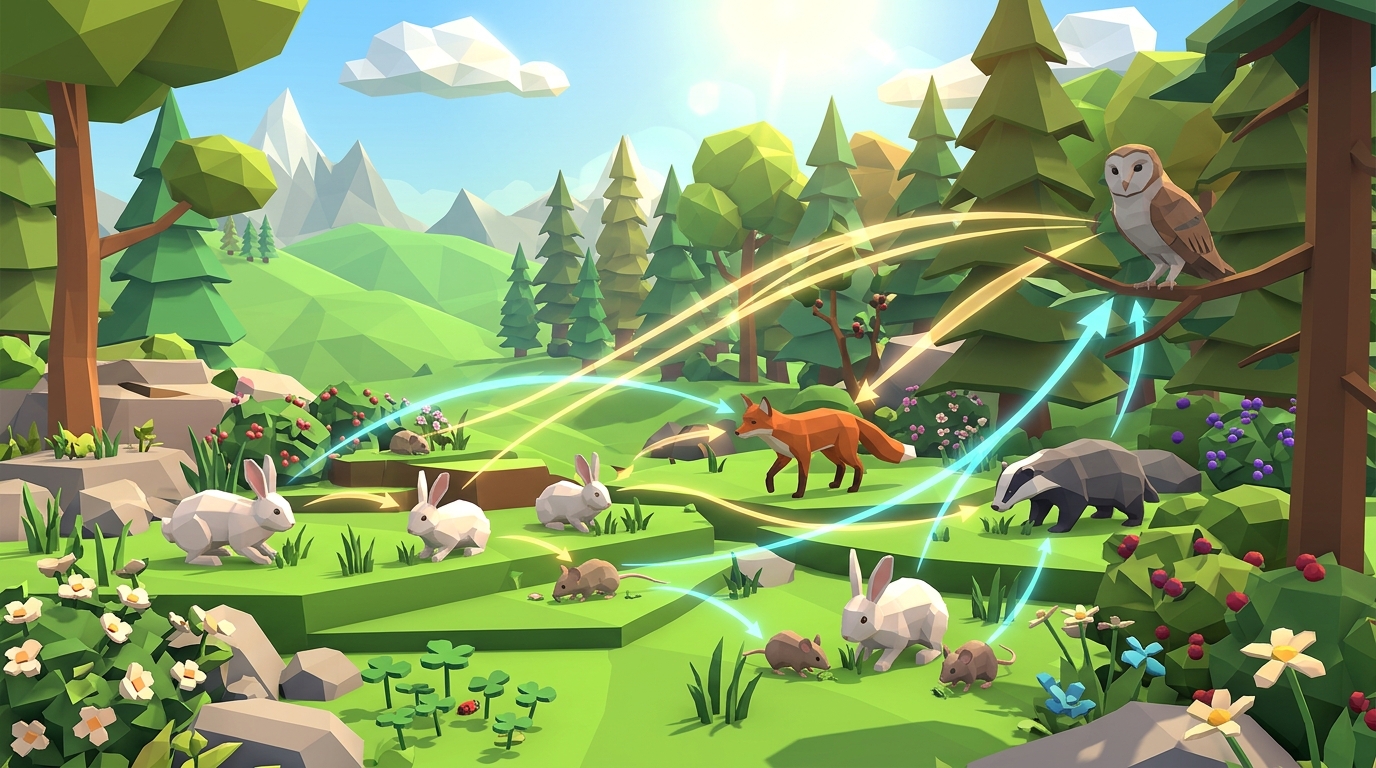
Students create interlocking construction paper loops color-coded by trophic role: Yellow (Sun), Green (Grass/Producer), Blue (Rabbit/Primary Consumer), Orange (Fox/Secondary Consumer), and Red (Hawk/Apex Predator). Breaking any link physically demonstrates how higher levels depend on foundational links.
- ✓Concepts: Trophic sequence, producer-consumer relationships
- ✓Materials: Construction paper strips, glue sticks, markers
- ✓Time: 20 minutes
The Living Yarn Food Web (Kinesthetic Class Network)
Grades 3-6 (Co-Ops & Classrooms)
Students stand in a circle wearing animal cards. The Sun holds a ball of yarn, tossing it to a plant, who tosses to an herbivore, until an intricate web connects the entire group. One student pulls their string to show how vibrations ripple across all species; when an organism drops out, the entire web sags.
- ✓Concepts: Ecosystem interconnectedness, multi-species feedback
- ✓Materials: Ball of yarn, index cards with organism names, hole punch, string
- ✓Time: 30 minutes
Owl Pellet Dissection & Skeletal Food Chain Reconstruction
Grades 4-8 (Anatomy & Predator Diets)
Students dissect heat-sterilized barn owl pellets using forceps and magnifying glasses. By separating and identifying rodent skulls, vertebrae, and hip bones against a bone identification chart, students reconstruct the owl exact prey food chain with physical forensic evidence.
- ✓Concepts: Apex predation, raptor physiology, biomass digestion
- ✓Materials: Sterilized owl pellet, dissection probe, tweezers, paper plate, bone chart
- ✓Time: 45 minutes
Virtual 3D Ecosystem Simulation & Trophic Cascades (Praxos Lab)
Grades 3-8 (Systems Thinking & Quantitative Modeling)
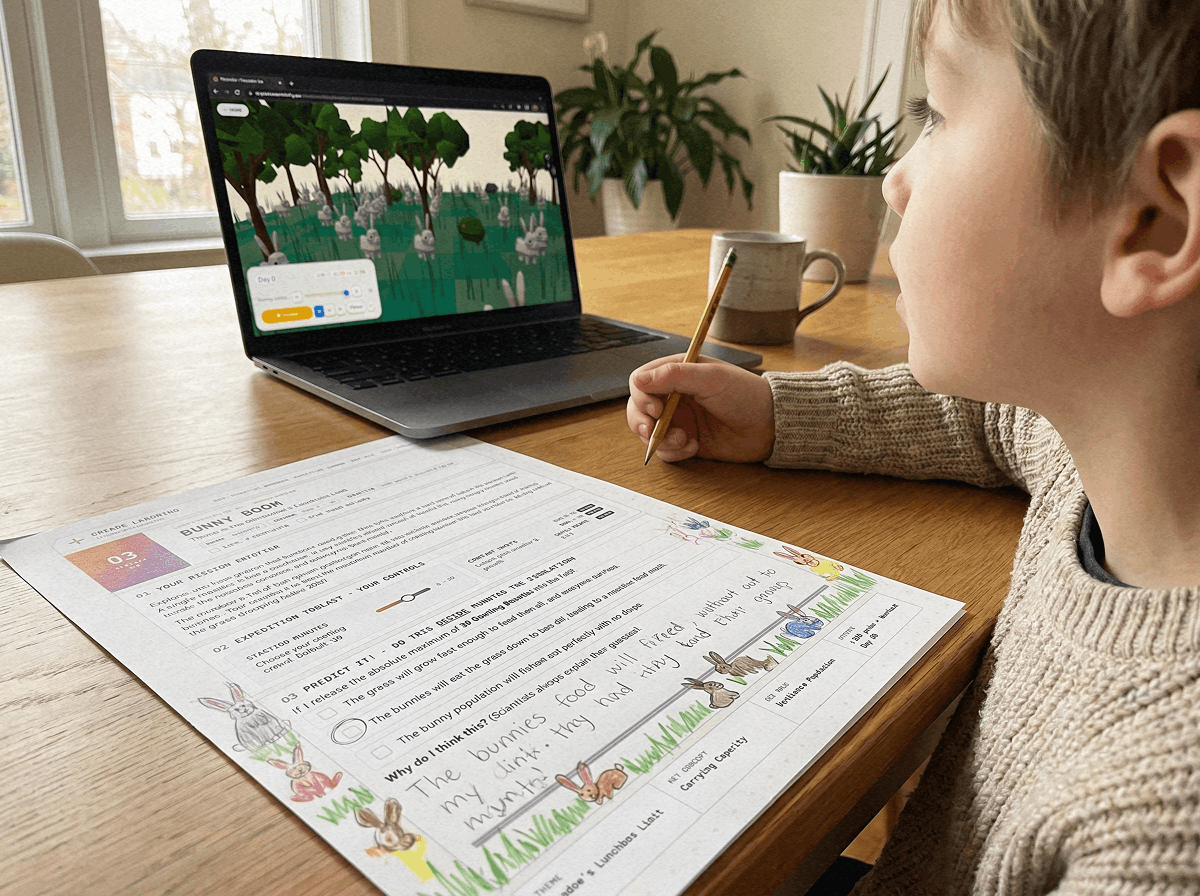
Students step into a live 3D sandbox in their web browser. By adjusting producer growth rates, initial herbivore counts, and carnivore hunting radii across 10-generation cycles, students record population curves and observe trophic cascades in real time on printable lab logbooks.
- ✓Concepts: Carrying capacity, predator-prey oscillations, energy limits
- ✓Materials: Web browser (Praxos Ecosystem) + printed 24-page lab logbook
- ✓Time: 30 minutes across 3 trials
Stacking Cup Energy Pyramids (10% Rule Math Model)
Grades 4-7 (Trophic Math & Energy Loss)
Using 100 plastic cups, students build a physical pyramid showing energy dissipation. The base uses 100 green cups (phytoplankton), the second level uses 10 blue cups (zooplankton), the third uses 1 yellow cup (fish), and a single small marker represents the apex predator, visually driving home the 90% energy loss rule.
- ✓Concepts: 10% ecological efficiency, biomass pyramids
- ✓Materials: 100 disposable cups, colored markers, ruler
- ✓Time: 25 minutes
Apex Predator Freeze Tag (Kinesthetic Energy Chase)
Grades 2-5 (Outdoor PE / STEM Integration)
An active playground game where 1 student is an Apex Hawk, 3 are Foxes, 8 are Rabbits, and cones represent Grass patches. Rabbits must touch grass cones to survive while avoiding foxes; foxes hunt rabbits to stay active. Demonstrates how predator-prey ratios dictate hunting success.
- ✓Concepts: Foraging efficiency, predator pressure, territory size
- ✓Materials: Cones or pinnies, open outdoor play area
- ✓Time: 30 minutes
Rotting Log & Soil Decomposer Terrarium
Grades 3-6 (Detritivores & Nutrient Cycles)
Build a miniature decomposing chamber in a clear jar using damp soil, decaying bark, dead leaves, and earthworms or pillbugs (isopods). Students observe the final link of the food chain as decomposers break organic matter back into nutrient-rich soil over 2 weeks.
- ✓Concepts: Decomposers, nutrient recycling, carbon cycle
- ✓Materials: Clear glass jar, damp forest soil, rotting wood, earthworms, spray bottle
- ✓Time: 2-week daily observation (5 mins/day)
Biome Food Web Card Matching Challenge
Grades 3-6 (Classification & Critical Thinking)
Students receive 24 illustrated cards of desert, ocean, forest, and tundra organisms. Working against a timer, they sort organisms into correct trophic categories and construct 3 independent 4-step chains with correct arrow directions.
- ✓Concepts: Biome-specific food webs, trophic classification
- ✓Materials: Printable organism cards, arrow tokens, timer
- ✓Time: 25 minutes
DIY Ecosystem Board Game Design Challenge
Grades 5-8 (Creative Synthesis & Game Design)
Students design their own board game where players collect primary producer resources, trade for consumer upgrades, and survive environmental hazard cards (such as drought, fire, or invasive species).
- ✓Concepts: System balance, carrying capacity, ecological hazards
- ✓Materials: Poster board, dice, index cards, game tokens
- ✓Time: 60 minutes
Multi-Generation Population Curve Graphing Lab
Grades 6-8 (Data Analysis & Mathematics)
Using raw trial data generated from Praxos Ecosystem, students plot multi-generational predator and prey counts onto two-variable line graphs, calculating phase lag and oscillation amplitude.
- ✓Concepts: Lotka-Volterra predator-prey cycles, mathematical modeling
- ✓Materials: Graph paper, colored pens, simulation data log
- ✓Time: 40 minutes
Activity Selection Matrix by Grade Level and Group Format
Use this matrix to choose the right activity for your homeschool setting, co-op, or classroom:
| Grade Level | Recommended Solo Activity | Recommended Group Activity | Key Learning Goal |
|---|---|---|---|
| GRADES K-3Grades K-3 | Activity #1 (Paper Chain Links) | Activity #6 (Apex Freeze Tag) | Linear sequencing and food chain roles |
| Grades 3-5 | Activity #4 (Praxos 3D Lab) & #8 (Card Match) | Activity #2 (Living Yarn Web) | Ecosystem balance and arrow direction rules |
| Grades 6-8 | Activity #3 (Owl Pellet) & #10 (Data Graphing) | Activity #5 (Cup Pyramid) & #9 (Game Design) | 10% energy law, carrying capacity & mathematical dynamics |
Best Practices for Running Food Chain Activities at Home or in Class
Maximize learning outcomes with these four practical guidelines:
Always Anchor the Arrow Direction First
Before beginning any activity, verify that students understand arrows point in the direction of energy flow (from the eaten organism toward the eater).
Combine Physical Crafting with Quantitative Testing
Pair tactile activities (such as paper chains or cup pyramids) with live simulation runs in Praxos to show how physical models translate into computational systems.
Introduce a System Disruption Scenario
In every activity, test what happens when one element changes: remove a primary producer, double an apex predator, or simulate a drought.
Maintain a Dedicated Science Lab Journal
Have students log hypotheses, drawings, and numerical results in their printed 24-page Expedition Science Journal for long-term retention.
Frequently Asked Questions About Food Chain Activities
Answers to common questions from elementary science teachers and homeschool educators.
What is the easiest food chain activity to start with at home?
How do these activities align with Next Generation Science Standards (NGSS)?
Can I use these activities with mixed-age homeschool siblings?
Are all simulation missions and printable journals free?
Launch Interactive Food Chain Activities with Praxos Lab
Make ecology unforgettable with our free interactive 3D science sandbox.
Start Level 1 instantly in your browser with zero registration. Unlock all 10 simulation missions and download the complete 24-page Expedition Science Journal 100% free with email.
Launch our interactive ecology simulation to test food webs, carrying capacity, and population dynamics.
START LEVEL 1 FREE10 Food Chain Activity Lab Guides & Printables (PDF)
A complete 24-page printable student lab journal featuring activity step-by-step checklists, cut-and-paste sorting cards, hypothesis logs, and trophic graphing grids for all 10 activities.