
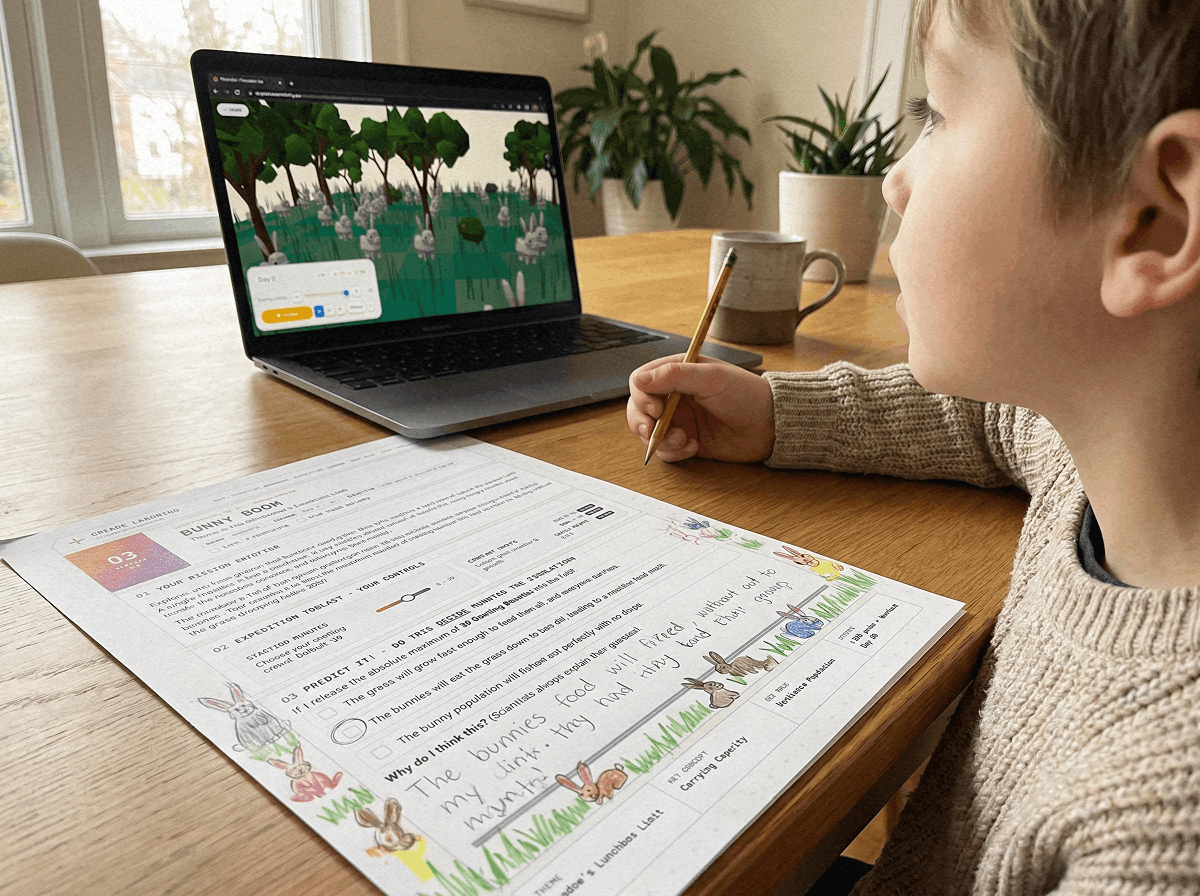
Why Portfolios Beat Standardized Test Scores
When state evaluators, charter school reviewers, or homeschool portfolio assessors examine a student's annual progress, a worksheet filled with multiple-choice bubbles provides very little insight into how the child genuinely reasons.
A physical science portfolio filled with dated hypotheses from a physical science journal provides undeniable proof of critical inquiry (explore why multiple-choice quizzes don't build intuition).
What State Reviewers and Evaluators Actually Look For
1. Authentic Student Voice: Evaluators want to see the child's original words, thinking process, and evolving explanations over time.
2. Data Literacy & Quantitative Reasoning: Clear evidence that the student can collect trial data, calculate equilibrium points, and interpret coordinate charts.
3. Methodological Progression: Documenting how the student learned to isolate variables and systematically test hypotheses from basic to advanced levels.
The 3 Core Components of an Outstanding Science Binder
1. The Prediction Trail: Dated mission sheets displaying the student's initial hypothesis before each simulation was run.
2. The Data Graphs: Hand-drawn population charts demonstrating that the student understands independent and dependent variables.
3. The Reflection Log: Short written paragraphs explaining why an experiment succeeded or what caused an unexpected system collapse.
Award your child an official Certificate of Scientific Mastery upon completing their 10-mission Expedition Logbook.
DOWNLOAD CERTIFICATE (PDF)Complete 10 Guided Labs
Start with Level 1 instantly in your browser (no sign-up needed). Complete all 10 missions and trial logs to build a full binder-ready science portfolio demonstrating ecological mastery.
Organizing Your Science Binder: A 4-Tab Master Template
Tab 1: Mission Logbook Sheets (Levels 1 to 10).
Tab 2: Hand-Drawn Population Graphs & Coordinate Charts.
Tab 3: Reflection Summaries & Dinner Roundtable Notes.
Tab 4: Official Certificate of Scientific Mastery.
Curating Evidence of Growth: The 5 Artifacts Every Evaluator Looks For
A compelling homeschool science portfolio does not consist of stacks of completed multiple-choice tests. Accredited evaluators, charter school oversight committees, and college admissions officers look for concrete evidence of authentic scientific thinking: the ability to frame testable questions, control variables, analyze numerical data, and synthesize conclusions.
Every exemplary science portfolio should showcase five core artifact types: (1) Initial Prediction Sketches illustrating mental models before experimentation, (2) Raw Quantitative Data Tables with handwritten student margin notes and measurement units, (3) Error Analysis Reflections documenting why an initial hypothesis was disproven, (4) Cross-Disciplinary Mathematical Graphs showing population growth or rate of change over time, and (5) Photographic or Digital Simulation Captures representing the physical or virtual experimental apparatus.
Encourage your student to date stamp every entry and write brief 2-sentence margin annotations explaining what surprised them. A portfolio that shows a student revising a flawed hypothesis three times demonstrates vastly deeper mastery than a folder filled with pristine, uncorrected worksheets.
Assessment Rubric for Inquiry-Based Science Logs
Evaluating open-ended science journals without standardized answer keys can feel daunting for homeschool parents. Using an objective 4-criteria rubric provides clear standards while encouraging creative experimentation across all grade levels.
Criteria 1: Variable Isolation (Did the student identify independent, dependent, and controlled variables clearly?). Criteria 2: Quantitative Fidelity (Are measurements recorded with proper units, structured tables, and chronological precision?). Criteria 3: Causal Reasoning (Does the student explain the underlying biological or physical mechanism rather than merely restating the final result?). Criteria 4: Iterative Synthesis (Did the student propose a logical follow-up experiment based on their findings?).
Reviewing journals monthly against this rubric allows parents to celebrate expanding analytical vocabulary and critical thinking skills rather than grading on rote memorization.
Certificate of Scientific Mastery (Printable)
An official printable certificate of achievement awarded upon completing all 10 Ecosystem expedition logs and lab experiments.