How Much Screen Time Should a 7 or 8-Year-Old Have Daily?
According to the American Academy of Pediatrics (AAP) and child development specialists, children aged 7 and 8 should generally be limited to 1 to 1.5 hours of recreational screen time on school days, and up to 2 hours on weekends. However, these limits specifically target passive entertainment (such as video streaming, social feeds, and arcade mobile games).
When screen time is dedicated to interactive educational tasks (like browser-based 3D science labs, introductory block coding, or typing practice), an additional 30 to 45 minutes of productive screen engagement is both safe and cognitively beneficial, provided sleep, physical movement, and homework are not displaced.
Developmental Breakdown: 7-Year-Olds vs 8-Year-Olds vs 9-Year-Olds
As children transition from early elementary (2nd grade) to upper elementary (3rd and 4th grade), their cognitive capacity and emotional self-regulation evolve significantly:
1. 7-Year-Olds (2nd Grade): Developing basic self-control and reading stamina. Visual stimulation is intense; rapid-cut videos can easily cause overstimulation and emotional dysregulation. Recommended limit: 45 to 60 minutes of recreational media, plus 20 to 30 minutes of guided educational inquiry.
2. 8-Year-Olds (3rd Grade): Expanding logical reasoning and spatial skills. Capable of navigating multi-variable simulations and multi-step digital projects. Recommended limit: 60 minutes of recreational media, plus 30 to 45 minutes of active STEM simulation or creative production.
3. 9-Year-Olds (4th Grade): Increasing independence and peer awareness. Begin managing digital assignments autonomously. Recommended limit: 60 to 90 minutes of recreational screen use, with flexible limits for creative coding, research, and interactive science modeling.
The Daily Balance Blueprint for Ages 7 to 8
A healthy day for a 7 or 8-year-old is defined by what happens off-screen just as much as on-screen. Use this balanced daily schedule as a baseline:
| Daily Activity | Recommended Duration | Developmental Priority | Screen Component |
|---|---|---|---|
| Nighttime Sleep | 9 to 11 Hours | Brain development, emotional regulation, memory consolidation | Zero screens in bedroom |
| Physical Play & Outdoor Activity | 60 to 90 Minutes | Gross motor skills, cardiovascular health, sunshine | 100% tech-free |
| Academic Learning & Reading | 4 to 5 Hours | Literacy, mathematics, critical thinking | Includes 30 min active digital lab |
| Family Meals & Chores | 60 to 90 Minutes | Life skills, conversational language, bonding | 100% tech-free zones |
| Recreational Free Time (Games/Shows) | 45 to 60 Minutes | Relaxation, creative unwind, social play | Capped and monitored |
The Quality Filter: Replacing Algorithmic Feeds with Active STEM Simulation
The primary source of screen-time meltdowns in 7 and 8-year-olds is the infinite scroll and unpredictable reward loop found in algorithmic video apps. These platforms trigger continuous dopamine spikes without giving the child a natural completion point.
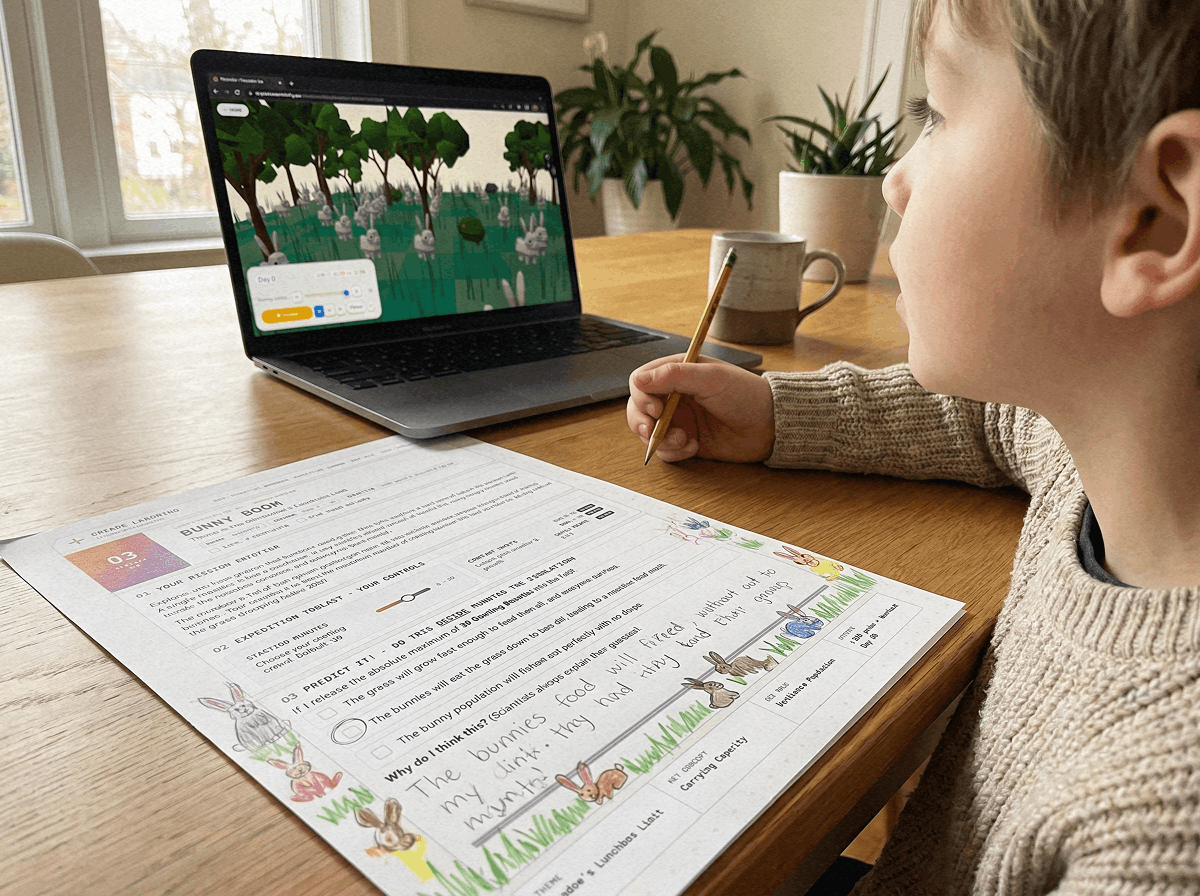
In contrast, goal-oriented educational tools (such as Praxos Ecosystem) provide structured scientific missions with clear beginning, middle, and end states. When a 7-year-old balances an ecosystem by finding the carrying capacity of rabbits and grasses, they experience authentic mastery satisfaction without addictive overstimulation.
4 Practical Household Screen Rules for 7 and 8-Year-Olds
Establish these four positive routines to eliminate daily screen negotiations and protect childhood focus:
Rule 1 (Zero Screens in Bedrooms Overnight): Charge all tablets, computers, and gaming devices in a central family charging station 60 minutes before bedtime to ensure deep, restorative sleep.
Rule 2 (The Create-Before-Consume Rule): Require that children complete creative, physical, or academic tasks (reading a book, building with LEGO, finishing homework, or completing a science simulation) before enjoying passive video entertainment.
Rule 3 (The 10-Minute Transition Runway): Avoid sudden device confiscation. Give a 10-minute and 2-minute verbal warning so the child can save their progress and mentally prepare for the transition.
Rule 4 (The Pencil-First Bridge): Require students to sketch hypotheses or record data in a physical science notebook during digital learning sessions to connect virtual discoveries to the real world.
Spend 10 minutes sitting alongside your child during educational simulation play. Asking open-ended questions like "What made the grass disappear?" deepens analytical thinking by over 40%.
Frequently Asked Questions About Screen Time for 7 and 8 Year Olds
How much screen time is healthy for a 7 year old?
How much screen time should an 8 year old have daily?
How much screen time for 9 year olds is normal?
Does educational screen time count toward daily limits for 7 and 8 year olds?
What are the signs that a 7 or 8 year old is getting too much screen time?
Start Meaningful Digital Science with Praxos Ecosystem
Give your 7 or 8-year-old high-yield screen time that teaches real scientific inquiry and systems thinking.
All 10 simulation missions and the printable 24-page Expedition Science Journal are 100% free with email. Level 1 starts instantly in your web browser with zero registration or download.
Watch your child master predator-prey dynamics and ecological balance in our 3D interactive laboratory.
LAUNCH FREE 3D LABPrintable 24-Page Science Lab Notebook
Hands-on cut-and-paste activities, animal habitat checklists, and population graphing worksheets designed specifically for grades 2-4.