The Straight-Line Trap: Why Traditional Schooling Leaves Kids Unprepared for Complex Problems
Have you ever watched a child try to fix a problem, only to accidentally create a brand new, bigger problem? That happens because standard school curricula almost exclusively teach straight-line thinking: "A causes B." If you push a domino, it falls over. If you flip a light switch, the light bulb illuminates.
Straight-line logic works well for simple mechanical tools. However, the real world; biology, ecosystems, technology, family dynamics, personal health, and economics; does not operate in neat straight lines. It operates in interconnected circular feedback loops.
When children learn to see systems rather than isolated events, their problem-solving ability transforms. Instead of looking for a single villain to blame or a magic button to fix everything, they begin analyzing the underlying structure, hidden delays, and multi-variable feedback loops that drive the behavior.
Straight-line thinkers ask: "What single action caused this event?" Systems thinkers ask: "What circular feedback loop keeps this entire pattern repeating, and what second-order consequences will our fix create?"
The 4 Core Pillars of Systems Thinking for Young Learners
You do not need an advanced engineering degree to teach systems thinking to elementary and middle school students. Introduce these four foundational concepts using simple physical analogies:
1. Stocks and Flows (The Bathtub Model). A stock is a reservoir of something that accumulates over time (like water in a bathtub, money in a bank account, or rabbit biomass in a meadow). Flows are the inflows that increase the stock (the faucet) and outflows that decrease it (the drain). If water is overflowing, you can either turn down the faucet or open the drain wider.
2. Balancing Feedback Loops (Negative Feedback / The Thermostat). Balancing loops resist change and seek stability. When your living room gets too cold, the thermostat triggers the furnace to heat the air; once warm, it shuts off. In ecology, when herbivores overpopulate, limited food slows reproduction back to carrying capacity.
3. Reinforcing Feedback Loops (Positive Feedback / The Snowball). Reinforcing loops amplify change and drive exponential growth or runaway collapse. A snowball rolling down a snowy hill picks up more snow, making it heavier, which makes it roll faster and gather even more snow.
4. Time Delays & Second-Order Consequences (The Hot Shower). When you adjust the temperature dial in a shower, the water takes five seconds to change. If you become impatient and crank the knob all the way hot, you will get scalded five seconds later. Teaching kids that causes and effects are often separated in time prevents over-correction.
| Everyday Scenario | Straight-Line Reaction ("A Causes B") | Systems Thinking Approach (Circular Feedback) |
|---|---|---|
| HOME HABITSMessy Bedroom | Parent yells; child cleans room once; room gets messy again 2 days later. | Examine the inflow/outflow: too many incoming toys without a clear daily storage system. |
| GARDENINGRabbits Eating Garden Plants | Eradicate all garden pests immediately with chemical sprays. | Recognize trophic role: lack of natural predators and habitat buffers causes herbivore surges. |
| LEARNINGSchool Procrastination | Label student "lazy" and assign more repetitive drill worksheets. | Identify the reinforcing loop: confusion leads to anxiety, anxiety causes avoidance, avoidance creates more confusion. |
| ECOLOGYEcosystem Management | Release 100 extra deer to help local hunters without tracking vegetation. | Model the multi-tier cascade: deer overgraze saplings, eroding soil and collapsing river banks. |
5 Engaging Systems Thinking Activities for Home and Classroom
1. The Living Thermostat Audit: Walk around your home with your child and map out self-regulating loops. Examine how the refrigerator maintains cool temperatures, how the toilet tank refills to an exact float line, and how human bodies sweat when overheated.
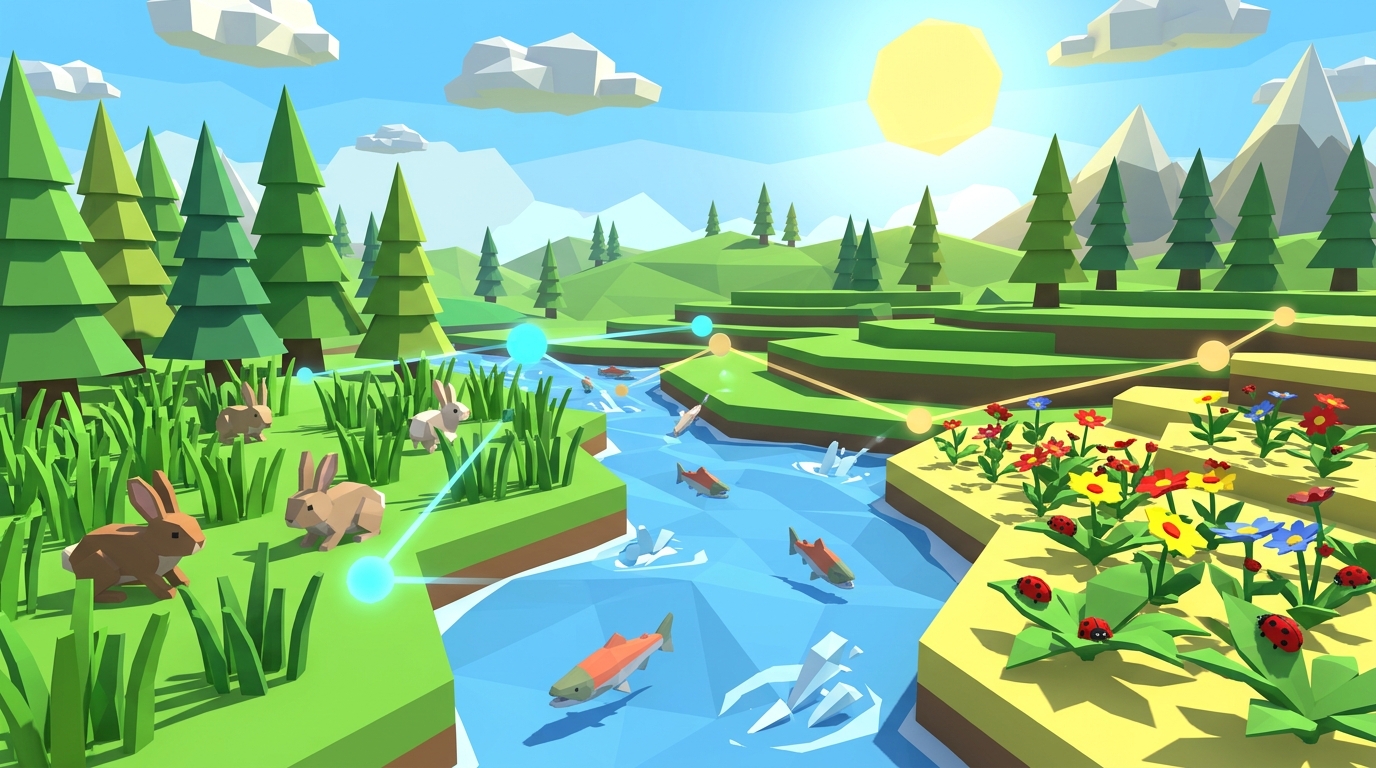
2. Causal Loop Arrow Mapping: Give your student a blank sheet of paper. Have them draw three elements (e.g. Grass, Rabbits, Wolves) and connect them with directional arrows labeled with "+" (reinforcing) or "-" (balancing).
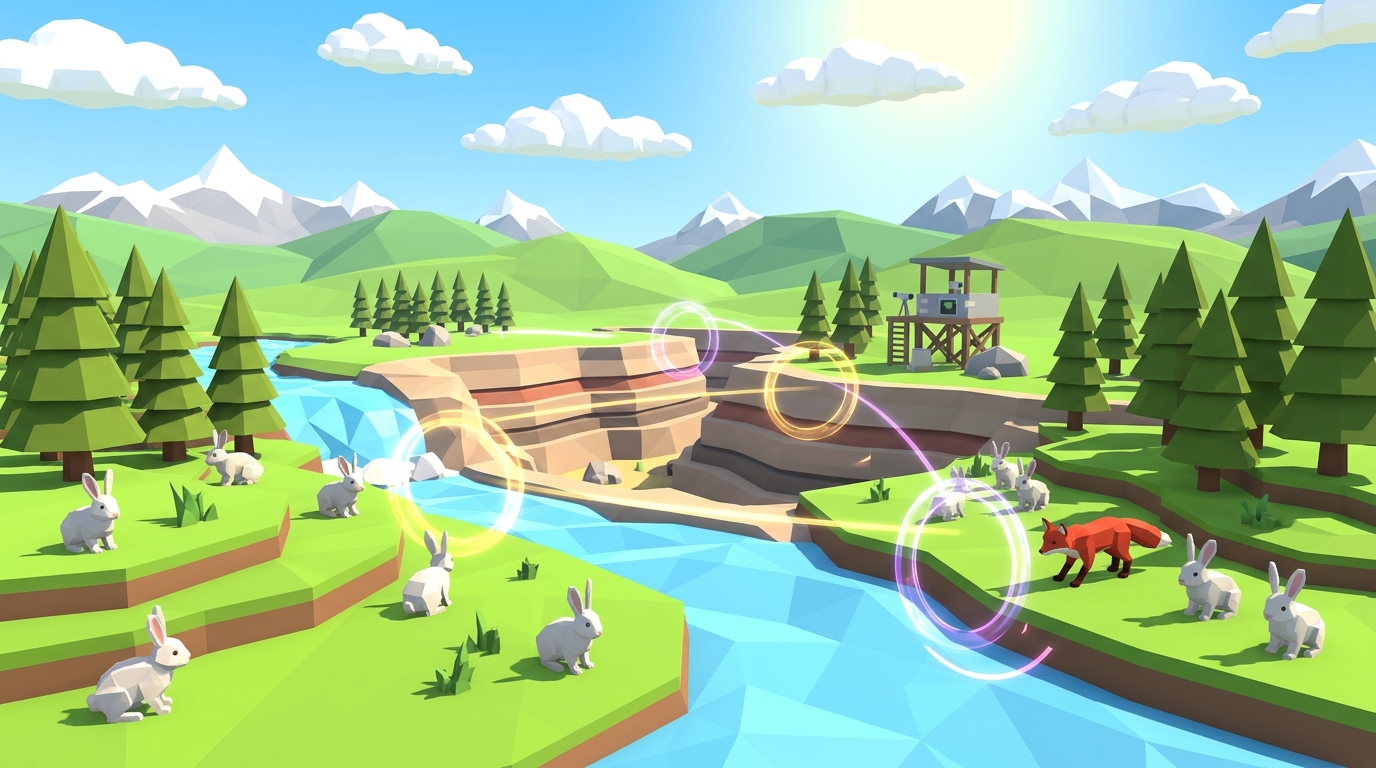
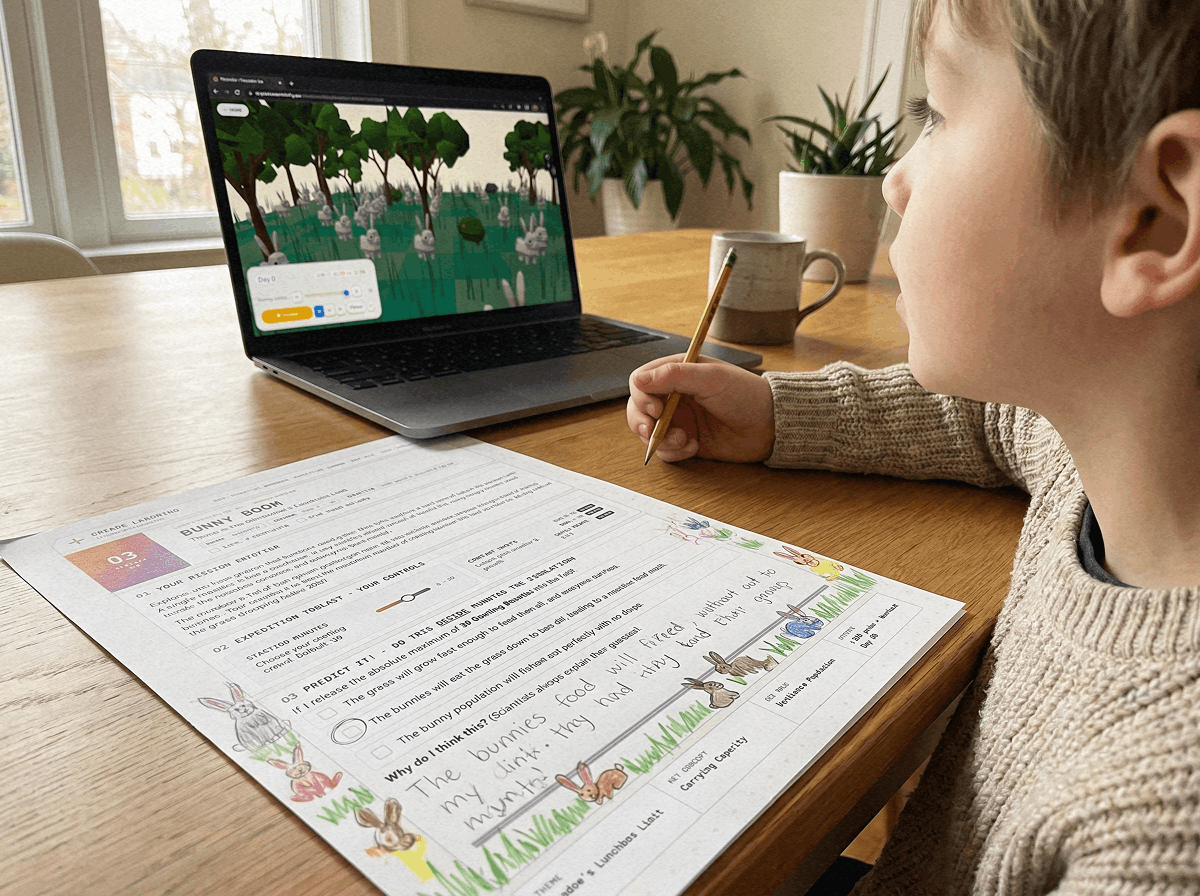
3. The 3D Dynamic Equilibrium Experiment: Launch Level 5 of the Praxos Ecosystem Simulation. Challenge your student to keep both rabbits and wolves alive for 60 consecutive virtual days by adjusting terrain hiding bushes and sunlight.
4. The "And Then What Happens?" Dinner Game: Pose a real-world scenario at dinner (e.g., "What if all traffic lights turned green at once?"). Every time someone gives an answer, the next person must ask: "And what second-order effect happens after that?"
5. The Bathtub Resource Simulation: Use a clear plastic cup with a tiny pinhole at the bottom. Pour water in at different speeds to demonstrate how inflow and outflow rates determine whether the stock rises, falls, or stays perfectly stable.
To explore more systems thinking frameworks, review my companion guides on how to teach the scientific method to kids, family style science curriculum, inquiry based science for kids, and carrying capacity explained.
Experience a Real Living System in 3D
Adjust plant growth rates, rabbit populations, and predator density to watch dynamic feedback loops balance or collapse in real time. Level 1 starts instantly with zero registration.
Why 3D Simulation Sandboxes Build Fearless Systems Thinkers
Textbooks and static worksheets can only show frozen moments in time. They cannot show the dynamic, living rhythm of a system as it breathes, oscillates, and responds to continuous stress.
Interactive 3D simulations allow children to step inside the role of a systems engineer. When a student dials up sunlight, introduces predators, or alters vegetation coverage, they watch the entire network ripple in real time.
If the ecosystem collapses, resetting the experiment takes exactly one second with zero cleanup. This fearless, iterative testing builds the deep cognitive intuition that empowers future scientists, innovators, and leaders.
The greatest gift we can give a young mind is not a catalog of static facts, but the mental toolkit to understand how the world connects, adapts, and thrives.
Frequently Asked Questions About Systems Thinking for Kids
Common questions from STEM educators, homeschool parents, and curious mentors.
At what age can children start learning systems thinking?
How does systems thinking connect to NGSS science standards?
What is the difference between critical thinking and systems thinking?
Are the systems thinking worksheets and 3D simulation levels free?
Master Systems Thinking in 3D
Put systems thinking into immediate practice with an interactive living ecosystem sandbox.
Start Level 1 instantly in your browser with zero registration. Unlock all 10 simulation missions and download the complete 24-page Expedition Science Journal 100% free with email.
Step inside Level 01: Solar Spark and explore dynamic feedback loops in real time.
START LEVEL 1 FREESystems Thinking Starter Sheet & Journal (PDF)
A complete systems thinking worksheet set with causal loop diagrams, stock-and-flow trackers, and the 24-page Expedition Science Journal.