What Is a Scientific Model in Elementary Education?
In many elementary science classrooms, the word "model" brings to mind a painted styrofoam solar system hanging from coat hangers or a papier-mache volcano erupting with baking soda and vinegar. While these physical crafts are memorable, they often miss the true heart of scientific practice.
In modern STEM education and the Next Generation Science Standards (NGSS Science and Engineering Practice 2: Developing and Using Models), a scientific model is not merely a static replica. A model is an explanatory thinking tool. Scientists construct models to conceptualize unseen mechanisms, formulate hypotheses, run experiments, and communicate complex phenomena.
Whether you are teaching in an elementary science classroom or guiding your homeschool learner through what inquiry is in science, introducing diverse model formats transforms science from rote memorization into active discovery.
An authentic science model allows a student to ask "What if I change this variable?" and observe how the system responds. If a model cannot test a prediction, it is a decoration, not a scientific instrument.
The 8 Types of Elementary Science Models
Elementary science topics span life science, earth and space science, and physical science. To help students make sense of these diverse domains, teachers and homeschool educators can leverage eight distinct modeling modalities:
Physical Scale Models (3D Replicas)
Earth & Space Science, Macro Systems
Tangible physical representations built to proportional scale. Examples include proportional planetary orbit models, clay cross-sections of Earth crustal layers, and articulated skeletal arm models demonstrating tendon motion.
Conceptual Diagrams & System Flowcharts
Cyclic Processes & Phase Changes
Visual maps illustrating sequential transitions and feedback loops. Classic examples include the water cycle (evaporation, condensation, precipitation), the rock cycle, and plant seed dispersal pathways.
Trophic Energy Webs & Food Chains
Ecosystem Interactions & Energy Transfer
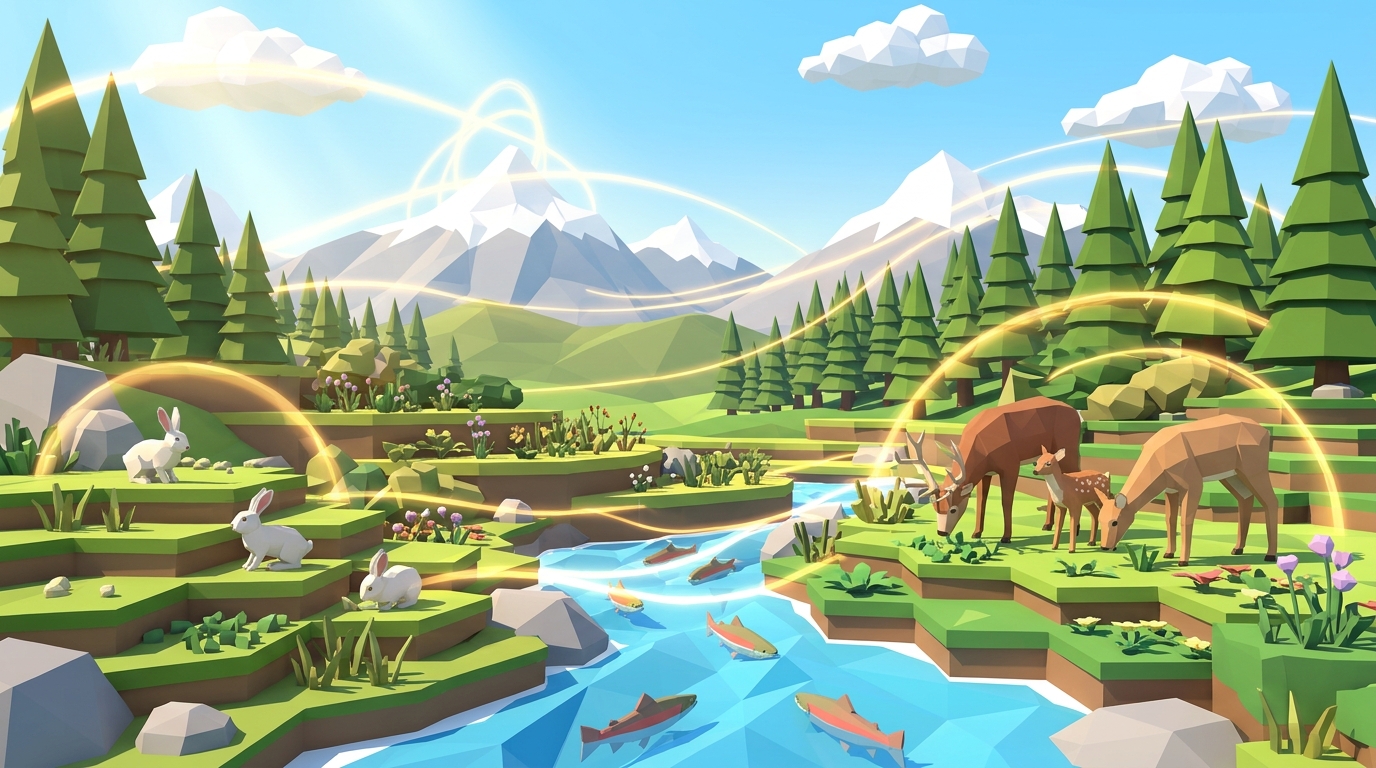
Structured node-and-arrow diagrams mapping the flow of chemical energy from primary producers to apex predators. Learn how to construct them in our guide on how to make a food chain and discover what arrows on a food web mean.
Interactive 3D Computer Simulations
Complex Feedback Loops & Real-Time Experimentation
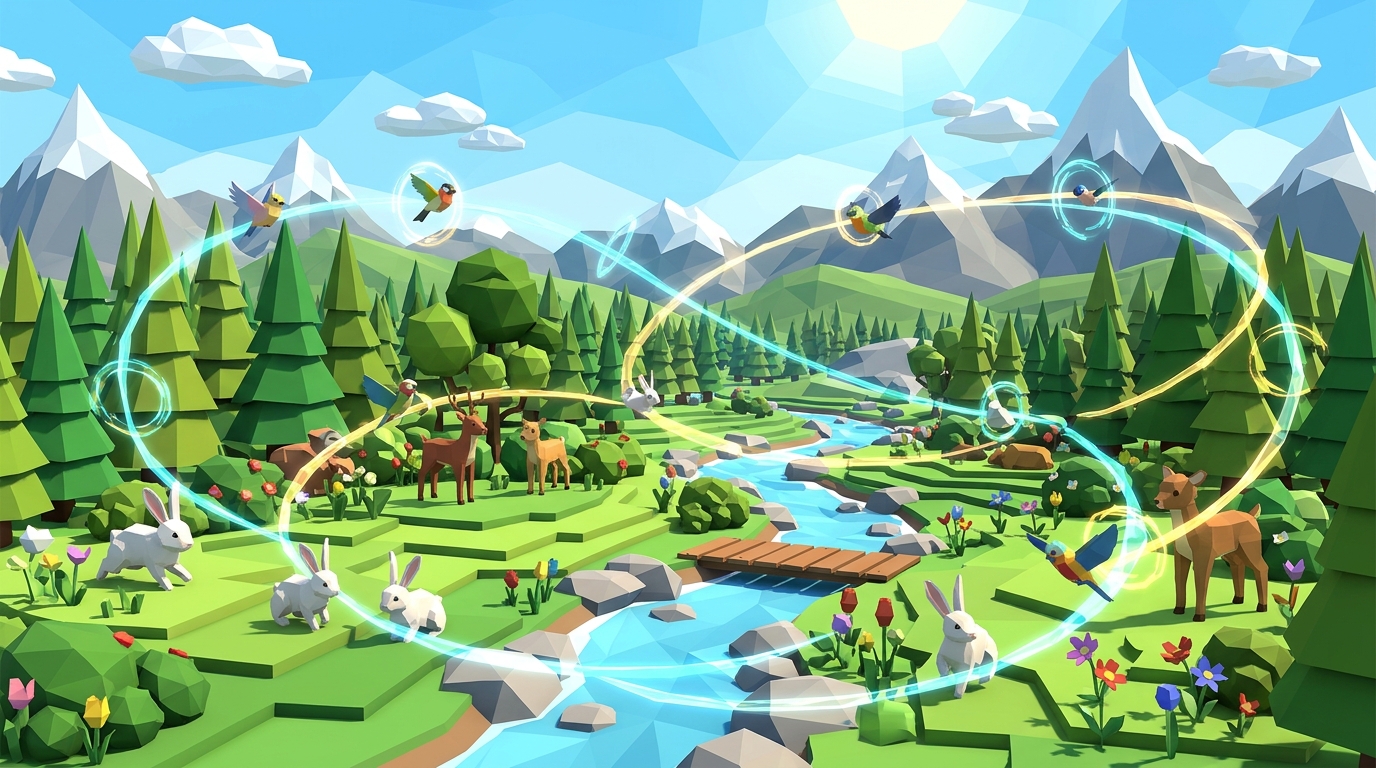
Dynamic digital sandboxes where students manipulate environmental variables and observe emergent outcomes. In our free ecosystem simulation for kids, learners adjust abiotic sun and rain sliders to witness plant growth cycles in real time.
Mathematical & Population Trend Graphs
Quantitative Data & Pattern Recognition
Line graphs, bar charts, and scatter plots that translate natural observations into mathematical patterns. Students plot herbivore population numbers over time to visualize S-curves in our carrying capacity lesson plan.
Living Mesocosms & Micro-Ecosystems
Longitudinal Biological Observation
Enclosed physical habitats that model real-world ecosystem functions on a miniature scale. Examples include sealed two-liter bottle terrariums, desktop worm composting bins, and aquatic snail jars showing balanced oxygen-carbon cycles.
Kinesthetic Roleplay & Analogy Models
Microscopic & Invisible Particle Dynamics
Embodied learning models where students physically act out scientific phenomena. For instance, students act as tightly packed vibrating ice molecules, spreading out as heat energy is added to model melting and boiling.
Structural Cross-Sections & Cutaway Views
Internal Anatomy & Hidden Structures
Cutaway representations revealing interior layers and mechanisms. Examples include sliced bean seed anatomy (showing embryo and cotyledon), leaf cross-sections showing stomata and chloroplasts, and soil horizon cores.
How to Choose the Right Model for Elementary Science Topics
Different science concepts require different modeling approaches. Matching the target elementary science topic to the right model type prevents common misconceptions and enhances student retention.
| Science Topic | Target NGSS Standard | Optimal Model Type | Misconception Corrected |
|---|---|---|---|
| Plant Growth & Photosynthesis | 5-LS1-1 (Matter and Energy) | Interactive 3D Simulation & Seedling Dissection | Corrects the belief that plants "eat" soil as food rather than synthesizing glucose from air and light. |
| CORE PRAXOS FOCUSEcosystem Food Webs | 5-LS2-1 (Trophic Energy Transfer) | Food Web Diagram & Population Graph | Corrects the idea that arrows point to what is eaten rather than showing energy flow direction. |
| Water Cycle & Weather Systems | 3-ESS2-1 (Earth Systems) | Sealed Bag Terrarium & Flowchart Diagram | Corrects the misconception that evaporated water disappears permanently from the biosphere. |
| States of Matter & Thermal Energy | 2-PS1-4 (Properties of Matter) | Kinesthetic Particle Roleplay & Clay Molecules | Corrects the misconception that cold is an added substance rather than the absence of thermal energy. |
How to Facilitate Modeling in an Elementary Classroom or Homeschool
To help elementary students build scientific modeling skills, follow this straightforward 4-step pedagogical cycle:
Observe Phenomenon and Sketch an Initial Mental Model
Present students with an intriguing natural question (e.g. "Why did all the fish in the pond die after the algae bloom?"). Have them draw their initial theory on paper using arrows, labels, and color codes before any formal lecture.
Manipulate a Physical or Computational Model
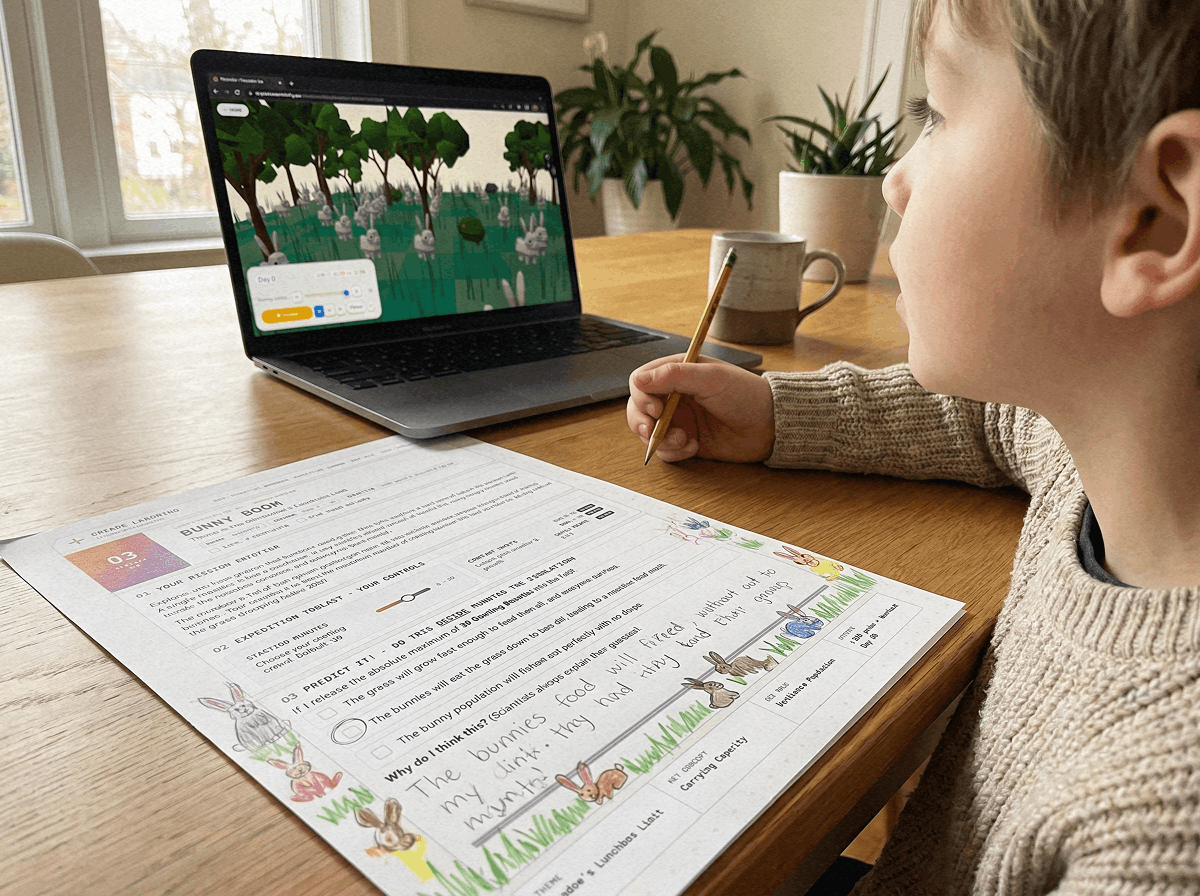
Provide a hands-on tool or digital simulation where students can alter individual variables. In an ecosystem lab, students adjust predator numbers or light levels to test what happens to surrounding organisms.
Record Quantitative Evidence in Lab Logbooks
Have students log exact data, graph population counts, and write down surprising outcomes in their lab journals. Dual-format learning (screen experimentation paired with paper logging) deepens retention.
Revise and Defend the Final Scientific Model
Students return to their initial sketch in Step 1. Using colored pens, they revise their diagrams to reflect their new discoveries, citing evidence gathered during their simulation experiments.
Frequently Asked Questions About Elementary Science Models
Here are common questions educators ask when implementing scientific modeling in elementary grades:
Question: What is the main purpose of using models in elementary science?
Answer: The main purpose is to give students a concrete way to visualize, test, and explain phenomena that are otherwise invisible, microscopic, or too vast to experience directly in a classroom.
Question: Can elementary students use computer simulations as models?
Answer: Yes. Modern web-based 3D simulations are among the most effective models for elementary grades because they provide instant visual feedback without requiring complex math software or chemical setup.
Question: How does NGSS evaluate scientific modeling in elementary grades?
Answer: NGSS evaluates modeling based on whether students can use their model to generate predictions, explain causal relationships, and revise their models when presented with new scientific evidence.
Question: How does Praxos incorporate elementary science models?
Answer: Praxos provides a living 3D computational ecosystem model where students test food web dynamics, carrying capacity limits, and trophic cascades across 10 progressive simulation missions, accompanied by printable student lab journals.
Elementary Science Modeling & Hypothesis Journal
A free 24-page printable student lab logbook designed to guide young learners through model sketch prediction, data tracking, and evidence synthesis.