What Should an Earth & Environmental Science Curriculum Cover?
Planet Earth is not a collection of static rocks and inert gases; it is an active, self-regulating planetary engine. Earth science investigates the complex interactions between Earth's four interconnected spheres:
1. The Geosphere (Lithosphere): Plate tectonics, volcanic eruptions, the rock cycle (igneous, sedimentary, metamorphic), mountain formation, and soil composition.
2. The Hydrosphere: Global ocean currents, freshwater aquifers, evaporation, condensation, precipitation cycles, and watershed dynamics.
3. The Atmosphere: Air pressure gradients, tropospheric weather patterns, wind circulation cells, climate zones, and greenhouse heat retention.
4. The Biosphere: How living communities adapt to abiotic physical conditions, cycling carbon, nitrogen, and phosphorus across global biomes.
For homeschool families in grades 3 through 8, teaching earth science provides essential context for understanding climate patterns, natural resources, and environmental stewardship.
Living ecosystems do not exist in a vacuum. The abiotic factors studied in earth science (sunlight angle, seasonal precipitation, soil mineral content) establish the physical carrying capacity of every living biome on Earth.
Comparing 4 Homeschool Earth Science Approaches
Homeschool parents have several distinct pedagogical philosophies to choose from when designing an earth and environmental science unit. Here is how the four most popular approaches compare:
| Curriculum Approach | Primary Modality | Best Grade Level | Core Strength | Potential Limitation |
|---|---|---|---|---|
| Classical Trivium | Memorization of rock types, geological eras, and vocabulary recitations. | Grades 3-6 (Grammar / Logic) | Builds strong scientific taxonomy and chronological historical framework. | Can feel dry and abstract without dynamic interactive experimentation. |
| Living Books (Charlotte Mason) | Narrative biographies of naturalists, nature study walks, and watercolor journaling. | Grades K-6 | Deeply engaging storytelling that nurtures wonder and aesthetic appreciation. | Often lighter on quantitative data graphing and rigorous variable testing. |
| Traditional Textbook / Boxed Kit | Chapter reading passages, end-of-unit tests, and boxed rock mineral kits. | Grades 6-8 | Familiar structure, clear grading rubrics, and predictable weekly pacing. | Kits can be costly with single-use consumables; tests emphasize rote recall. |
| RECOMMENDED DUAL-FORMATDual-Format Inquiry Simulation (Praxos) | Printable field logbooks paired with interactive 3D computational labs. | Grades 3-8 | Multi-variable abiotic modeling, zero setup, 100% free software access. | Requires internet-connected computer or tablet for simulation sessions. |
Abiotic Factors in Action: How Earth Science Drives Living Ecosystems
In many traditional curricula, earth science and life science are taught in separate school years with little cross-disciplinary synthesis. However, understanding abiotic factors is the foundation of ecological intuition.
When students adjust abiotic sliders in a computational lab, they see cause-and-effect relationships that take decades to observe in nature:
Sunlight Intensity: Drives plant photosynthesis rates. Lowering solar radiance reduces glucose synthesis, limiting herbivore forage in our sun, rain, and soil lab.
Precipitation & Soil Moisture: Determines plant germination and vegetative density. Simulating prolonged drought triggers an immediate population bottleneck for herbivores.
Thermal Equilibrium & Seasonal Stress: Tests the carrying capacity of living organisms under shifting climatic extremes.
A biome is simply an ecosystem defined by its abiotic earth science parameters: average annual temperature and total precipitation. Alter those two numbers, and a lush temperate forest shifts into a semi-arid grassland.
A 4-Step Earth Science Investigation Routine for Homeschoolers
To cultivate authentic scientific habits, follow this 4-step investigation framework when exploring earth and environmental science topics:
Outdoor Field Observation & Local Weather Logging
Begin with real-world observation. Have your student record daily temperature, cloud formations, rainfall measurements, and soil moisture levels in their nature logbook.
Variable Isolation in a 3D Simulation Sandbox
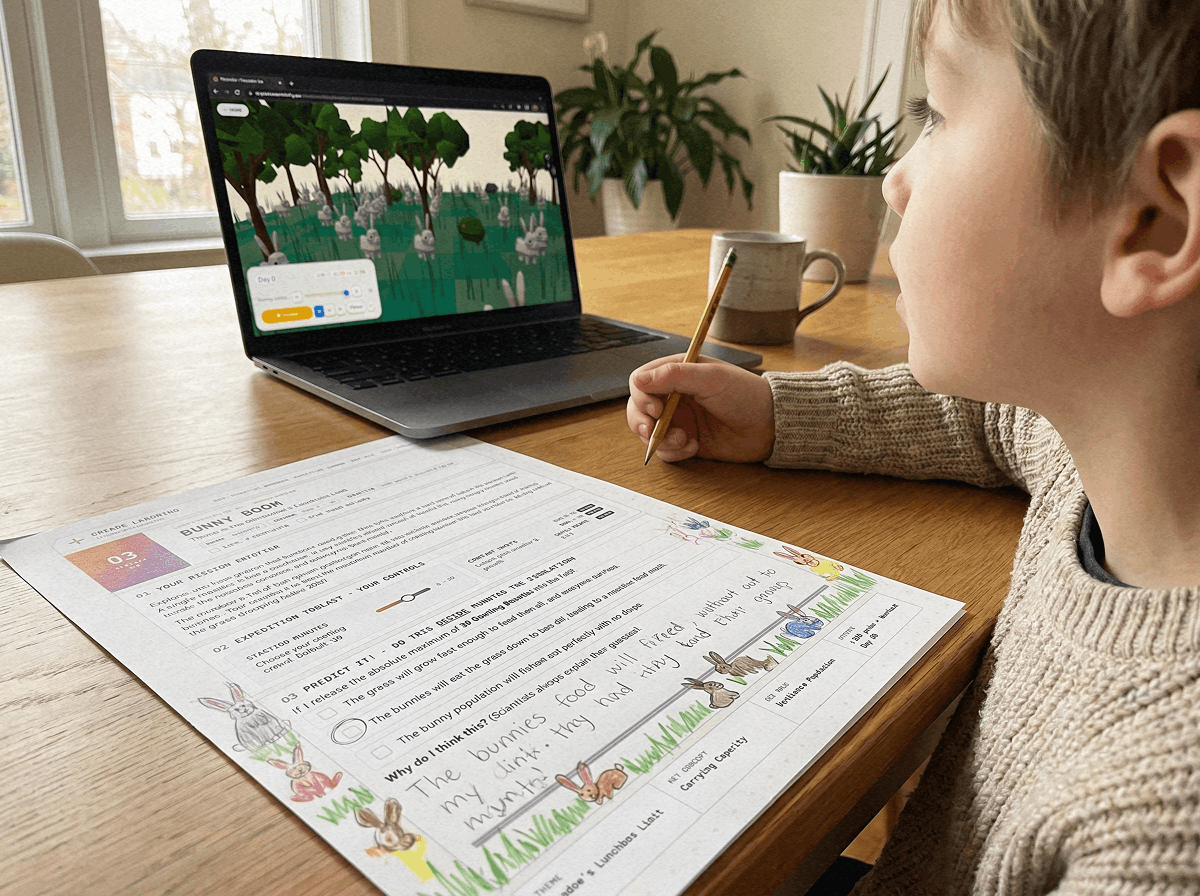
Transition to an interactive computational model. In Praxos Level 1, students test how varying sunlight and rainfall affects plant biomass and energy transfer in a controlled environment.
Coordinate Graphing & Mathematical Analysis
Students plot their trial results on coordinate grids, tracking the mathematical relationship between abiotic moisture input and primary producer biomass.
Claim-Evidence-Reasoning (CER) Synthesis
The student writes a structured conclusion explaining how abiotic earth forces regulate the biological carrying capacity of the environment.
Frequently Asked Questions About Earth Science Homeschooling
Here are answers to common questions parents ask when selecting earth science resources:
What grade is best for homeschool earth science?
Earth science is commonly taught in 3rd or 4th grade in elementary school, and in 7th grade in middle school where students explore plate tectonics, climate modeling, and biogeochemical cycles.
How does earth science connect to life and physical science?
Earth science provides the physical abiotic stage where biological life unfolds, while relying on physical chemistry principles (thermodynamics, atomic structure, and gravity) to explain geological and atmospheric forces. Explore our middle school science topics scope.
What free resources are available for homeschool earth science?
Praxos Learning provides a complete 10-level interactive 3D ecosystem and abiotic simulation lab, along with a free 24-page printable student journal at `praxoslearning.com`.
Earth Science Field Investigation Journal
A 24-page printable student logbook with weather tracking grids, rock cycle charts, and biome stability rubrics.