The Engine of Living Systems: Why Abiotic Factors Control All Life
When children explore a forest or park, their attention immediately fixes on living things: running squirrels, singing robins, scurrying beetles, and tall oak trees. These living components are known in science as biotic factors.
However, none of these organisms could survive for even a few minutes without non-living components: the abiotic factors. The radiant heat from the sun, moisture falling as rain, carbon dioxide drifting through the air, and microscopic mineral crystals in the soil form the indispensable foundation of every ecosystem.
What is the connection between photosynthesis and abiotic factors? Photosynthesis is the exact biological bridge where abiotic matter transforms into biotic life. Green plants capture non-living solar photons, water molecules, and atmospheric gas, synthesizing rich organic sugars that fuel every herbivore, carnivore, and decomposer on Earth.
Abiotic factors are the non-living ingredients (sunlight, rain, soil minerals, carbon dioxide); photosynthesis is the chemical process that turns those non-living ingredients into living plant food.
Biotic vs. Abiotic Factors: The Essential Classroom Breakdown
To help students master ecology, categorizing ecosystem components into biotic (living or once-living) and abiotic (never living) factors provides an intuitive foundation.
| Ecosystem Component | Classification | Primary Function | What Happens When It Is Missing? |
|---|---|---|---|
| PRIMARY ENERGYSunlight / Solar Radiation | Abiotic Factor | Energizes chlorophyll molecules during photosynthesis | Vegetation cannot synthesize glucose; plant mortality within weeks |
| SOLVENT OF LIFEWater / Precipitation | Abiotic Factor | Hydrates plant cells; splits water molecules during photosynthesis | Severe drought causes cell turgor loss and catastrophic wilting |
| NUTRIENTSSoil Minerals (N, P, K) | Abiotic Factor | Provides chemical building blocks for plant proteins and DNA | Stunted foliage growth, chlorosis, and reduced seed production |
| LIVING BASEPrimary Producers (Grass, Trees) | Biotic Factor | Converts abiotic inputs into animal-edible plant biomass | Primary consumers starve; ecosystem carrying capacity collapses to zero |
| CONSUMERSHerbivores & Carnivores | Biotic Factor | Distributes energy across higher trophic tiers; regulates plant cover | Plants overgrow initial capacity or succumb to disease unchecked |
Photosynthesis Demystified: The Kitchen Recipe of Plants
Many textbooks intimidate young learners with complex chemical formulas like 6CO2 + 6H2O -> C6H12O6 + 6O2. In hands-on teaching, it is far more effective to explain photosynthesis as a solar baking recipe.
Ingredients:
1. Sunlight: The stove heat (energy). Plant leaves act like tiny solar panels containing microscopic green pigments called chlorophyll.
2. Water: Sucked up from deep soil through roots like microscopic drinking straws.
3. Carbon Dioxide: Inhaled from the air through microscopic mouth-like pores on leaf surfaces called stomata.
The Output:
Inside the plant's chloroplasts, solar energy breaks apart water and carbon dioxide, reassembling their carbon, hydrogen, and oxygen atoms into glucose: plant sugar. As a generous byproduct, the plant exhales clean oxygen gas into the air, which animals and humans breathe every second.
Plants absorb what animals exhale (carbon dioxide), and release what animals inhale (oxygen). At the same time, they turn sunshine into sugar.
Forest Animal Food Web: How Photosynthesis Feeds the Woods
To see how photosynthetic energy travels through a forest biome, consider how energy flows through a temperate woodland food web:
At the base, deciduous oak trees produce thousands of acorns, while understory berry bushes produce sweet fruit. Both rely entirely on sunlight, rain, and rich forest loam.
Primary consumers (herbivores and granivores) eat this plant harvest directly: caterpillars munch oak leaves, field mice gather wild acorns, and white-tailed deer browse succulent shrubs.
Secondary consumers hunt these herbivores: songbirds pluck caterpillars from leaves, red foxes catch mice in grassy meadows, and barn owls hunt under cover of darkness.
At the top, apex predators like bobcats and red-tailed hawks maintain population balance across secondary consumers. When any organism dies, fungi and earthworms decompose the organic matter, returning minerals to the soil for tree roots to absorb again.
Hands-On Plant Energy Tracker: A 4-Step Home or School Investigation
Rather than merely reading about photosynthesis, students can test abiotic variables directly with this practical scientific trial:
Plant Three Identical Bean Seedlings
Sprout three fast-growing bean seeds in identical cups containing the same volume of potting soil.
Isolate One Abiotic Variable Per Plant
Keep all factors identical except for the target abiotic test variable: Plant A gets daily light and water, Plant B gets water in complete darkness, Plant C gets bright light but zero water.
Record Daily Height and Leaf Pigment in the Lab Journal
Measure shoot height with a millimeter ruler each morning and record qualitative leaf pigmentation (vibrant green vs pale yellow chlorosis).
Model Extreme Climate Shifts in the 3D Simulator
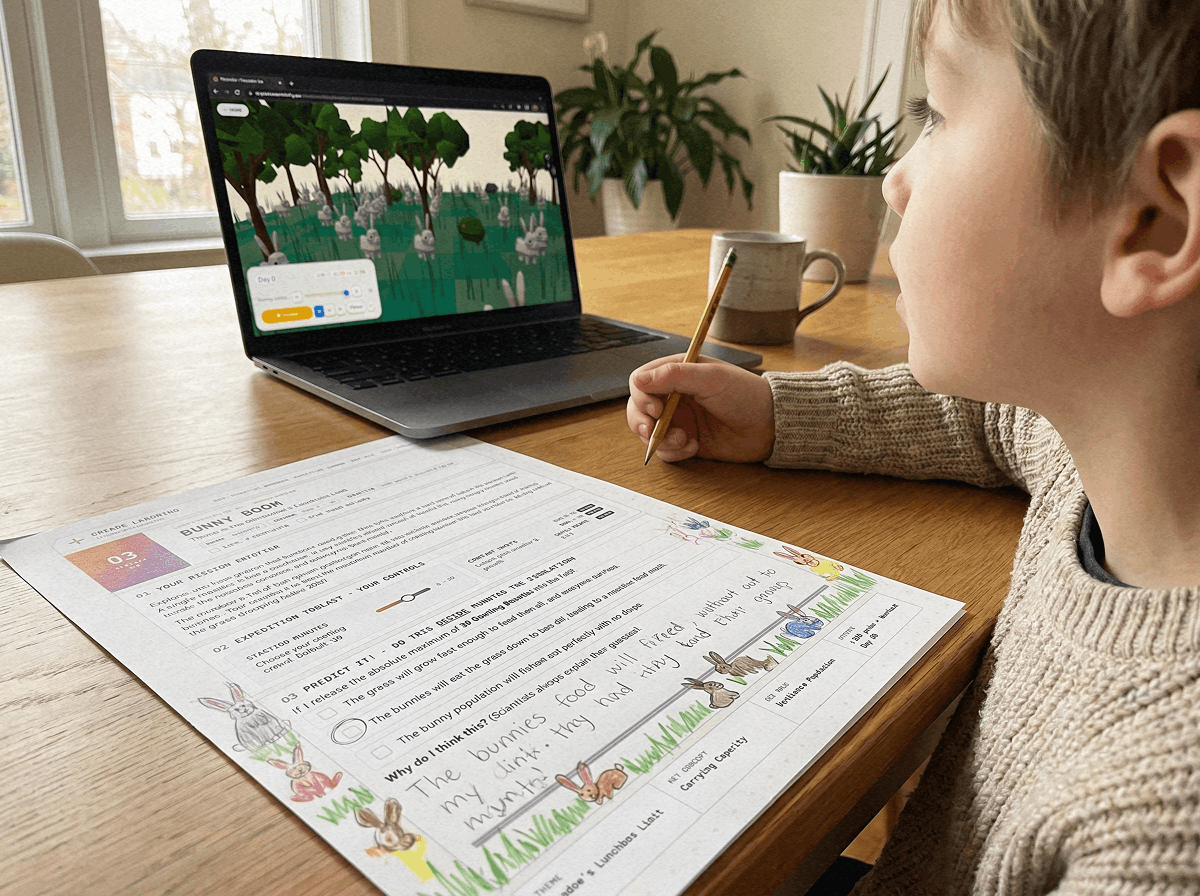
Open Level 1 in Praxos. Slide sunlight to minimum and rainfall to maximum to observe how digital plant biomass curves respond compared to your physical seedlings.
Frequently Asked Questions About Photosynthesis & Abiotic Factors
Answers to common questions from STEM teachers, homeschool parents, and curious young scientists.
Can plants undergo photosynthesis under artificial lamp light?
Do plants make food at night?
What happens to a forest food web if an extended drought occurs?
Are all simulation missions and printable worksheets free?
Experiment with Sun and Rainfall in the Praxos 3D Lab
Test how abiotic variables control living ecosystems in an interactive browser sandbox.
Start Level 1 instantly in your browser with zero registration. Unlock all 10 simulation missions and download the complete 24-page Expedition Science Journal 100% free with email.
Step inside Level 01: Solar Spark to manipulate sunlight intensity and precipitation levels and watch plant biomass react in real time.
START LEVEL 1 FREEPlant Energy Tracker & Science Journal (PDF)
A 24-page hands-on student lab journal with dedicated sunlight-growth logging sheets, abiotic parameter worksheets, and plant cell diagram templates.