Understanding the Prairie and Grassland Biome
Vast expanses of open land, sweeping winds, and endless seas of golden vegetation define the North American prairie. Unlike dense woodlands or mountain slopes, temperate grasslands receive intermediate rainfall: enough to nourish deep-rooted perennial grasses, but not enough to support widespread forests.
Periodic lightning fires, severe summer droughts, and intense grazing by native herds historically prevented woody shrubs from colonizing the plains. As a result, the prairie ecosystem food chain evolved unique physical dynamics.
With no towering tree canopies to intercept sunlight, virtually 100% of solar radiation strikes ground-level foliage. This makes temperate grasslands some of the most productive photosynthetic engines on the planet, producing enormous volumes of energy that nourish massive populations of primary consumers.
A prairie food chain traces energy from native grasses (producers) through herbivores like grasshoppers and prairie dogs (primary consumers), to carnivores like garter snakes and badgers (secondary consumers), reaching apex predators like red-tailed hawks and coyotes (tertiary consumers).
The 5 Trophic Levels of the Prairie Food Chain
Energy flows linearly through specific feeding ranks known as trophic levels. In a healthy grassland ecosystem, energy passes through five distinct tiers:
1. Primary Producers (Autotrophs / Level 1): Native perennial grasses such as big bluestem, little bluestem, and switchgrass, alongside vibrant wildflowers like purple coneflower and black-eyed Susan. Their roots penetrate up to 10 feet into the soil, storing solar energy converted through photosynthesis.
2. Primary Consumers (Herbivores / Level 2): Plant eaters that feed directly on seeds, blades, and roots. This includes insects like differential grasshoppers, burrowing rodents like black-tailed prairie dogs and pocket gophers, and large ungulate grazers like American bison and pronghorn.
3. Secondary Consumers (Carnivores & Omnivores / Level 3): Predators that hunt primary consumers. Plains garter snakes feast on crickets and grasshoppers, western meadowlarks forage for caterpillars, and American badgers excavate rodent tunnels.
4. Tertiary & Apex Predators (Carnivores / Level 4): Top-ranking hunters that regulate secondary and primary consumer densities. Red-tailed hawks spot rodents from high thermal updrafts, while coyotes maintain broad predatory control over rabbits and mice.
5. Decomposers & Detritivores (Nutrient Recyclers / Level 5): Ground beetles, mycorrhizal fungi, and soil bacteria that decompose dead organic matter, breaking down tough cellulose and returning nitrogen and phosphorus to the soil.
10 Key Prairie Species by Trophic Role
To understand how prairie food chains connect into a resilient, multi-branching grassland food web, examine these 10 representative grassland organisms:
| Species Name | Trophic Level | Primary Food Source | Ecological Impact |
|---|---|---|---|
| PRODUCERBig Bluestem Grass | Primary Producer (Level 1) | Sunlight, water, carbon dioxide | Foundational prairie turf; prevents soil wind erosion |
| PRODUCERPurple Coneflower | Primary Producer (Level 1) | Sunlight, minerals, groundwater | Supplies nectar for pollinators and winter seeds for birds |
| HERBIVOREDifferential Grasshopper | Primary Consumer (Level 2) | Grass foliage and wildflower leaves | Converts tough cellulose into edible protein for birds |
| KEYSTONEBlack-Tailed Prairie Dog | Primary Consumer (Level 2) | Grass stems, roots, and seeds | Keystone species; underground burrows shelter 100+ species |
| HERBIVOREAmerican Bison | Primary Consumer (Level 2) | Fibrous prairie grasses and sedges | Grazing stimulates root regeneration and maintains open plain |
| HERBIVOREPlains Pocket Gopher | Primary Consumer (Level 2) | Subterranean plant roots and tubers | Tunnels aerate dense clay and cycle organic topsoil |
| INSECTIVOREWestern Meadowlark | Secondary Consumer (Level 3) | Grasshoppers, beetles, weed seeds | Insectivorous songbird regulating agricultural pest insects |
| CARNIVOREAmerican Badger | Secondary Consumer (Level 3) | Ground squirrels, mice, pocket gophers | Specialized digger regulating rodent colony density |
| APEX PREDATORCoyote | Tertiary Consumer / Apex (Level 4) | Rabbits, rodents, carrion, fruit | Adaptable meso-predator maintaining trophic balance |
| APEX RAPTORRed-Tailed Hawk | Apex Predator (Level 4) | Snakes, voles, prairie dogs, mice | Aerial raptor preventing herbivore population explosions |
Forest Food Web vs. Prairie Food Web: Structural Differences
While temperate forests and prairies both contain producers, consumers, and apex hunters, comparing a food web of forest animals with a prairie food web reveals dramatic ecological contrasts:
1. Canopy Architecture vs. Horizontal Ground Cover: In temperate forests, primary production is distributed vertically across multiple strata: tall canopy trees, understory berry bushes, herbaceous floor plants, and moss. In prairies, production is strictly horizontal, concentrated in a dense layer of grasses and forbs where every plant competes directly for sunlight and root space.
2. Browsers vs. Grazers: Forest animals (such as white-tailed deer, caterpillars, and squirrels) feed by browsing on woody twigs, tree nuts, acorns, and broad leaves. In contrast, prairie herbivores (bison, prairie dogs, grasshoppers) are adapted for grazing tough, silica-rich grass blades that wear down ordinary teeth.
3. Arboreal vs. Subterranean Refuge: Forest prey species seek safety by climbing high into tree limbs or hiding behind dense undergrowth. Because prairies lack vertical cover, grassland animals rely on underground burrow networks (such as prairie dog towns and gopher tunnels) or exceptional overland running speed (pronghorn).
For a deeper look into forest dynamics and species interactions, see my companion guides on the forest animal food chain, predator-prey relationships, and photosynthesis and abiotic factors in woods and plains.
Hands-On Classroom Activity: Build Your Own Prairie Food Chain
To help students build genuine intuition for energy flow in grasslands, use this 4-step classroom or homeschool investigation:
Select Organisms Across All Trophic Levels
Choose one native prairie grass, one herbivorous grazer, one insectivore or small carnivore, one apex predator, and one decomposer organism.
Draw Energy Arrows in the Correct Direction
Ensure arrows point in the direction of energy transfer (from the organism being consumed to the consumer receiving the calories), rather than the direction of hunting.
Calculate Energy Transfer Using Lindeman 10% Rule
Assign 10,000 kcal to the starting grass harvest. Have students calculate available energy at each tier: 1,000 kcal for grasshoppers, 100 kcal for snakes, and only 10 kcal for the red-tailed hawk.
Simulate Grassland Disruptions in the 3D Sandbox
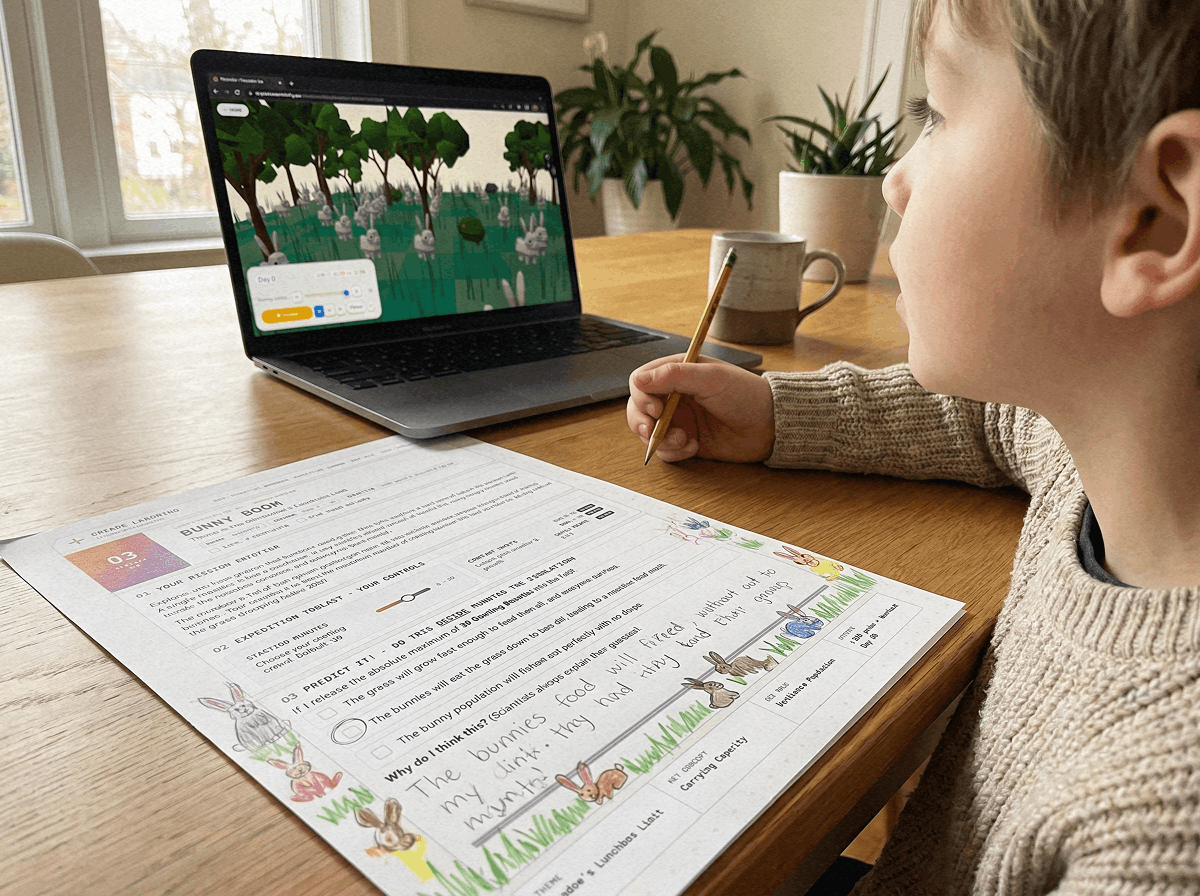
Open Level 2 in Praxos. Adjust herbivore grazing pressure and observe how fast vegetative biomass drops when natural predators are absent.
Frequently Asked Questions About Prairie Food Chains
Direct answers to common questions about grassland ecology, trophic structures, and food web modeling.
What is a classic 5-step prairie food chain example?
Why are prairie dogs considered a keystone species in the prairie ecosystem?
How does a prairie food chain differ from a forest food chain?
What happens when apex predators are removed from a prairie food chain?
Experiment with Grassland Food Webs in 3D
Bring prairie food chains to life with interactive scientific simulation.
Start Level 1 instantly in your browser with zero registration. Unlock all 10 simulation missions and download the complete 24-page Expedition Science Journal 100% free with email.
Step inside Level 02: Meadow Equilibrium to balance vegetation, grazing herbivores, and grassland predators in real time.
START LEVEL 1 FREEPrairie Food Chain Lab Sheet & Journal (PDF)
Download printable temperate grassland food chain diagram templates, trophic level matching activities, and field data logs for grades 3-8.