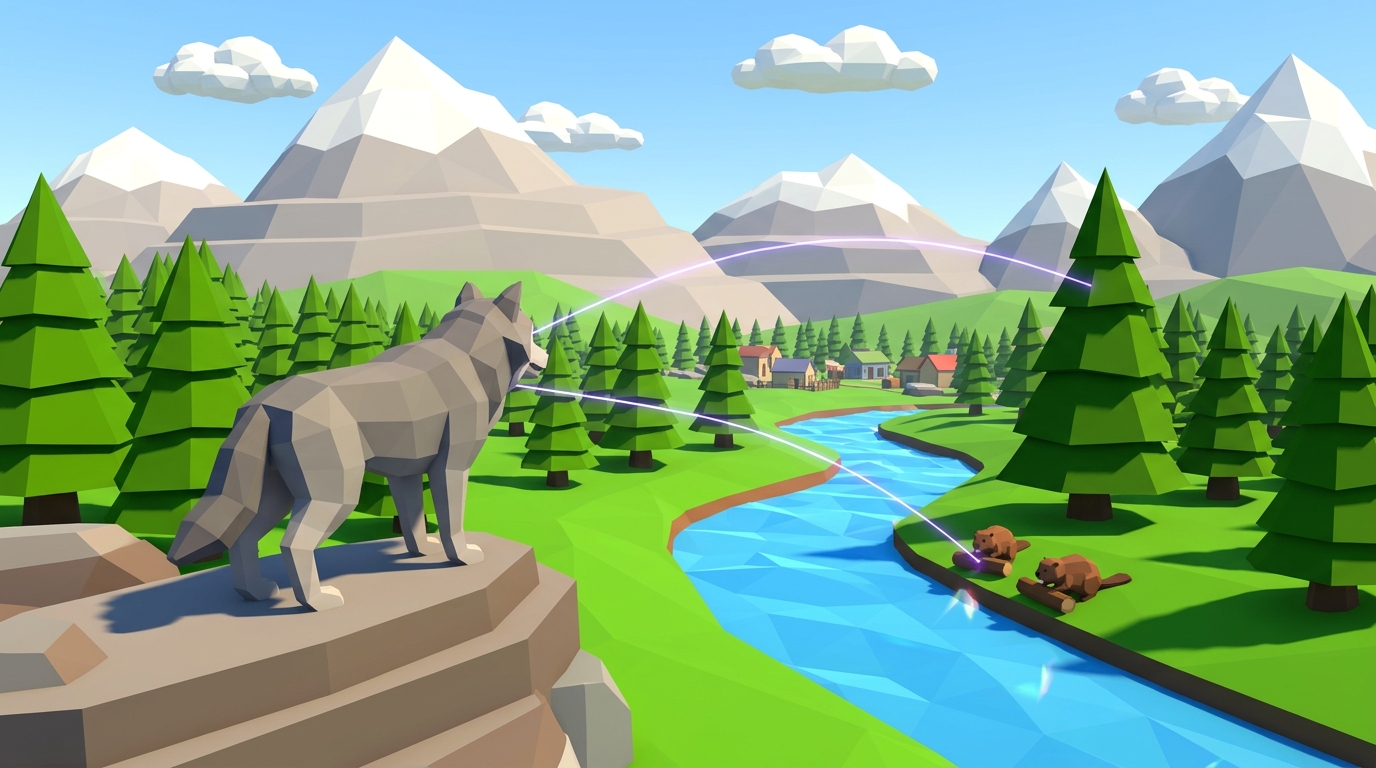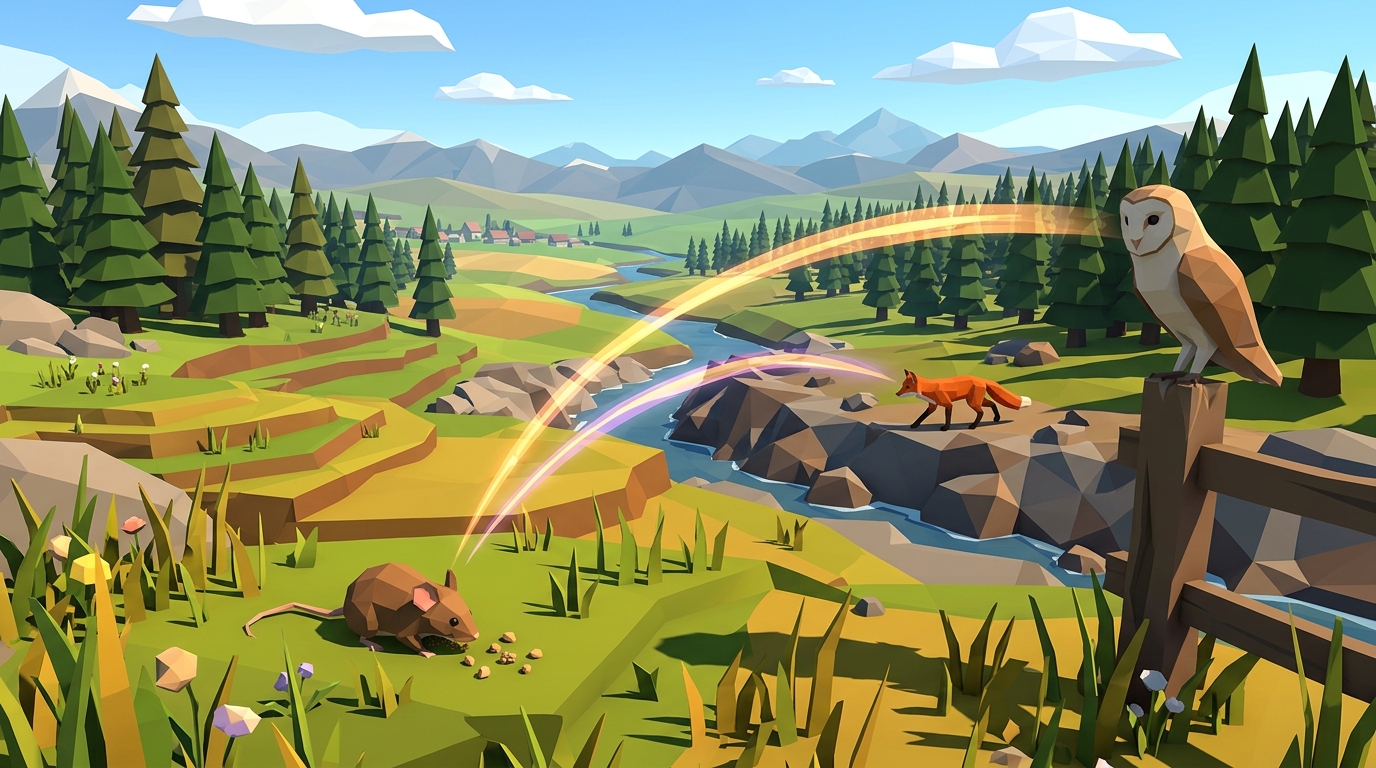
The Most Common Question in Life Science: Which Way Does the Arrow Point?
If you take any standardized middle school science exam, state biology assessment, or NGSS classroom quiz, you will inevitably encounter this question: In a food chain, the arrows always point to the one [making food / being eaten / doing the eating].
Thousands of students hesitate and choose the wrong answer because intuitive thinking conflicts with scientific modeling. In everyday life, an arrow often indicates an action, like a hunter aiming an arrow at a target or a predator chasing its prey. But in ecology, an arrow does not represent an attack: it represents the movement of biological fuel.
The correct answer is always: doing the eating. To explore the broader concept of energy movement, consult our core guide on what arrows in a food web represent.
The arrow ALWAYS points into the mouth of the animal doing the eating: Plant (Eaten) -> Herbivore (Doing the Eating) -> Carnivore (Doing the Eating).
What Do the Arrows Point Away From, and What Do They Point To?
To ensure you never make a mistake on a diagram, break down the two ends of any food chain arrow:
1. What the Arrow Points AWAY From: The tail of the arrow begins at the organism being eaten (the energy source). This organism is surrendering its stored glucose, carbohydrates, and proteins.
2. What the Arrow Points TOWARD: The arrowhead points directly at the organism doing the eating (the consumer). This organism is receiving the energy and incorporating those calories into its own living tissues.
Consider a simple meadow example: Grass -> Rabbit -> Fox. The arrow between grass and rabbit points away from the grass and toward the rabbit, because grass energy moves into the rabbit. The arrow between rabbit and fox points away from the rabbit and toward the fox, because rabbit calories move into the fox.
The 3-Step Test Question Breakdown
Let us analyze the exact multiple-choice format found on science assessments across the country:
| Option | Why It Is Incorrect or Correct | Scientific Explanation |
|---|---|---|
| Option A: The one making food | INCORRECT | Producers make food, but arrows point AWAY from producers toward herbivores. |
| Option B: The one being eaten | INCORRECT | The tail of the arrow originates at the organism being eaten; it does not point toward it. |
| Option C: The one doing the eating | CORRECT (100%) | Energy enters the organism doing the feeding; therefore, the arrow points directly to it. |
Why Science Uses Energy Arrows Instead of Attack Arrows
Why did biologists standardize on drawing arrows in the direction of energy flow instead of hunting behavior? Because ecosystems are governed by the laws of physics and thermodynamics.
An ecosystem is fundamentally a thermodynamic engine powered by sunlight. What matters to an ecologist is not the behavioral drama of a fox stalking a rabbit, but how many calories of chemical potential energy pass from trophic tier to trophic tier.
If arrows pointed from predators to prey, they would point backward against the flow of energy, making it mathematically impossible to calculate ecological efficiency or model carrying capacity. To understand this deeper biological principle, read our guide on why food web arrows point from prey to predator.
Think of arrows as arrows on a bank statement: they show where the currency (calories) is being deposited.
Trace Energy Arrows in Real Time with the Praxos 3D Simulation
Memorizing rules from a textbook is helpful for exams, but witnessing energy transfers in an interactive 3D world builds permanent scientific intuition.
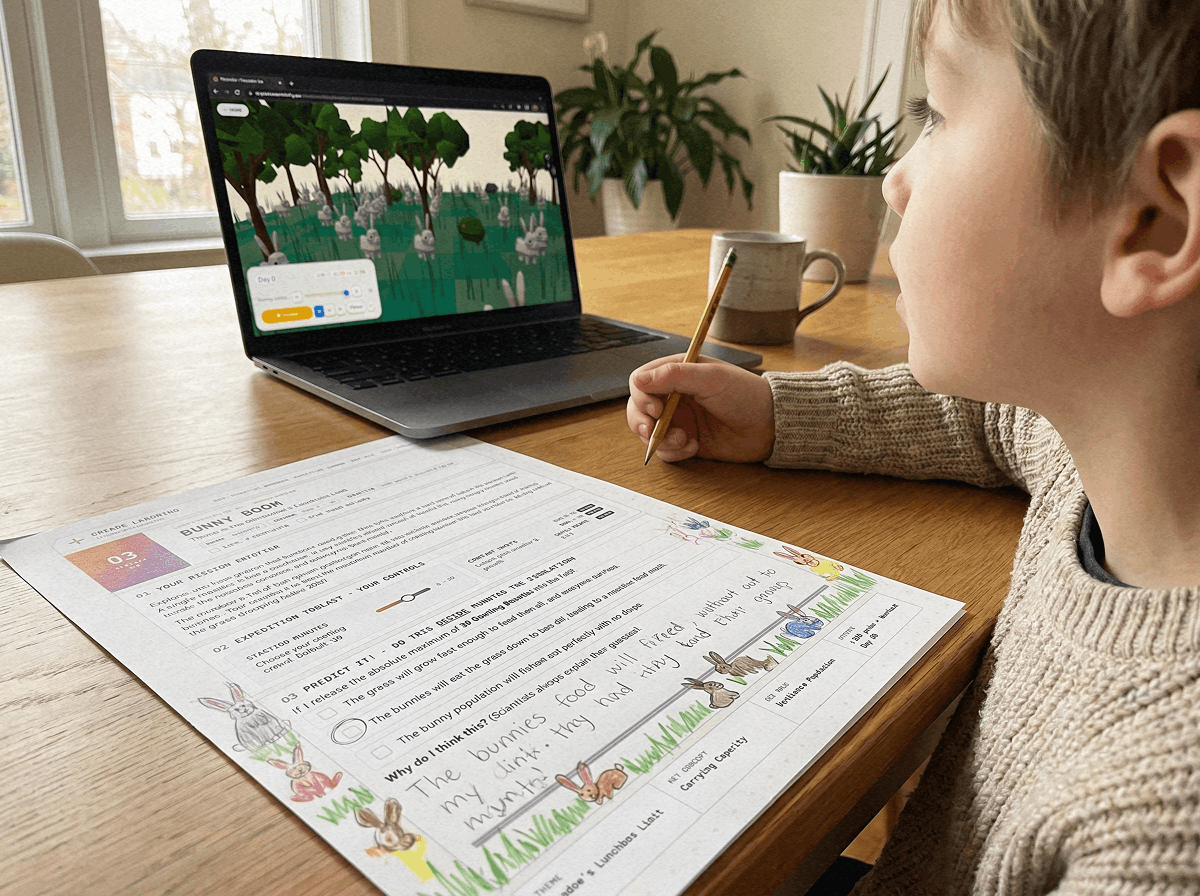
In the Praxos 3D Ecosystem Simulation, students adjust sunlight to power grass growth, then watch virtual herbivores consume plant tiles. Transparent energy bars visually fill as organisms consume food, giving students an immediate, intuitive sense of how energy travels through living systems.
You can run the simulation right now in any web browser without creating an account or downloading files. To support classroom instruction, download the free 24-page companion mission journal designed for student data recording and hypothesis testing.
Observe real-time energy flow, balance producer-consumer ratios, and avoid ecosystem collapse in our free browser simulation.
LAUNCH SIMULATION LABFrequently Asked Questions About Food Chain Arrow Directions
Common questions asked by elementary and middle school students regarding food chain arrows.
Which way do arrows point in a food chain or food web?
In a food chain, do arrows point to predator or prey?
What do arrows point away from in a food web?
Why do food chain arrows not point to what the animal eats?
Do arrows ever point from predators to plants?
Free Supporting Energy Flow Resources for Teachers and Students
Deepen your classroom understanding of ecosystem energy flow with these free companion guides:
Review the overarching rules of food web diagrams in our pillar guide on what arrows in a food web represent.
Understand why arrows point from prey to predators in our guide on why food web arrows point from prey to predator.
Explore how arrows represent heat loss on pyramids in our guide on energy pyramid arrows explained.
Discover where arrows go when organisms die in our guide on whether all food web arrows point to decomposers.
Access classroom setup guides and student progress tracking on our educator dashboard.
Equip your class with printable hypothesis tables, food web tracking grids, and CER science synthesis logs designed for all 10 simulation missions.
GET FREE MISSION LOGBOOK (PDF)24-Page Ecosystem Companion Mission Journal (PDF)
Download the complete 24-page printable companion logbook with structured data logs, food web arrow tracing guides, and ecosystem investigation missions.