The Two Types of Arrows on an Energy Pyramid
When students look at a standard food chain or food web diagram, arrows simply point from food to consumer. But when they encounter an ecological energy pyramid, diagrams often include arrows pointing in multiple directions: some point straight up between tiers, while others curve dramatically out of the sides of the pyramid into open space.
On science assessments, a frequent question asks: What do the arrows coming out of the pyramid represent? Students who guess that they show animals migrating or waste leaving the ecosystem miss the central thermodynamic reality of all living organisms.
Those exit arrows represent metabolic heat loss: energy that can never be reused by the ecosystem. To explore how this connects to broad food chain modeling, see our foundational guide on what arrows in a food web represent.
Vertical Arrows = Usable chemical energy transferred to the next trophic level (approx. 10%). Lateral Exit Arrows = Thermal heat energy dissipated into the environment (approx. 90%).
Why Does Energy Leave the Pyramid? (The Second Law of Thermodynamics)
Living organisms are not 100% efficient machines. When a primary consumer, such as a meadow vole or cottontail rabbit, eats 1,000 calories of grass, where do those calories go?
1. Cellular Respiration and Body Heat: The majority of digested energy powers basic cellular functions: pumping blood, maintaining body temperature, contracting muscles, and repairing tissues. In accordance with the Second Law of Thermodynamics, every energy conversion releases waste thermal energy into the surrounding air.
2. Locomotion and Foraging: Finding food, escaping predators, and building burrows consumes substantial caloric fuel that burns off as body heat.
3. Indigestible Biomass: Cellulose, plant fiber, fur, and bones cannot be digested by herbivores or carnivores and are passed out as fecal waste.
As a result, approximately 90% of ingested energy radiates away as heat. The arrows exiting the sides of the pyramid visually depict this thermal energy escaping into space.
Comparing Food Web Arrows with Energy Pyramid Arrows
To avoid confusion on biology exams, contrast how arrows function across these two standard diagram types:
| Feature | Food Web Diagram Arrows | Energy Pyramid Diagram Arrows |
|---|---|---|
| Primary Purpose | Shows who feeds on whom in a complex habitat network | Quantifies caloric energy, biomass, and thermodynamic loss |
| Arrow Direction | Always points from prey to predator (organism to organism) | Points vertically between tiers AND sideways out into the environment |
| Decomposers | Can show arrows connecting all dead matter to decomposers | Typically shown at the side or bottom receiving unassimilated waste |
| Quantitative Meaning | Indicates pathway of energy without showing exact calories | Directly represents the 10% ecological efficiency step-down |
What Substances and Quantities Do the Arrows Represent?
When testing questions ask what substances move along the arrows of an energy pyramid, the answer depends on whether you are tracking energy or matter:
Energy (Non-Cyclical): Chemical potential energy stored in the covalent bonds of carbohydrates, lipids, and proteins. Energy flows in a one-way path through the pyramid, ultimately dissipating as degraded thermal heat. It never cycles back to the sun.
Matter (Cyclical): Organic molecules built from carbon, nitrogen, phosphorus, and hydrogen atoms. While energy dissipates, these physical atoms do not vanish: when organisms die, decomposers recycle those atomic building blocks back into the soil for plants to absorb again. Learn more about this distinction in our guide on whether all food web arrows point to decomposers.
Energy FLOWS one-way through an ecosystem (and dissipates as heat). Matter CYCLES continuously between living organisms and physical soil.
Simulating Energy Dissipation in the Praxos 3D Lab
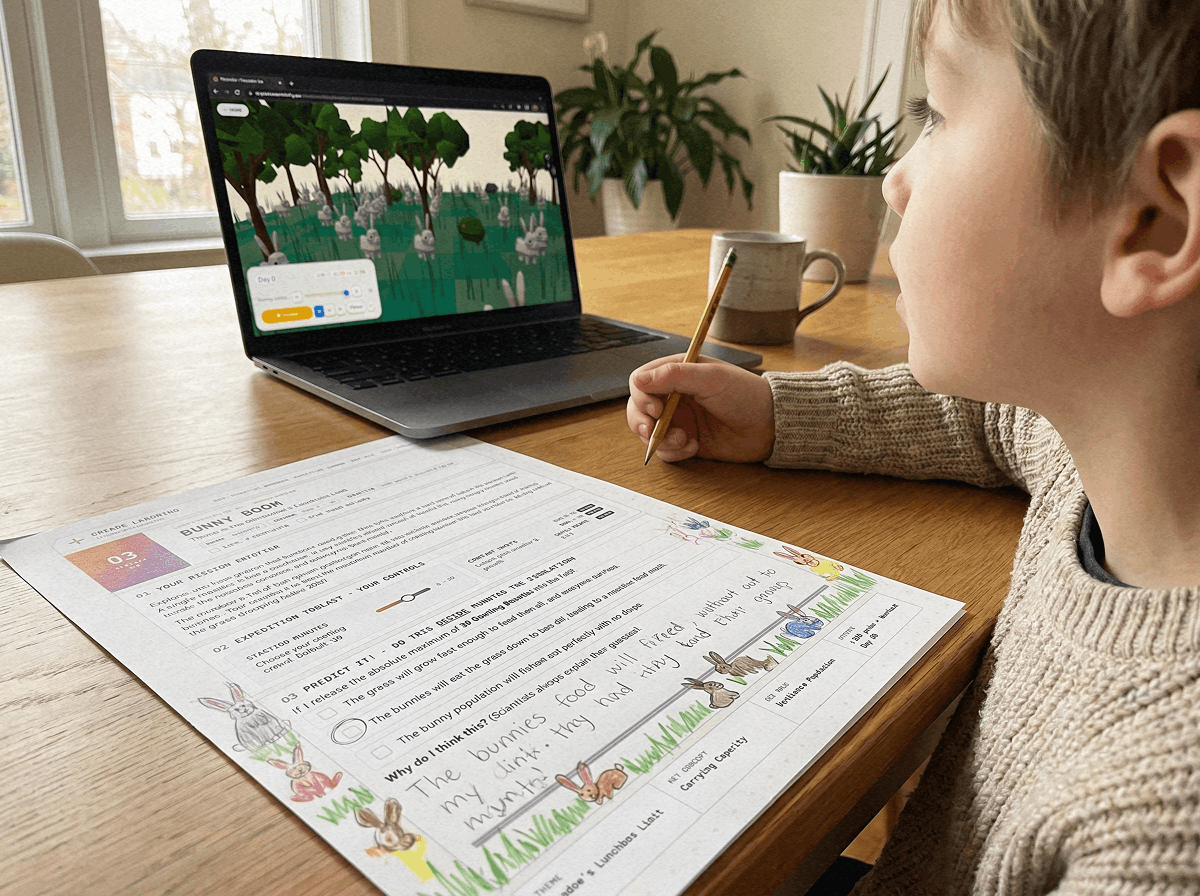
In the Praxos 3D Simulation, students can see energy loss happen before their eyes. When students run Levels 4 and 5, apex predators must continuously hunt to sustain their internal energy meters.
If primary consumer numbers drop slightly, predators run out of calories within simulated days because so little energy reaches the top of the trophic pyramid. Students discover firsthand why large predatory animals naturally have small populations.
Launch Level 4 right now in your web browser with zero registration. Download our free 24-page companion mission journal to provide students with structured data logging tables and energy calculation prompts.
Model apex predator energy consumption, observe metabolic burnout, and maintain ecosystem balance in our free browser simulation.
EXPERIMENT WITH ENERGY PYRAMIDSFrequently Asked Questions About Energy Pyramid Arrows
Common questions asked by middle and high school students regarding energy pyramids.
What do the arrows pointing out of an energy pyramid represent?
What percentage of energy is transferred upward on an energy pyramid?
Can heat energy lost from an energy pyramid be reused by plants?
Why does an energy pyramid get narrower at the top?
What do vertical arrows on an energy pyramid show?
Free Supporting Energy Flow Resources for Teachers and Students
Enhance your classroom ecosystem unit with these comprehensive free resources:
Review the overarching rules of food web diagrams in our pillar guide on what arrows in a food web represent.
Learn the foolproof test question rule in our guide on which way food chain arrows point.
Understand why arrows point from prey to predators in our guide on why food web arrows point from prey to predator.
Discover where arrows go when organisms die in our guide on whether all food web arrows point to decomposers.
Access classroom setup guides and student progress tracking on our educator dashboard.
Printable energy pyramid calculation tables, trophic level matching sheets, and hypothesis logs designed for all 10 simulation missions.
GET FREE MISSION LOGBOOK (PDF)24-Page Ecosystem Companion Mission Journal (PDF)
Download the complete 24-page printable companion logbook with structured data logs, food web arrow tracing guides, and ecosystem investigation missions.