Moving Beyond Elementary Chains: Systems Thinking in Middle School Ecology
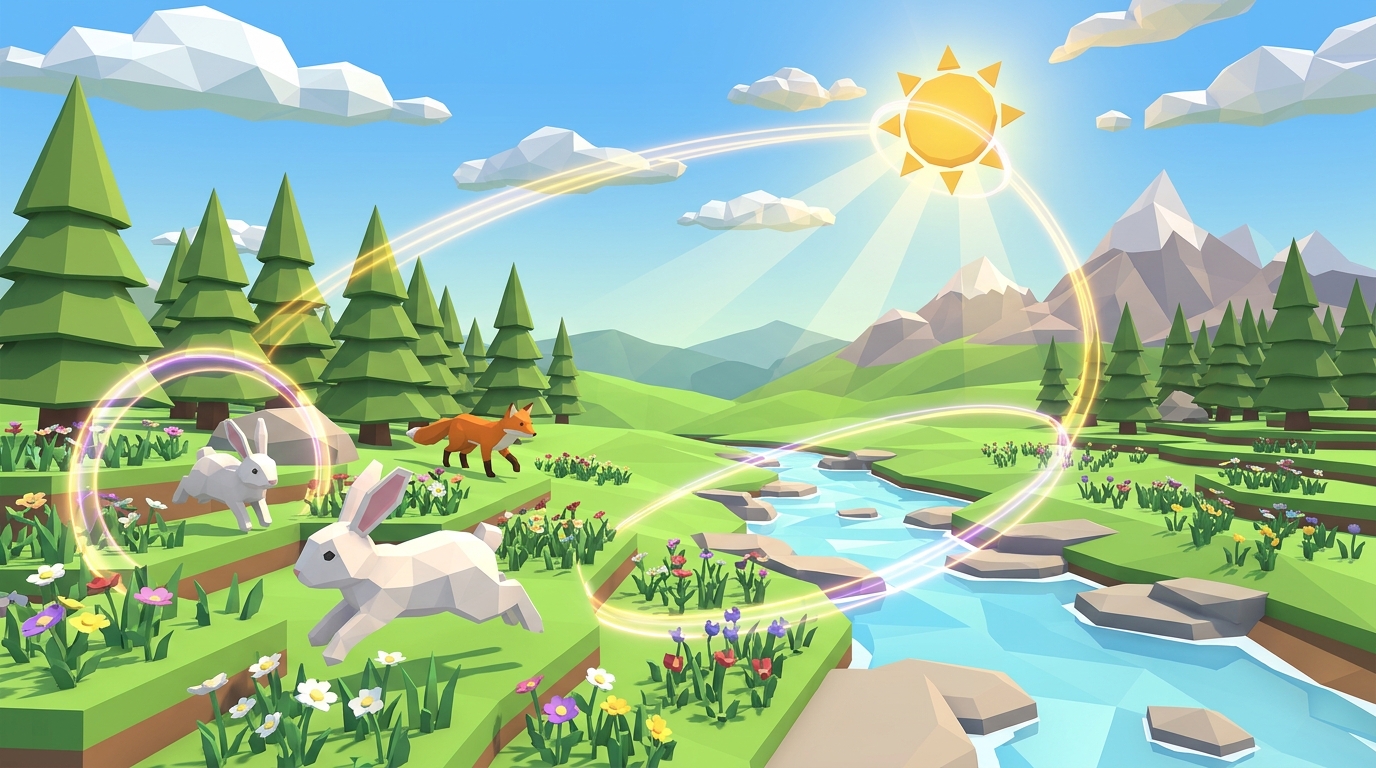
In elementary school, life science curricula emphasize linear food chains: sun to corn to mouse to owl. But by middle school (grades 6 through 8), the Next Generation Science Standards demand a fundamental shift toward complex systems thinking. Under performance expectation MS-LS2-3, students must *develop a model to describe the cycling of matter and flow of energy among living and nonliving parts of an ecosystem*.
Linear food chains present a dangerous scientific illusion: they imply that if one link breaks, every organism above it instantly starves. In real ecosystems, organisms participate in intricate food webs with multiple alternative feeding pathways. When a disease wipes out one primary consumer, generalist predators pivot to alternative prey, demonstrating network redundancy and ecological resilience.
Middle school students cannot truly grasp this emergent stability through static 2D poster diagrams. To understand why biodiversity protects ecosystems, students must physically stress a virtual network: systematically removing primary producers, keystone predators, and intermediate herbivores to observe quantitative tipping points.
Ecosystem resilience is directly proportional to network connectivity. Highly connected food webs possess multiple pathways for caloric energy to bypass damaged nodes, preventing total system extinction.
5 Best Middle School Food Web Simulators Ranked and Reviewed
We reviewed the leading digital biology tools suitable for middle school science classes, grading them on quantitative data logging, NGSS alignment, and Chromebook performance:
Praxos Learning: 3D Multi-Trophic Food Web Simulator
Quantitative biomass modeling, trophic cascade labs, and CER inquiry (Grades 6 to 8)
Praxos delivers a full 3D interactive laboratory where middle school students model complex food web dynamics. Level 16 (*Food Web Redundancy vs Linear Fragility*) explicitly tasks students with contrasting a fragile single-chain habitat against a resilient multi-pathway network under drought and disease pressures.
- ✓Live quantitative biomass readouts demonstrating Lindeman 10% energy transfer rule
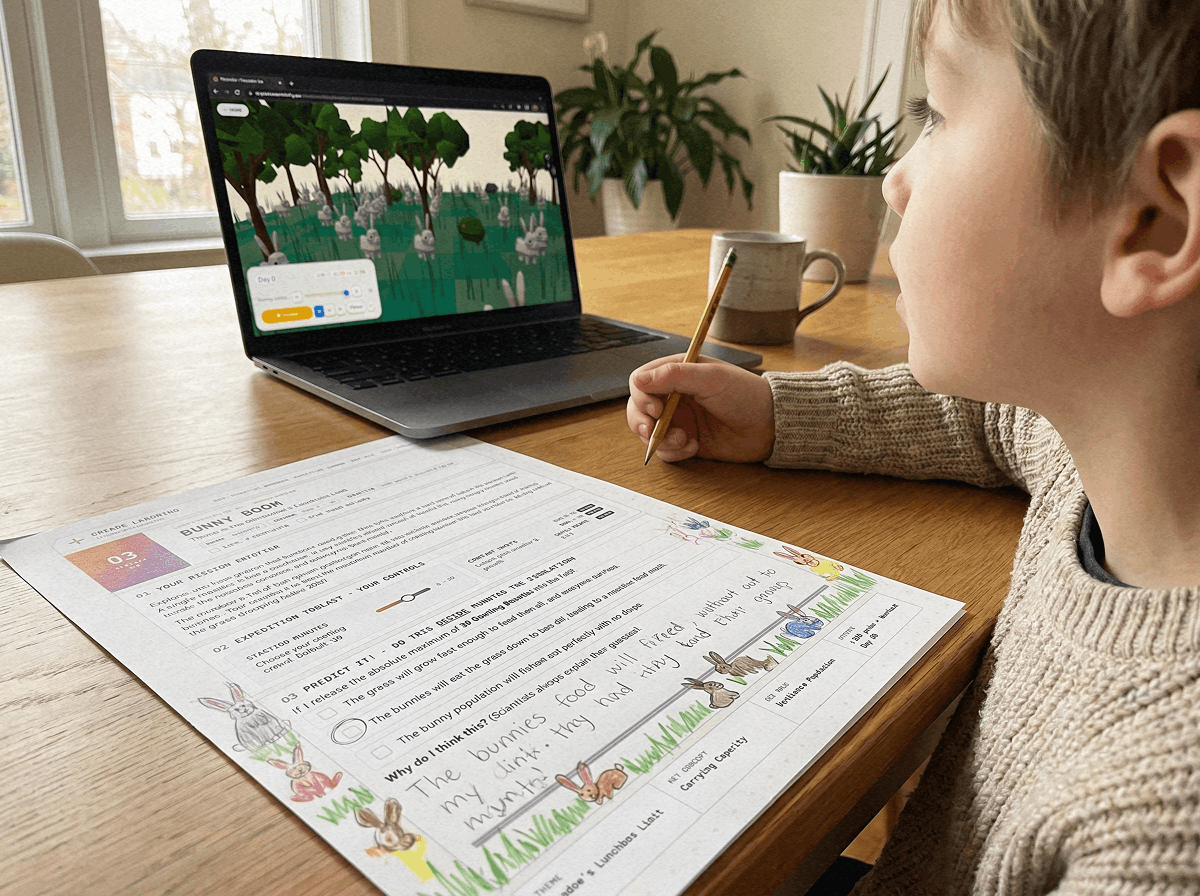
- ✓Integrated CER (Claim-Evidence-Reasoning) data logging via 24-page printable journal
- ✓Runs natively in Chrome on school Chromebooks with zero installation or licensing fees
- ✓Fully aligned with NGSS MS-LS2-1, MS-LS2-2, MS-LS2-3, and MS-LS2-4 standards
HHMI BioInteractive: Trophic Cascades Click & Learn
Authentic empirical field research analysis and graphing (Grades 7 to 9)
Explores Robert Paine seminal keystone species experiments in Pacific tide pools and the return of wolves to Yellowstone. Students analyze authentic field graphs and construct food web matrices based on real scientific papers.
- ✓Peer-reviewed real-world scientific data and video documentation
- ✓Outstanding for developing scientific argumentation and critical data literacy
- ✓Structured primarily as a guided interactive lesson rather than an open sandbox simulator
PhET Interactive Simulations: Natural Selection & Food Web Dynamics
Investigating how environmental mutations alter predator feeding success (Grades 6 to 9)
A classic staple in middle school science. Students manipulate rabbit generations, food scarcity, and wolf predation while tracking population demographics across generation charts.
- ✓Clean, intuitive graphical interface with responsive population graphs
- ✓Superb for bridging genetics (MS-LS3) with population ecology (MS-LS2)
- ✓Does not feature full multi-tiered food web networks or soil decomposer loops
Concord Consortium: High-Adventure Science Ecosystem Models
Computational systems thinking and parameter experimentation (Grades 7 to 9)
Concord Consortium provides computer-based modeling environments where students vary carrying capacity, migration, and reproductive rates to study complex systems feedback.
- ✓Strong emphasis on computational thinking and scientific modeling practices
- ✓Includes integrated student response prompts and teacher assessment dashboards
- ✓Visual presentation is more technical and abstract than immersive 3D sandboxes
Annenberg Learner: The Habitable Planet Ecology Simulator
Advanced middle school and introductory high school biology (Grades 8 to 10)
Allows students to configure starting population levels for multiple producers, herbivores, and carnivores, testing competitive exclusion and niche partitioning over dozens of generations.
- ✓Covers multi-species competition and predatory interactions
- ✓Displays detailed multi-variable line graphs over time
- ✓Interface is text and chart heavy with no real-time animal animations
Middle School Simulator Matrix: Rigor, Quantitative Data & NGSS Compliance
Compare the pedagogical depth and technical features of popular middle school science tools:
| Feature | Praxos Learning | HHMI BioInteractive | PhET Natural Selection | Concord Consortium |
|---|---|---|---|---|
| CurriculumNGSS Alignment | MS-LS2-1, MS-LS2-3, MS-LS2-4 | MS-LS2-2, MS-LS2-4, HS-LS2 | MS-LS2-1, MS-LS4-4 | MS-LS2-3, MS-ESS3-3 |
| Energy Rule Modeling | Quantitative Lindeman 10% Biomass Gauges | Empirical Trophic Efficiency Charts | Qualitative Food Meter | Mathematical Parameter Sliders |
| Simulation Medium | Real-Time 3D Browser WebGL | Interactive Graphs & Real Video | 2D Interactive Canvas | NetLogo-Based Computational Engine |
| Trophic Cascades | Full Top-Down & Bottom-Up Dynamics | In-Depth Case Study Scenarios | Wolf-Rabbit Direct Predation | Multi-Variable Population Curves |
| Chromebook Compatibility | High (Instant WebGL Zero Install) | High (Modern Web Standards) | High (HTML5) | High (Web-Based Applets) |
| Printable Science Journal | Included (24-Page Expedition Journal) | Downloadable PDF Student Guides | Community Lesson Worksheets | Online Digital Response Log |
Model Middle School Food Webs in 3D
Run NGSS MS-LS2-3 compliant simulations right in your browser. Measure biomass transfers, trigger trophic cascades, and compare food web resilience without logins or setup.
Core Concepts Taught in Middle School Food Web Simulations
To meet NGSS MS-LS2 performance standards, students explore four foundational principles through simulation experiments:
Principle 1: Multi-Pathway Network Redundancy
Students model two habitats: Habitat A has a linear chain (Grass to Mouse to Owl), while Habitat B has a network web (Grass and Berries to Mice, Rabbits, and Crickets to Snakes and Owls). When disease strikes the mice, Habitat A collapses, while Habitat B survives because the owls switch prey.
Principle 2: Lindeman 10% Biomass Rule (Energy Pyramids)
Middle schoolers calculate the trophic transfer efficiency between levels. By measuring standing biomass in kilograms, students verify that 90% of caloric energy is dissipated through cellular respiration, movement, and heat loss at each successive trophic tier.
Principle 3: Trophic Cascades & Keystone Species
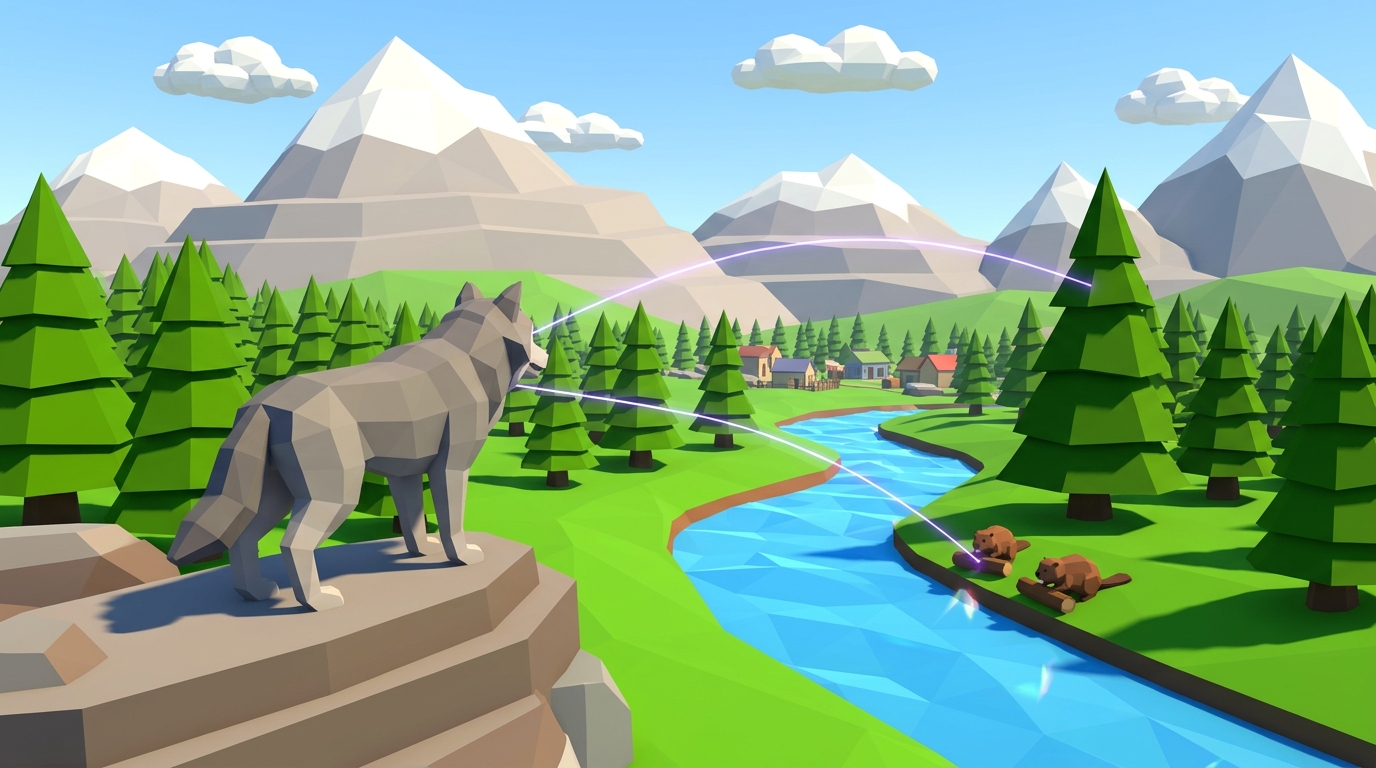
Students simulate top-down control by removing apex wolves from a river valley ecosystem. They watch herbivores multiply exponentially, overgrazing stream-side willow bushes, causing bank erosion, and driving away songbirds and aquatic species.
Principle 4: Decomposers & Closed-Loop Matter Cycling
While energy flows linearly and escapes as heat, chemical matter (carbon, nitrogen, phosphorus) must be recycled indefinitely. Middle schoolers monitor soil nitrate pools to prove that without decomposers, life ceases.
50-Minute NGSS MS-LS2-3 Chromebook Lab Procedure
A complete, turnkey middle school science inquiry lab ready for district Chromebooks:
Minute 00 to 10: Engagement & Phenomenon. Show students a brief 60-second video of the reintroduction of wolves into Yellowstone. Introduce the inquiry question: *How can adding a top predator make an entire river healthier?*
Minute 10 to 30: Simulation Data Collection. Students open Praxos 3D Simulation Level 16 (*Food Web Redundancy vs Linear Fragility*). Students test two environmental disruptions: a severe summer drought (abiotic) and a herbivore pathogen (biotic). They log quantitative biomass readouts in their science journals.
Minute 30 to 42: Claim-Evidence-Reasoning (CER) Synthesis. Students write a scientific argument answering: *Does species biodiversity increase or decrease food web resilience during environmental stress?*
Minute 42 to 50: Class Evaluation. Randomly select three student groups to present their CER conclusions using live simulation replay data.
Directly test ecological network resilience against severe drought and disease shocks in a living 3D habitat simulator.
LAUNCH LEVEL 16 LABFrequently Asked Questions About Middle School Food Web Simulations
Common questions from middle school life science teachers and science department leads:
How does Praxos align with middle school NGSS MS-LS2-3 standards?
Can middle school students record and graph simulation data?
Is Praxos compatible with Google Classroom?
How long does it take for students to complete a simulation mission?
Related Middle School Science Units & Lab Resources
Expand your middle school life science unit with these related guides:
Review classroom games in our food chain games for the classroom guide.
Explore browser tools in our free food web simulation online lab.
Compare alternative tools in our food web simulation PhET alternative article.
Review top-ranked software in our interactive food chain games catalog.
Set up your school classes on our educator dashboard.
24 pages of printable biomass calculation sheets, trophic cascade flowcharts, and CER templates designed for middle school classrooms.
DOWNLOAD EXPEDITION LOGBOOK (PDF)Middle School Ecosystem Data Logbook (PDF)
A 24-page printable student lab journal featuring biomass calculation tables, trophic cascade mapping sheets, and CER (Claim-Evidence-Reasoning) templates.