Why Online Food Web Simulators Transform Biology Learning
In traditional middle school science classrooms, students often struggle to grasp that ecosystems are governed by interconnected mathematical rules. When textbook passages state that energy decreases by roughly 90% at each successive trophic level, students memorize the number without understanding the physical constraint it places on predator populations.
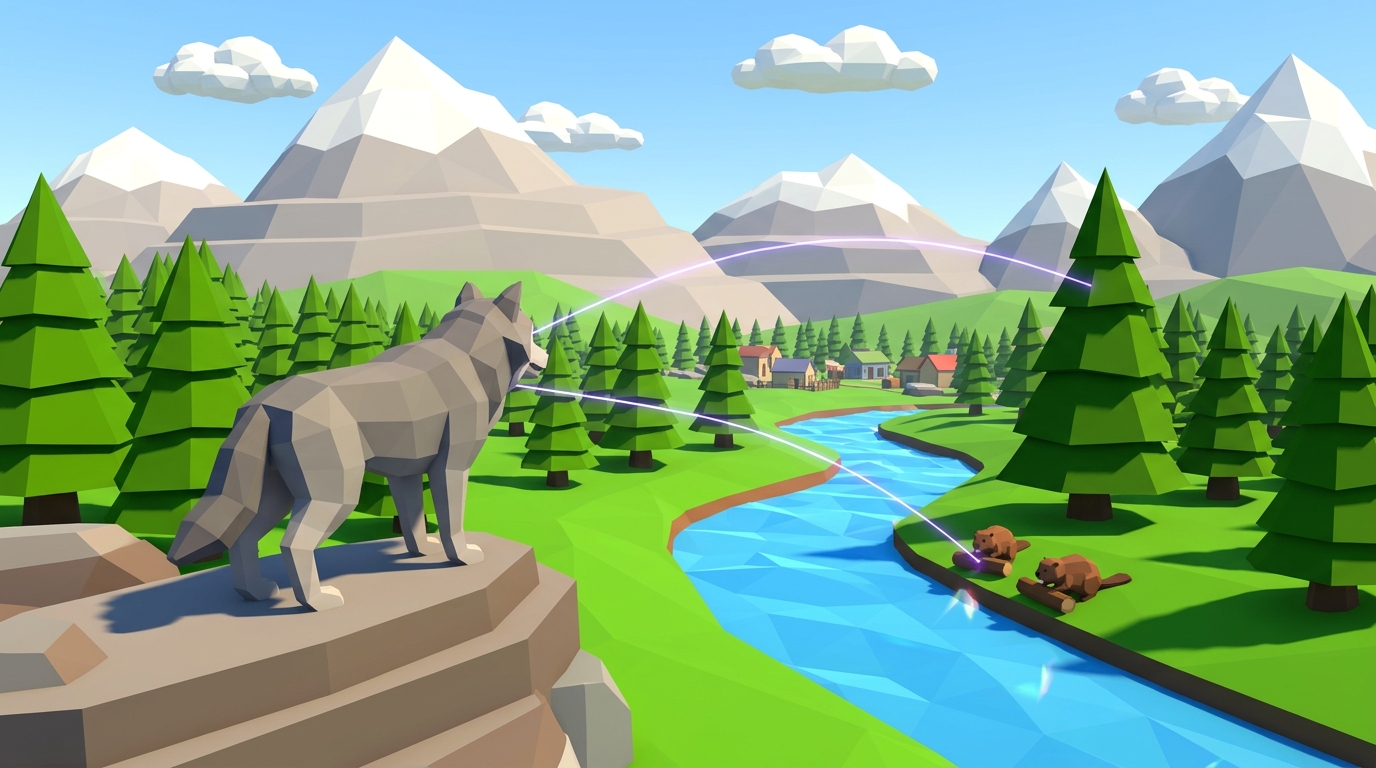
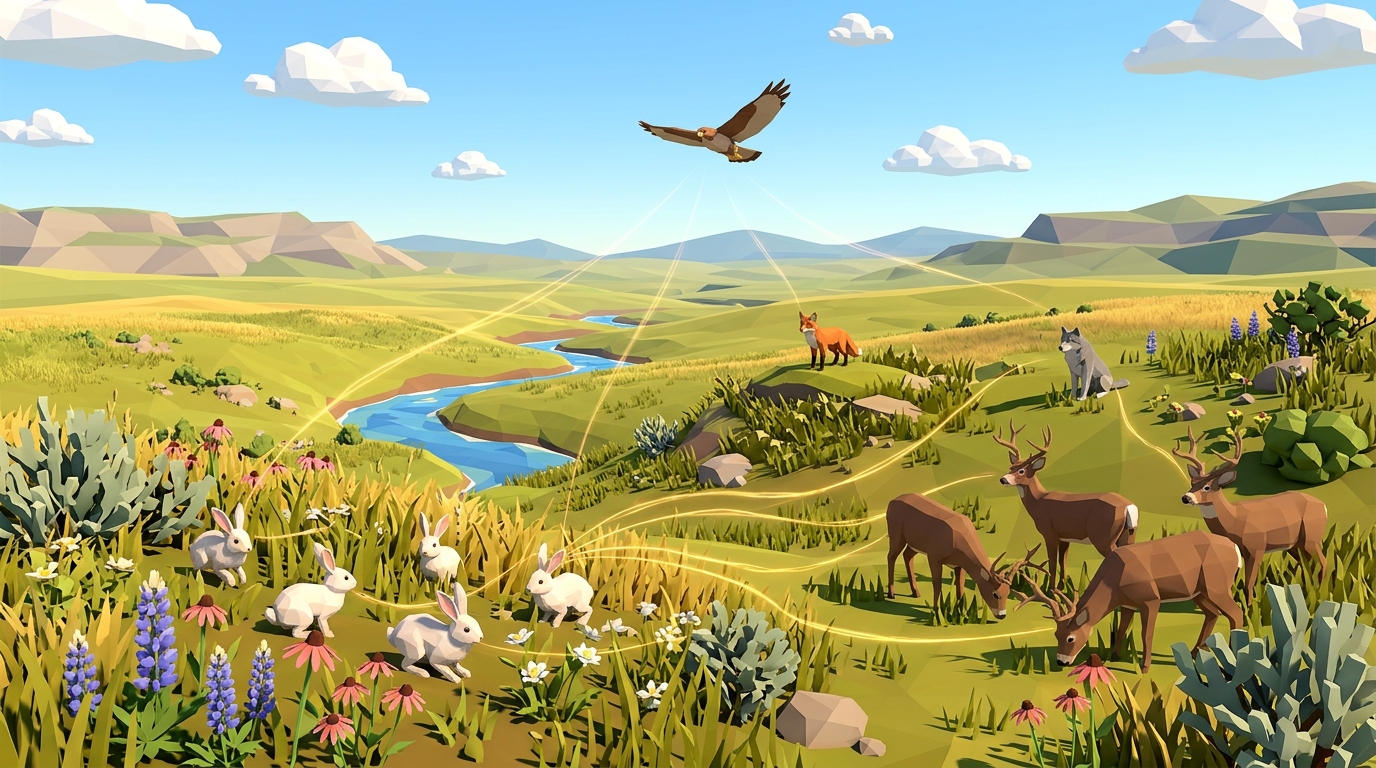
An online food web simulation brings these abstract principles to life. Inside a computational 3D environment, every organism operates under physiological energetic rules: plants convert solar radiation and soil moisture into biomass, herbivores graze on vegetation to maintain metabolic reserves, and predators expend kinetic energy hunting prey.
If a student attempts to introduce 50 foxes into a habitat containing only 10 rabbits, the simulator demonstrates immediate consequences: the predator population crashes from starvation, allowing the surviving rabbits to reproduce rapidly once hunting pressure subsides. Through iterative experimentation, students discover the self-regulating mechanisms of natural ecosystems.
Simulations make the invisible laws of ecology visible. Students see the direct relationship between abiotic inputs and multi-species carrying capacity.
Core Ecological Mechanics Modeled in a 3D Food Web Simulator
Our browser-based food web simulator models four fundamental ecological systems in real time:
1. Abiotic Energy Inputs: Sunlight and precipitation controls directly influence plant photosynthetic efficiency and primary productivity across the terrain.
2. Lotka-Volterra Predator-Prey Dynamics: Algorithmic population equations govern birth rates, natural mortality, and predation encounters, generating authentic cyclic oscillations.
3. Trophic Efficiency and Biomass Loss: Respiration, heat dissipation, and metabolic maintenance reduce available energy at each ascending trophic level.
4. Spatial Foraging and Shelter: Organisms interact with physical 3D terrain features, seeking cover in brush and grazing along nutrient-dense riparian zones.
Step-by-Step Guide: Conducting an Ecosystem Stress Test Online
Follow this structured 4-step protocol to run a scientific stress test in the food web simulator:
ESTABLISH BASELINE EQUILIBRIUM (Days 1 to 20)
Run the simulation at default slider values. Confirm that primary producer vegetation, rabbit herbivores, and fox predators maintain stable oscillatory cycles without species extinction.
INTRODUCE AN ABIOTIC DISTURBANCE (Day 21)
Throttle rainfall slider to minimum to simulate an acute regional drought. Record daily vegetation biomass drop and note the exact day herbivore starvation commences.
APEX PREDATOR SHOCK (Day 45)
Inject additional predator pairs into the water-stressed landscape. Observe whether intense hunting pressure accelerates ecosystem collapse or forces herbivores into smaller micro-habitats.
MEASURE SYSTEM RECOVERY (Days 60 to 100)
Restore rainfall to optimal levels. Track the recovery trajectory: do vegetation patches regenerate before animal populations rebound, or does the system shift into a degraded state?
Comparing Online Food Web Simulators Across Key Features
Here is how Praxos compares with other leading educational biology simulations:
| Simulator Platform | Rendering Engine | Accessibility | Curriculum Alignment | Printable Materials |
|---|---|---|---|---|
| TOP CHOICEPraxos 3D Ecosystem Lab | Native Three.js WebGL 3D | 100% Free Browser Access (No Login) | NGSS MS-LS2 Middle School | 24-Page Science Journal Included |
| NetLogo Web Models | 2D Agent-Based Canvas | Free Open Source (Java/JS) | Secondary Science / Computational Thinking | Online Code Documentation Only |
| HHMI BioInteractive Click & Learn | 2D Interactive Diagrams | Free Educational Resource | High School & AP Biology | Teacher Guide PDFs Available |
| ExploreLearning Gizmos | 2D Flash-Converted Widget | Paid Subscription Required | State Science Standards | Digital Student Exploration Sheets |
Frequently Asked Questions About Online Food Web Simulators
Key questions educators ask when deploying virtual food web labs:
Can this food web simulator run on school Chromebooks?
How does the simulation handle trophic energy loss?
Is there a time limit or paywall on the simulation?
How do students record quantitative data during simulation runs?
Free Supporting Science Curriculum and Classroom Tools
Deepen your students ecological inquiry with these companion resources:
Explore our complete overview in the best free food web games online catalog.
Structure your 45-minute lab using our interactive food web activity guide.
Review classroom favorites in our feed the dingo game alternatives article.
Check out virtual biology alternatives in our food web simulation phet alternative guide.
Review underlying ecological balance rules in our carrying capacity explained explainer.
Printable energy pyramid calculation tables, trophic level matching sheets, and hypothesis logs designed for all 10 simulation missions.
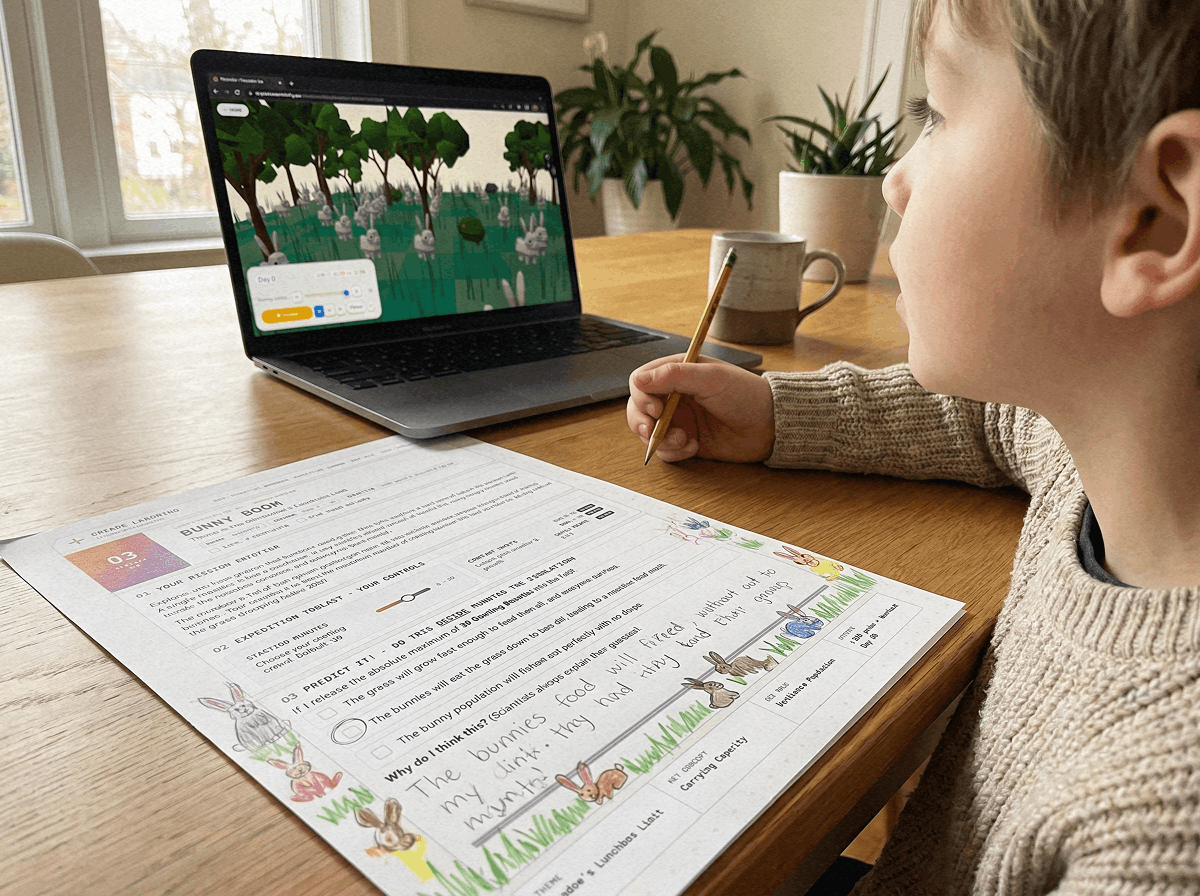
GET FREE MISSION LOGBOOK (PDF)24-Page Expedition Science Journal
A student lab companion complete with population graphing worksheets, abiotic factor tracking charts, and trophic cascade reflection questions.