What Is a Natural Selection Simulation for Kids?
Natural selection is one of the most foundational principles in biological science, yet it is frequently misunderstood by young learners as intentional evolution or individual choice. Animals do not decide to evolve thicker fur or sharper claws; instead, environmental pressures determine which individuals survive long enough to pass their genes to the next generation.
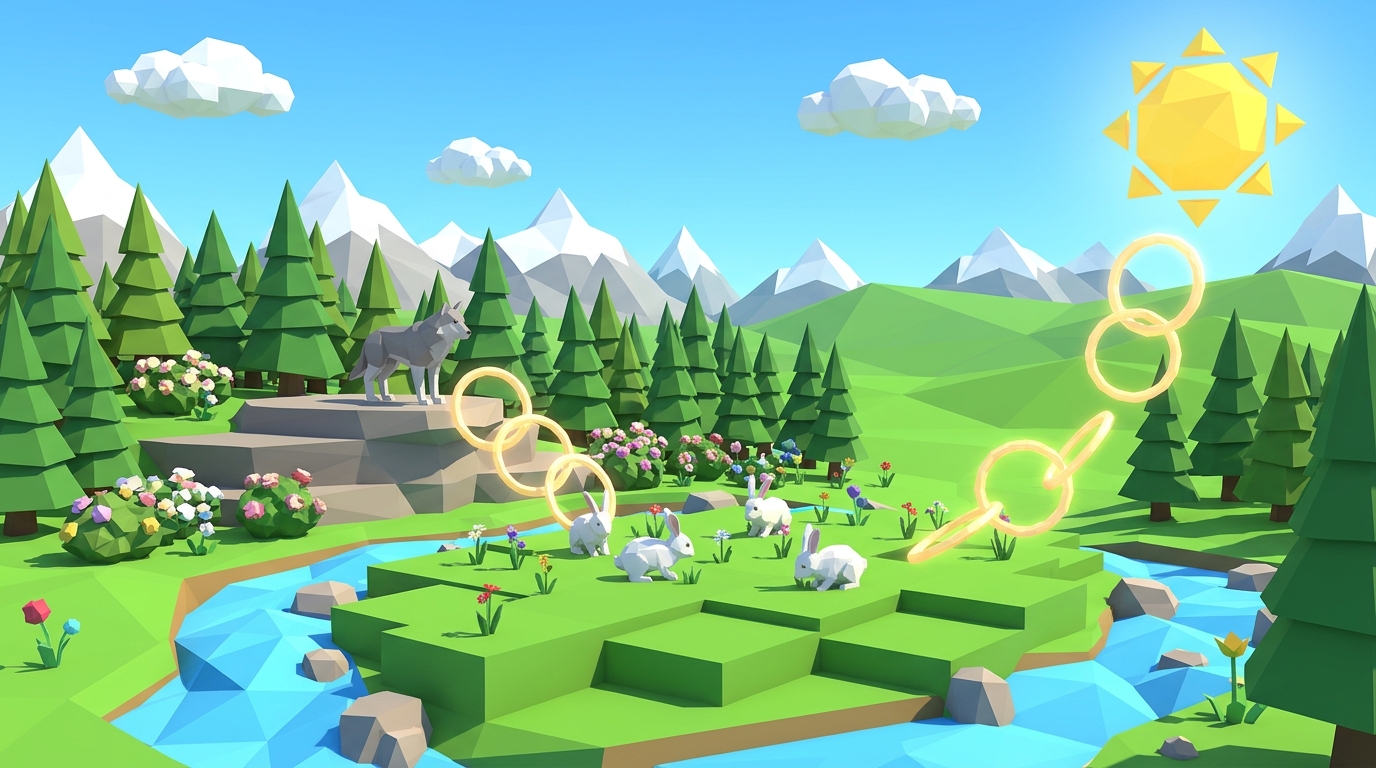
A natural selection simulation transforms this abstract historical concept into an active, observable laboratory experiment. Rather than reading about Darwinian finches on a printed worksheet, students manipulate living populations directly, introducing selective stressors such as winter food shortages, drought, and predators to see which traits thrive over successive generations.
Natural selection acts on populations, not individuals. Real-time simulations let students watch population-level trait shifts unfold before their eyes.
How Level 3 (Bunny Boom) Demonstrates Selective Survival
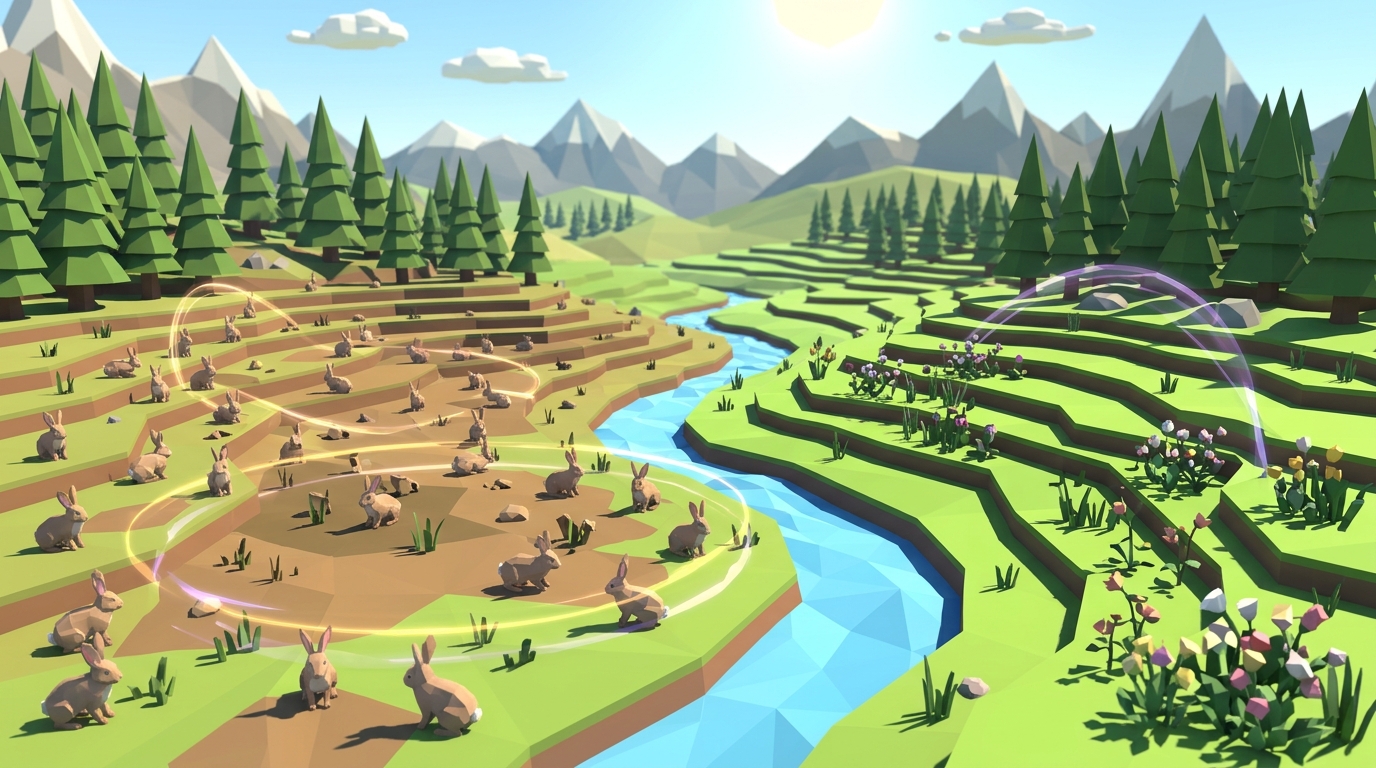
In Praxos Ecosystem Level 03 (Bunny Boom), students encounter the four essential pillars of natural selection in a contained meadow environment:
1. Overproduction of Offspring: Left unchecked, rabbit populations multiply exponentially according to standard biological fecundity curves.
2. Resource Limitation: The virtual meadow produces a finite amount of plant biomass per day, establishing a hard ecological carrying capacity limit.
3. Struggle for Existence: As rabbit density exceeds available vegetation, competition for clover and grass intensifies, leaving slower or poorly positioned grazers without food.
4. Differential Mortality: Starvation sets in selectively, trimming the population back down to what the abiotic energy inputs can sustainably support.
PhET Natural Selection vs. Praxos 3D Ecosystem Sandbox
Many science educators are familiar with classic 2D simulation tools like PhET Natural Selection. Here is how Praxos compares across key classroom and homeschool learning dimensions in our free ecosystem simulation game:
| Simulation Feature | PhET Natural Selection | Praxos Ecosystem Lab |
|---|---|---|
| Visual Engine | 2D Flash-style Canvas | Real-time 3D WebGL (Three.js) Sandbox |
| Ecological Scope | Isolated genetic mutations (fur, teeth, tail) | Full multi-trophic web (sunlight, plants, herbivores, apex predators) |
| Simulation Timing | Manual generation steps | Continuous deterministic daily ticks at 60 FPS |
| Data Visualization | Static pedigree & population graphs | Live 2D real-time population trend curves |
| Physical Learning Bridge | Digital only (third-party PDF printouts) | Integrated 24-page physical Expedition Science Journal |
| 100% FREECost & Accessibility | 100% Free (Open source academic) | 100% Free (All 10 levels & full printable journal) |
Natural Selection Concepts Explained: A Teacher & Student Guide
Whether you are preparing a middle school science lesson or completing an ecology study guide, here are clear explanations for the core concepts tested in natural selection curricula:
Selective Pressure: Any external factor that reduces reproductive success in a portion of the population (e.g. predator hunting, drought, extreme cold, or limited nesting space).
Biological Fitness: A measure of reproductive success; an organisms ability to survive, find a mate, and produce fertile offspring in its specific environment.
Carrying Capacity Ceiling: The maximum number of individuals an ecosystem can sustain. When populations overshoot this ceiling, selective mortality rises sharply.
Dynamic Oscillations: Why predator and prey populations naturally oscillate in repeating waves rather than remaining frozen in static balance.
When students observe a simulated population overshoot its food supply and crash on screen, the relationship between carrying capacity and selective mortality becomes unforgettable.
The 3-Step Inquiry Method for Evolution Labs
To ensure simulations foster genuine scientific reasoning rather than passive trial-and-error gaming, follow this structured 3-step inquiry process:
Formulate a Written Hypothesis (5 Minutes)
In your [physical science journal](/resources/power-of-physical-science-journal-in-digital-world), record your starting population, food supply, and write a concrete prediction: If starting rabbits increase to 50 with no extra sunlight, the meadow will deplete within 20 days.
Execute the Simulation Trial (20 Minutes)
Run Level 3 in the 3D lab. Watch the live spatial interaction of rabbits foraging across terrain while tracking the population line chart to spot the exact peak and crash point.
Synthesize Data & Reflect (5 Minutes)
Compare your initial prediction against the simulation data, calculate the population variance, and answer the guided reflection prompt in your journal.
Launch Your Free Natural Selection Lab Online
You can explore natural selection, population growth curves, and trophic cascades without specialized lab equipment or paid software subscriptions.
All 10 levels of Praxos Ecosystem and the complete 24-page Expedition Science Journal are 100% free with email. Launch Level 1 instantly in your browser with zero registration.
Model population explosions, resource depletion, and natural selection in our free 3D digital laboratory.
LAUNCH FREE 3D LABFree 24-Page Expedition Science Journal
Complete with natural selection trial logs, population graphing templates, and NGSS MS-LS2 aligned reflection prompts.