Why Interactive Games Make Trophic Roles Click for Students
Every elementary and middle school biology curriculum introduces the foundational triad of ecology: producers that capture solar energy, consumers that eat organic matter, and decomposers that recycle dead tissue. Yet when taught exclusively through static textbook definitions and flashcard matching drills, students routinely treat these categories as isolated bins rather than interdependent links in a closed energetic circle.
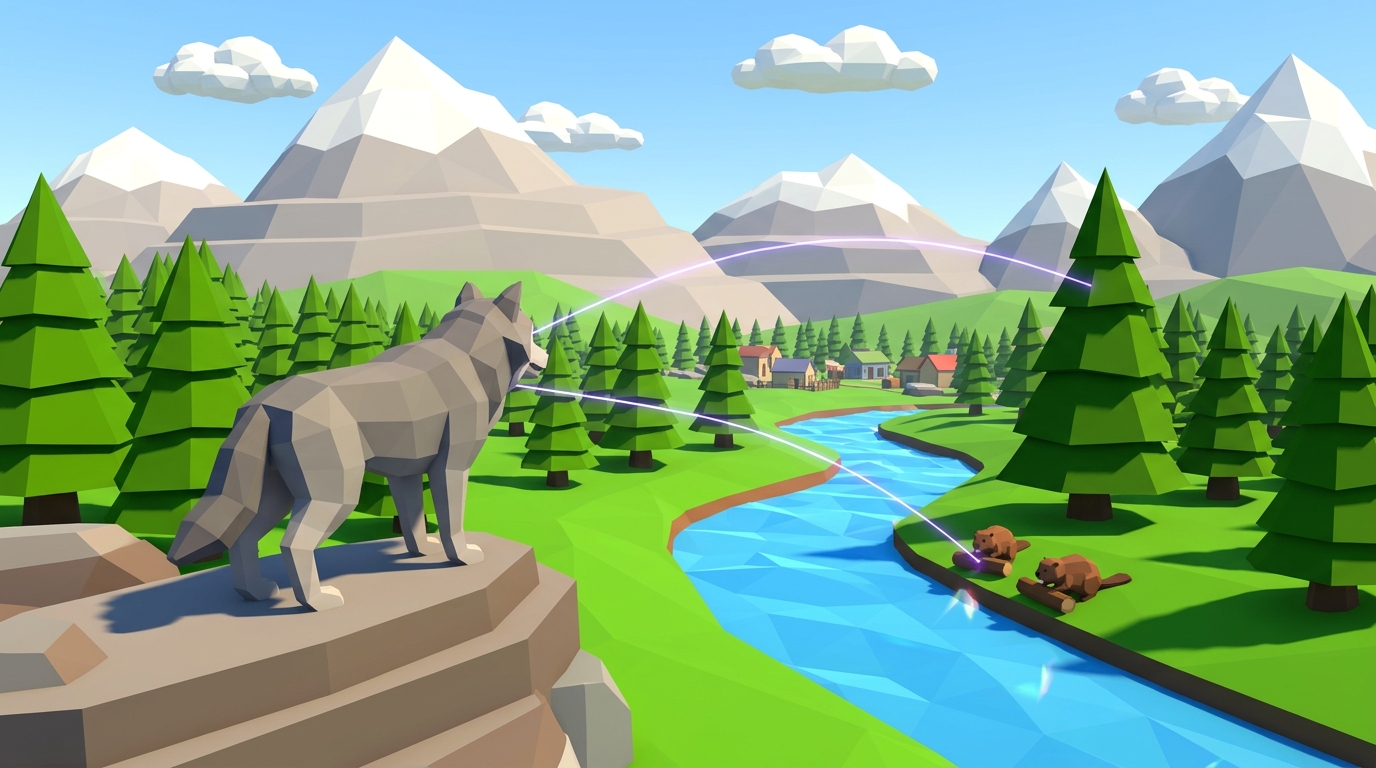
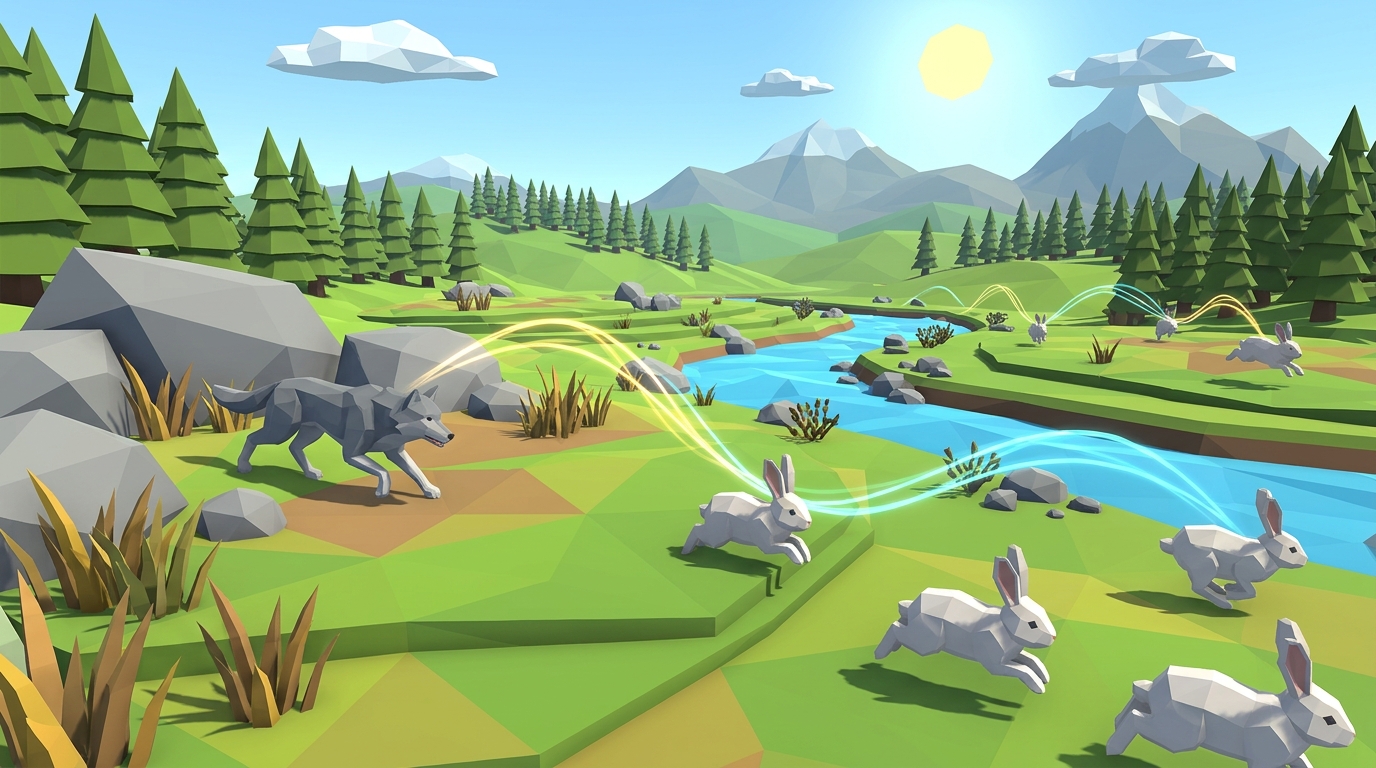
The fundamental breakthrough occurs when students transition from passive labeling to active system regulation. In a dynamic 3D simulator, children do not simply define an autotroph: they watch what happens when solar irradiance drops, causing plant biomass to plummet, subsequently starving the primary consumers, and eventually leaving apex predators without prey.
Furthermore, decomposers (often relegated to a forgotten footnote at the bottom of 2D food chain worksheets) reclaim their central ecological role. When a virtual simulation models the nitrogen cycle, kids visibly observe dead biomass piling up and soil nutrients depleting unless saprotrophic fungi and bacteria actively break down carcasses to replenish the soil.
Energy enters ecosystems through solar radiation and dissipates as metabolic heat, but chemical matter is strictly conserved. Decomposers are the indispensable engine that closes this loop by returning minerals to autotrophs.
5 Best Producers, Consumers, and Decomposers Games Ranked and Reviewed
We tested and evaluated the leading digital science tools that teach trophic roles, ranking them on scientific accuracy, interactive feedback loops, Chromebook accessibility, and student engagement:
Praxos Learning: 3D Living Ecosystem Sandbox
Real-time multi-trophic population modeling and hands-on experiments (Grades 3 to 8)
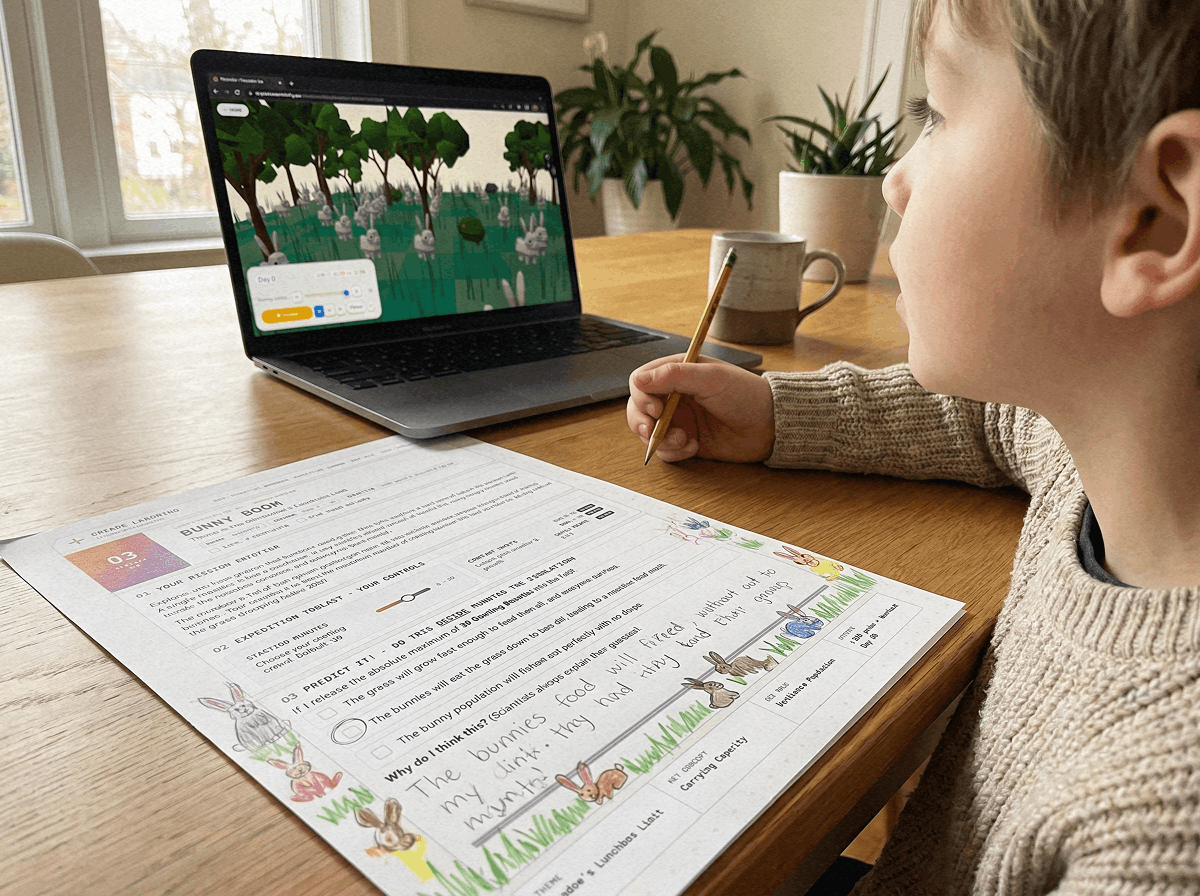
Praxos provides an authentic 3D physics-driven virtual habitat where students adjust sunlight, rainfall, vegetation density, herbivore herds, and soil microbial activity. Rather than static drag-and-drop mechanics, students observe mathematical Lotka-Volterra dynamics and carrying capacity in a living virtual ecosystem.
- ✓Zero setup, instant loading on any district Chromebook or iPad
- ✓Models autotrophic biomass, primary/secondary consumers, and decomposers simultaneously
- ✓Free printable 24-page Student Science Journal with experiment logging sheets
- ✓Explicit NGSS alignment covering 4-LS1-1, 5-PS3-1, and MS-LS2-3 standards
Sheppard Software: Producers, Consumers, and Decomposers
Introductory vocabulary drill and basic categorization (Grades 2 to 4)
A classic 2D educational game where learners sort animated organisms into correct buckets based on dietary classifications. While effective for basic vocabulary reinforcement, it lacks dynamic population models or energetic consequences when balances shift.
- ✓Bright, colorful animations suitable for younger elementary learners
- ✓Immediate audio feedback on correct and incorrect category selections
- ✓Ad-supported layout may require classroom ad-blockers
PBS LearningMedia: Build a Food Web & Energy Flow
Structured whiteboard walk-throughs and modular lesson plans (Grades 4 to 6)
PBS LearningMedia offers interactive modules that guide students through constructing ecosystem food webs from primary autotrophs to tertiary carnivores. It includes strong narrative prompts but limited real-time sandbox experimentation.
- ✓High production value with real wildlife photography and video clips
- ✓Direct connection to standard PBS educational videos
- ✓Rigid linear progression with predetermined outcomes
BrainPOP: Food Fight & Food Chain Interactions
Competitive classroom multiplayer and concept quizzes (Grades 4 to 7)
BrainPOP gamifies trophic feeding relationships into an arcade-style battle where players manage organisms to capture energy. Great for engagement, though institutional licensing costs can be a barrier for budget-conscious schools and homeschoolers.
- ✓High gamification and competitive mechanics that motivate students
- ✓Includes post-game comprehension quizzes and animated movies
- ✓Requires district or parental paid subscription for full access
PhET Interactive Simulations: Natural Selection & Ecology
Genetic variation and abiotic environmental pressures (Grades 6 to 9)
While PhET lacks a dedicated consumer-decomposer nutrient cycle tool, its natural selection sandbox lets students model how environmental changes alter producer availability and predator hunting success.
- ✓Rigorous mathematical modeling backed by university research
- ✓Excellent for upper middle school and high school biology units
- ✓Omits soil decomposers and nutrient recycling loops
Feature Comparison: Static Sorting Bins vs Dynamic 3D Simulators
Selecting the right digital science tool depends on your instructional objective. Use this matrix to compare core pedagogical capabilities across popular platforms:
| Feature | Praxos Learning | Sheppard Software | PBS LearningMedia | BrainPOP |
|---|---|---|---|---|
| ArchitectureSimulation Type | Real-Time 3D Physics Sandbox | 2D Drag-and-Drop Sorting | Linear Guided Web Builder | Arcade Card / Action Game |
| Decomposer Modeling | Active Soil Nitrogen Feedback Loop | Static Classification Bin | Diagrammatic Mention Only | Basic Energy Pickup Item |
| Population Oscillations | Dynamic Mathematical Equilibrium | None (Static Screens) | None (Predetermined States) | Score-Based Health Gauges |
| Chromebook Optimization | Ultra-Fast Browser WebGL (No Lag) | HTML5 Compatible | HTML5 Compatible | Requires High-Speed Login |
| Student Account Needed | Zero (Instant Demo Mode) | Zero Accounts | Zero Accounts | Teacher & Student Logins |
| Printable Lab Journal | 24-Page NGSS Companion PDF | None | Printable PDF Handouts | Online Digital Quizzes |
Balance Producers, Consumers, and Decomposers in 3D
Test the delicate balance of life in your browser. Grow native grasses, introduce primary grazers, and activate soil decomposers to maintain ecological equilibrium without subscriptions or signups.
How Each Trophic Role Functions in a Living Simulation
When students conduct virtual experiments in a multi-trophic sandbox, they witness how each functional group contributes to systemic stability:
Autotrophic Producers (Solar Converters)
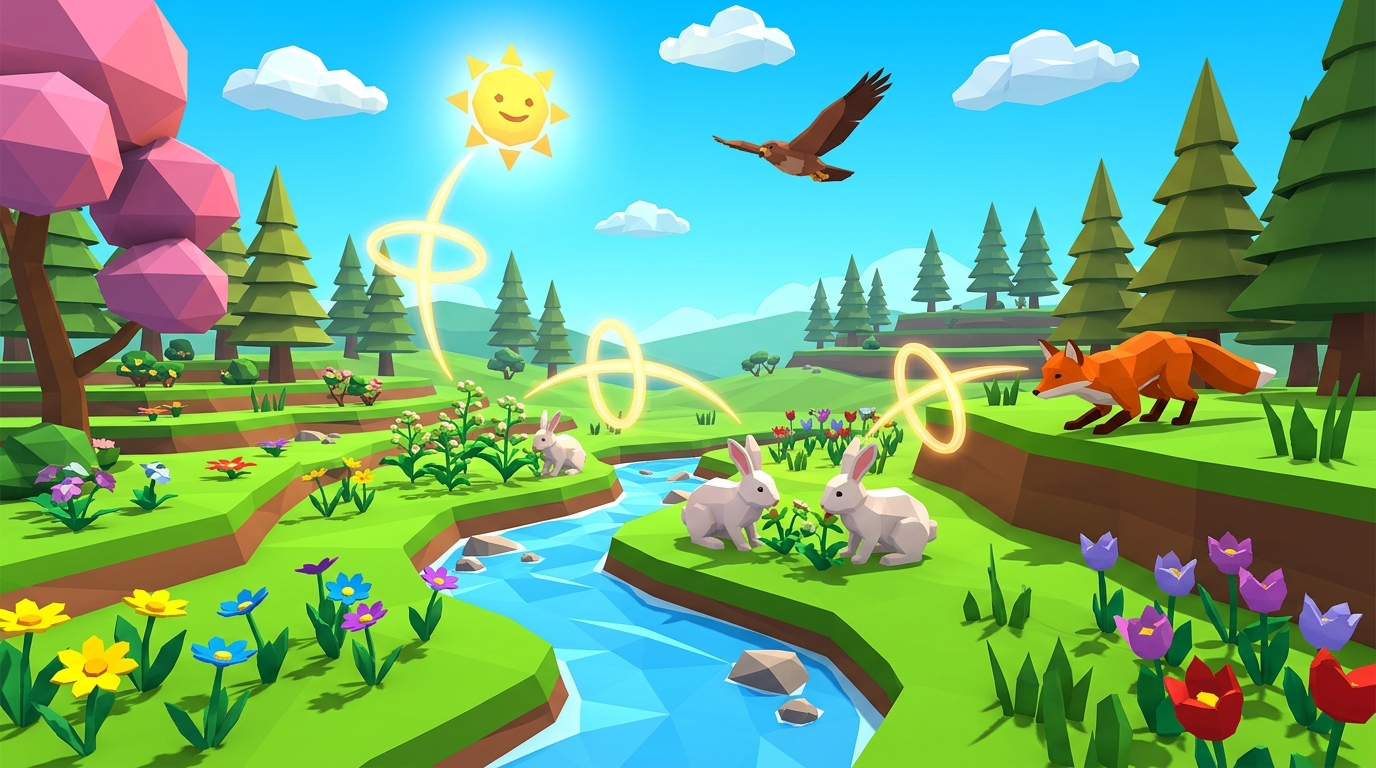
Grass, wildflowers, and shrubs convert photon irradiance and water into glucose through photosynthesis. In the simulation, adjusting solar exposure or rainfall directly impacts total producer biomass, dictating the carrying capacity of the entire ecosystem.
Primary Consumers (Herbivore Grazers)
Rabbits, rodents, and grasshoppers consume vegetable matter to fuel cellular respiration and growth. Because only 10% of plant caloric energy is converted into consumer biomass, herbivore populations can never outnumber the standing stock of producers.
Secondary & Apex Consumers (Predator Balance)
Foxes, snakes, and gray wolves maintain ecosystem balance by preying on grazers. This top-down trophic control prevents herbivores from denuding the terrain, protecting producer roots and preserving biodiversity.
Saprotrophic Decomposers (Soil Recycling Engines)
Earthworms, soil fungi, and ammonifying bacteria break down fallen leaves and animal remains. They release mineralized nitrates and phosphates into the topsoil, closing the energetic loop and fertilizing the next generation of autotrophs.
45-Minute Classroom Lesson Plan: Modeling the Nutrient Loop on Chromebooks
This turnkey lesson plan integrates browser simulations with physical logging to maximize student retention:
1. Hook & Prior Knowledge (8 Minutes): Ask students to sketch what happens to an apple core dropped in the forest. Define producers, consumers, and decomposers on the whiteboard.
2. Browser Sandbox Exploration (18 Minutes): Students open Praxos 3D Ecosystem on individual Chromebooks. In Mission 1 and Mission 2, students balance grass coverage and herbivore count, recording population numbers every 10 simulation days.
3. The Decomposer Catastrophe Challenge (12 Minutes): Have students run Mission 11 (*The Cleanup Crew*). Students deliberately pause decomposer activity and record how rapidly soil fertility crashes and vegetation withers.
4. Synthesis & Journal Reflection (7 Minutes): Students complete the trophic pyramid reflection questions in their printable lab logbook.
Praxos is optimized to launch in under 2 seconds on standard school-issued Chromebooks with zero downloads, browser extensions, or administrative permissions required.
LAUNCH CLASSROOM DEMOFrequently Asked Questions About Producers, Consumers, and Decomposers Games
Common questions from teachers and homeschooling parents looking for virtual science tools:
What is the main difference between a food chain game and a producer consumer decomposer game?
Are there free online games that teach decomposers accurately?
What grade levels are these interactive trophic role games designed for?
Can students access Praxos games at home without an account?
Free Supporting Ecology Resources and Curriculum Guides
Deepen your life science unit with our companion curriculum guides:
Compare additional digital tools in our interactive food chain games ranked review.
Explore interconnected feeding networks in our best free food web games online catalog.
Review classroom teaching strategies in our food chain games for the classroom guide.
Examine predator and prey balance in our predator-prey relationship guide.
Register your school or class on our dedicated educator dashboard.
Download printable energy pyramid graphing templates, trophic role sorting cards, and experiment logs designed for elementary and middle school classrooms.
DOWNLOAD MISSION JOURNAL (PDF)Trophic Roles & Nutrient Cycles Lab Logbook (PDF)
A 24-page printable companion journal with classification cut-outs, biomass tracking charts, and hypothesis logs for elementary and middle school ecology units.