Why 4th Graders Need Interactive Food Chain Games Instead of Paper Worksheets
Fourth grade marks a critical cognitive leap in elementary science. According to NGSS standard 4-LS1-1, nine- and ten-year-old students transition from merely memorizing animal names to constructing explanations of how anatomical structures and physiological behaviors support survival, growth, and energy acquisition.
Traditional paper worksheets typically ask 4th graders to draw arrows between animals or cut and paste pictures of grass, rabbits, and hawks into linear boxes. While these exercises teach the correct arrow direction (showing energy moving into the eater), they fail to convey the dynamic fragility of living systems. A student who pastes a paper hawk onto a worksheet cannot see what happens when a drought wipes out the grass.
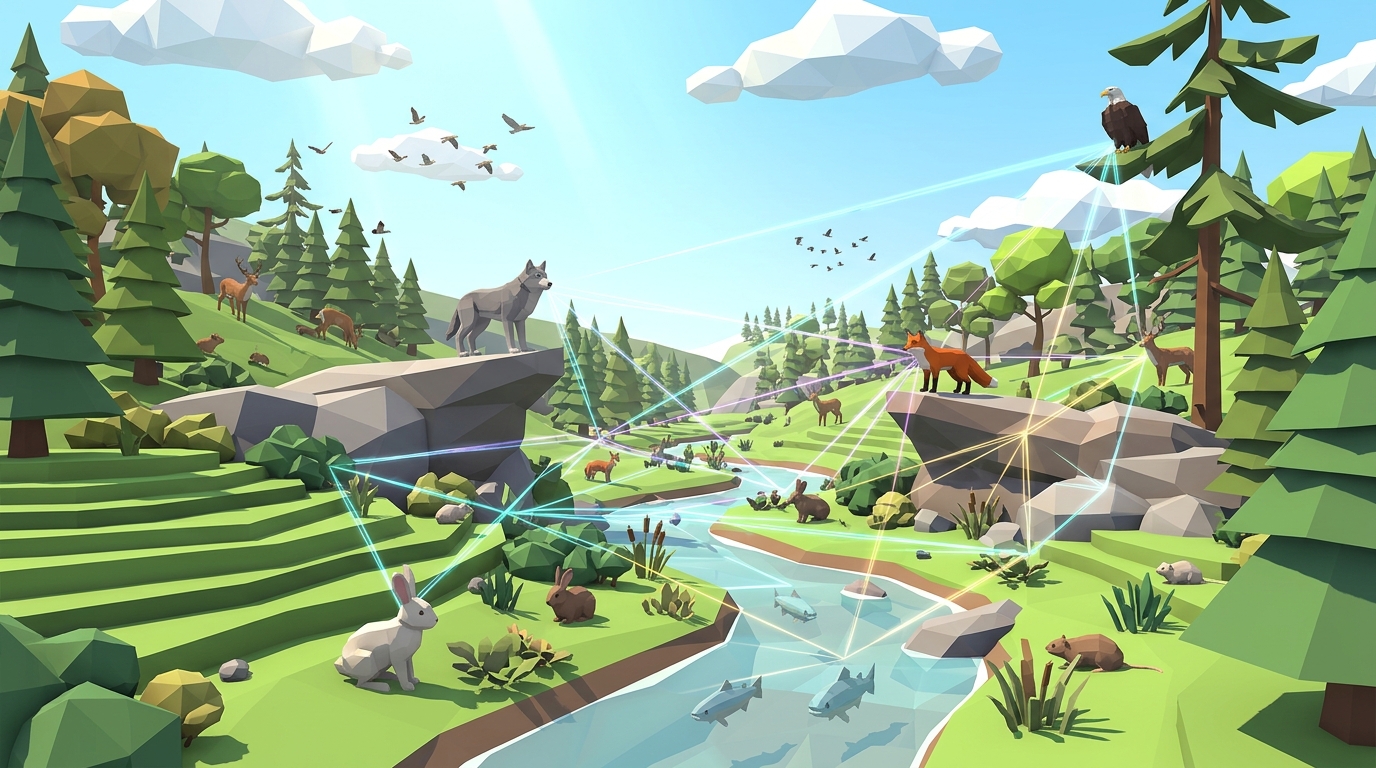
Interactive 3D simulations bridge this gap by transforming abstract biological principles into concrete, observable causes and effects. When 4th graders adjust sunlight and rainfall in a living sandbox, they immediately understand that every calorie inside an apex predator originally came from radiant solar photons converted by green leaves.
A common misconception among 4th graders is that food chain arrows point from predator to prey because predators attack. In science, the arrow represents the flow of energy: always pointing into the organism doing the eating.
Best Food Chain Games and Virtual Labs for 4th Grade Classrooms
We evaluated the top digital resources used in 4th-grade science classrooms based on curriculum alignment, reading accessibility, and technical reliability on district devices:
Praxos Learning: 3D Elementary Habitat Explorer
Hands-on inquiry, Chromebook usability, and NGSS 4-LS1-1 alignment (Ages 9 to 11)
Praxos puts 4th graders in the pilot seat of a living 3D prairie ecosystem. Students complete sequential missions: first generating soil moisture and sunlight, then introducing foraging primary consumers, and finally balancing the food web with apex predators.
- ✓No passwords, emails, or logins needed: launches in 2 seconds on school Chromebooks
- ✓Large, kid-friendly controls with visual indicators for hunger, hydration, and energy
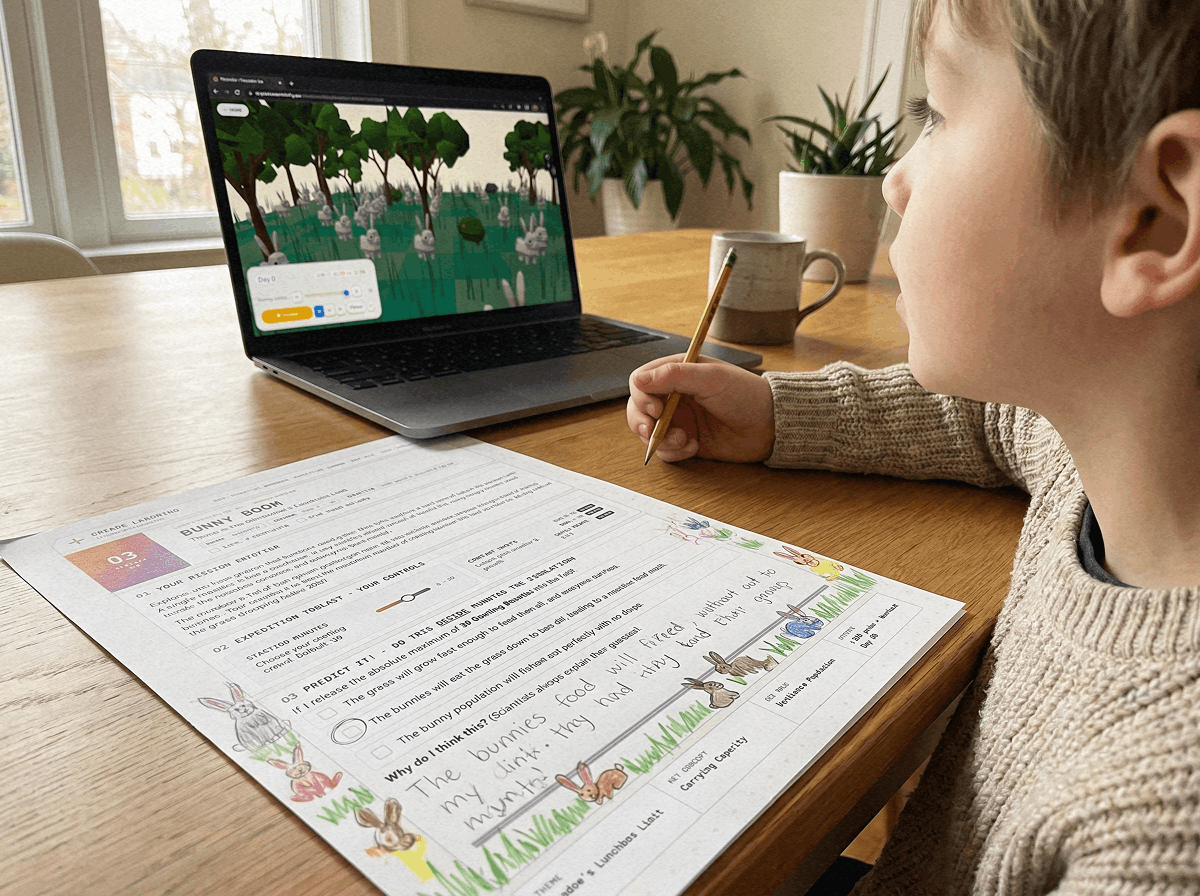
- ✓Comes with a free 24-page printable student lab journal for physical note-taking
- ✓Explicitly targets NGSS 4-LS1-1 and 5-PS3-1 life science standards
PBS Kids: Wild Kratts Creature Powers & Feeding Webs
Introducing animal adaptations and predatory mechanics through narrative (Ages 7 to 10)
Wild Kratts games engage elementary students through narrative adventures where animal suit powers teach specific adaptations: cheetah speed, chameleon vision, and raptor talons.
- ✓Beloved television characters that immediately capture 4th-grade interest
- ✓Emphasizes anatomical adaptations and predator-prey tactics
- ✓Mini-games are arcade-focused rather than open-ended ecological modeling
Sheppard Software: Chain Reaction & Animal Diets
Classifying carnivores, herbivores, and omnivores in 5-minute warmups (Ages 8 to 10)
Simple drag-and-drop game where students build simple 3-step and 4-step food chains in marine, forest, and desert biomes. Helpful for introductory vocabulary and quick bell-ringer warmups.
- ✓Clean, straightforward interface requiring minimal teacher instruction
- ✓Covers multiple distinct biomes including ocean and temperate woodland
- ✓Ad banners present on screen; outcomes are strictly predetermined
National Geographic Kids: Creature Feature & Web Builders
Researching organism diets and global habitat facts (Ages 8 to 11)
Nat Geo Kids combines high-resolution wildlife photography with interactive fact files and mini-quizzes, helping 4th-grade students research real-world diets of apex predators and primary consumers.
- ✓Stunning world-class wildlife photography and authoritative biological data
- ✓Great for cross-curricular reading comprehension and science research reports
- ✓Informational article format with limited open sandbox simulation mechanics
4th Grade Curricular Alignment: NGSS 4-LS1-1 and 5-PS3-1
How digital simulations fulfill key elementary science learning milestones:
| NGSS Standard Code | Core Requirement | How 4th Graders Test It in Praxos Simulation |
|---|---|---|
| Grade 4 CoreNGSS 4-LS1-1 | Internal and external structures support survival, growth, and reproduction | Students observe rabbit grazing teeth and sprint speed, noting how physical structures permit foraging and predator evasion in 3D. |
| NGSS 5-PS3-1 (Bridge) | Energy in animals food was once energy from the sun | Students manipulate sunlight levels in Level 1 and watch how solar photon reduction restricts plant sugar production and starves herbivores. |
| NGSS 3-5-ETS1-2 | Generate and compare multiple possible solutions to an engineering/design problem | Students adjust herbivore-to-predator ratios across multiple trials to design a self-sustaining ecosystem that survives 100 virtual days. |
Explore 4th Grade Food Chains in 3D
Zero account setup, zero ads. Let 4th-grade students control sun and rain, guide foraging herbivores, and observe predator balance on standard school Chromebooks.
Step-by-Step 4th Grade Lesson: Tracking Energy from Sun to Apex Predator
Follow this structured 4-step inquiry path during your 4th-grade science unit:
Step 1: Sunlight to Sugar (Photosynthesis)
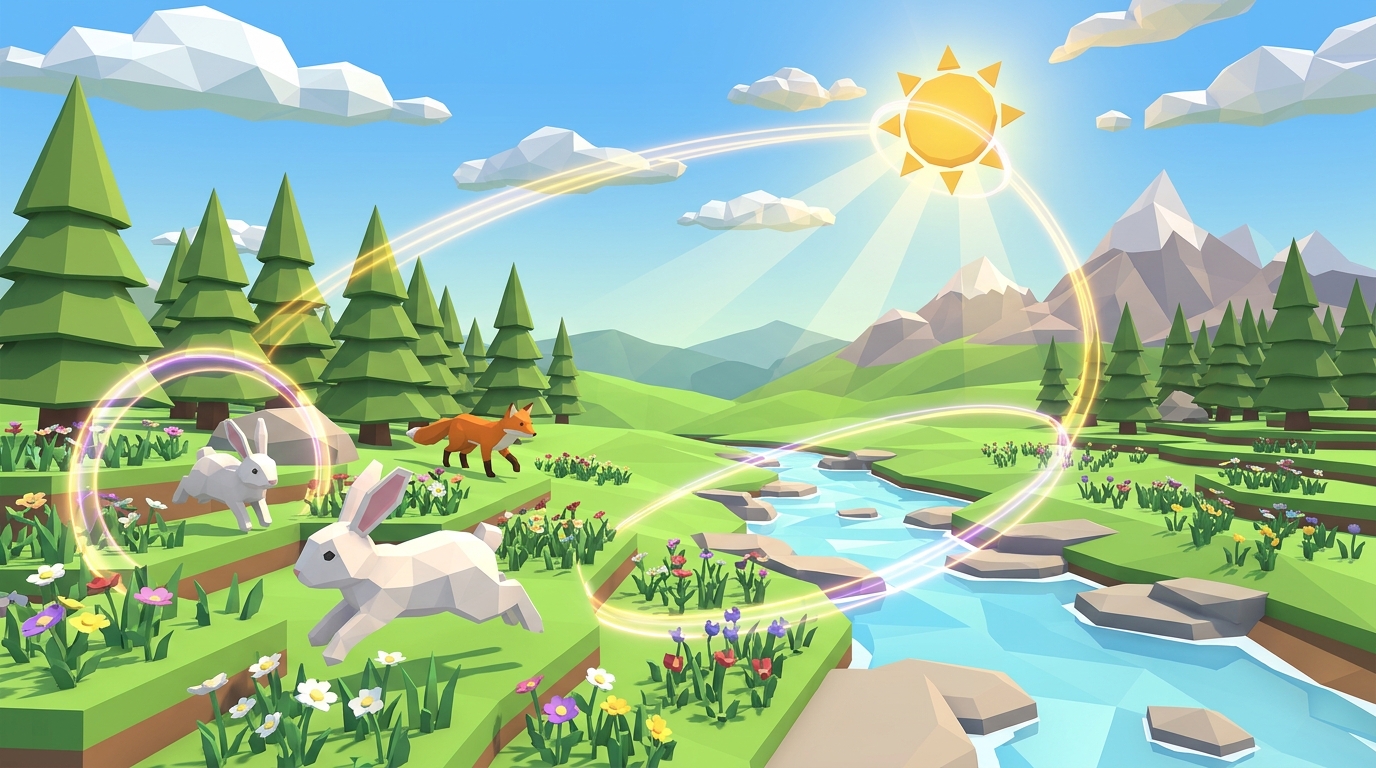
Students start with bare soil. They increase sunlight and rainfall sliders to trigger grass growth, observing that living plants do not eat soil: they convert solar energy into living plant biomass.
Step 2: Herbivore Foraging (Energy Step 1)
Introduce two rabbits into the field. 4th graders watch the herbivores seek out green plants, recording how each bite reduces plant biomass while boosting the rabbit energy bar.
Step 3: Carnivore Hunting (Energy Step 2)
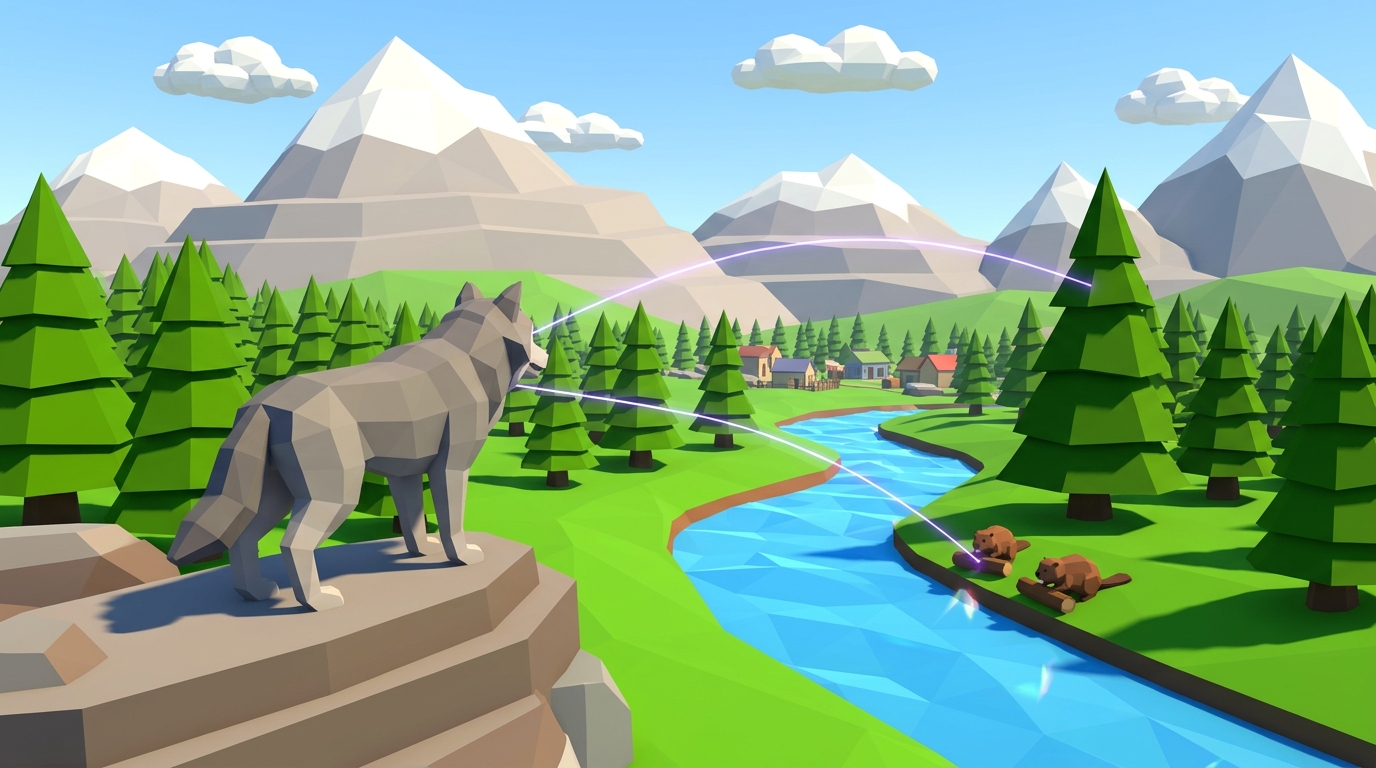
Introduce a gray wolf. Students observe how predators must constantly expend metabolic energy prowling for food, understanding why prey animals must always outnumber apex hunters.
Step 4: Energy Loss & The 10% Reality
Students review the summary graph at the end of the mission. They see that it takes thousands of pounds of grass to support a dozen rabbits, which in turn support just one or two wolves.
40-Minute Chromebook-Ready Classroom Mission Guide
Designed for elementary computer lab sessions or 1:1 Chromebook classrooms:
Minute 00 to 05: Warm-up question on the board: *Where does a wolf get its energy if it only eats meat?* Trace back to grass and sunlight.
Minute 05 to 25: Students open Praxos 3D Simulation and complete Missions 1, 2, and 3. Students record their starting and ending animal counts in their science notebooks.
Minute 25 to 35: Students tackle the *Prairie Drought Challenge*. Turn off rain for 30 simulation days and record which organism suffers first: plants, herbivores, or carnivores.
Minute 35 to 40: Wrap-up check for understanding: have students point their thumbs in the direction food chain arrows flow (into the mouth of the eater!).
No student emails, passwords, or district software installs required. Praxos runs natively in Google Chrome on any standard school Chromebook.
OPEN 4TH GRADE DEMOFrequently Asked Questions About 4th Grade Food Chain Games
Answers to common questions from 4th-grade educators and homeschooling parents:
Are these food chain games appropriate for 4th-grade reading levels?
How do 4th-grade food chain games connect to NGSS standards?
Can this be used for homeschool science portfolios?
Does the game require any paid subscription or classroom license?
Free Elementary Science Resources and Printable Guides
Explore additional free resources for 4th-grade science lessons:
Review top software in our interactive food chain games ranked guide.
Explore ocean biology in our ocean food chain 4th grade unit study.
Find hands-on classroom experiments in our 10 food chain activities for kids article.
Learn the rules of food web arrows in our which way do food chain arrows point explainer.
Access classroom tools and lesson plans on our teachers hub.
Printable energy flow diagrams, predator observation logs, and vocabulary puzzles designed specifically for 4th-grade classrooms.
DOWNLOAD 4TH GRADE LOGBOOK (PDF)4th Grade Food Chain Lab Expedition Journal (PDF)
A 24-page printable companion journal with animal trait checklists, food chain arrow diagrams, and observation logs tailored for 4th-grade science standards.