How Solar Energy Moves Through a Temperate Forest Canopy
Temperate deciduous forests are among the most biologically productive ecosystems on Earth. Characterized by distinct seasonal shifts, rich canopy layers, and deep leaf-litter soil, a healthy woodland operates as a continuous energy conversion machine.
Every forest food chain begins with the sun. Towering autotrophs such as Northern Red Oaks, Sugar Maples, and Eastern White Pines capture solar photons through chlorophyll-rich leaves. Through photosynthesis, these trees convert radiant energy and carbon dioxide into chemical glucose, producing tons of calorie-dense foliage, seeds, and acorns.
This primary biomass provides the foundational caloric engine that powers every animal in the forest ecosystem.
Energy in a forest moves vertically as well as trophicly: from the high canopy (photosynthesis) down through the understory, shrub layer, and forest floor (decomposition).
The 5 Essential Trophic Levels of the Forest Food Chain
To understand how forest animals interact, ecologists organize organisms into five distinct trophic levels based on where they obtain their nutritional energy:
Primary Producers (Autotrophs)
Oak Trees, Sugar Maples, Wild Ferns & Berry Shrubs
Plants capture sunlight and absorb groundwater nutrients to manufacture glucose. They form the base of the entire forest biomass pyramid.
- ✓Produce acorns, nuts, berries, and nutrient-dense leaves
- ✓Generate 100% of the initial organic calories in the food web
Primary Consumers (Herbivores)
Eastern Gray Squirrel, Gypsy Moth Caterpillar & White-Tailed Deer
Herbivorous animals consume plant tissues, seeds, and tree bark to acquire glucose and carbohydrates for cellular metabolism.
- ✓Eastern gray squirrels harvest and cache oak acorns
- ✓Caterpillars convert deciduous leaf foliage into animal protein
Secondary Consumers (Carnivores & Omnivores)
Woodland Songbirds (Warblers), Red Fox & Garter Snakes
Secondary consumers prey upon herbivores. For example, songbirds consume caterpillars, while red foxes hunt squirrels and mice.
- ✓Keep herbivore populations from over-consuming young saplings
- ✓Exhibit omnivorous dietary flexibility across changing seasons
Tertiary Consumers (Apex Predators)
Red-Tailed Hawk, Great Horned Owl & Gray Wolf
Apex raptors and large carnivores sit at the top of the forest chain with virtually no natural predators, regulating secondary and primary consumers.
- ✓Red-tailed hawks hunt rodents, squirrels, and small reptiles from tree perches
- ✓Prevent secondary consumer overpopulation through top-down predation
Decomposers & Detritivores (Nutrient Recyclers)
Bracket Fungi, Earthworms, Wood-Boring Beetles & Soil Bacteria
Decomposers break down fallen logs, leaf litter, and animal carcasses into rich humus soil, returning nitrogen and phosphorus to tree roots.
- ✓Prevent dead organic matter from suffocating the forest floor
- ✓Close the ecological loop by fertilizing primary producer root networks
Forest Animal Trophic Level Comparison Table
Here is a comprehensive reference table categorizing 10 common temperate forest species by their exact scientific classification, trophic tier, diet, and ecological niche:
| Organism Name | Scientific Name | Trophic Level | Primary Diet | Key Forest Niche |
|---|---|---|---|---|
| PRODUCERNorthern Red Oak | Quercus rubra | Producer (Autotroph) | Sunlight, H2O, CO2 | Supplies high-fat acorns and canopy shelter for hundreds of species. |
| Eastern Gray Squirrel | Sciurus carolinensis | Primary Consumer | Acorns, nuts, fungi, tree bark | Essential seed disperser through forgotten winter acorn caches. |
| Polyphemus Moth Caterpillar | Antheraea polyphemus | Primary Consumer | Oak and birch foliage | Converts tree leaf mass into high-protein biomass for songbirds. |
| White-Tailed Deer | Odocoileus virginianus | Primary Consumer | Twigs, shrubs, young saplings | Shapes forest understory structure through browse pressure. |
| Black-Capped Chickadee | Poecile atricapillus | Secondary Consumer | Caterpillars, insects, seeds | Regulates woodland insect and moth populations in tree canopies. |
| Red Fox | Vulpes vulpes | Secondary / Tertiary Consumer | Mice, squirrels, berries, insects | Versatile mesopredator keeping rodent numbers balanced. |
| Eastern Garter Snake | Thamnophis sirtalis | Secondary Consumer | Earthworms, slugs, frogs | Ground-level predator regulating soil invertebrates and amphibians. |
| APEX RAPTORRed-Tailed Hawk | Buteo jamaicensis | Tertiary / Apex Consumer | Squirrels, rabbits, snakes, mice | Daytime aerial hunter patrolling forest borders and clearings. |
| Great Horned Owl | Bubo virginianus | Tertiary / Apex Consumer | Skunks, hares, rodents, waterfowl | Nocturnal apex predator controlling forest mammal populations. |
| DECOMPOSERArtist Bracket Fungus | Ganoderma applanatum | Decomposer | Decaying hardwood lignin & cellulose | Breaks down fallen tree trunks into nutrient-rich organic soil. |
The 10% Energy Transfer Law in Forest Ecosystems
Why are there millions of acorns and thousands of squirrels in a forest, but only a few red-tailed hawks? The answer lies in Lindeman 10% Ecological Efficiency Law.
When a squirrel eats oak acorns, only about 10% of the energy stored in those acorns is converted into squirrel body mass. The other 90% is expended through movement, body warmth, digestion, and metabolic respiration.
Likewise, when a red-tailed hawk preys on a squirrel, only 10% of the squirrel caloric energy transfers into hawk tissue. Because 90% of energy is lost at each trophic link, an ecosystem requires an immense foundational biomass of oak trees to support a single family of apex hawks.
Learn more about how energy arrows work in our complete guide to what arrows mean in a food web and explore how secondary consumers function.
Step-by-Step: How to Draw a Forest Food Chain Diagram
When drawing a forest food chain for a science project or notebook log, follow these four simple steps:
Start with the Sun and Primary Producer on the Far Left
Draw the Sun providing radiant light to an Oak Tree. Write "Producer" underneath and specify that it converts sunlight into glucose through photosynthesis.
Draw Energy Arrows Pointing TOWARD the Consumer
Draw an arrow from the Oak Acorns pointing to the Eastern Gray Squirrel. The arrow represents the transfer of calories into the squirrel stomach.
Connect Secondary Consumers and Apex Predators
Draw an arrow from the Squirrel to the Red Fox, and an arrow from the Red Fox to the Red-Tailed Hawk or Gray Wolf. Label each organism with its specific trophic level.
Close the Nutrient Loop with Woodland Decomposers
Draw dashed arrows from every dead organism down to Bracket Fungi and Earthworms on the forest floor, with arrows returning minerals back to tree roots.
Frequently Asked Questions About Forest Food Chains
Here are answers to common questions about forest animal food chains and food web dynamics:
What is the main difference between a forest food chain and a forest food web?
What happens if a primary producer like oak trees dies off?
Why are decomposers crucial in a temperate deciduous forest?
Can an animal occupy more than one trophic level in a forest food web?
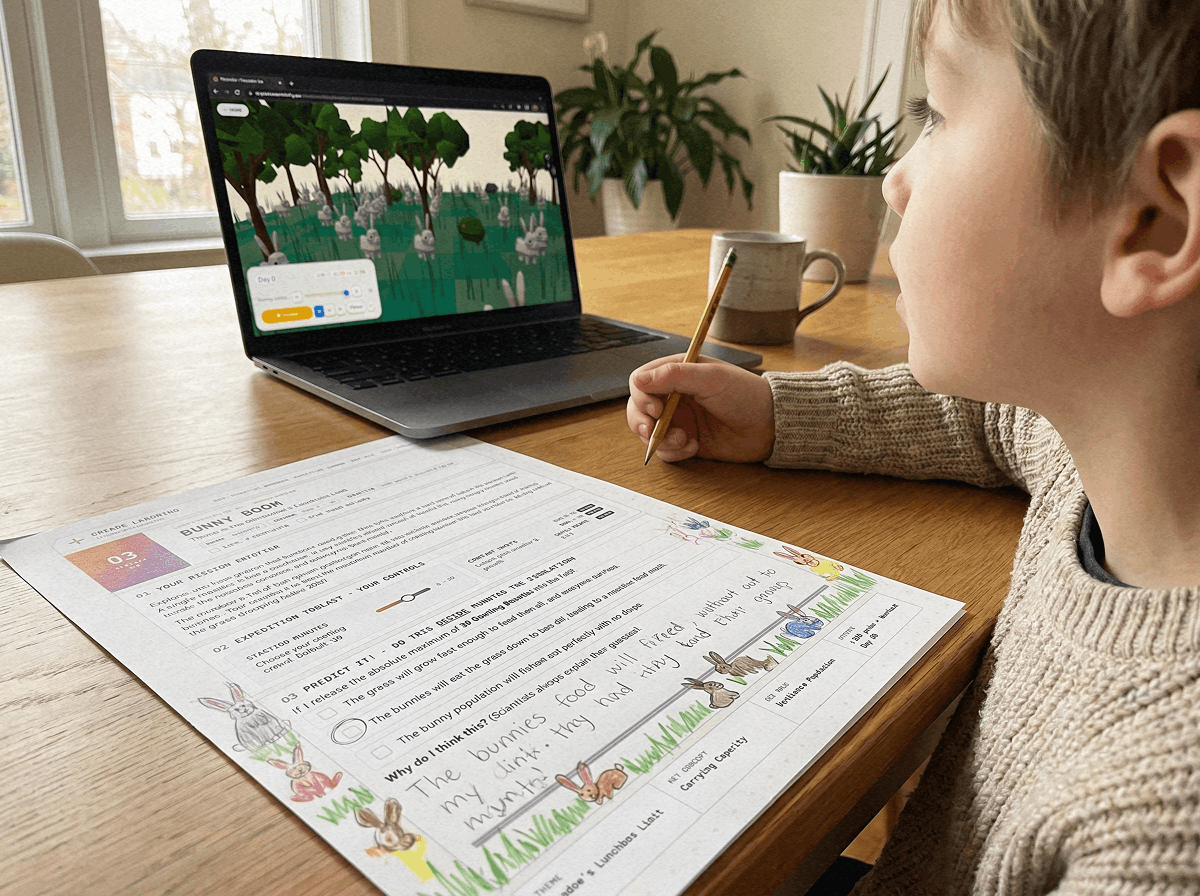
How can kids simulate a forest food chain on Praxos?
Temperate Forest Food Chain Diagram & Worksheet Template
A free printable student activity sheet with forest food chain diagram templates, trophic level classification cards, and energy arrow mapping grids designed for grades 3 through 8.