The Language of Loops: Why Positive and Negative Confuse Students
In everyday human conversation, "positive" means good and "negative" means bad. If a teacher gives positive feedback, it means you did great work; if a friend gives negative feedback, it means something went wrong.
In science, physics, biology, and engineering, positive and negative have nothing to do with good or bad. Instead, they describe the direction and momentum of change:
1. Positive (Reinforcing) Feedback Loops: Amplify change. When a variable increases, the loop causes it to increase even further. When a variable decreases, the loop accelerates its decline. Think of an avalanche: a small snowball rolls, gathers more snow, gets heavier, rolls faster, and grows into a giant snowslide. You can model this runaway compounding by testing Level 1 instantly or unlocking Level 3: The Bunny Boom 3D simulation free with email, where unchecked reproduction triggers an exponential population surge.
2. Negative (Balancing) Feedback Loops: Counteract change. When a variable increases, the loop pushes it back down. When a variable drops, the loop pushes it back up. Think of a tightrope walker: when they lean too far to the left, they adjust their balance pole to the right to stay upright. In our Level 5: Dynamic Equilibrium 3D lab (unlocked free with email), students introduce natural predator counters to stabilize these shifts.
In science, positive feedback loops amplify change (making growth or decline faster and more extreme), while negative feedback loops resist change (pushing systems back toward balance and homeostasis).
Real-World Examples: Everyday Technology vs. Biological Systems
To make feedback loops intuitive for kids, comparing household systems with living biology highlights how universal these mechanics are:
| System & Scenario | Loop Classification | Initial Disturbance | System Response | Ultimate Outcome |
|---|---|---|---|---|
| BALANCINGHome Thermostat Heating | Negative (Balancing) | Room temperature drops below 68 F | Furnace turns on, blowing warm air | Temperature stabilizes at target setpoint |
| HOMEOSTASISHuman Body Sweating | Negative (Balancing) | Body heats up during strenuous exercise | Sweat glands release moisture that evaporates | Core body temperature cools back to 98.6 F |
| AMPLIFYINGMicrophone Audio Screech | Positive (Reinforcing) | A tiny sound enters the microphone | Speaker plays sound louder, re-entering mic | Deafening high-pitched screeching loop |
| RUNAWAYArctic Sea Ice Melting | Positive (Reinforcing) | Global temperatures rise slightly | White ice melts, exposing dark ocean water | Dark water absorbs more sunlight, melting more ice |
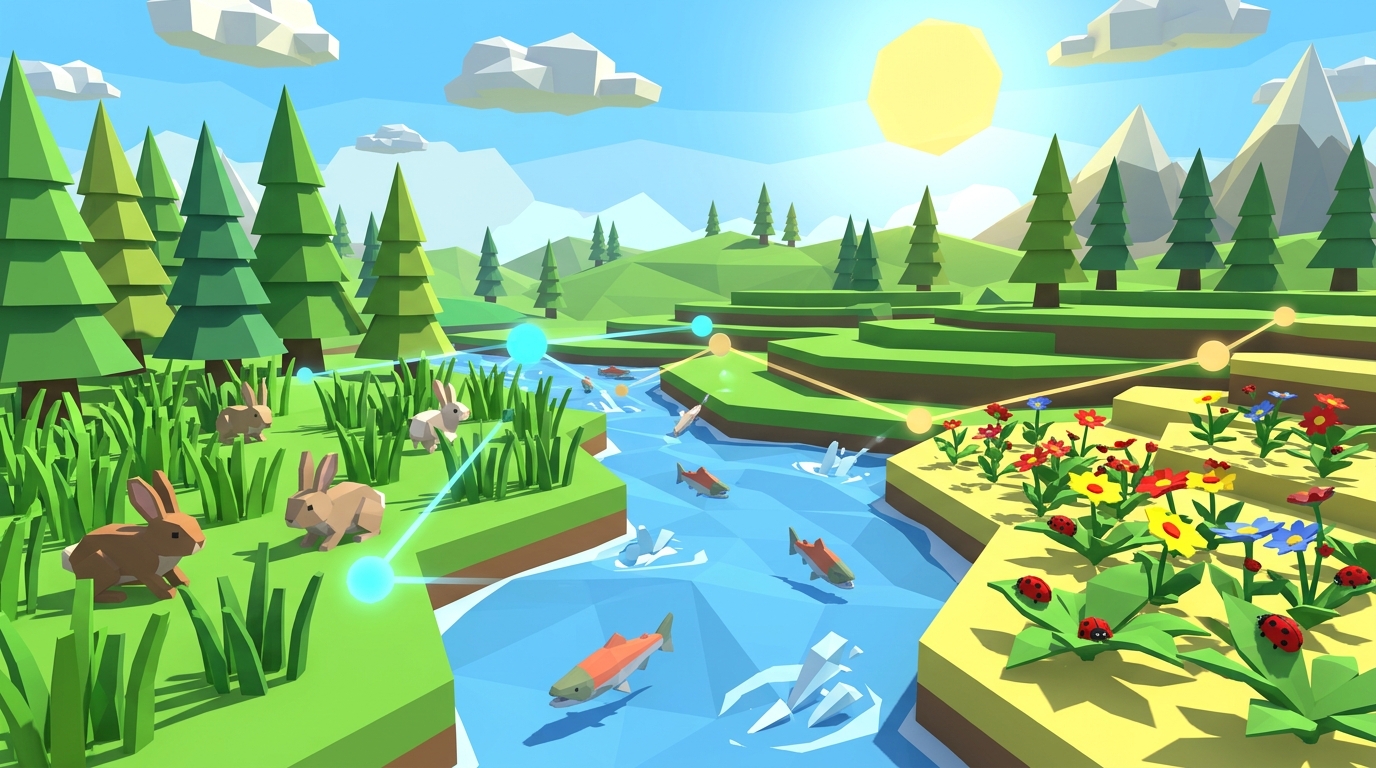
| ECOLOGY BOOMRabbit Boom Without Predators | Positive (Reinforcing) | Initial rabbit population has abundant food | More rabbits give birth to more litters | Exponential population explosion until food vanishes |
| ECOLOGY BALANCEWolf & Elk Population Balance | Negative (Balancing) | Elk herd population increases | Wolves hunt more elk; wolf population rises | Elk numbers decrease back to sustainable levels |
Simulate Reinforcing and Balancing Loops in Real Time
Don't just read about feedback loops: test living variables in our free 3D simulator. Level 1 starts instantly with zero login; explore runaway growth in Level 3 and predator balancing in Level 5 free with email.
Predator-Prey Feedback Loops: The Lotka-Volterra Dance
In natural ecosystems, positive and negative feedback loops are constantly entangled. This interplay creates the famous coupled population cycles described by the Lotka-Volterra equations.
Consider a grassland meadow with grass, rabbits, and foxes:
Phase 1 (The Positive Reproductive Loop): When grass is abundant and foxes are few, rabbits reproduce rapidly. More rabbits produce more offspring: an accelerating positive feedback loop that students can witness firsthand in Level 3: The Bunny Boom (unlocked free with email).
Phase 2 (The Negative Predation Loop Kicks In): As rabbit density surges, foxes find food easily. Well-fed foxes survive and raise large litters. More foxes consume more rabbits, turning the system into a balancing negative loop that drives rabbit numbers back down. In Level 5: Dynamic Equilibrium (unlocked free with email), students introduce predator populations to actively regulate herbivore booms.
Phase 3 (The Crash and Recovery): With fewer rabbits available, some foxes starve or migrate. With fewer predators hunting them, the surviving rabbits begin multiplying again, starting the cycle anew.
Without the balancing negative loop provided by predators, the positive reproduction loop would cause rabbits to overshoot carrying capacity, strip the meadow bare, and trigger catastrophic starvation. You can test these coupled oscillations directly by launching Level 1 instantly or unlocking Level 3: Bunny Boom free with email to observe how predator density acts as an automatic thermostat for herbivore populations.
For more on predator-prey dynamics, read my companion guides on predator-prey relationships, carrying capacity explained, and photosynthesis and abiotic factors.
Hands-On Activity: Feedback Loop Matching Cards Investigation
Help students master systems thinking with this simple 4-step classroom or homeschool investigation:
Sort Scenario Cards into Balancing vs. Reinforcing
Provide students with 8 real-world scenario cards (sweating, microphone screech, thermostat, stampede, bank interest, fruit ripening). Have them sort each into balancing or reinforcing categories.
Draw the Closed Circular Diagram
Students map the feedback loop using circular arrows with positive (+) and negative (-) polarity labels at each transition.
Identify the Tipping Point and Limiting Factor
Challenge students to identify what abiotic or biotic constraint stops a positive feedback loop from expanding infinitely.
Test Runaway Loops in the 3D Simulation Lab
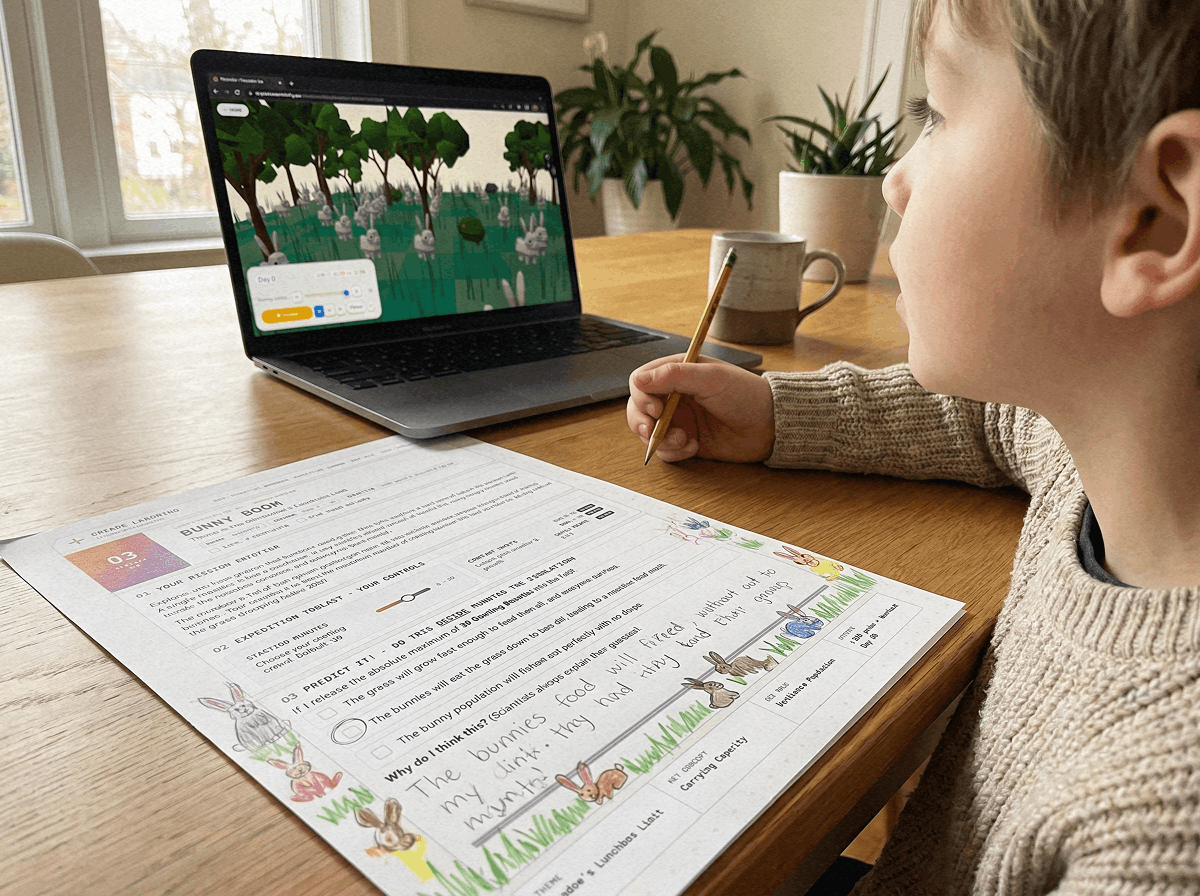
Test Level 1 instantly, then open Level 3: Bunny Boom in the 3D lab (unlocked free with email). Start with high vegetation and zero predators. Watch the population graph skyrocket (positive loop) and then suddenly crash to zero when food is depleted.
Frequently Asked Questions About Feedback Loops for Kids
Common questions from STEM teachers, homeschool parents, and young systems thinkers.
What is the simplest way to explain a feedback loop to a child?
Why is sweating considered a negative feedback loop?
Can positive feedback loops be dangerous in ecosystems?
Are all simulation levels and printable matching worksheets free?
Experiment with Dynamic Feedback Loops in 3D
See systems thinking and feedback loops in action in an interactive browser sandbox.
Start Level 1 instantly in your browser with zero registration. Unlock all 10 simulation missions and download the complete 24-page Expedition Science Journal 100% free with email.
Start Level 1 instantly, then unlock Level 03: Bunny Boom and Level 05: Dynamic Equilibrium free with email to observe runaway reinforcing loops and stable balancing loops in real time.
SIMULATE FEEDBACK LOOPS IN 3DFeedback Loop Matching Cards & Lab Journal (PDF)
Printable feedback loop sorting cards, systems thinking diagrams, and 10-level student experiment logging sheets.