The Wet Sponge Paradox: How Ice-Cold Seawater Ignites Underground Fire
Ask most adults where volcano magma comes from, and they will tell you that Earth's interior is a raging ocean of liquid fire, or that volcanoes are connected by colossal pipes directly to the molten iron core. Both ideas are completely false.
As demonstrated in our earlier geophysics investigations, Earth's mantle is composed of solid silicate peridotite rock under staggering lithostatic pressure. At 100 kilometers beneath the surface, mantle temperatures hover between 1,000°C and 1,200°C. While that sounds intensely hot, completely dry peridotite rock requires temperatures exceeding 1,400°C to melt at that immense depth. Under normal conditions, the mantle remains completely solid.
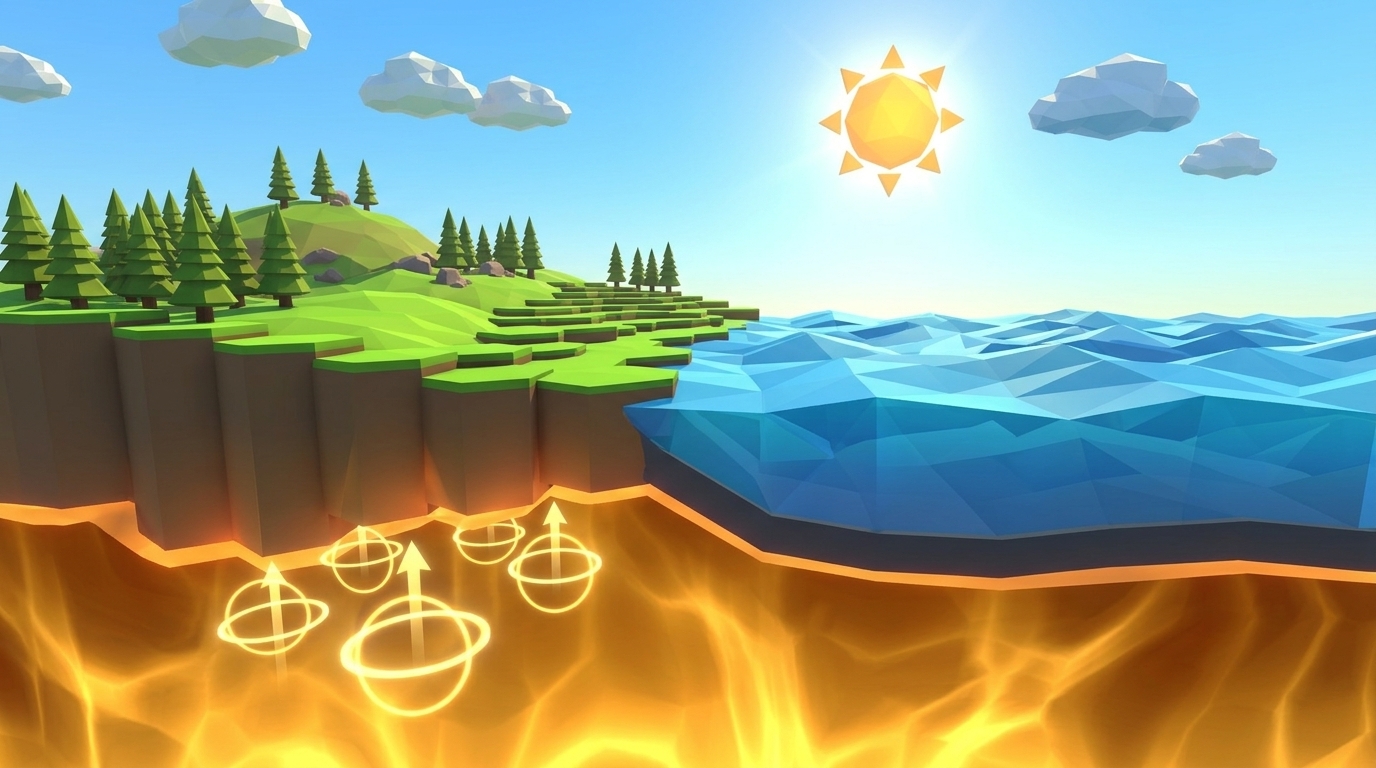
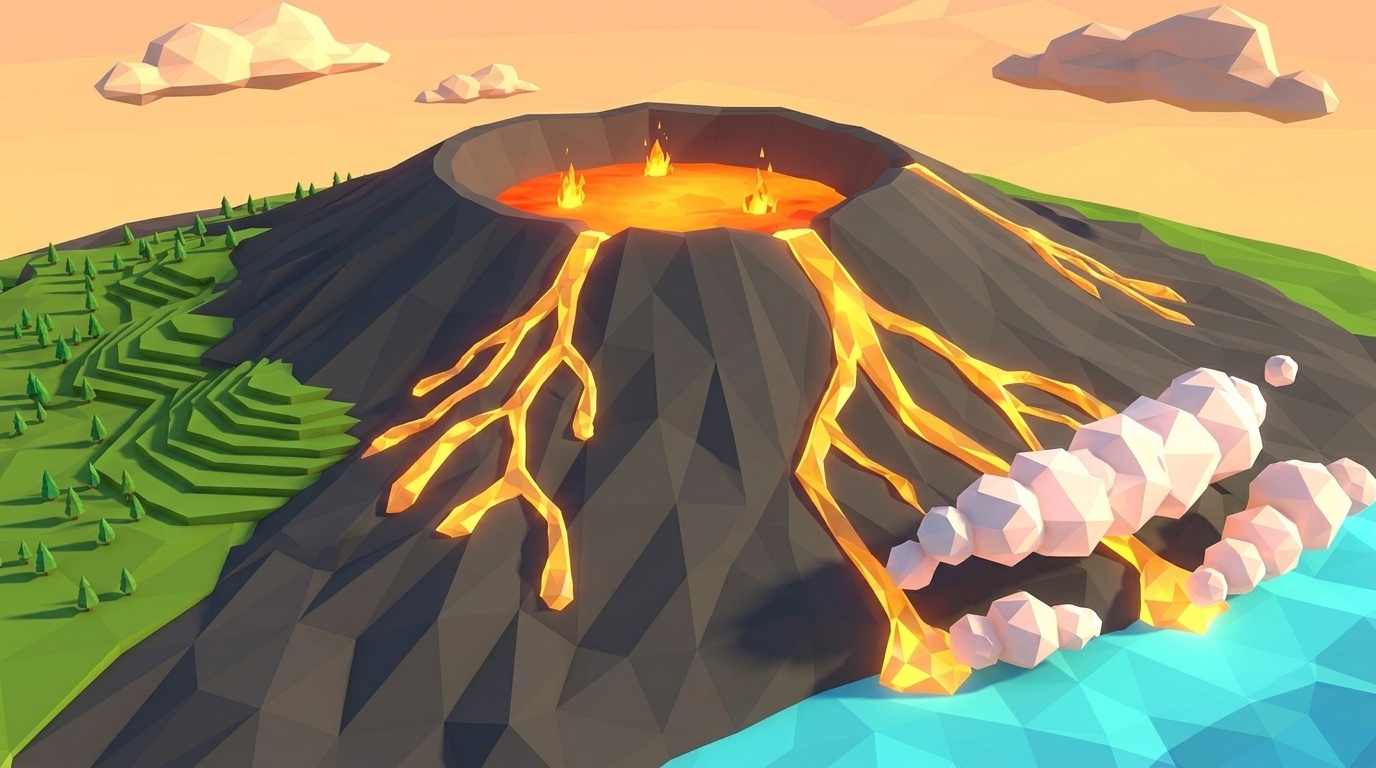
So how do the world's most famous volcanic arcs, including Mount St. Helens, Mount Fuji, and the entire Pacific Ring of Fire, produce endless rivers of molten lava? The secret arrives from the ocean floor, carried inside a subducting tectonic plate behaving like a water-logged sponge.
Over a hundred million years of seafloor exposure, ocean water chemically bonds with basaltic minerals, creating hydrated metamorphic rocks such as serpentinite, chlorite, and amphibole. When the cold oceanic slab dives 100 kilometers deep into the mantle (as explored in Level 4), roasting temperatures bake this trapped seawater out of the stone in a process called metamorphic dehydration.
Just as spreading rock salt on an icy road lowers the melting point of ice so it turns to liquid water below freezing, injecting superheated water into solid mantle rock lowers its melting point by over 200°C, triggering partial melting without any added heat.
The Physics of Partial Melting and Buoyant Magma Ascent (Diapirs)
What happens when superheated, supercritical water rises from the subducting slab into the overlying mantle wedge? The volatile water molecules aggressively break the strong silicon-oxygen bonds within solid silicate minerals. This catalytic reaction is known as flux melting (or hydration melting).
Because natural rocks are heterogeneous mixtures of minerals with varying melting points, the rock does not liquefy all at once. Instead, it undergoes partial melting: roughly 10 to 20 percent of the rock, the silica- and iron-rich mineral fraction with lower melting temperatures, melts into tiny droplets of molten basaltic magma, leaving solid, unmelted olivine crystals behind.
Once molten, Archimedes' Principle takes over. Solid mantle peridotite has a density of roughly 3.3 grams per cubic centimeter. In contrast, liquid basaltic magma has a significantly lower density of approximately 2.7 to 2.8 grams per cubic centimeter. Because the liquid rock is substantially lighter than the solid rock surrounding it, positive buoyancy exerts an immense upward restoring force.
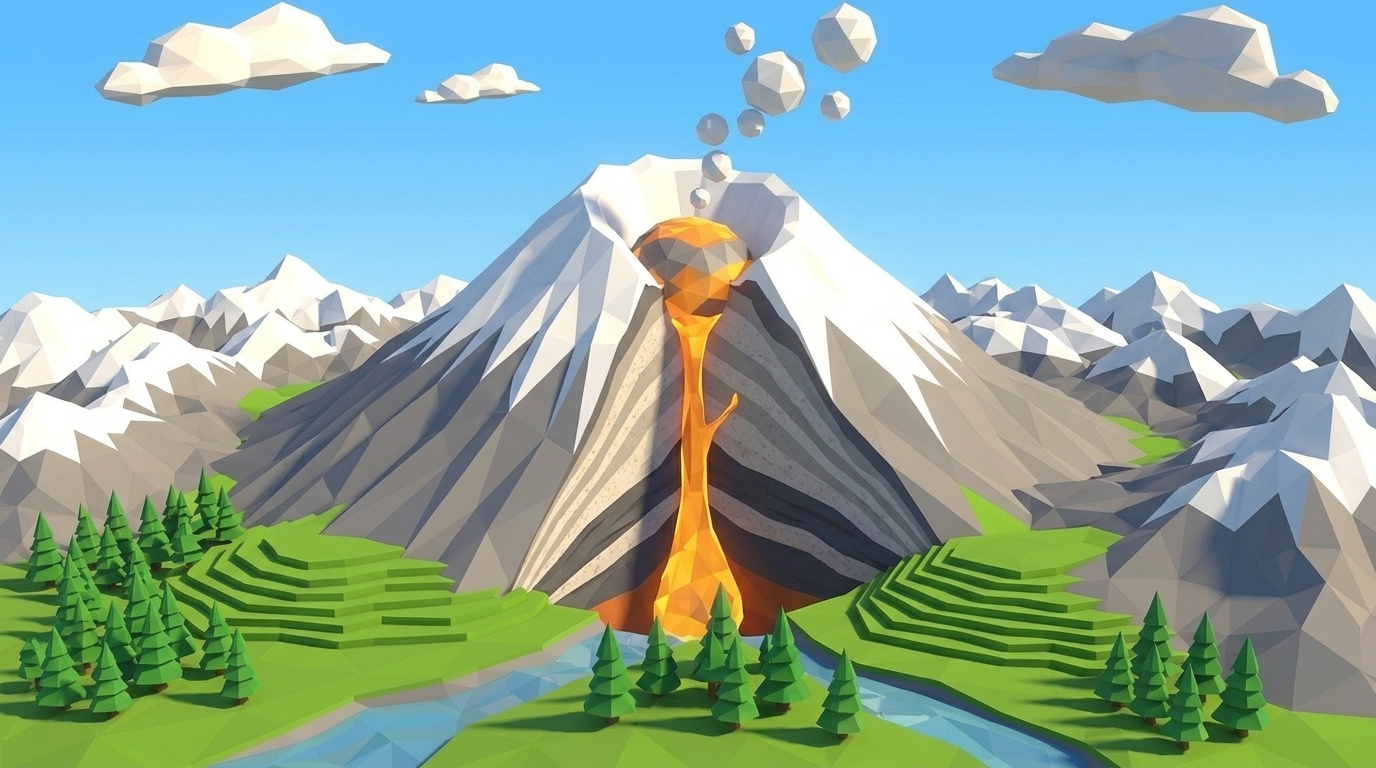
The dispersed droplets coalesce into rising teardrop-shaped magma plumes called diapirs. These molten conduits squeeze upward through ductile mantle fractures at velocities of centimeters to meters per year. When the rising magma reaches the base of the continental crust (roughly 6 to 10 kilometers beneath the surface), it encounters lighter granitic country rock and settles into neutral buoyancy, pooling into a subterranean reservoir: the magma chamber.
| Melting Mechanism | Geological Setting | Physical Trigger | Resulting Magma Type | Volcano Examples |
|---|---|---|---|---|
| LEVEL 05 LAB FOCUSFlux / Hydration Melting | Convergent Subduction Zones | Volatile water lowers solidus melting point by ~200°C | Water-rich basaltic & andesitic magma | Mount St. Helens, Mount Fuji, Krakatoa (Ring of Fire) |
| DIVERGENT RIFTDecompression Melting | Divergent Mid-Ocean Ridges | Pressure decreases as mantle upwells at constant temperature | Dry, iron-rich tholeiitic basalt | Mid-Atlantic Ridge, East Pacific Rise, Iceland rifts |
| MANTLE PLUMEThermal Hotspot Melting | Deep Core Mantle Plumes | Extreme core heat flux exceeds the dry rock solidus curve | High-temperature primitive picritic basalt | Hawaii (Kilauea, Mauna Loa), Yellowstone supervolcano |
The Mechanics of Level 05: Calibrating Flux Melting in Real-Time 3D
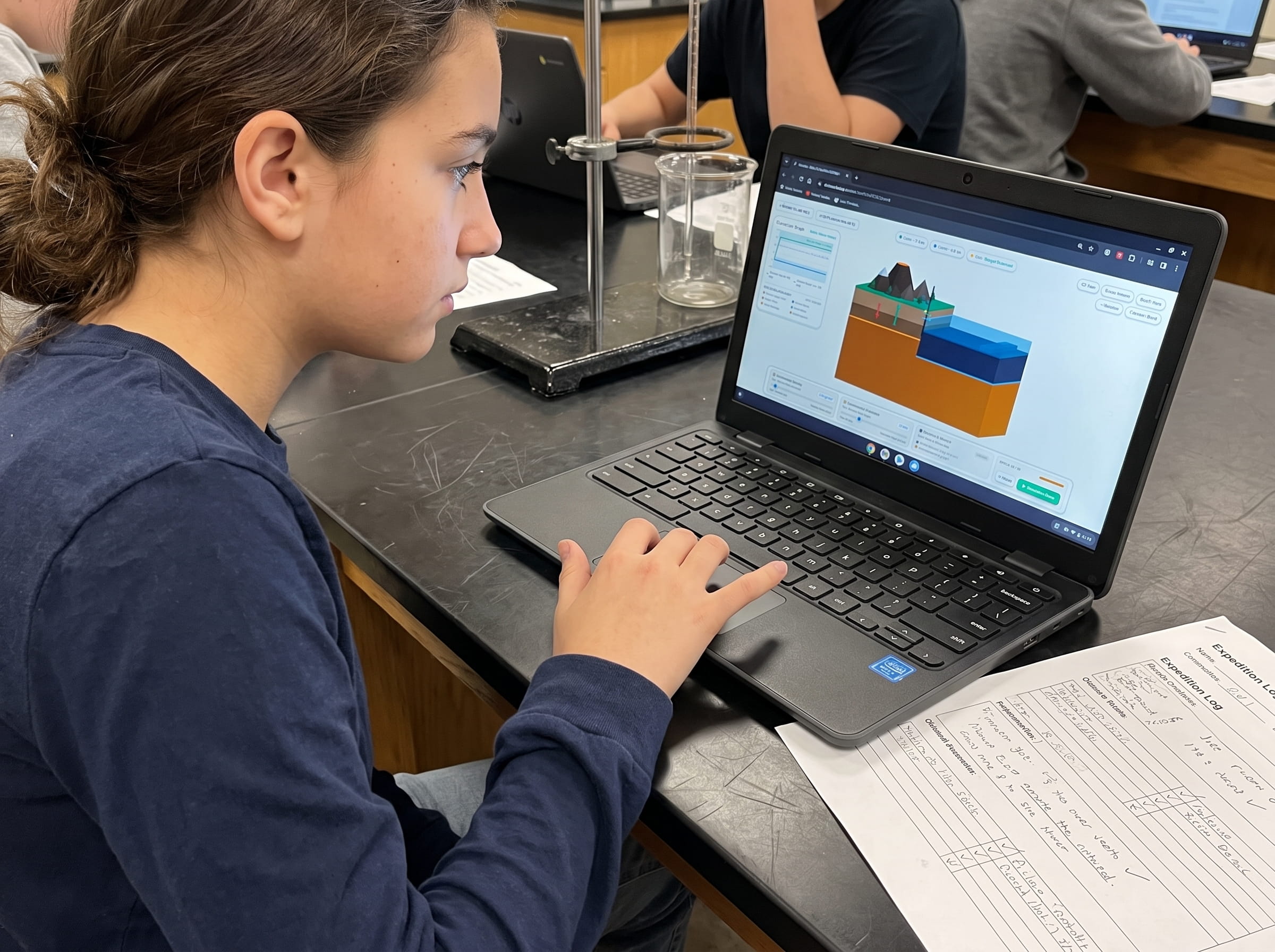
In Level 05 of the Praxos Volcano Island simulation laboratory (First Magma Chamber), students step into the role of deep-crust geochemists. An interactive 3D cutaway diorama displays a descending subducting slab at 100 km depth directly beneath a continental mountain arc.
Students control two fundamental thermodynamic variables:
1. Slab Hydration (Trapped Water Content): Adjustable from 0.0% to 10.0% (defaulting to a bone-dry 0.5%).
2. Mantle Wedge Temperature: Adjustable from 800°C to 1,400°C (defaulting to a cool 900°C).
A live 2D coordinate graph displays Pooled Magma Chamber Volume (km³, orange line, target: at least 25 km³) plotted against the Mantle Melting Point Delta (°C, red line). At Epoch 20, a dynamic Dehydration Pulse occurs: trapped water releases from serpentinite minerals in the descending slab, sending a visible swarm of cyan steam particles upward into the mantle wedge.
If the slab is bone-dry (under 2% water), solid mantle rock remains completely frozen, resulting in zero magma generation even if temperatures are cranked to 1,350°C. If water content is set too high combined with extreme heat, runaway overpressure melts a massive magma blob that erupts through the surface before a chamber can pool. To win, students must calibrate hydration to roughly 5.5% and temperature to 1,200°C, successfully pooling a stable 25 to 35 km³ magma chamber at 8 km depth across 40 simulation epochs.
Before launching the simulation run, students formulate and test one of three structured inquiry hypotheses:
Hypothesis A: The Water-Catalyzed Chamber (Dynamic Equilibrium)
Calibrate Slab Hydration to 5.5% and Mantle Wedge Temperature to 1,200°C. At Epoch 20, the dehydration pulse lowers the melting solidus, generating buoyant magma diapirs that rise and pool cleanly into a 32 km³ chamber at 8 km depth.
Hypothesis B: The Bone-Dry Melting Barrier (Thermal Stall)
Leave Slab Hydration at 0.5% while cranking Temperature to 1,350°C. Because dry rock requires over 1,400°C to melt under lithostatic pressure, zero magma forms and the chamber volume stays flat at 0 km³.
Hypothesis C: The Runaway Overpressure Blowout (Catastrophic Breach)
Set Slab Hydration to 9.5% with Temperature at 1,400°C. Overwhelming water volume triggers hyperactive melting of over 75 km³ of magma, which surges violently to the surface before a stable reservoir can form.
Spark volcanic creation in your browser. Release a slab dehydration pulse and pool a 25 cubic kilometer magma chamber in real-time 3D.
Launch Free Level 1 Volcano SimulationSpark Volcanic Birth Through Subterranean Flux Melting in 3D
Calibrate Slab Hydration and Mantle Wedge Temperature in our real-time cutaway diorama. Release a dehydration pulse at 100 km depth to generate and pool a 25 cubic km magma chamber at 8 km depth. Zero sign-up, instant browser play.
The Anatomy of a Magma Chamber: Crystal Mush vs. Liquid Fire
Hollywood movies and cartoon diagrams often depict magma chambers as hollow, glowing underground caverns where lakes of liquid lava slosh against stone ceilings. Modern geophysical imaging has completely dismantled this myth.
In reality, an active magma chamber is primarily a crystal mush: an expansive, rigid sponge of interlocking mineral crystals (plagioclase, pyroxene, and olivine) with liquid melt filling the tiny pore spaces between grains, much like a slushy drink or saturated wet sand.
Over thousands of years, as heat slowly dissipates into the surrounding crust, the liquid melt crystallizes from the outside edges inward. However, when a fresh injection of hot, buoyant basaltic magma wells up from the subduction zone below, it underplates the reservoir, transferring fresh thermal energy that re-melts the crystal mush and dissolves volatile gases under immense pressure. This cyclic recharging sets the stage for Phase 2 of Volcano Island: the explosive physics of surface eruptions.
A magma chamber is not an open cavern of bubbling lava; it is an immense sponge of hot crystalline mush with liquid melt filling the spaces between mineral grains.
The Dual-Format Advantage: Plotting the Solidus Curve on Paper First
Why does Praxos require students to complete printed journal exercises alongside digital simulations? Because graphing non-linear phase change thresholds by hand transforms abstract chemical formulas into tangible spatial intuition.
In our dual-format Earth Science curriculum, students open their printable Volcano Island Expedition Science Journal to Mission 05. On a coordinate grid plotting Temperature on the horizontal axis and Depth on the vertical axis, students first draw the Earth's natural Geotherm line (the ambient subterranean temperature gradient).
Next, students plot the Dry Peridotite Solidus curve (the temperature where dry rock begins to melt). Students immediately notice that the Geotherm line never touches the dry solidus line: proving that Earth's mantle rock cannot naturally melt on its own. Finally, students plot the Wet Peridotite Solidus curve (shifted left by 200°C due to hydration), discovering the exact depth window (80 to 120 km) where the two lines intersect. This tactile graphing routine cements why volcanoes occur exclusively in narrow subduction corridors across our planet.
Prompt for students: Using your plotted solidus graph, identify the temperature difference between dry mantle melting and water-saturated melting at 100 km depth. Explain why pouring water into subterranean rock causes it to melt rather than cool down.
Frequently Asked Questions About Flux Melting and Level 05
Answers to common questions from middle school science educators, homeschool parents, and students studying igneous petrology and magma formation.
How can ocean water remain inside a rock down to 100 kilometers depth?
Why doesn't water turn into steam and boil away at 1,000°C inside the Earth?
What is the physical difference between magma and lava?
What is the exact win condition for Volcano Island Level 5?
How does Level 5 conclude Phase 1 and prepare students for Phase 2?
Related Earth Science Units & Simulation Lab Resources
Continue your middle school Earth and Space science exploration with these curriculum-aligned resources:
Review crustal buoyancy in our crustal buoyancy isostasy simulation Level 1 guide.
Explore deep thermal circulation in our mantle convection tectonics simulation Level 2 guide.
Discover seafloor spreading in our seafloor spreading divergent boundary simulation Level 3 lab.
Investigate subduction abysses in our subduction zones deep trench simulation Level 4 article.
Review complete homeschool science options in our earth science homeschool curriculum guide.
Set up student accounts with zero student logins on our educator dashboard.
24 pages of printable isostatic buoyancy calculation tables, paleomagnetic zebra stripe rulers, and seismogram triangulation exercises designed for grades 4 to 8.
DOWNLOAD EXPEDITION LOGBOOK (PDF)Level 5 Solidus Melting Curve & Magma Chamber Journal (PDF)
A printable 24-page Volcano Island Expedition Science Journal featuring structured dry vs wet rock solidus melting graphs, magma ascent velocity tables, and volcanic arc cross-section worksheets.