The Postcard Trap: Why Earth's Most Majestic Mountains Are Deadly Pressure Cookers
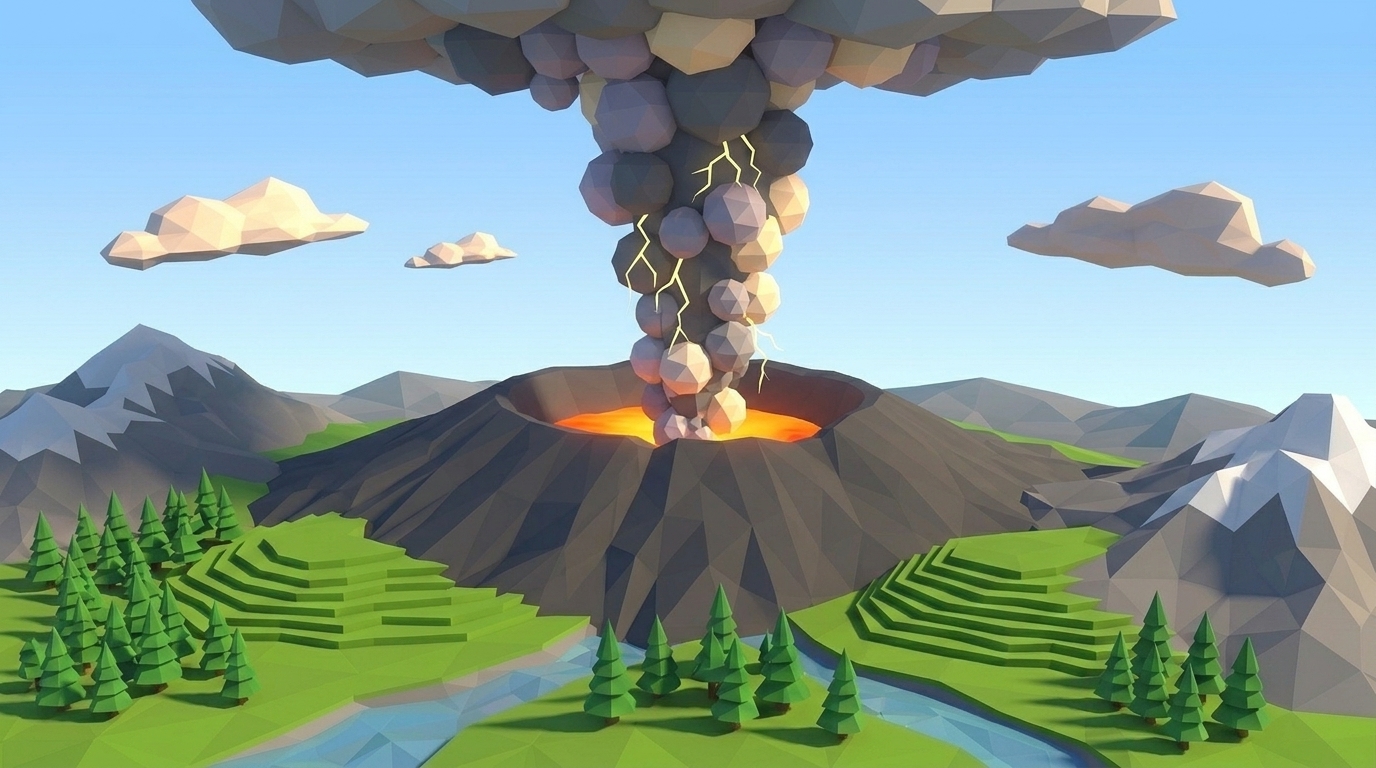
When artists paint famous mountains, they invariably choose the same dramatic silhouette: a perfectly symmetrical, snow-dusted pyramid towering over emerald valleys. Mount Fuji in Japan, Mount Rainier in Washington State, Mount Mayon in the Philippines, and Mount St. Helens before its 1980 eruption all share this iconic geometry.
These geological monuments are composite stratovolcanoes. In popular culture, their steep elegance is celebrated as the pinnacle of natural beauty. In geophysics, however, that identical steep geometry is a flashing red warning beacon signaling extreme planetary violence.
In Level 6, students explored the gentle giants of Hawaii: Mauna Loa and Kilauea. Those shield volcanoes are immense, yet their slopes are extraordinarily gentle, rarely exceeding 6 to 8 degrees. They behave gently because their basaltic magma contains only 48% to 50% silica, flowing smoothly across dozens of miles like warm maple syrup.
Stratovolcanoes along the Pacific Ring of Fire represent the opposite physical extreme. Their magma is enriched with 60% to 70% silica, transforming molten rock into a stiff, gummy paste with the consistency of chilled peanut butter or modeling clay. Because this pasty rock cannot flow away, it piles up directly around the volcanic conduit, stacking steep 30-degree walls while trapping dissolved volatile gases in a catastrophic subterranean pressure cooker.
The steeper a volcano's mountain flanks, the stickier its internal magma: gentle 5-degree slopes signify runny basalt where gases escape peacefully, while steep 30-degree cones reveal viscous silica paste that traps explosive pressure until the mountain ruptures.
Silica Chemistry and the Molecular Spiderweb: How Silicate Tetrahedra Trap Outflow
Why does a difference of just 15% silica content completely transform volcanic behavior? The explanation lies in the molecular geometry of silicate minerals.
Silica ($SiO_2$) consists of a central silicon ion surrounded by four oxygen ions in a rigid tetrahedral pyramid. In liquid magma, these tetrahedra do not remain isolated; they share oxygen atoms at their corners, linking into complex molecular chains, rings, and three-dimensional lattice frameworks in a process known as polymerization.
1. Low-Silica Basalt (Mafic, ~50% $SiO_2$): At high temperatures (1,150°C to 1,220°C), thermal kinetic energy easily breaks silicate bonds. The molecular chains remain short and fragmented, allowing molten basalt to flow with low dynamic viscosity (10 to 100 Pascal-seconds). Dissolved gas bubbles exsolve and rise smoothly into the open atmosphere.
2. Intermediate Andesite & Felsic Dacite (60% to 70% $SiO_2$): As continental crust melts into magma chambers (explored in Level 5), silica concentration climbs above 65%, while eruption temperatures drop to between 800°C and 950°C. Cooler temperatures allow silicate polymers to link into a dense, tangled macromolecular web, like a pot of boiling starch. The dynamic viscosity skyrockets to between 10,000 and 1,000,000 Pascal-seconds; ten thousand times stiffer than basalt.
Under this extreme internal friction, molten rock cannot travel far across the surface. According to the systems principle of localized stock accumulation (Ormanci 2026), when outflow velocity is constrained by high internal viscosity, ejected material accumulates directly at the source, constructing steep topographic gradients that reach thousands of meters into the troposphere.
| Magma Type | Silica Content | Eruption Temp | Viscosity (Pa·s) | Flow Velocity | Primary Hazard | Iconic Volcano Examples |
|---|---|---|---|---|---|---|
| LEVEL 07 LAB FOCUSIntermediate Andesite | 57% - 63% | 950°C - 1,050°C | 1,000 - 10,000 | Sluggish (m/day) | Blocky lava flows, explosive ash columns | Mount Fuji (Japan), Mount Rainier (USA) |
| LAVA DOME PLUGFelsic Dacite | 63% - 68% | 850°C - 950°C | 10,000 - 100,000 | Creeping (cm/day) | Summit lava domes, lateral blasts, pyroclastic flows | Mount St. Helens (USA), Mount Pinatubo (Philippines) |
| SUPER-VOLCANOHigh-Silica Rhyolite | 68% - 75% | 700°C - 850°C | 100,000 - 10,000,000 | Near-Immobile | Catastrophic caldera collapses, super-eruptions | Yellowstone Caldera, Taupo (New Zealand) |
| SHIELD BASELINEMafic Basalt (Comparison) | 45% - 52% | 1,150°C - 1,220°C | 10 - 100 | Rapid (km/hour) | Gentle effusive lava rivers, benign fire fountains | Kilauea, Mauna Loa (Hawaii) |
Anatomy of a Stratovolcano: Alternating Beds of Ash, Pumice, and Andesite Armor
The name "stratovolcano" comes from the Latin word stratum, meaning layer. Unlike shield volcanoes that are composed almost exclusively of basalt sheets, a composite cone is built of alternating layers of two distinct materials: pyroclastic ash and pasty lava flows.
During an active eruption cycle, a stratovolcano progresses through three distinct structural phases:
Phase 1 (The Explosive Ash Phase): Trapped subterranean gases reach critical overpressure and rupture the volcanic vent. The sudden decompression shreds the viscous magma into billions of microscopic, razor-sharp volcanic glass shards, blasting towering plinian columns of volcanic ash, cinders, and porous pumice miles into the atmosphere. This loose tephra rains down on the surrounding slopes, settling at its natural angle of repose (roughly 30 to 35 degrees).
Phase 2 (The Effusive Armoring Phase): Once the primary gas charge vents into the sky, the remaining degassed andesitic magma oozes sluggishly from the crater. Because the lava is thick and pasty, it creeps only a few hundred meters down the mountainside, solidifying into rough, blocky andesite rock. This hardened rock crust acts like armor, capping and cementing the loose ash layer beneath it so erosion cannot wash it away.
Phase 3 (The Summit Dome Plug): As the eruption wanes, the last blob of dacite magma squeezes into the summit crater like a giant dollop of toothpaste, hardening into a bulbous plug called a lava dome. This plug seals the throat of the volcano, setting the trap for the next eruption cycle decades or centuries later.
A stratovolcano is not a solid granite mountain; it is a colossal geological layer cake composed of soft, explosive ash beds reinforced by brittle crusts of pasty lava, making its flanks towering yet structurally unstable.
Stack a 3-Kilometer Composite Stratovolcano in 3D
Calibrate Magma Silica Percentage, Eruption Intervals, and Pyroclastic Ash Ratios in our real-time island sandbox. Build steep alternating ash and andesite layers to raise a 3.2 km peak with 30-degree slopes without triggering a premature lateral blast. Zero sign-up, instant browser play.
The Mechanics of Level 07: Stacking a 3-Kilometer Composite Peak in Real-Time 3D
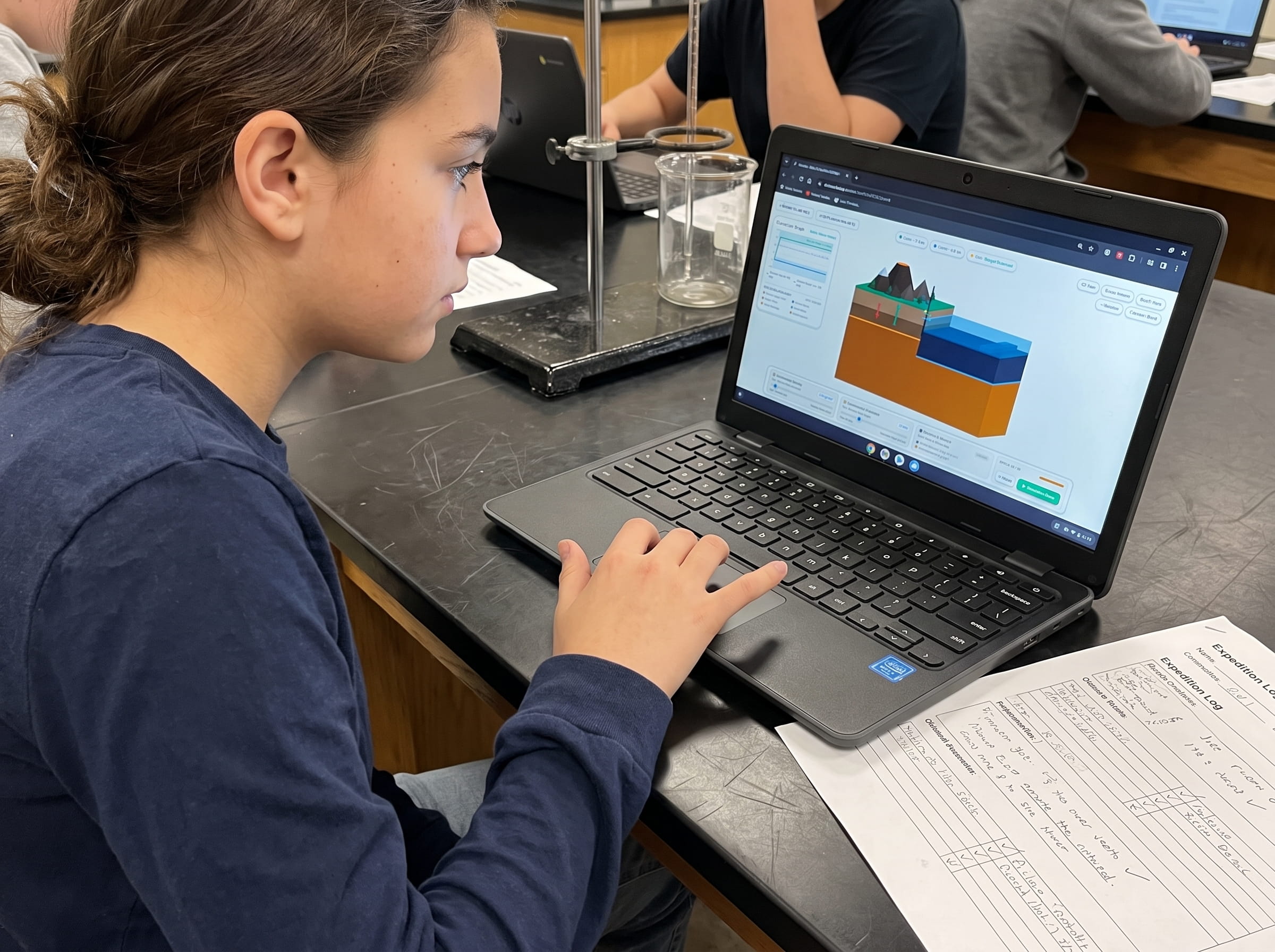
In Level 07 of the Praxos Volcano Island laboratory (The Sticky Trap), students step into the role of physical volcanologists tasked with engineering a symmetrical composite stratovolcano across 50 simulation cycles.
Students calibrate three interdependent thermodynamic controls:
1. Magma Silica Percentage: Adjustable from 45.0% to 75.0% (defaulting to an uncalibrated, runny 48.0% basalt).
2. Eruption Interval: Adjustable from 5 to 30 days between bursts (defaulting to a hyperactive 5 days).
3. Pyroclastic Ash Ratio: Adjustable from 10.0% to 80.0% (defaulting to a low 10.0%).
A synchronized live 2D telemetry chart tracks Summit Peak Elevation (km above sea level, green curve, target: at least 3.0 km) plotted alongside Flank Slope Angle (degrees, purple curve, target: 25 to 35 degrees).
If students leave the default settings unchanged (48% silica), the magma behaves like water: runny basalt spreads evenly across the ocean floor, forming a flat 6-degree shield that fails to reach the required 3.0 km summit height. Conversely, if silica is set above 72% with zero ash, the magma plugs the vent instantly, triggering an overpressure blowout that decapitates the peak.
At Cycle 20, a dynamic event occurs: an Andesitic Dome Extrusion pulse. Pasty lava surges into the summit crater, solidifying into a rugged plug that anchors the steep upper flanks. To win Level 7, students must calibrate Silica Percentage to roughly 66%, Pyroclastic Ash Ratio to 45%, and Eruption Interval to 18 days, successfully stacking alternating layers of ash and blocky lava into a majestic 3.2 km stratovolcano cone with classic 30-degree slopes.
Before launching the simulation run, students formulate and test one of three structured inquiry hypotheses:
Hypothesis A: The Steep Stratovolcano Cone (Localized Stock Accumulation)
Calibrate Silica Percentage to 66% and Pyroclastic Ash Ratio to 45% with an 18-day Eruption Interval. High internal viscosity restricts runout distance, stacking alternating ash and andesite layers into a symmetrical 3.2 km peak with 30-degree slopes.
Hypothesis B: The Flat Island Pancake (Viscosity Deficit)
Leave Silica Percentage at 48%. Low-viscosity basalt flows away for miles rather than stacking locally, failing to build elevation and creating a flattened shield with slopes under 12 degrees.
Hypothesis C: The Hollow Balloon Myth (Gas Envelope Illusion)
Test the common student misconception that sticky lava inflates into a hollow stone balloon and floats into the sky. Observe how gravity, lithostatic weight, and brittle fracture prevent balloon-like inflation.
Stack a towering 3-kilometer composite volcano in your browser. Calibrate silica viscosity and watch alternating ash and andesite strata rise in real-time 3D.
Launch Free Level 1 Volcano SimulationThe Dual-Format Advantage: Sketching Stratigraphic Layers on Paper First
Why does Praxos require students to complete printed journal activities alongside digital simulations? Because drawing internal stratigraphy by hand builds spatial reasoning that pure screen time cannot match.
In our dual-format Earth Science curriculum, students open their printable Volcano Island Expedition Science Journal to Mission 07. Students are presented with an uncompleted cross-sectional diagram of a composite stratovolcano.
Using colored pencils, students alternate between light-gray shading for loose pyroclastic tephra layers and dark-slate hatching for hardened andesite lava flows. Students label the central conduit, parasitic side vents, alternating strata, summit crater, and the viscous dacite lava dome corking the top.
Next, students calculate the cone's aspect ratio: dividing the 3.0 km peak height by the 10 km base diameter. Comparing this 0.3 aspect ratio to the 0.05 aspect ratio of Hawaiian shield volcanoes cements why viscosity dictates the three-dimensional geometry of continents.
Prompt for students: Using your cross-section sketch, explain why a stratovolcano is structurally vulnerable to giant landslides. If an earthquake shakes the mountain, why do loose ash layers between lava crusts act like ball bearings, potentially triggering a lateral blast like Mount St. Helens in 1980?
Frequently Asked Questions About Composite Volcanoes and Level 07
Answers to common questions from middle school science educators, homeschool parents, and students investigating volcanic landforms and magma petrology.
Why are composite volcanoes so much steeper than Hawaiian shield volcanoes?
What is a volcanic lava dome and how does it act like a cork?
What caused the famous north flank bulge at Mount St. Helens in 1980?
What is the exact win condition for Volcano Island Level 7?
How does Level 7 prepare students for Level 8 (Gas & Ash Plume)?
Related Earth Science Units & Simulation Lab Resources
Continue your middle school Earth and Space science exploration with these curriculum-aligned resources:
Review crustal buoyancy in our crustal buoyancy isostasy simulation Level 1 guide.
Explore deep thermal circulation in our mantle convection tectonics simulation Level 2 guide.
Discover seafloor spreading in our seafloor spreading divergent boundary simulation Level 3 lab.
Investigate subduction abysses in our subduction zones deep trench simulation Level 4 article.
Explore subterranean magma generation in our flux melting magma chamber simulation Level 5 guide.
Study effusive basalt rivers in our shield volcano basaltic lava simulation Level 6 lab.
Review complete homeschool science options in our earth science homeschool curriculum guide.
Set up student accounts with zero student logins on our educator dashboard.
24 pages of printable isostatic buoyancy calculation tables, paleomagnetic zebra stripe rulers, and seismogram triangulation exercises designed for grades 4 to 8.
DOWNLOAD EXPEDITION LOGBOOK (PDF)Level 7 Stratovolcano Strata & Magma Viscosity Journal (PDF)
A printable 24-page Volcano Island Expedition Science Journal featuring structured pre-run inquiry hypotheses, composite cone cross-section labeling diagrams, and silica viscosity vs slope angle calculation worksheets.