The Gentle Giant Paradox: Why the Largest Mountain on Earth Never Explodes
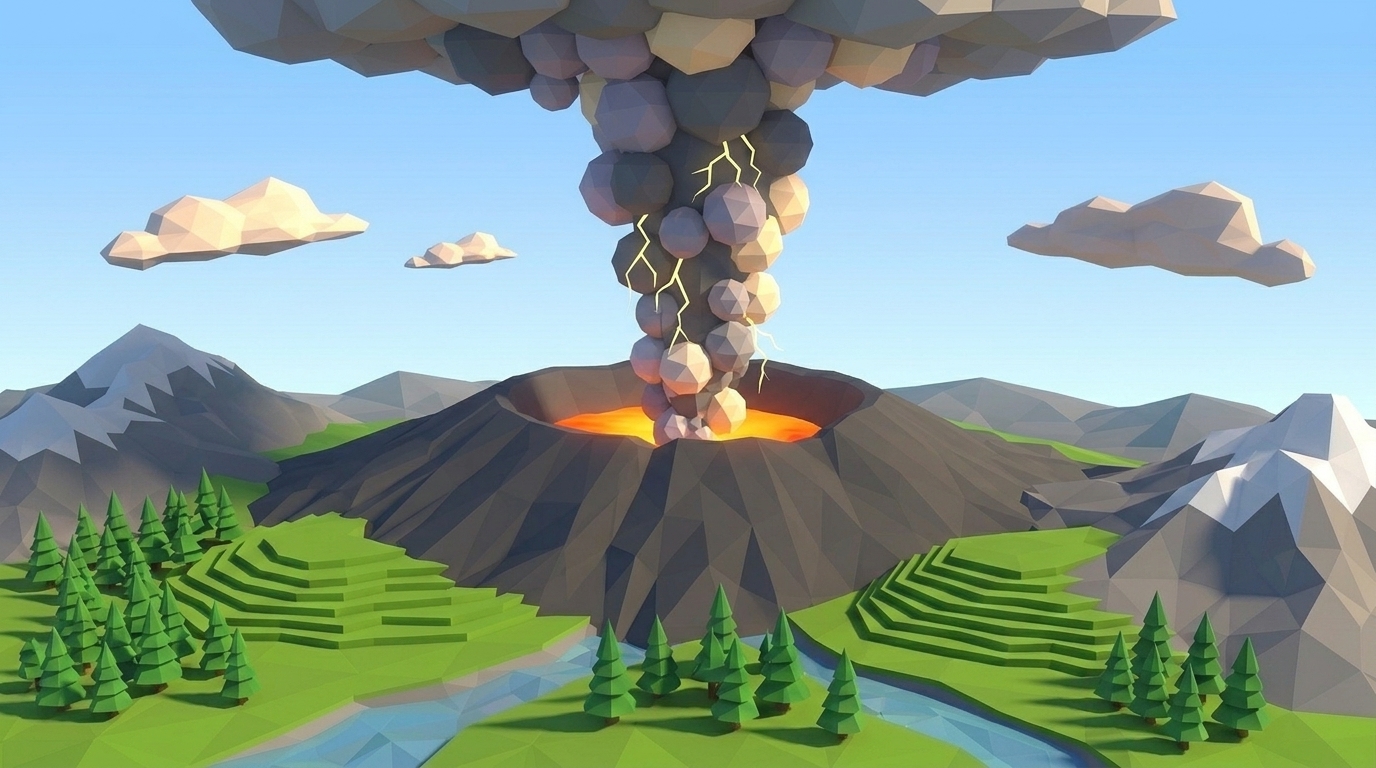
If you ask middle school students to draw a volcano, nearly all of them sketch the same dramatic scene: a steep, triangular mountain peak blasting a towering black mushroom cloud of ash into the stratosphere, accompanied by lightning bolts and showers of burning boulders. This Hollywood disaster image represents an explosive stratovolcano, such as Mount St. Helens or Mount Vesuvius.
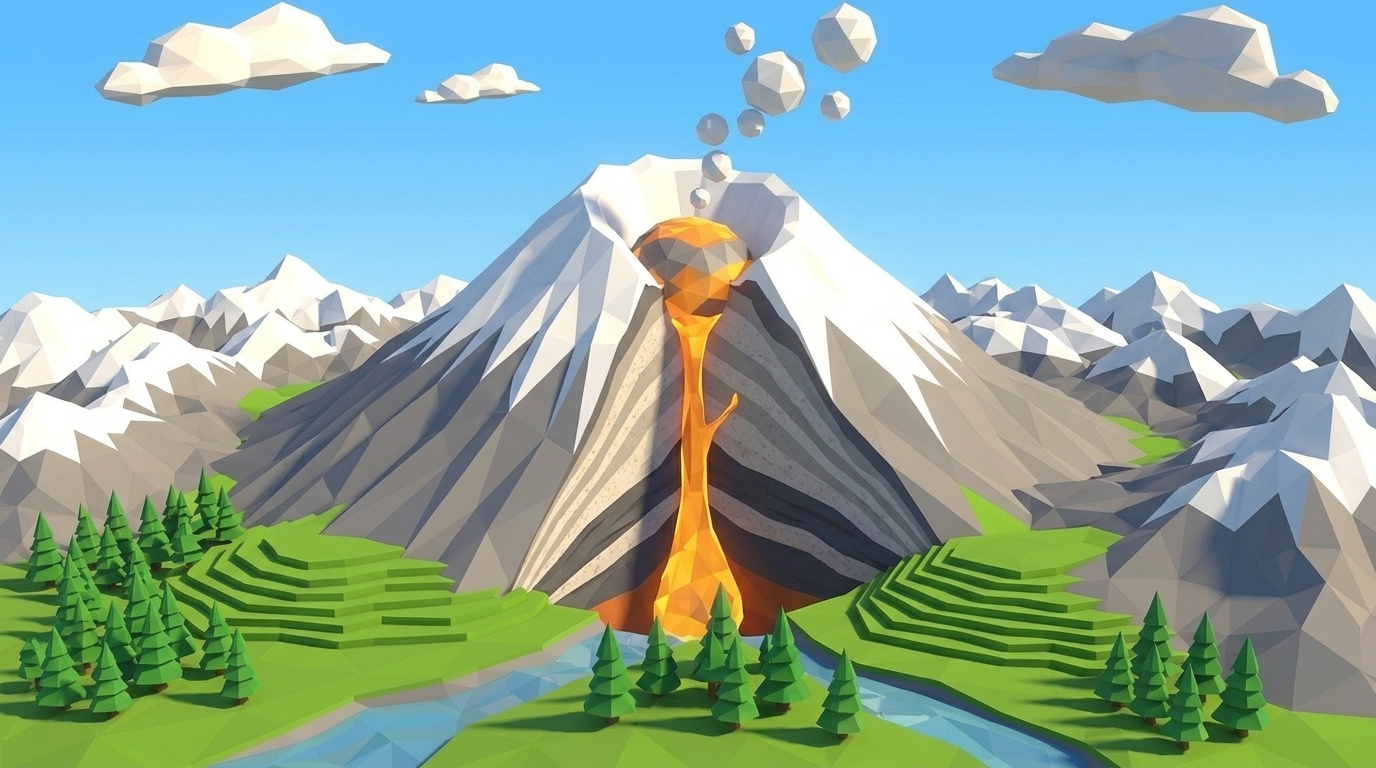
Yet if you travel to the middle of the Pacific Ocean, you encounter a geological structure that shatters this stereotype: Mauna Loa on the Big Island of Hawaii. Mauna Loa is the largest active volcano on planet Earth. Its summit rises 4,169 meters (13,678 feet) above sea level, but its colossal base rests on the ocean floor five kilometers below the waves. From its underwater base to its mountain crest, Mauna Loa stands over 9,100 meters tall; taller than Mount Everest.
Despite containing enough molten rock to bury entire nations, Mauna Loa has never produced a catastrophic planetary blast in recorded history. Instead of exploding, it erupts effusively: glowing fountains of incandescent orange lava spray hundreds of feet into the tropical night sky, feeding wide rivers of liquid rock that gently travel dozens of miles across the island before tumbling peacefully into the sea.
Why does one volcano explode like a thermonuclear bomb while another, holding ten times more magma, oozes as smoothly as warm maple syrup? The answer has nothing to do with magic or luck. It is governed entirely by the physical chemistry of magma viscosity.
Volcanoes do not explode because of heat; they explode because of trapped gas pressure. When magma is runny and fluid, volcanic gases bubble out harmlessly into the open sky, creating peaceful lava rivers rather than devastating ash clouds.
The Chemistry of Magma Viscosity: Silica Polymers and Trapped Gas Bubbles
Viscosity is a fluid's internal resistance to flow. Water and gasoline have very low viscosity; they pour rapidly and splash easily. Cold honey, peanut butter, and silicone paste have high viscosity; they resist movement and deform sluggishly under shear stress.
In planetary geology, magma viscosity is controlled by two fundamental variables: chemical composition (specifically silica content, SiO2) and temperature. Silica molecules consist of one silicon atom bonded to four oxygen atoms in a tetrahedral geometry. In a molten state, these silicate tetrahedra chemically link together to form long, tangled macromolecular polymer chains.
1. Mafic Basaltic Magma (Low Viscosity): Basaltic magma contains low silica levels (roughly 45% to 52%), with rich concentrations of heavy iron and magnesium. Because there is relatively little silica to form long molecular chains, the fluid remains unpolymerized. Combined with blistering eruption temperatures between 1,150°C and 1,220°C, basalt has a dynamic viscosity of only 10 to 100 Pascal-seconds; comparable to warm honey or motor oil.
2. Felsic Rhyolitic Magma (High Viscosity): In contrast, felsic and andesitic magmas contain high silica levels (65% to 75%) and erupt at cooler temperatures (750°C to 850°C). The dense tangle of silicate polymers creates an ultra-thick, gummy paste with viscosities exceeding 1,000,000 Pascal-seconds; millions of times more viscous than basalt.
This viscosity difference dictates how dissolved volcanic gases behave. As magma ascends toward Earth's surface and lithostatic pressure drops, dissolved water vapor, carbon dioxide, and sulfur dioxide expand into bubbles. In runny basalt, these gas bubbles escape easily and vent peacefully into the atmosphere. In thick felsic paste, the expanding bubbles remain trapped, stretching the viscous rock until the pressure shatters the conduit in a violent supersonic explosion.
| Volcano Type | Magma Type | Silica Content | Eruption Temp | Dynamic Viscosity | Slope Angle | Iconic Examples |
|---|---|---|---|---|---|---|
| LEVEL 06 LAB FOCUSShield Volcano | Mafic Basalt | 45% - 52% | 1,150°C - 1,220°C | 10 - 100 Pa·s (Runny) | 2° - 10° (Gentle Profile) | Mauna Loa, Kilauea, Olympus Mons (Mars) |
| LEVEL 07 PREVIEWComposite Stratovolcano | Intermediate Andesite | 55% - 65% | 900°C - 1,050°C | 1,000 - 10,000 Pa·s (Sticky) | 20° - 35° (Steep Cone) | Mount Fuji, Mount Rainier, Mount St. Helens |
| GAS-CHARGEDCinder Cone | Basaltic Tephra / Scoria | 50% - 55% | 1,000°C - 1,150°C | Moderate (Gas-rich) | 30° - 40° (Angle of Repose) | Parícutin (Mexico), Sunset Crater (Arizona) |
| VISCOUS PLUGLava Dome | Felsic Rhyolite / Dacite | 68% - 75% | 700°C - 850°C | 100,000+ Pa·s (Solid Paste) | 40° - 50° (Bulbous Mound) | Novarupta (Alaska), Chaitén (Chile) |
Pahoehoe, 'A'a, and Lava Tubes: The Architecture of an Effusive Island
Because basaltic lava is so runny, it creates distinctive geological surface structures that middle school students can easily recognize and analyze in our 3D simulation.
When basaltic lava flows across a landscape, it cools into one of two iconic Hawaiian textures:
1. Pahoehoe (Smooth & Ropey): When lava flows at high temperatures with low velocity, a thin, flexible, glassy skin forms on top. As the molten liquid continues to surge beneath this skin, it wrinkles and twists the cooling surface into smooth, rope-like folds resembling braided cordage.
2. 'A'a (Rough & Jagged): As pahoehoe lava flows further away from the vent, it loses heat, degasses, and increases in viscosity. When the stiffening lava is torn apart by internal flow currents, it breaks into a grinding mass of sharp, jagged, spine-covered clinkers called 'a'a. Walking across 'a'a in bare feet is nearly impossible, which gave the rock its Hawaiian name.
Another remarkable feature of basaltic volcanism is the formation of subterranean lava tubes. As a wide river of 1,180°C basalt flows down a mountain flank, the upper surface exposed to cool ambient air crusts over and solidifies into solid stone. This hardened roof forms an insulated pipeline. Molten rock continues to rush through the underground tube with virtually zero heat loss, traveling 20 to 30 miles down to the coastline. When the tube empties at the end of an eruption, it leaves behind an expansive underground cave system.
Hardened stone is an exceptional thermal insulator. Lava tubes act like thermos bottles, allowing molten basalt to travel dozens of miles across an island with less than a 10°C drop in temperature.
Build a Hawaiian Shield Volcano with Effusive Basalt in 3D
Control Silica Content, Magma Temperature, and Inflow Rate in our real-time island sandbox. Channel fluid basaltic lava rivers across 12 kilometers to construct a broad 6-degree shield volcano without explosive blowouts. Zero sign-up, instant browser play.
The Mechanics of Level 06: Constructing a Hawaiian Shield in Real-Time 3D
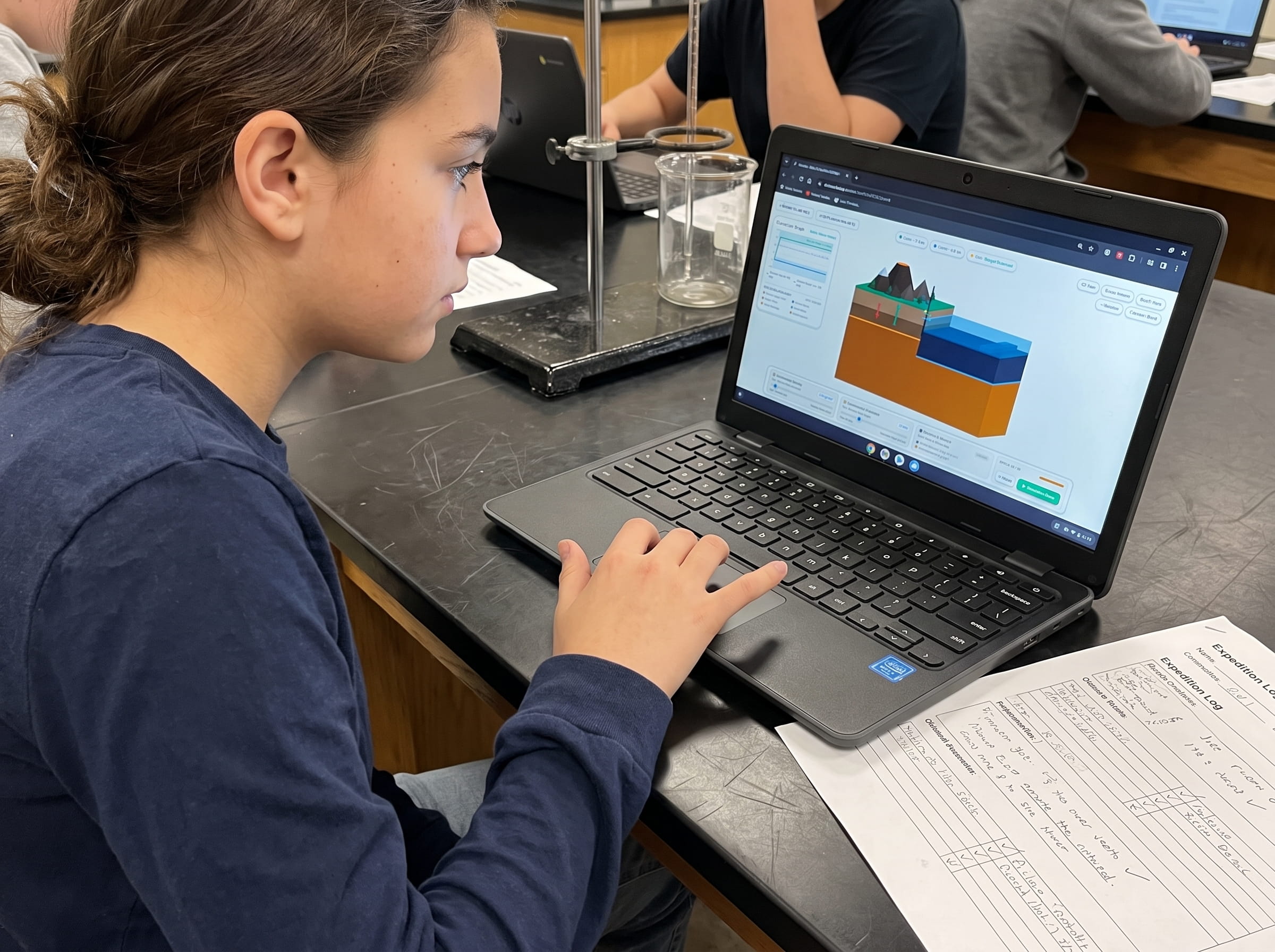
In Level 06 of the Praxos Volcano Island laboratory (Lava River), students apply fluid dynamics to construct a broad shield island across 60 simulation days.
Students take command of a volcanic conduit vent positioned in the center of an expansive 12-kilometer oceanic caldera radius. Students calibrate three primary geomechanical sliders:
1. Silica Content (%): Adjustable from 45.0% to 75.0% (defaulting to an uncalibrated 68.0% felsic paste).
2. Magma Temperature (°C): Adjustable from 800°C to 1,250°C (defaulting to a cool 850°C).
3. Magma Inflow Rate (m³/s): Adjustable from 10 to 100 m³/s (defaulting to 30 m³/s).
A live 2D telemetry chart tracks Cumulative Island Coverage (% of 12 km radius, green line, target: at least 60%) plotted against Volcano Slope Angle (degrees, blue line, target: less than or equal to 10 degrees).
If students leave the default settings unchanged (68% silica at 850°C), the high-viscosity paste acts like a cork in a champagne bottle. Volcanic gases cannot escape, pressure spikes within the conduit, and at Day 14 the volcano suffers an explosive blowout, failing the effusive shield criteria. To master Level 6, students must drag Silica down to roughly 48% to 52%, raise Temperature to 1,180°C, and calibrate Inflow Rate to 60 m³/s. Runny basalt pours freely from the summit vent, spreading across the island into the ocean to build a gentle 6-degree shield profile across 60 days.
Before launching the simulation run, students formulate and test one of three structured inquiry hypotheses:
Hypothesis A: The Effusive Basalt Shield (Dynamic Equilibrium)
Calibrate Silica Content to 50% and Eruption Temperature to 1,180°C with an Inflow Rate of 60 m³/s. Fluid basalt rivers flow smoothly across the landscape into the ocean, building a broad shield volcano with gentle 6-degree slopes.
Hypothesis B: The Universal Explosion Myth (Atmospheric Shock)
Test the common student assumption that all lava naturally explodes when hitting atmospheric air. Observe how low-viscosity basalt allows volcanic gases to vent peacefully without generating shockwaves.
Hypothesis C: The Viscous Conduit Plug (Catastrophic Overpressure)
Leave Silica Content at 68% and Temperature at 850°C. Sticky felsic paste plugs the conduit neck, generating extreme backpressure that triggers an explosive blowout failure on Day 14.
Construct an authentic Hawaiian shield volcano in your browser. Calibrate silica content and watch fluid basalt build a low-angle island in real-time 3D.
Launch Free Level 1 Volcano SimulationThe Dual-Format Advantage: Graphing Viscosity vs. Slope on Paper First
Why does Praxos integrate printable physical journals into digital simulation units? Because plotting fluid resistance curves by hand connects abstract chemical percentages to concrete physical geometry.
In our dual-format Earth Science curriculum, students open their printable Volcano Island Expedition Science Journal to Mission 06. On a semi-logarithmic coordinate graph, students plot Magma Dynamic Viscosity (measured in Pascal-seconds on the horizontal axis) against Final Volcanic Slope Angle (measured in degrees on the vertical axis).
Students plot empirical data points gathered from real-world volcanic landforms: Kilauea (10 Pa·s, 4° slope), Mauna Loa (50 Pa·s, 6° slope), Mount Fuji (5,000 Pa·s, 28° slope), and Mount St. Helens lava dome (500,000 Pa·s, 42° slope). Hand-drawing this exponential trendline cements the fundamental systems concept: fluid viscosity directly dictates the morphological geometry of our planet's surface.
Prompt for students: Using your plotted viscosity graph, explain why a volcano built of low-silica basalt spreads out like a pancake, while a volcano built of high-silica andesite piles up like a pyramid. Why does this make shield volcanoes much safer for geologists to study up close?
Frequently Asked Questions About Shield Volcanoes and Level 06
Answers to common questions from middle school science educators, homeschool parents, and students exploring volcanic morphology and fluid dynamics.
What is a shield volcano and why is it shaped like a warrior's shield?
What causes Hawaiian fire fountains to shoot hundreds of feet into the air?
Can humans easily outwalk a basaltic lava flow?
What is the exact win condition for Volcano Island Level 6?
How does Level 6 prepare students for Level 7 (The Sticky Trap)?
Related Earth Science Units & Simulation Lab Resources
Continue your middle school Earth and Space science exploration with these curriculum-aligned resources:
Review crustal buoyancy in our crustal buoyancy isostasy simulation Level 1 guide.
Explore deep thermal circulation in our mantle convection tectonics simulation Level 2 guide.
Discover seafloor spreading in our seafloor spreading divergent boundary simulation Level 3 lab.
Investigate subduction abysses in our subduction zones deep trench simulation Level 4 article.
Explore subterranean magma generation in our flux melting magma chamber simulation Level 5 guide.
Review complete homeschool science options in our earth science homeschool curriculum guide.
Set up student accounts with zero student logins on our educator dashboard.
24 pages of printable isostatic buoyancy calculation tables, paleomagnetic zebra stripe rulers, and seismogram triangulation exercises designed for grades 4 to 8.
DOWNLOAD EXPEDITION LOGBOOK (PDF)Level 6 Basalt Viscosity & Shield Volcano Slope Journal (PDF)
A printable 24-page Volcano Island Expedition Science Journal featuring structured pre-run inquiry hypotheses, silica viscosity vs slope angle coordinate graphs, and pahoehoe flow velocity calculation worksheets.