The Illusion of Competence: Why 100% on a Science Quiz Does Not Equal Understanding
Nobel laureate physicist Richard Feynman famously recounted a childhood lesson from his father: "You can know the name of a bird in all the languages of the world, but when you are finished, you will know absolutely nothing whatever about the bird."
In traditional schooling and many homeschool curricula, science is frequently reduced to vocabulary flashcards and multiple-choice comprehension checks. A student memorizes that photosynthesis is "the process by which plants convert light energy into chemical energy" and scores 100% on Friday's quiz.
Yet when that same student is asked what happens to deer populations when a severe drought cuts grassland sunlight and rain by 50%, they freeze. Multiple-choice tests measure passive vocabulary recognition, but they fail to build generative scientific intuition: the mental ability to simulate cause-and-effect chains in dynamic systems.
Recognizing a correct definition on a multiple-choice quiz is passive recall. Scientific intuition is generative: it enables a student to mentally simulate how changing one variable ripples across an entire interconnected living system.
The Flight Simulator Principle: Why Pilots and Scientists Do Not Learn on Flashcards
No commercial airline trains pilots exclusively through multiple-choice questionnaires or flashcards. Before ever stepping into a cockpit, pilots spend hundreds of hours inside high-fidelity flight simulators: facing engine failures, crosswinds, and changing weather patterns in real time.
Modern STEM education requires the exact same approach. When children interact with living 3D simulations, they manipulate environmental sliders, observe real-time feedback loops, and witness the immediate consequences of their decisions.
They do not have to mechanically memorize that vegetation requires solar photons because they have personally watched grassland biomass collapse when sunlight was throttled in a digital sandbox.
Generative Assessment: 4 Ways to Evaluate True Science Mastery at Home
To assess whether your child truly understands a scientific concept, replace multiple-choice trivia drills with four generative assessment methods:
| Assessment Format | Traditional Multiple-Choice Drill | Generative Inquiry Approach (Praxos Method) | Depth of Understanding Built |
|---|---|---|---|
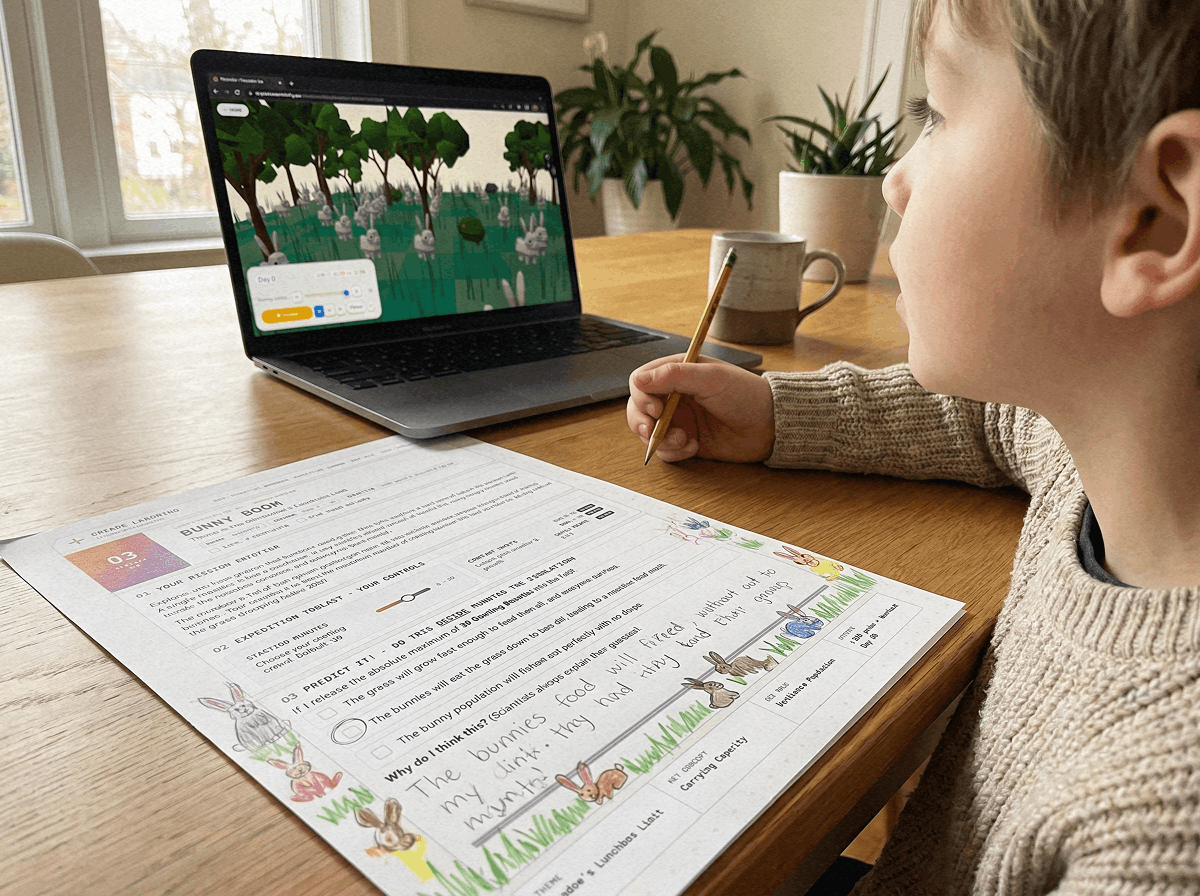
| PREDICTIVE1. Predictive Graphing | Pick the correct graph shape from four given options (A, B, C, D) | Draw the next 10 days of a population curve on paper before unpausing the 3D lab | High (forces student to construct causal hypothesis by hand) |
| DIAGNOSIS2. Reverse Diagnosis | Answer a factual quiz question about keystone species definitions | Hand student a dying virtual habitat and challenge them to diagnose which hidden variable was changed | High (builds authentic scientific detective skills and variable isolation) |
| OPTIMIZATION3. Parameter Optimization | Calculate a textbook formula from a static math word problem | Find the exact sunlight, water, and predator balance required to sustain an ecosystem for 60 cycles | High (develops engineering mindset and dynamic equilibrium intuition) |
| TEACH-BACK4. Socratic Teach-Back | Repeat a memorized paragraph back to the parent verbatim | Explain why overgrazing destroyed riverbanks to a younger sibling using an everyday lunchbox analogy | High (demonstrates conceptual synthesis and clear communication) |
The 5E Inquiry Framework for Homeschool Families
You can easily implement inquiry-based science at home using the proven 5E instructional framework:
1. Engage (5 Min): Spark curiosity with an unexpected phenomenon or open question: "What would happen to the rabbits in our meadow if we completely doubled the grass overnight?"
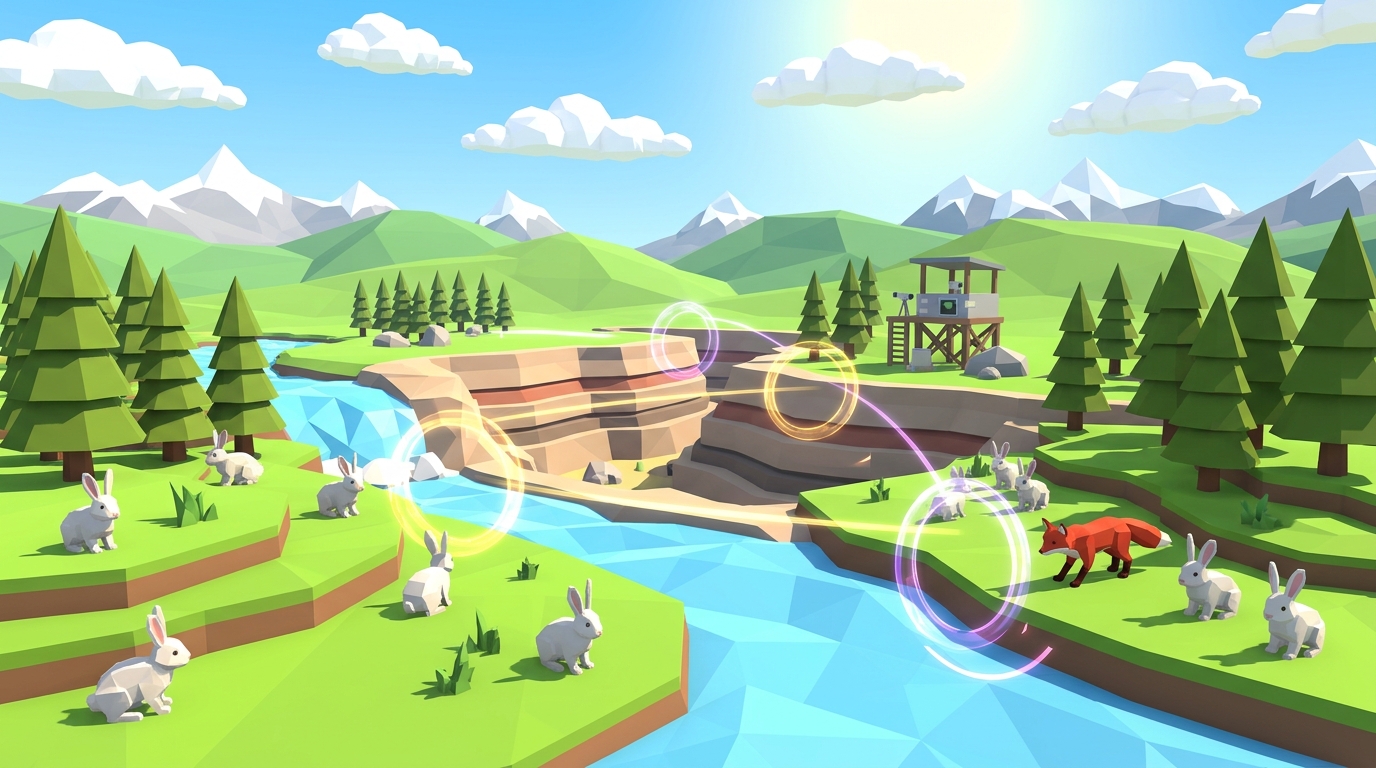
2. Explore (10 Min): The student tests their hypothesis inside the 3D browser simulation, observing whether rabbit populations boom, plateau, or crash.
3. Explain (5 Min): The child describes what they observed in their own words before introducing formal terms like "carrying capacity" or "overshoot."
4. Elaborate (5 Min): Connect the digital finding to real-world biology: "How does this explain why deer overpopulate in suburban neighborhoods without wolves?"
5. Evaluate (5 Min): The student records their quantitative data in their 24-page Expedition Journal, documenting what surprised them.
To explore more hands-on learning strategies, review my companion guides on how to teach the scientific method to kids, systems thinking for kids, feedback loops explained for kids, and 30-minute homeschool science routine.
Science is not a collection of established facts to be memorized; it is an active process of asking testable questions, testing boundaries, and discovering how nature operates.
Frequently Asked Questions About Inquiry-Based Learning at Home
Practical questions from parents seeking alternatives to traditional textbooks.
Is inquiry-based learning harder to teach than traditional textbook curricula?
Will inquiry-based learning prepare my child for standardized tests?
How do I know my child is learning if we do not take multiple-choice quizzes?
Are the inquiry observation sheets and 3D simulation levels free?
Experience Active Inquiry Free in 3D
Ditch the flashcards and launch an interactive living laboratory.
Start Level 1 instantly in your browser with zero registration. Unlock all 10 simulation missions and download the complete 24-page Expedition Science Journal 100% free with email.
Step inside Level 01: Solar Spark to test environmental sliders and build intuitive science understanding.
START LEVEL 1 FREEStudent Observation & Variable Testing Sheet (PDF)
A complete inquiry starter kit with predictive sketching spreads, variable logs, and the 24-page Expedition Science Journal.