Why Static Food Web Diagrams Fail to Teach Dynamic Balance
In traditional science lessons, food webs are taught with static paper worksheets: students draw pencil arrows connecting a patch of grass to a rabbit, and a rabbit to a fox. The teacher explains that the arrow points in the direction of energy flow. Students memorize the terms producer, primary consumer, and secondary consumer, and pass the multiple-choice test.
The fundamental limitation of a static diagram is that nature is never static. An arrow on paper never shows what happens when rabbit numbers surge, overgraze the grassland, and run out of food. It cannot show the delayed wave when foxes arrive, reduce herbivore numbers, and allow the grass to regenerate. In real ecosystems, every species is connected through continuous feedback loops.
This free 3D food web simulator turns passive diagramming into an active living experiment. Kids ages 7 to 12 do not just look at a food chain: they build it, stress it, manipulate variables, and watch how energy moves through each trophic level in real time.
Start Level 1 instantly in your browser. Add producers, herbivores, and predators to see dynamic balance in action. All 10 levels are 100% free with your email.
LAUNCH 3D FOOD WEB SIMULATORHow the Praxos Food Web Simulator Works Across Levels 1 to 5
The Praxos Ecosystem simulator is structured as a 10-level progressive sandbox. Levels 1 through 5 build a complete, multi-tiered food web step by step, allowing kids to isolate and understand each ecological layer before introducing the next:
Level 01 (Bare Dirt Genesis): The Producer Layer. Kids adjust solar radiation and rainfall sliders to establish foundational plant biomass. Without sunlight and water, no food web can exist.
Level 02 (The First Grazer): The Herbivore Layer. Kids introduce primary consumers (white rabbits) and must balance grazing pressure against the natural regrowth rate of the grass.
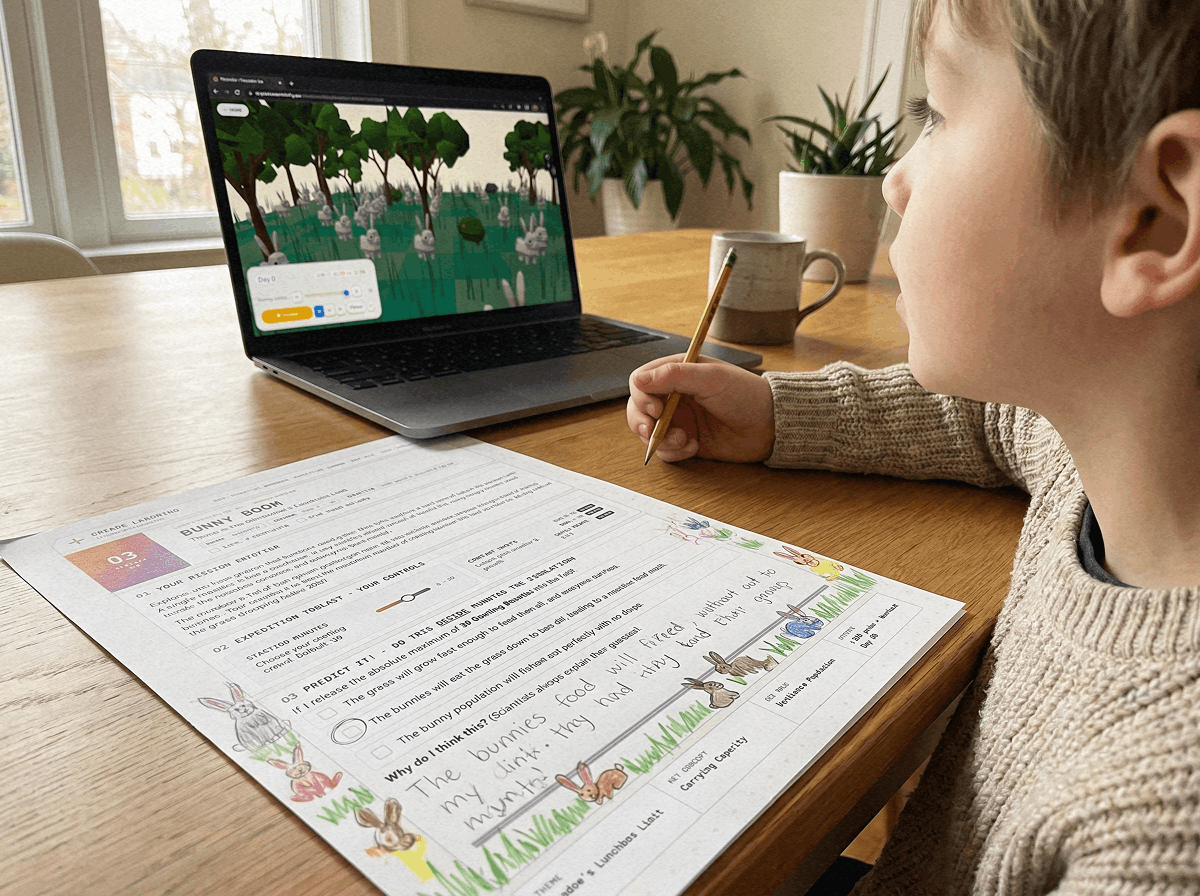
Level 03 (Bunny Boom): Carrying Capacity & Overpopulation. Kids witness exponential population growth when herbivores have no natural checks, experiencing the classic population boom and crash.
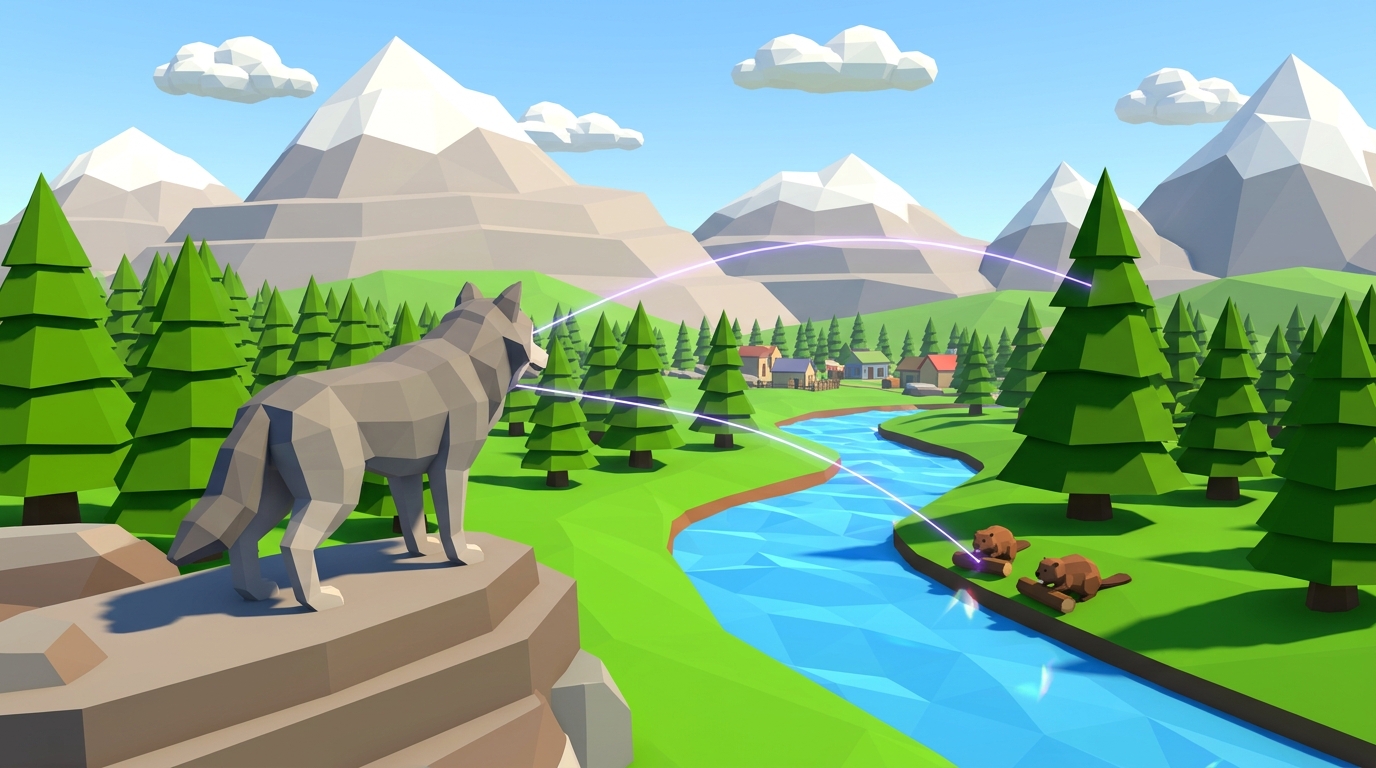
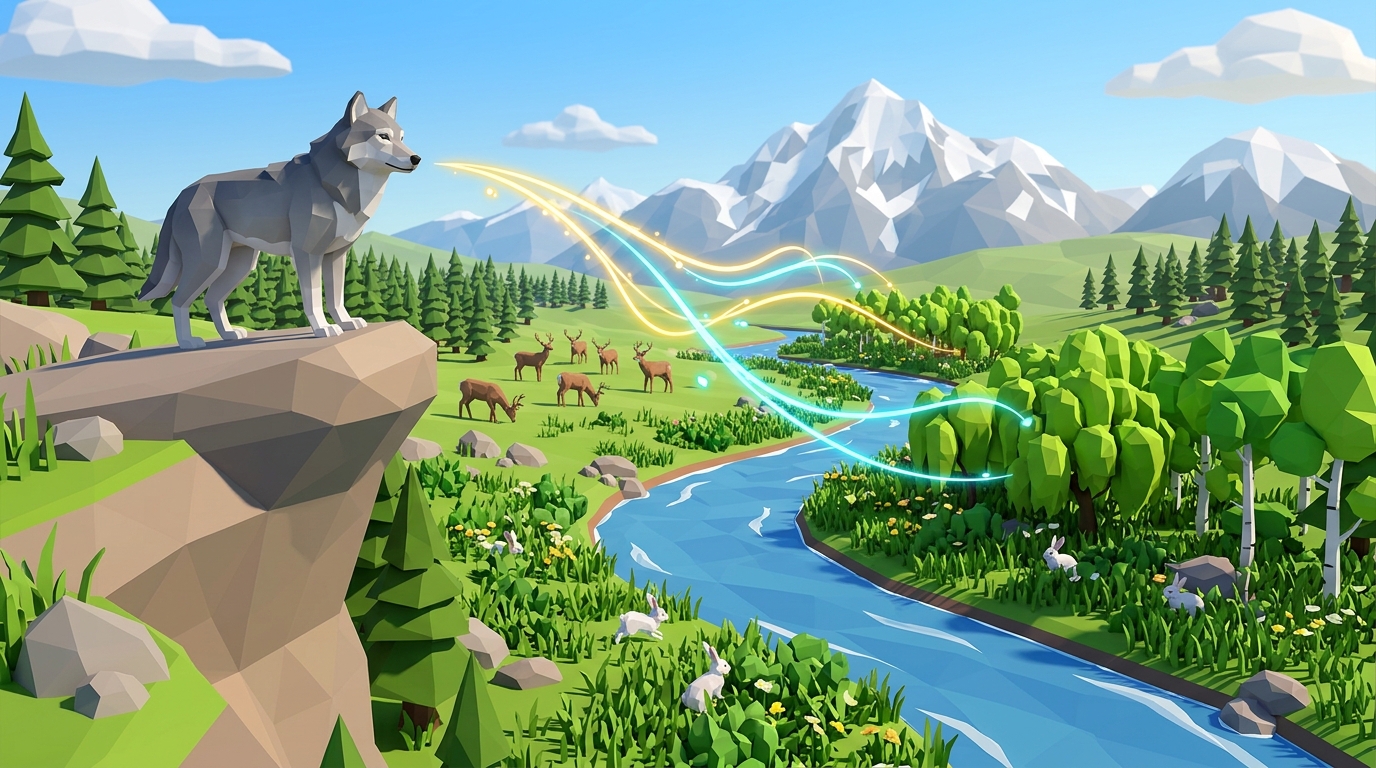
Level 04 (The Gray Shadow): The Apex Predator Layer. Kids introduce predators (foxes and wolves), discovering how top-down predation stabilizes herbivore numbers and protects plant life.
Level 05 (Dynamic Equilibrium): The Balanced Multi-Species Web. Kids manage a full three-tier food web simultaneously, maintaining steady population oscillations across changing seasons.
Missions 06 through 10 add environmental stressors including drought seasons, cold snaps, and habitat competition, challenging kids to build resilient, self-sustaining ecosystems.
Food Web Learning Tools & Methods Compared
Here is an objective look at the most common methods used to teach food webs and energy flow to elementary and middle school students:
| Learning Tool | Hands-On Level | Real-Time Dynamics | Data Depth | Cost |
|---|---|---|---|---|
| Paper food chain worksheets | Low (pencil and paper) | None (static drawings) | None (qualitative only) | Free / Low |
| Cut-and-paste food web craft | Moderate (crafting) | None (fixed connections) | None (vocabulary focus) | Consumable costs |
| 2D Flash-style food chain games | Moderate (clicking icons) | Basic (scripted animations) | Low (score-based) | Free |
| 100% FREEPraxos 3D Food Web Simulator | Very High (full 3D sandbox controls) | Real-time 60 FPS deterministic physics | Quantitative (live population graphs) | Free (all levels + journal) |
45-Minute Producer, Consumer, Predator Classroom & Homeschool Lab
This guided lab fits within a standard 45-minute class period or home science block. It requires only standard web browsers on school Chromebook carts, family iPads, or home computers.
Part 1: Pre-Lab Energy Prediction (10 minutes). Distribute the printed 24-page Expedition Science Journal. Students open to the Food Web Mapping sheet and draw their starting hypothesis: which trophic level must always have the largest biomass (producers or predators), and why?
Part 2: Multi-Trophic Simulation Trials (20 minutes). Students run three distinct food web configurations: Trial A (Producers only: measuring maximum grass yield). Trial B (Producers + Herbivores: observing grazing depletion). Trial C (Producers + Herbivores + Predators: tracking balanced dynamic equilibrium). Students record population numbers and terrain health for each trial.
Part 3: CER Written Synthesis (15 minutes). Students write a Claim-Evidence-Reasoning summary in their journal. Claim: Can an ecosystem remain healthy without predators? Evidence: Specific population counts and grass levels from Trial B vs. Trial C. Reasoning: Why do predators paradoxically keep plant communities healthier?
Curriculum Standards & Age Adaptability (Ages 7-12 / Grades 3-7)
This free food web simulator directly supports key Next Generation Science Standards across upper elementary and middle school grade bands:
NGSS 5-LS2-1 (Grade 5): Develop a model to describe the movement of matter among plants, animals, decomposers, and the environment. Levels 1 through 3 provide an interactive 3D model of plant growth and consumer energy transfer.
NGSS MS-LS2-1 (Grades 6-8): Analyze and interpret data to provide evidence for the effects of resource availability on organisms and populations in an ecosystem. Live population trend curves provide real quantitative data for students to analyze.
NGSS MS-LS2-2 (Grades 6-8): Construct an explanation that predicts patterns of interactions among organisms across multiple ecosystems. Level 4 and 5 illustrate predator-prey relationships and multi-species dependencies.
Level 1 runs instantly in any web browser with zero registration. All 10 simulation missions and the complete 24-page printable CER journal are 100% free with your email.
Device Compatibility: Built for School Chromebooks and Home Devices
Educational software is only useful if it runs reliably on standard classroom hardware without IT headaches. The Praxos 3D simulation engine was designed specifically for frictionless accessibility:
Browser Compatibility: Fully tested on Google Chrome 90+, Microsoft Edge 89+, Apple Safari 14+, and Mozilla Firefox 85+.
Hardware Requirements: Runs smoothly on standard school Chromebooks (2GB RAM, integrated Intel graphics), family tablets, and laptops.
Zero Installation: No app store downloads, browser extensions, or administrative permissions required.
Student Privacy: Zero student personal identifiable information (PII) is ever collected. No student logins or individual student accounts are needed.
Frequently Asked Questions From Parents & Science Teachers
Common questions about using the 3D Food Web Simulator in classrooms and homeschool environments.
Is this food web simulator completely free for my entire class or family?
What age group is this food web simulator designed for?
How is a food web different from a food chain in this simulation?
Can I integrate this simulator into Google Classroom, Canvas, or Schoology?
Does the simulation include printable worksheets or student materials?
Free Ecology & Science Resources to Pair With This Simulator
Enhance your food web unit with these free educational resources:
The food web vs food chain guide breaks down the key conceptual differences with simple diagrams for young scientists.
The trophic cascades explained for kids guide shows how apex predators maintain ecosystem balance, linking directly to Level 4.
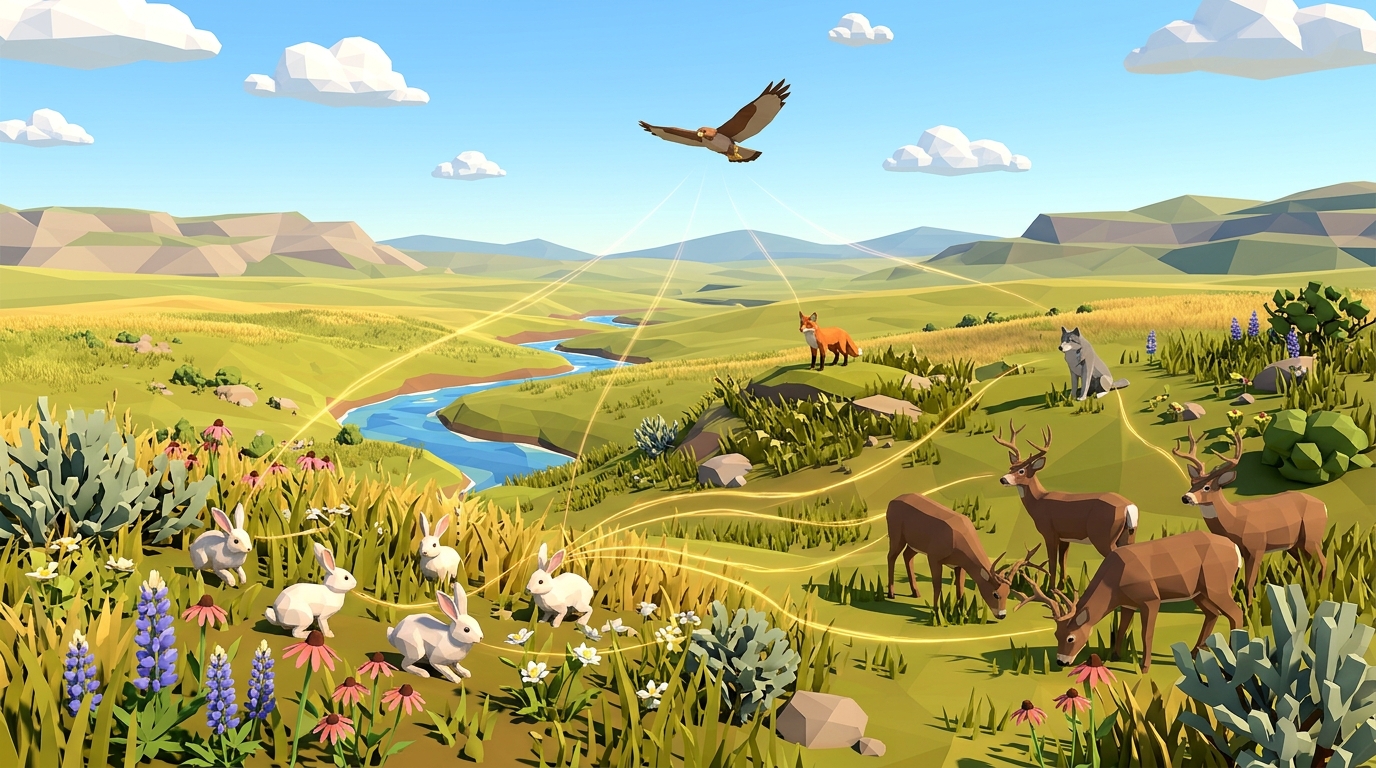
The prairie food chain guide explores real grassland species interactions in North American prairie biomes.
The carrying capacity simulation game lets kids dive deeper into population limits and resource balance in Level 3.
Get the complete printable food web and ecology lab journal with prediction pages, data tables, and CER reflection prompts. Formatted for easy black-and-white printing.
GET FREE LAB JOURNAL24-Page Expedition Science Journal
A printable CER lab logbook featuring food web mapping diagrams, energy pyramid calculations, and scientific reflection sheets designed for kids ages 7-12.