The Red Pen Problem: Why Traditional Science Teaches Kids to Fear Mistakes
In standard school environments, an incorrect answer on a worksheet is circled with red ink and penalized with lost points. Over time, children internalize a harmful lesson: making an error means you are not smart.
When this mindset carries over into science class, it produces a perverse result: children fake their lab data. If a baking soda reaction does not bubble as high as expected, or a potted plant grows slower than predicted, students erase their original hypotheses and write in whatever answer they think the teacher wants to see.
This is the exact opposite of genuine scientific inquiry. In real science, physics, biology, and aerospace engineering, a failed trial is not an embarrassment; it is the most valuable data point you have. It reveals the exact boundaries, constraints, and hidden mechanics of the system.
In authentic science, disproving a hypothesis is just as successful as confirming one. A failed experiment provides objective empirical data that refines your mental model and powers the next breakthrough.
The 6 Steps of the Scientific Method for Kids (With Ecosystem Lab Examples)
To make the scientific method practical and memorable for elementary and middle school students, connect each step to a tangible, interactive investigation:
| Scientific Method Step | Classroom Definition | Interactive Ecosystem Example | Student Journal Action |
|---|---|---|---|
| STEP 11. Ask a Testable Question | Identify an observable phenomenon in nature | How does reducing sunlight affect grassland plant biomass? | Write the central inquiry question at top of mission sheet |
| STEP 22. Background Research | Gather facts on the underlying mechanism | Review how chloroplasts use solar photons during photosynthesis | List known biotic and abiotic requirements on chart |
| STEP 33. Form a Falsifiable Hypothesis | Make a specific prediction with a clear cause and effect | If sunlight drops by 50%, grass biomass will decline below 30% by Day 15 | Record quantitative prediction before touching controls |
| STEP 44. Run Controlled Experiments | Isolate one variable while holding all others constant | Slide sunlight to 50% while keeping rain and starting seeds unchanged | Run the 3D trial and observe population curve in real time |
| STEP 55. Analyze Data & Graph Curves | Record quantitative numbers and identify patterns | Plot daily biomass on paper coordinate grid; note Day 12 plateau | Calculate difference between predicted vs actual values |
| STEP 66. Draw Conclusions & Iterate | Explain why the outcome occurred and plan next trial | Hypothesis supported: reduced light limited photosynthetic sugar production | Write conclusion and design next trial with low sunlight + drought |
The My Best Mistake Protocol: Building Scientific Resilience
To help children shed perfectionism and embrace scientific experimentation, introduce the "My Best Mistake" protocol during family or classroom science debriefs:
Instead of asking "Did you get the right answer?", ask: "What was the most surprising mistake your simulation made today, and what did it teach you about the habitat?"
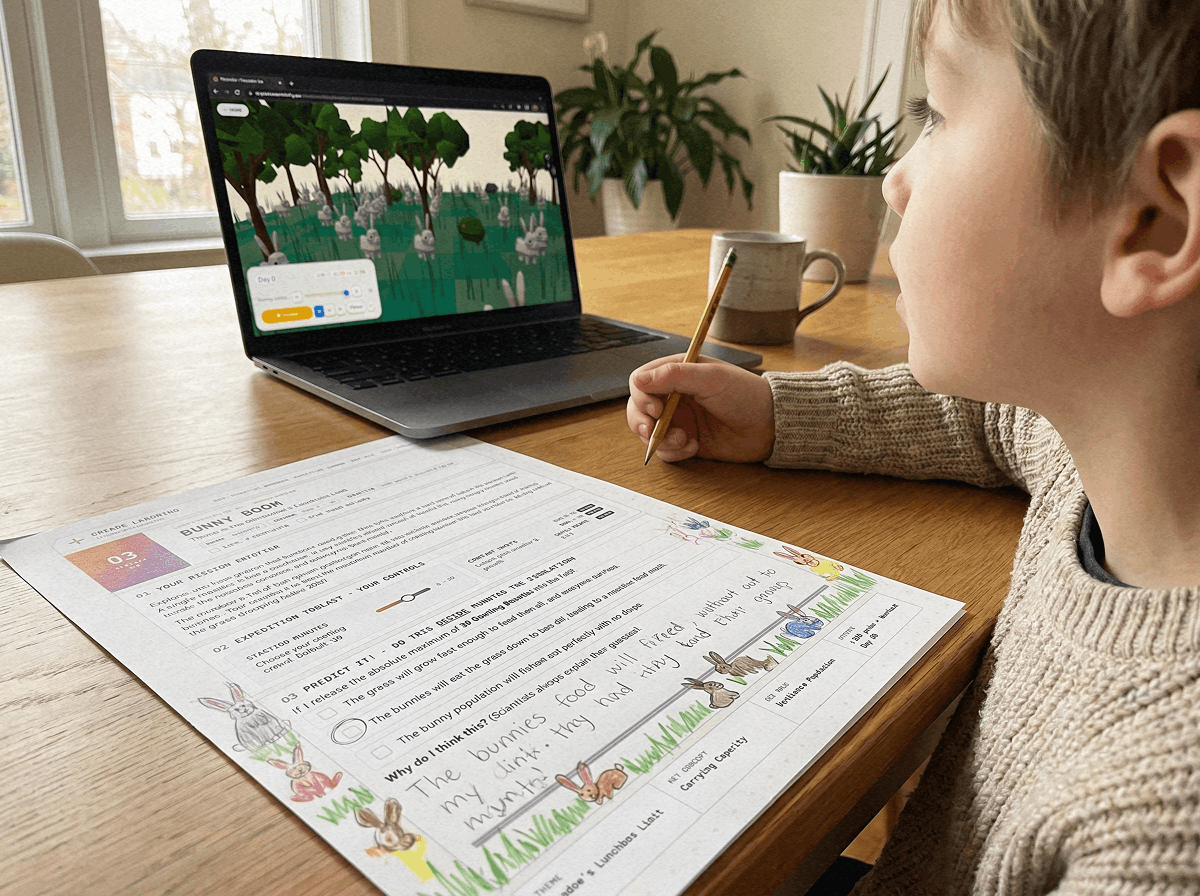
For example, when a student accidentally releases 50 rabbits with no predators in Level 3 and watches the entire meadow collapse from overgrazing, celebrate the crash. Prompt them: "Look at your population graph: at what exact day did the grass hit zero? What does that tell us about carrying capacity?"
Documenting these systemic crashes in a dedicated "Mistake Log" transforms frustration into objective curiosity.
To explore more systems thinking tools, review my companion guides on feedback loops explained for kids, family style science curriculum, inquiry based science for kids, and carrying capacity explained.
Thomas Edison famously noted that he had not failed 10,000 times; he had simply discovered 10,000 ways that did not work. In science, failure is nature revealing how it really operates.
Why 3D Simulations Give Kids the Freedom to Fail Safely
In physical chemistry and biology labs, mistakes carry real penalties: broken test tubes, spilled vinegar, wasted expensive kit reagents, or hours of cleanup.
Interactive 3D simulations remove these emotional and financial penalties. If a student tests a radical hypothesis and crashes a virtual ecosystem, they lose zero dollars and create zero mess. Resetting the sandbox takes one click.
This friction-free experimentation allows children to run 15 iterations in a single 30-minute block: building the fearless, iterative mindset that defines world-class scientists and engineers.
Frequently Asked Questions About Teaching the Scientific Method
Common questions from STEM educators, homeschool parents, and curious mentors.
What is the most common mistake kids make with the scientific method?
How do you explain a hypothesis to a 3rd grader?
What should a child do if their hypothesis turns out to be wrong?
Are the scientific method worksheets and 3D simulation missions free?
Run Your First Hypothesis Test in 3D
Put the 6 steps of the scientific method into immediate practice in an interactive browser sandbox.
Start Level 1 instantly in your browser with zero registration. Unlock all 10 simulation missions and download the complete 24-page Expedition Science Journal 100% free with email.
Step inside Level 01: Solar Spark to form your prediction, adjust abiotic sliders, and test your hypothesis in real time.
START LEVEL 1 FREEMy Best Mistake Lab Journal & Pacing Guide (PDF)
Printable scientific method trial templates, hypothesis reflection sheets, and 24-page student experiment logbook.