What Is Inquiry-Based Science? (Beyond Rote Memorization)
For decades, traditional science education has followed a familiar script: read a textbook chapter, memorize bold vocabulary terms, watch a teacher demonstrate a concept at the front of the room, and take a multiple-choice quiz on Friday.
While this approach can help students pass basic recall exams, cognitive research shows that factual retention drops rapidly once the test is over. Real scientific understanding is not a collection of static trivia; it is a dynamic method of investigating the natural world.
Inquiry-based science flips the traditional script. Instead of presenting students with pre-digested answers to questions they never asked, inquiry begins with an intriguing phenomenon. Students are invited to observe, formulate hypotheses, test variables, and construct their own conceptual models based on observed evidence.
Traditional instruction asks: "What is the textbook definition of carrying capacity?" Inquiry science asks: "What happens to a rabbit population when food supplies run out, and how can we test our prediction?"
The 5E Inquiry Cycle Explained (With Real Ecology Examples)
The most widely respected instructional model for inquiry-based learning is the 5E Instructional Model, developed by the Biological Sciences Curriculum Study (BSCS).
Here is how the five sequential phases work in practice when exploring ecosystem science:
Engage: Sparks Curiosity with a Real Phenomenon
Present a puzzling observation or open-ended challenge. For example: "Why did a sudden increase in meadow rainfall cause the rabbit population to crash two months later?"
Explore: Hands-On Investigation and Data Gathering
Students manipulate variables in a digital lab or physical experiment. In Praxos Level 1, students adjust sunlight and rainfall sliders, observing biomass accumulation in real time.
Explain: Connecting Observations to Scientific Terms
After observing patterns, students introduce formal vocabulary (such as primary producers, trophic efficiency, and arrows on a food web) to describe the mechanics they just witnessed.
Elaborate: Applying Concepts to New Scenarios
Students extend their mental model to novel challenges: "If drought hits a grassland ecosystem, how will secondary consumers be affected compared to herbivores?"
Evaluate: Evidence-Based Reflection and Self-Assessment
Students compare their initial written hypothesis against their trial data in their printable science logbook, evaluating why their prediction succeeded or failed.
Inquiry-Based Learning vs Traditional Instruction
To understand why modern STEM standards like the Next Generation Science Standards (NGSS) prioritize inquiry, consider how the two approaches compare across classroom environments:
| Educational Dimension | Traditional Instruction | Inquiry-Based Science | Cognitive Advantage |
|---|---|---|---|
| Primary Goal | Memorize facts, definitions, and procedures for written tests. | Understand underlying causal systems and testable mechanisms. | Builds deep intuition rather than short-term recall. |
| Role of the Student | Passive listener, note-taker, and reader of textbook summaries. | Active investigator formulating questions and running experiments. | Fosters intrinsic curiosity and intellectual ownership. |
| Role of the Teacher / Parent | Sole source of information delivering lectures from teacher guides. | Facilitator who poses guiding questions and manages investigations. | Reduces parent prep pressure; shifts focus to guided dialogue. |
| Handling Experimental Mistakes | Errors are marked as wrong answers that lower student grades. | Anomalies and unexpected results serve as valuable new data points. | Builds scientific resilience and a growth mindset. |
| HIGH RETENTIONLong-Term Retention | Rapid decay once the exam cycle concludes (cramming effect). | High retention because concepts are tied to personal observations. | Prepares students for complex high school and college STEM. |
4 Common Parent Fears About Inquiry Science (And Why They Dissolve)
When homeschool parents and classroom educators first consider switching to inquiry science, several common concerns frequently arise.
Here is why those fears dissolve when using structured inquiry frameworks:
"Will my student miss out on core factual knowledge?"
No. Inquiry science does not abandon facts; it changes the sequence in which facts are encountered. When a student discovers why secondary consumers keep herbivores from overgrazing through direct simulation, the vocabulary labels stick permanently.
"Do I need an advanced STEM degree to teach this?"
Not at all. Your role is not to have all the answers in advance; your role is to ask great questions: "What did you notice when you increased rainfall?", "Why do you think the population dropped on Day 30?", or "How could we test that idea?"
"Does inquiry require hours of messy lab prep and expensive kits?"
No. Digital 3D simulation sandboxes combined with printable field journals provide instant, multi-variable scientific inquiry with zero clean-up and zero consumable supply costs.
"How do I evaluate progress without multiple-choice tests?"
Review their written hypotheses, data graphs, and reflection conclusions in their lab journal. A child who can explain why an ecosystem collapsed demonstrates far higher mastery than one who simply selects option C on a quiz.
The Dual-Format Advantage: Pencil Predictions + 3D Sandbox Trials
Inquiry science reaches its highest effectiveness when physical writing and digital simulation work hand in hand.
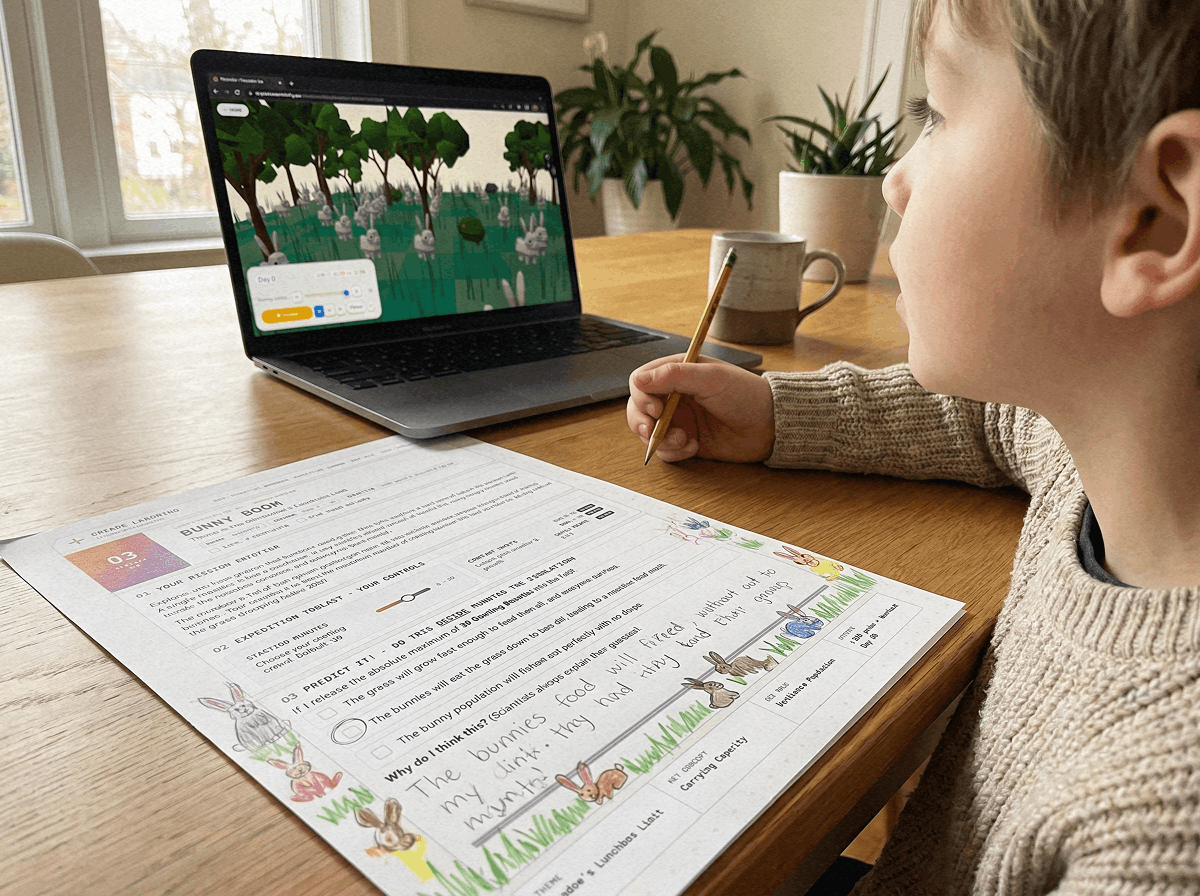
When students write down a hypothesis with a pencil before touching a screen, they make a psychological commitment to their idea. When they launch the 3D lab to test their prediction, they are not casually clicking buttons; they are actively searching for data to validate or challenge their mental model. This dual-format bridge is at the heart of the Praxos Learning curriculum.
Get our free 24-page Expedition Science Journal with 10 guided inquiry missions, hypothesis recording sheets, and reflection prompts.
Download Free Journal (PDF)Inquiry Lesson Starter Kit & 24-Page Science Journal
Includes 10 guided inquiry mission sheets with hypothesis boxes, variable tracking tables, and data synthesis rubrics.