Defining Inquiry in Science: The 4 Developmental Levels
In science pedagogy, inquiry is not an all-or-nothing proposition. Educational researchers categorize scientific inquiry into four distinct developmental levels based on how much structure the educator provides versus how much autonomy the student exercises.
Understanding these four tiers helps parents and teachers select the appropriate level of scaffolding for their students grade level:
Confirmation Inquiry
The educator provides the question, the exact step-by-step procedure, and the expected outcome in advance. The student runs the trial to confirm a known scientific principle (e.g. following a recipe to verify that baking soda and vinegar produce carbon dioxide). Best for building basic lab tool familiarity.
Structured Inquiry
The educator provides the inquiry question and the investigation procedure, but the final outcome remains unknown to the student. The learner collects the data and determines the explanation (e.g. testing which of four soil samples retains water longest).
Guided Inquiry
The educator provides only the central driving question. The student must design their own experimental procedure, select which variables to control, collect data, and form conclusions. This is the primary sweet spot for upper elementary and middle school students.
Open / True Inquiry
The student formulates their own original scientific question, designs the experimental method, gathers data, and presents evidence-based conclusions. This represents the authentic workflow of professional research scientists.
The 4 Levels of Inquiry Classification Matrix
The table below summarizes how responsibility shifts from the educator to the student across the four levels of scientific inquiry:
| Inquiry Level | Question Source | Method / Procedure | Solution / Outcome | Best Fit Grade Band |
|---|---|---|---|---|
| Level 1: Confirmation | Given by Educator | Given by Educator | Known in Advance | Grades K - 2 (Early elementary) |
| Level 2: Structured | Given by Educator | Given by Educator | Discovered by Student | Grades 3 - 5 (Upper elementary) |
| OPTIMAL STEM DEPTHLevel 3: Guided | Given by Educator | Designed by Student | Discovered by Student | Grades 5 - 8 (Middle school) |
| Level 4: Open Inquiry | Formulated by Student | Designed by Student | Discovered by Student | Grades 7 - 12 (Advanced middle & high school) |
5 Testable Ecology Inquiry Questions for Kids
A strong inquiry question must be testable, specific, and focused on causal relationships rather than simple yes/no trivia.
Here are five high-impact inquiry questions students can investigate using an ecosystem simulation:
1. "How does doubling starting plant biomass affect the time it takes for a herbivore population to reach its carrying capacity?"
2. "What is the minimum predator-to-prey ratio required to prevent overgrazing without driving herbivores to extinction?"
3. "If rainfall drops by 50% for 30 simulation days, which trophic level experiences the highest percentage mortality first?"
4. "How do hiding bushes alter the hunting efficiency of wolves in a closed meadow habitat?"
5. "Why does introducing a non-native competitor disrupt native food chains even when total food supplies appear abundant?"
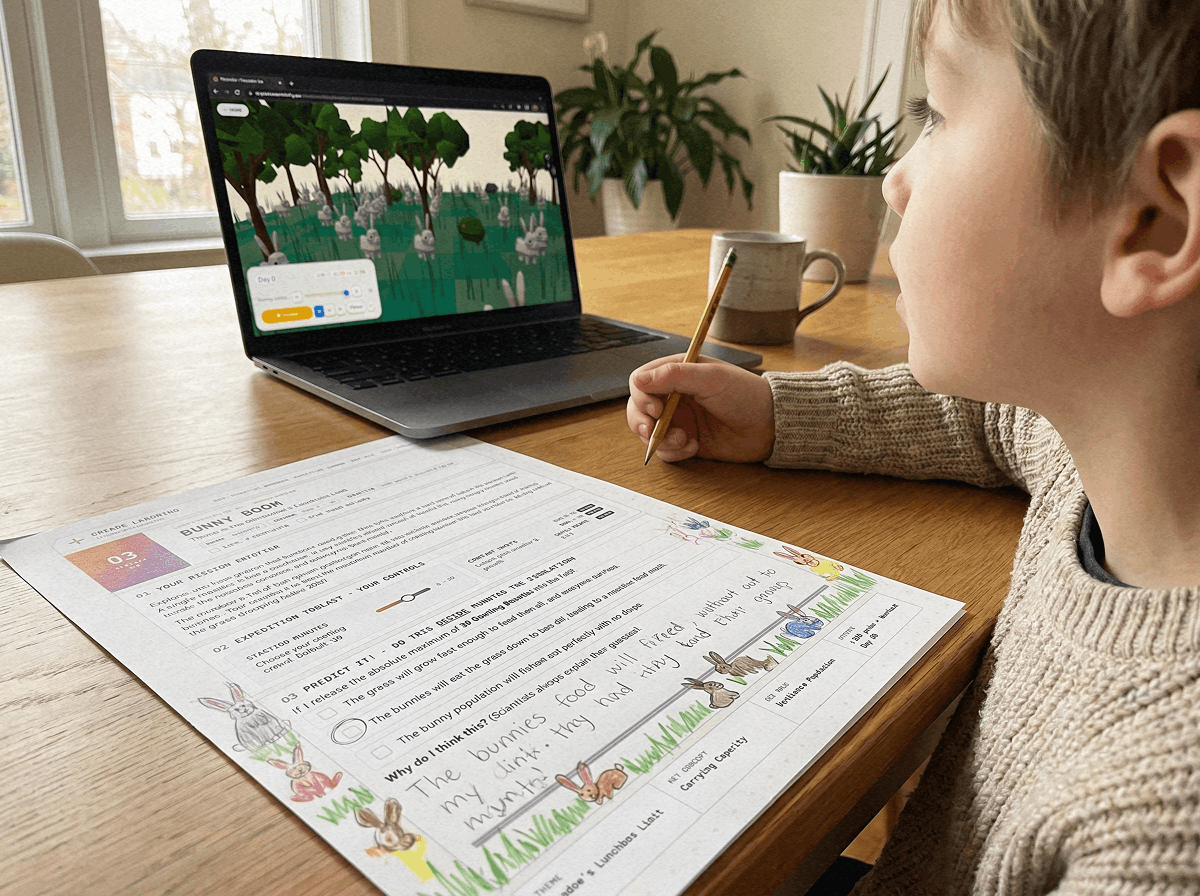
Put these inquiry questions to the test. Launch Praxos Ecosystem Level 1 free in your browser with no account needed.
Launch Free LabFrequently Asked Questions About Scientific Inquiry
Here are quick answers to common questions about implementing inquiry-based strategies in homeschool and classroom environments:
How is inquiry science different from standard hands-on crafts?
Hands-on crafts often focus on assembling a model (like gluing pasta onto a paper plate). Scientific inquiry focuses on testing variables, collecting quantitative data, and explaining causal relationships.
Where can I read more about teaching systems thinking and science?
Explore our complete guides for how to develop systems thinking in children and 5th grade science curriculum.
Inquiry Observation & Data Sheet
A printable lab template featuring hypothesis blocks, independent variable logs, and data trend graphing grids.