The Tale of Two Volcanoes: Gentle Fountains vs. Cataclysmic Blasts
On the island of Hawaii, tourists can stand safely a few hundred yards away from Kilauea volcano, watching glowing crimson lava stream placidly downhill like rivers of hot maple syrup. Photographers capture incandescent fountains splashing harmlessly into stone ponds.
Five thousand miles to the northeast, on May 18, 1980, Mount St. Helens in Washington State detonated with the explosive energy of 1,600 atomic bombs. The entire north flank of the mountain collapsed, unleashing a supersonic blast of ash, gas, and pulverized rock that leveled 230 square miles of old-growth forest within seconds.
Both peaks are volcanoes, both are powered by subterranean magma chambers, and both erupt molten rock. Why does one volcano ooze gently while the other detonates like an planetary bomb? The answer boils down to a single chemical compound and a fundamental physical property: silica and viscosity.
Think of drinking through a straw. If you blow air through a straw into a glass of plain water, tiny bubbles form easily and pop gently at the surface without splashing. Now imagine trying to blow bubbles through a straw into cold, thick peanut butter. Air cannot escape easily; pressure builds up beneath your cheeks until a massive bubble bulges and abruptly splatters peanut butter across the kitchen ceiling. In volcanology, water is basaltic magma, and peanut butter is high-silica rhyolitic magma.
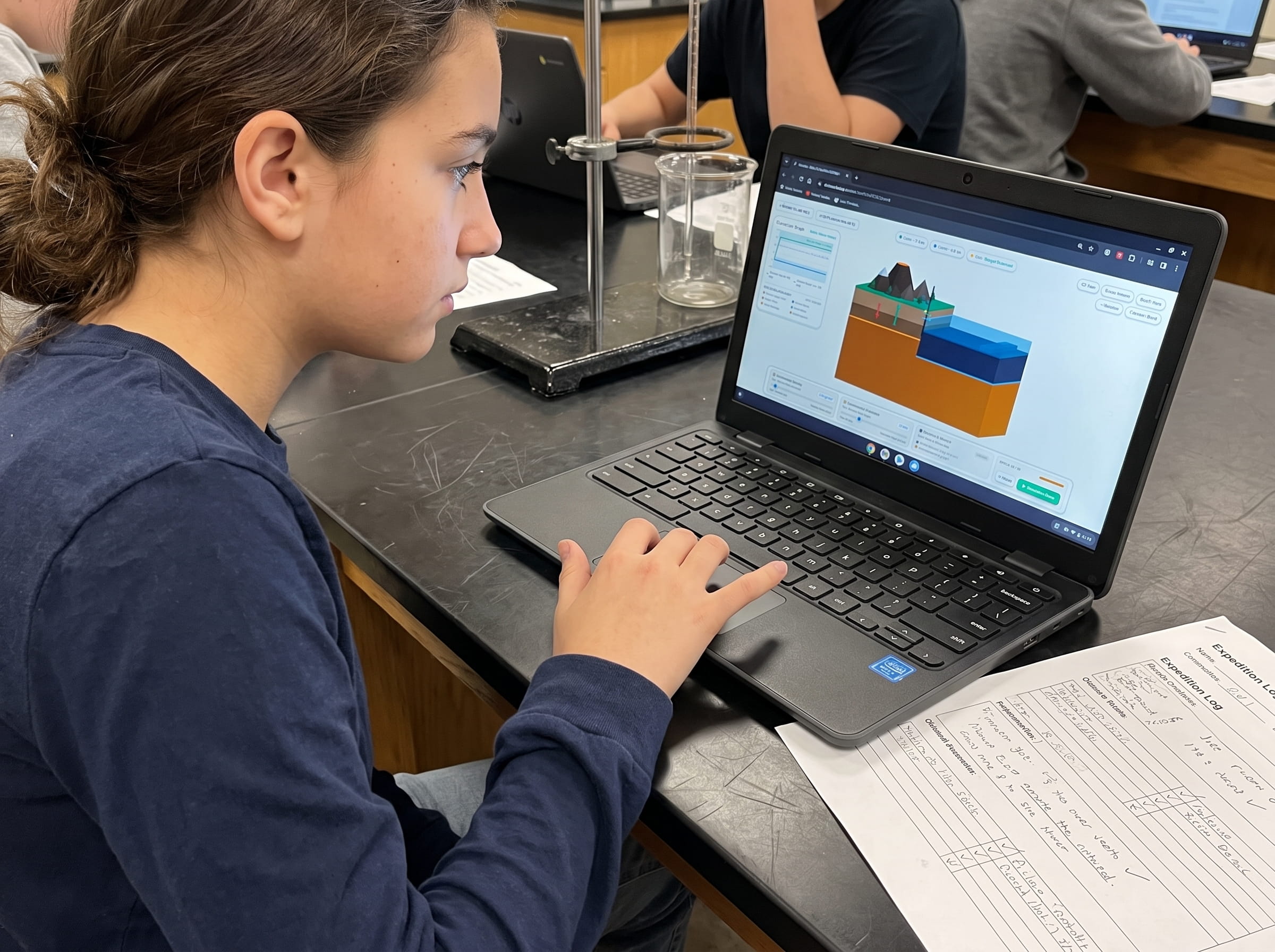
Open Volcano Island Level 6 and Level 7 directly in your browser. Experiment with fluid basalt flows in Level 6 and high-pressure explosive plumes in Level 7 with zero logins.
Launch Free 3D Volcano Physics SandboxThe Molecular Chemistry of Silica: Why Molecular Chains Resist Flow
Viscosity is defined in fluid dynamics as a material's resistance to deformation or shear stress. Honey has a higher viscosity than water; pitch has a higher viscosity than honey. In molten silicate rocks, viscosity is governed by the concentration of silicon dioxide (SiO2), commonly known as silica.
At the atomic scale, silica molecules form microscopic geometric pyramids called silicon-oxygen tetrahedra (one silicon atom surrounded by four oxygen atoms). When magma contains relatively low silica (around 45 to 52 percent), these tetrahedra remain isolated or form short, simple clusters that slide easily past one another, creating a fluid, low-viscosity liquid.
As silica concentration climbs above 65 to 70 percent, oxygen atoms begin sharing electrons between neighboring tetrahedra in a process called polymerization. These tetrahedra link together into complex, rigid three-dimensional networks, long molecular chains, and interlocking silicate sheets. The resulting molten rock becomes extraordinarily sticky, gummy, and resistant to motion.
Temperature amplifies this effect. Low-silica basaltic magma originates deep in the mantle and erupts at blistering temperatures between 1,000 and 1,200 degrees Celsius, which keeps molecules vibrating rapidly and reduces internal friction. High-silica rhyolitic magma forms through crustal melting and erupts at much cooler temperatures between 700 and 850 degrees Celsius, allowing silicate polymers to lock together even more firmly.
Silica Polymerization Builds Molecular Chains
As magma silica levels rise above 60 percent, silicon-oxygen tetrahedra link into long polymer chains that increase internal fluid friction by orders of magnitude.
Volatile Gas Exsolution During Magma Ascent
Deep underground under thousands of pounds of lithostatic pressure, water vapor and carbon dioxide remain dissolved in the magma like carbonation in an unopened soda bottle.
Gas Trapping and Catastrophic Fragmentation
In fluid basalt, bubbles rise swiftly and escape into the air. In viscous rhyolite, bubbles remain trapped in the sticky matrix, expanding until internal pressure shatters the melt into pulverized volcanic ash.
In Level 7 of Volcano Island, adjust the Silica Percentage dial from 50% to 75% and watch how lava velocity plummets while explosive chamber pressure rises exponentially.
Test Silica Percentages in Level 7The Three Primary Magma Types: Basaltic, Andesitic, and Rhyolitic
Volcanologists categorize all volcanic magmas into three primary chemical families based on their silica concentration, mineralogy, and physical behavior:
1. Basaltic (Mafic) Magma: Contains 45 to 52 percent silica and is rich in iron and magnesium. It is the hottest magma (1,000 to 1,200 C) and has the lowest viscosity (roughly 10 to 100 Pascal-seconds, comparable to warm corn syrup). Because dissolved gases escape effortlessly, basaltic eruptions are predominantly effusive, building broad, gently sloping shield volcanoes (like Mauna Loa and Kilauea in Hawaii) or flooding vast basalt plateaus.
2. Andesitic (Intermediate) Magma: Contains 53 to 65 percent silica, named after the Andes Mountains where subduction flux melting generates abundant intermediate magma. It erupts at intermediate temperatures (800 to 1,000 C) with a viscosity thousands of times greater than basalt. Andesitic magma generates alternating layers of lava flows and explosive ash deposits, constructing steep, symmetrical composite stratovolcanoes like Mount Fuji, Mount Rainier, and Mount Mayon.
3. Rhyolitic and Dacitic (Felsic) Magma: Contains 65 to over 75 percent silica, enriched in quartz, potassium feldspar, and sodium. It is the coolest magma (700 to 850 C) and possesses extreme viscosity (up to 10 million Pascal-seconds, millions of times thicker than basalt). Because rhyolitic magma is too thick to flow away from the vent, it often piles up into steep volcanic domes like toothpaste squeezed from a tube, or traps colossal volumes of subterranean gas that detonate in supervolcano caldera collapses (such as Yellowstone, Toba, and Taupo).
In your printed Field Geologist Logbook, calculate flow rates for three simulated lava channels across 10-degree slopes. Plot silica percentage versus velocity in meters per hour.
Adjust Magma Chemistry & Test Eruption Explosivity in 3D
Slide the silica percentage dial from 48% (runny basalt) to 73% (sticky rhyolite), calibrate chamber gas pressure, and observe real-time eruption physics in our browser-based 3D volcano diorama.
Teaching this topic tomorrow? Download the Free NGSS Student Lab Sheet (Printable PDF)
A printable 24-page Earth Science Student Journal featuring magma viscosity laboratory calculation sheets, silica content vs VEI index graphs, and volcano profile sketch templates for middle school classrooms.
The Pressure Cooker Effect: How Trapped Volatiles Trigger Volcanic Explosivity
Viscosity alone does not cause an explosion; it is the combination of high viscosity and dissolved volcanic gases that transforms a volcano into a bomb.
Underground magma chambers are saturated with volatile gases, primarily water vapor (H2O), carbon dioxide (CO2), and sulfur dioxide (SO2). According to Henry's Law of gas solubility, the amount of gas dissolved in a liquid is directly proportional to the confining pressure exerted on that liquid.
Miles deep in Earth's crust, immense lithostatic pressure forces these gases to stay dissolved within the liquid rock. But as magma ascends up the volcanic conduit toward the surface, confining pressure steadily drops. Just like twisting the cap off a warm bottle of soda, the dissolved gases instantly bubble out of solution (a process called exsolution).
In low-viscosity basalt, these gas bubbles coalesce, rise rapidly through the runny melt, and vent gently into the atmosphere. But in high-viscosity rhyolite or dacite, the sticky molecular silicate chains prevent the bubbles from moving. As the magma nears the surface, the trapped gas bubbles expand rapidly against the rigid melt walls.
When internal bubble pressure exceeds the tensile strength of the surrounding molten rock, the liquid magma literally shatters into microscopic shards of volcanic glass and pulverized rock dust: a catastrophic process called brittle fragmentation. The pressurized gas expands thousands of times in volume, rocketing the shattered ash cloud into the stratosphere at supersonic speeds.
In Volcano Island, toggle the Dissolved Gas Fraction slider from 1% to 6% in a high-silica chamber and observe how gas exsolution triggers a transition from slow dome extrusion to a Plinian explosive eruption column.
Magma Chemistry and Eruption Styles: Comparative Diagnostic Matrix
Review this classroom diagnostic reference comparing magma families, chemical compositions, eruption temperatures, viscosity ranges, and classic global volcanic landmarks:
| Magma Family | Silica Content (SiO2) | Eruption Temperature | Viscosity Level | Gas Content | Primary Eruption Style | Volcanic Structure Formed | Classic Global Example |
| :--- | :--- | :--- | :--- | :--- | :--- | :--- | :--- |
| Basaltic (Mafic) | 45% - 52% | 1,000 C - 1,200 C | Low (10 - 100 Pa·s) | Low (0.5% - 1.5%) | Effusive lava rivers, gentle fire fountaining | Broad shield volcanoes, cinder cones, basalt plateaus | Kilauea (Hawaii), Mauna Loa, Iceland Rift Basalts |
| Andesitic (Intermediate) | 53% - 65% | 800 C - 1,000 C | Medium (10^3 - 10^5 Pa·s) | Moderate (2% - 4%) | Alternating effusive flows and explosive ash bursts | Steep, symmetrical composite stratovolcanoes | Mount Fuji (Japan), Mount Rainier, Mount Mayon |
| Dacitic (Felsic-Intermediate) | 63% - 68% | 800 C - 900 C | High (10^5 - 10^7 Pa·s) | High (3% - 5%) | Explosive lateral blasts, pyroclastic surges, lava domes | Steep lava domes, composite cones with calderas | Mount St. Helens (1980), Mount Pinatubo (1991) |
| Rhyolitic (Felsic) | 68% - 77% | 700 C - 850 C | Extreme (10^7 - 10^11 Pa·s) | Very High (4% - 7%) | Cataclysmic ultra-Plinian explosions, caldera collapse | Massive resurgent calderas, thick obsidian domes | Yellowstone Caldera, Santorini, Lake Toba |
Frequently Asked Questions About Magma Viscosity and Eruption Styles
Direct, curriculum-aligned answers to common questions middle school teachers, students, and homeschool parents ask about magma viscosity and volcanic explosions.
What makes magma thick or runny?
Can a shield volcano ever explode violently?
What happens when volcanic gases cannot escape from rising magma?
What is the difference between pahoehoe and aa lava?
Related Earth Science Guides and Interactive Laboratories
Continue expanding your Earth and Space science curriculum with our companion interactive guides:
Learn how tectonic plates pull apart in our divergent ocean boundaries and seafloor spreading guide.
Discover why continents collide and subduct in our convergent plate boundary and subduction lab.
Explore how rocks melt, cool, and transform in our rock cycle interactive middle school guide.
Model low-viscosity lava flows in our shield volcano basaltic lava simulation resource.
Browse our complete inquiry-based earth science homeschool curriculum options.
Free 24-Page Field Geologist Expedition Logbook (Printable PDF)
A printable 24-page Earth Science Student Journal featuring magma viscosity laboratory calculation sheets, silica content vs VEI index graphs, and volcano profile sketch templates for middle school classrooms.